Saturday, July 04, 2026

Action! NSF–DOE Vera C. Rubin Observatory Begins Capturing the Greatest Cosmic Movie Ever Made

PR Image noirlab2616a
Ocean of Stars

PR Image noirlab2616b
The depth of NSF–DOE Rubin’s LSST

PR Image noirlab2616c
Ocean of Stars excerpts

PR Image noirlab2616d
NSF–DOE Rubin’s LSST coverage

PR Image noirlab2616e
NSF–DOE Vera C. Rubin Observatory by the numbers

PR Image noirlab2616f
NSF–DOE Rubin’s Legacy Survey of Space and Time

PR Image noirlab2616g
NSF–DOE Rubin’s Ocean of Stars field in the constellation Lupus

PR Image noirlab2616h
NSF–DOE Vera C. Rubin Observatory by the numbers (Spanish)

PR Image noirlab2616i
NSF–DOE Rubin’s Legacy Survey of Space and Time (Spanish)


Videos

A Week in the Life of NSF–DOE Rubin LSST
PR Video noirlab2616a
A Week in the Life of NSF–DOE Rubin LSST
The depth of NSF–DOE Rubin’s LSST
PR Video noirlab2616b
The depth of NSF–DOE Rubin’s LSST
How NSF–DOE Rubin maps the Universe every night
PR Video noirlab2616c
How NSF–DOE Rubin maps the Universe every night

Pan on NSF–DOE Rubin’s Ocean of Stars
PR Video noirlab2616d
Pan on NSF–DOE Rubin’s Ocean of Stars
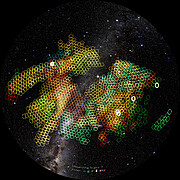
A Week in the Life of NSF–DOE Rubin LSST (fulldome fisheye)
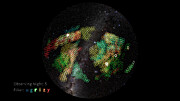
PR Video noirlab2616e
A Week in the Life of NSF–DOE Rubin LSST (fulldome fisheye)

A Week in the Life of NSF–DOE Rubin’s LSST (no annotations)
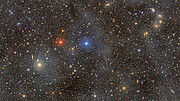
PR Video noirlab2616f
A Week in the Life of NSF–DOE Rubin’s LSST (no annotations)

Zooming into NSF–DOE Rubin’s Ocean of Stars
PR Video noirlab2616g
Zooming into NSF–DOE Rubin’s Ocean of Stars

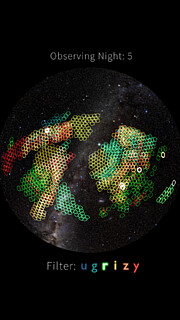
A Week in the Life of NSF–DOE Rubin’s LSST (vertical)
PR Video noirlab2616h
A Week in the Life of NSF–DOE Rubin’s LSST (vertical)


The 10-year Legacy Survey of Space and Time has officially started, marking the beginning of a new era in astronomy and astrophysics

The wait is over: NSF–DOE Rubin Observatory, funded by the U.S. National Science Foundation and the U.S. Department of Energy’s Office of Science, is now capturing the cosmos in unprecedented detail, transforming the way we study the dynamic Universe.

From a mountaintop in Chile, under clear dark skies, NSF–DOE Vera C. Rubin Observatory has begun the revolutionary Legacy Survey of Space and Time (LSST). The ten-year survey is Rubin’s signature campaign to create the most comprehensive, cinematic record of the Universe in history.

Rubin Observatory is a U.S. government facility jointly operated by NSF NOIRLab and DOE’s SLAC National Accelerator Laboratory. NOIRLab is managed by the Association of Universities for Research in Astronomy (AURA).

Over the next ten years, Rubin will relentlessly observe the entire southern sky every few nights to create an ultra-wide, ultra-high-definition time-lapse record of our Universe. This long-awaited milestone is the culmination of years of effort by thousands of people around the world. It follows the celebratory Rubin First Look event that took place in June 2025, which was followed by final commissioning work, an operational readiness review, and the beginning of the alert stream.

“Today, we begin filming the greatest cosmic movie ever made,” says Brian Stone, performing the duties of the NSF Director. “This moment reflects decades of vision, innovation, and the power of federal investment in science through the U.S. National Science Foundation and the Department of Energy. Every night, NSF–DOE Rubin Observatory will expand the frontiers of knowledge and strengthen America's global leadership in science and innovation.”

“With the launch of the ten-year Legacy Survey of Space and Time, NSF–DOE Rubin Observatory is opening a new window on the Universe. It is embarking on a mission that will redefine modern cosmology and astrophysics,” says Darío Gil, Under Secretary for Science at the U.S. Department of Energy. “With its world-class design and tools, Rubin Observatory will capture the dynamic nature of our cosmos and reveal unimagined insights into our Universe’s biggest mysteries, from our own Solar System to the very structure of the Universe. By seeking to understand the enigmatic phenomena of dark energy and dark matter, we are not just observing the stars; we are striving to grasp the fundamental laws that govern our existence.”

“It is amazing and humbling to be here at this time and place as we start the Legacy Survey of Space and Time, after more than two decades of incredible work by our dedicated team,” says Bob Blum, Director of Rubin Observatory at NSF NOIRLab. “Rubin Observatory is for everyone; the LSST will change how we do astronomy and astrophysics, allowing researchers anywhere to participate in cutting-edge science.”

“It’s taken 20 years of hard science, engineering, and more to get to the point where we can call ‘action’ as we start rolling on this blockbuster movie of the Universe,” says Phil Marshall, Deputy Director of Rubin Operations for SLAC. “Millions of alerts in just the last couple of months show that Rubin is up and running as a discovery machine. Now we’re putting it all together.”

“The decision to officially begin the LSST was made after a period of system optimization and a careful operational review of technical readiness, data system performance, and scientific validation,” says Željko Ivezić, Head of LSST. Important factors that played a role in this decision included image quality, effective survey speed, system uptime and reliability, and calibration accuracy.

Rubin Observatory’s unique design combines enormous light-collecting power, the ability to move rapidly across the sky, and a wide field of view. Its 3200-megapixel camera — the largest digital camera in the world — is now capturing a new, detailed image approximately every 40 seconds. Operating with this speed and sensitivity, Rubin functions as a unified, well-tuned system capable of catching faint objects and fleeting events with remarkable reliability and consistency every night. Visit rubinobservatory.org to follow the status of the Rubin in real time (and visit the real-time Alert Dashboard).

Rubin is bringing the Universe to life, illuminating a treasure trove of discoveries: pulsating stars, supernova explosions, the fossil record of galaxies, clues to the mysteries of dark energy and dark matter, and entirely new phenomena we’ve never seen before. Some cosmic processes unfold slowly, unpredictably, or incredibly rarely, which is why a ten-year survey is essential. By returning to each point in the sky about 800 times over a decade, Rubin data is providing the scientific community with deep, time-rich views needed to uncover subtle events, capture moving objects, and study the accelerating expansion of the Universe.

Not only is Rubin helping to unlock the mysteries of the distant Universe, it is also the most powerful Solar System discovery machine ever built. By taking about a thousand images every night, Rubin is compiling an astonishingly detailed census of our Solar System, including millions of asteroids and comets. In just a month and a half, during early optimization surveys, Rubin discovered over 11,000 never-before-seen asteroids, including 33 near-Earth objects and 380 trans-Neptunian objects [1].

Rubin will also advance opportunities for multi-messenger astronomy, which is the study of cosmic events using multiple signals such as light, gravitational waves, and cosmic rays. The observatory’s rapid, color-rich observations of transients such as stellar explosions, actively feeding black holes, and collisions between compact objects will guide telescopes around the world to follow up on these fleeting events.

Each night, Rubin is collecting approximately ten terabytes of data and producing as many as seven million alerts of changes in the night sky. These alerts stream to alert brokers — automated systems that sort and classify these changes so scientists can act quickly.

When the LSST is complete, the final dataset will contain billions of objects with trillions of measurements, all accessible through regular data releases. This is the first time so much astronomical data will be available to so many people, opening the door to new kinds of discovery by both scientists and the public. Rubin invites anyone in the world to engage with its data and explore the dynamic Universe in ways never before possible.


Notes

[1] One of the newly discovered asteroids is the fastest-spinning asteroid larger than 500 meters (0.3 miles) ever found, and it resides in the main asteroid belt.


More information

NSF–DOE Vera C. Rubin Observatory, funded by the U.S. National Science Foundation and the U.S. Department of Energy’s Office of Science, is a groundbreaking new astronomy and astrophysics observatory on Cerro Pachón in Chile. It is named after astronomer Vera Rubin, who provided the first convincing evidence for the existence of dark matter. Using the largest camera ever built, Rubin will repeatedly scan the sky for 10 years to create an ultra-wide, ultra-high-definition, time-lapse record of our Universe.

NSF–DOE Vera C. Rubin Observatory is a joint initiative of the U.S. National Science Foundation (NSF) and the U.S. Department of Energy’s Office of Science (DOE/SC). Its primary mission is to carry out the Legacy Survey of Space and Time, providing an unprecedented data set for scientific research supported by both agencies. Rubin is operated jointly by NSF NOIRLab and SLAC National Accelerator Laboratory. NSF NOIRLab is managed by the Association of Universities for Research in Astronomy (AURA) and SLAC is operated by Stanford University for the DOE. France provides key support to the construction and operations of Rubin Observatory through contributions from CNRS/IN2P3. The Science and Technology Facilities Council supports the wide range of UK contributions to Rubin operations provided through the LSST:UK Science Centre programme. Rubin Observatory is privileged to conduct research in Chile and gratefully acknowledges additional contributions from more than 40 international organizations and teams.

The U.S. National Science Foundation (NSF) is an independent federal agency created by Congress in 1950 to promote the progress of science. NSF supports basic research and people to create knowledge that transforms the future.

The DOE’s Office of Science is the single largest supporter of basic research in the physical sciences in the United States and is working to address some of the most pressing challenges of our time.

NSF NOIRLab, the U.S. National Science Foundation center for ground-based optical-infrared astronomy, operates the International Gemini Observatory (a facility of NSF, NRC–Canada, ANID–Chile, MCTIC–Brazil, MINCyT–Argentina, and KASI–Republic of Korea), NSF Kitt Peak National Observatory (KPNO), NSF Cerro Tololo Inter-American Observatory (CTIO), the Community Science and Data Center (CSDC), and NSF–DOE Vera C. Rubin Observatory (in cooperation with DOE’s SLAC National Accelerator Laboratory). It is managed by the Association of Universities for Research in Astronomy (AURA) under a cooperative agreement with NSF and is headquartered in Tucson, Arizona.

The scientific community is honored to have the opportunity to conduct astronomical research on I’oligam Du’ag (Kitt Peak) in Arizona, on Maunakea in Hawai‘i, and on Cerro Tololo and Cerro Pachón in Chile. We recognize and acknowledge the very significant cultural role and reverence of I’oligam Du’ag to the Tohono O’odham Nation, and Maunakea to the Kanaka Maoli (Native Hawaiians) community.

SLAC National Accelerator Laboratory explores how the Universe works at the biggest, smallest and fastest scales and invents powerful tools used by researchers around the globe. As world leaders in ultrafast science and bold explorers of the physics of the Universe, we forge new ground in understanding our origins and building a healthier and more sustainable future. Our discovery and innovation help develop new materials and chemical processes and open unprecedented views of the cosmos and life’s most delicate machinery. Building on more than 60 years of visionary research, we help shape the future by advancing areas such as quantum technology, scientific computing and the development of next-generation accelerators. SLAC is operated by Stanford University for the U.S. Department of Energy’s Office of Science.

Forty-three international teams outside the U.S. and Chile are contributing to Rubin Observatory and LSST Science through the In-kind Program, in exchange for LSST data rights. These contributions are recognized in the International Data Rights Holder list, which includes all individuals nominated by their respective international programs.


Links


Contacts:

Bob Blum
Director for Operations
NSF–DOE Vera C. Rubin Observatory/NSF NOIRLab
Email:
bob.blum@noirlab.edu

Phil Marshall
Deputy Director of Operations
SLAC National Accelerator Laboratory
Email:
pjm@slac.stanford.edu

Lars Lindberg Christensen
Head of Communications, Education & Engagement
NSF NOIRLab
Email:
lars.christensen@noirlab.edu

Manuel Gnida
Head of External Communications
SLAC National Accelerator Laboratory
Email:
mgnida@slac.stanford.edu


Friday, July 03, 2026

NASA’s Webb Reveals Stars Sparking to Life in Cosmic Celebration

In infrared light, NASA’s James Webb Space Telescope reveals bright protostars in star system FS Tau and a tapestry of background galaxies. FS Tau B, the orange protostar slightly right of center, is thought to be responsible for the orange outflows amid the dusty region. Credit Image: NASA, ESA, CSA, STScI; Image Processing: Alyssa Pagan (STScI)

A comparison between the observations of FS Tau by NASA’s Hubble and James Webb space telescopes. Hubble’s visible-light view shows the star-forming region mostly obscured by thick dust. Webb sees through the dust, revealing how the protostars are shaping their surroundings. Credit Image: NASA, ESA, CSA, STScI; Image Processing: Alyssa Pagan (STScI)

An image of FS Tau captured by Webb’s NIRCam (Near-Infrared Camera), with compass arrows, scale bar, and color key for reference. Credit Image: NASA, ESA, CSA, STScI; Image Processing: Alyssa Pagan (STScI)


NASA’s James Webb Space Telescope has captured the infrared light of numerous features that previously were impossible to see beyond the thick dust of the FS Tau star system. In addition to myriad background galaxies that burst into view like fireworks for the United States’ 250th anniversary celebrations, this image flickers with a number of protostars, or baby stars that are formed from dense pockets of gas and dust. These hot, clumpy, and low-mass objects eventually will become full-fledged stars capable of burning hydrogen in their cores, like our Sun. The protostars of FS Tau are about 1 to 3 million years old, which is relatively young in cosmic scales. Our Sun, by contrast, is 4.6 billion years old.

Low-mass stars emit less radiation and have less energetic stellar winds than those with larger masses, which means they disrupt their environment at a much lower level. This makes the FS Tau region incredibly useful for studying low-mass star evolution without the same level of environmental interference seen near higher-mass stars. A pair of protostars that creates the largest diffraction pattern seen slightly to the left of center in the image, called FS Tau A, is about half the mass of our Sun.

Even though these objects are young and low-mass, they still can impact their surroundings, partially due to the outflows they emit. These outflows, seen as orange and red wisps and wide sheets, are theorized to come from FS Tau B, the protostar slightly to the right of center that has an orange diffraction pattern. As FS Tau B feeds on the surrounding dust and gas to grow, it ejects some of that matter outward. The wider outflows are thought to come from the interaction between the protostar’s magnetic field and superheated matter closest to the protostar within its accretion disk. The disk is seen as a dark band that cuts across at a 30-degree angle.

The gaps between the outflows, newly discovered in this Webb observation, add to growing evidence that protostars accrete matter in discrete episodes. In the periods where protostars gather material and increase in mass, they also eject superheated matter in different directions. In between these episodes, they are relatively quiet.

As protostars eject these outflows, they shape their surroundings. This is best shown by the prominent light-blue ridges of dust and gas near FS Tau B. These thicker regions were likely created as outflows struck and compressed matter together. The brightness of these light-blue ridges shows that the nearby protostar’s light is reflected. Moreover, Webb’s sensitivity reveals the varying textures of dust and gas across the entire region.

The range of colors seen in this observation also provides a wealth of information, specifically about where dust is and how much of it obscures the region. Light with bluer wavelengths is absorbed and scattered by dust, while redder-wavelength light is able to slip through. Therefore, background galaxies behind thicker foreground dust appear redder. Alternatively, yellow galaxies have much less dust obscuring them. The few white stars visible in this image are likely in the foreground.

The James Webb Space Telescope is the world’s premier space science observatory. Webb is solving mysteries in our solar system, looking beyond to distant worlds around other stars, and probing the mysterious structures and origins of our universe and our place in it. Webb is an international program led by NASA with its partners, ESA (European Space Agency) and CSA (Canadian Space Agency).


Details:

Last Updated: Jul 02, 2026
Location:
NASA Goddard Space Flight Center

Contact Media:

Laura Betz
NASA’s Goddard Space Flight Center
Greenbelt, Maryland

laura.e.betz@nasa.gov

Matthew Brown
Space Telescope Science Institute
Baltimore, Maryland


Abigail Major
Space Telescope Science Institute
Baltimore, Maryland


Thursday, July 02, 2026

NASA’s Webb Studies How Planet Survived Death of its Star

Exoplanet WD 1856 b, shown in this artist’s concept, is a gas giant that orbits its star at a distance 50 times closer than Earth orbits the Sun. Observations by NASA’s James Webb Space Telescope determined the planet’s temperature and detected molecules in its atmosphere. Credit Artwork: NASA, ESA, CSA, Ralf Crawford (STScI)

NASA’s James Webb Space Telescope measured the constituents of exoplanet WD 1856 b as it passed in front of its star, finding signs of methane. WD 1856 b orbits a white dwarf star the size of Earth. As a result, the planet blocks more than half of the star’s light. Credit Illustration: NASA, ESA, CSA, Joseph Olmsted (STScI)


NASA’s James Webb Space Telescope is giving us new insight into the far-future of solar systems like our own, as the agency continues to reveal the secrets of the universe and our place in it. Billions of years ago, a Sun-like star nearing the end of its life swelled tremendously in size to become a red giant before ejecting its outer layers, leaving a hot, remnant core known as a white dwarf. As a red giant, the star should have engulfed and destroyed any nearby planets. Yet astronomers have found a Jupiter-sized exoplanet orbiting the white dwarf every 34 hours at a separation of less than 2 million miles (3 million kilometers).

To solve the mystery of how this exoplanet survived, an international team of astronomers used NASA’s James Webb Space Telescope to watch the Jupiter-sized exoplanet WD 1856 b transit its host star, measuring the planet’s temperature and detecting molecules in its atmosphere. They found the planet is significantly warmer than expected and determined how it most likely reached its very tight orbit around the white dwarf star. The results are a window into the future of planets like Jupiter after the death of the Sun, billions of years into the future.

The results published Wednesday in the journal Nature.

WD 1856 b was discovered in 2020 by scientists using NASA’s TESS (Transiting Exoplanet Survey Satellite) and the retired Spitzer Space Telescope. It orbits the white dwarf WD 1856+534, which is located about 80 light-years from Earth. “The planet is about the size of Jupiter, but the white dwarf it orbits is the size of Earth, so the planet is seven times larger than its star," said lead author Ryan MacDonald of the University of St. Andrews in the United Kingdom.

WD 1856 b orbits extremely close to its host star, a distance 50 times closer than Earth orbits the Sun. If WD 1856 b had originally been orbiting at that distance, it would have been obliterated while the star was a red giant. How did it survive the death of its host star and end up in its current position?

How big, how hot

The new study used Webb to watch the planet passing in front of its star. This transit yielded unique information about the planet’s mass, which is between four and eleven times the mass of Jupiter.

The team also was able to determine the planet’s temperature. During the transit, light from the star was partly blocked, but infrared light was reduced less than other wavelengths. The difference was infrared light emitted by the planet from its own heat. The data indicated that the planet has a temperature of about 260 degrees Fahrenheit (126 degrees Celsius) — significantly hotter than it would be if its only source of heat was the light from the white dwarf. This puzzling discovery turned out to be the key fact that proved how the planet must have reached its current orbit.

Christopher O’Connor of Northwestern University in Illinois, a co-author on the paper, was responsible for tracing the temperature of the planet back in time. O’Connor said, “The big question is how WD 1856 b ended up where it is today, and there are two theories. One is that the planet was swallowed by the host star as it was dying, and managed to survive on the inside. The other is that migration took place due to the gravitational effect of other objects in the system. The white dwarf is part of a triple star system, and the companion stars could have influenced WD 1856 b’s orbit.”

The researchers realized that there was no source of energy present to generate that heat today, so it must be residual energy from an earlier time when the planet was heated. Using models of how sub-stellar objects like WD 1856 b cool down over time, coupled with the new data from Webb, the team was able to project its temperature back in time and deduce how long ago the heating must have happened. The timing is key to determining whether the heating was from being engulfed by the red giant or occurred during an inward migration.

They concluded that the heating most likely happened between 3 and 5.5 billion years after the star became a white dwarf. In this scenario, the planet was on a wide orbit that kept it safe from the star during its destructive red giant phase, and only migrated to its present location later on. “As the planet moved inward, its interactions with the strong gravity of the white dwarf will have caused it to warm up considerably, and it has been cooling ever since,” said O’Connor.

Light from the star passing through the planet’s atmosphere also picked up information about its chemical composition. “We saw the telltale signatures of small cloud particles and hydrocarbons, most likely methane, which is the first time we have seen an atmosphere on a planet transiting a dead star,” said co-author Victoria Boehm of Cornell University. “We recently observed four more transits of WD 1856 b with Webb to take a deeper look into its atmospheric chemistry and can’t wait to see the results.”

Solar system’s possible future

In approximately five billion years, the Sun will run out of hydrogen fuel in its core and swell up more than 100 times larger than it is now into a red giant star. It will then shed its outer layers and end its life as a white dwarf star. Mercury, Venus, and possibly the Earth will be destroyed by the red giant. However, the fate of the more distant planets, particularly the gas giants, is unclear. Finding and studying planets in orbit around the remnants of Sun-like stars after their death is a means of learning what might happen in our own solar system in the far future.

“We’re used to looking back in time when we use telescopes, but this is the first time we have been able to look forward to what might happen to the outer planets around the remnant of a Sun-like star,” said MacDonald. “It’s like using a time machine to peer into the distant future of our solar system.”

The James Webb Space Telescope is the world’s premier space science observatory. Webb is solving mysteries in our solar system, looking beyond to distant worlds around other stars, and probing the mysterious structures and origins of our universe and our place in it. Webb is an international program led by NASA with its partners, ESA (European Space Agency) and CSA (Canadian Space Agency).


Details:

Last Updated: Jul 01, 2026
Location:
NASA Goddard Space Flight Center

Contact Media:

Laura Betz
NASA’s Goddard Space Flight Center
Greenbelt, Maryland

laura.e.betz@nasa.gov

Bethany Downer
ESA/Webb
Baltimore, Maryland
Christine Pulliam Space Telescope Science Institute Baltimore, Maryland


Wednesday, July 01, 2026

Cosmic Eruption Caught in the Act by Submillimeter Array’s New Fastest Response System

An artist's impression of a superluminous supernova and an associated gamma-ray burst being driven by a rapidly spinning neutron star.


New semi-automated system demonstrates how the radio interferometer quickly responds to discoveries from space-based telescopes

Cambridge, MA (June 30, 2026) — On January 26, 2026, the Submillimeter Array (SMA) on Maunakea crossed an important threshold for time‑domain astronomy.

For the first time, scientists from the Center for Astrophysics | Harvard & Smithsonian (CfA) demonstrated a new rapid‑response capability at millimeter and submillimeter wavelengths, zooming in on a gamma‑ray burst (GRB) within minutes of its discovery and capturing the earliest observations of such an event ever made at these frequencies.

GRBs are the brightest explosions in the universe — brief but staggeringly immense flashes produced by jets launched in the collapse of massive stars or the merger of compact objects like neutron stars. Their initial burst is followed by a glow that X-ray and optical telescopes have long been able to chase within seconds or minutes of the event, but that millimeter-wave telescopes have historically lagged behind in observing.

That changed in January of this year, when the SMA rapidly responded to an automated alert from NASA’s Neil Gehrels Swift Observatory, which detected a flash of gamma rays. The sequence played out almost entirely without human intervention. Within 90 seconds, the on-duty operator had been alerted. Within four minutes, the telescope was moving to start observations.

"It was an incredible thing to watch in real time," said Garrett Keating, an astrophysicist at CfA and Deputy Director of the SMA, who led the rapid-response effort. "Being able to react and process data this quickly is a big departure from how SMA usually operates, but it was absolutely critical for capturing an event where minutes matter. This was the first time we had the full system online. We learned a lot from the experience, and think we can get the response time down to as little as two to three minutes."

Within thirteen minutes, the telescopes were on target, and a separate automated analysis was already generating images of the explosion in near real-time.

“With interferometry, we don’t get direct images from the telescope,” explained Ranjani Srinavasan, interim director of the SMA. “Usually that process takes a long time.”

The response time is roughly two orders of magnitude faster than the typical response time for millimeter and submillimeter telescopes.

“The SMA’s new capability is a game-changer for the field,” said Edo Berger, professor of astronomy at Harvard and a co-author of the study.

Follow‑up observations two days later showed that the source had faded, strengthening the case that SMA had indeed captured a transient afterglow rather than a steady background galaxy.

“This new capability opens a unique window into the physics behind some of the most powerful stellar explosions,” said Tanmoy Laskar, Assistant Professor of Physics and Astronomy at the University of Utah and a coauthor of the study. “With the SMA, we can now probe the structure and composition of the ejecta in unprecedented detail, bringing us closer to understanding how these explosions launch their powerful jets.”

The fast observations mark the launch of the SMA Sub/millimeter Program to Rapidly Investigate Novel Time‑domain Sources (SMA SPRINTS), a program designed to use the SMA and its wideband upgrade, called wSMA, to provide quick, sensitive and flexible follow‑up of transient events across the time‑variable sky.

The goal is to be ready as new facilities such as the Rubin Observatory’s Legacy Survey of Space and Time (LSST) and, later, the Roman Space Telescope, begin sending large numbers of alerts to the astronomy community.

The successful demonstration is published today in Astrophysical Journal Letters. Co-authors include Peter Blanchard, Mark Gurwell, Joshua Lovell, Ramprasad Rao, and Peter Willians, all from CfA, Anna Ho from Cornell University, Kate Alexander from the University of Arizona, Tarraneh Eftekhari from Northwestern University, and Chloe Xu from the Massachusetts Institute of Technology.


About the Center for Astrophysics | Harvard & Smithsonian

The Center for Astrophysics | Harvard & Smithsonian is a collaboration between the Smithsonian Astrophysical Observatory and the Harvard College Observatory designed to ask, and ultimately answer, humanity’s greatest unresolved questions about the universe.


Monday, June 29, 2026

Galaxy Pair NGC 3504 and NGC 3512

Galaxy Pair NGC 3504 and NGC 3512

Detail: Low Res. (800 KB) / Mid. Res. (2.6 MB) / High Res. (6.4 MB)

This striking pair of galaxies lies in the constellation Leo against a backdrop of distant galaxies. The barred spiral galaxy NGC 3504 is seen on the right, while the spiral galaxy NGC 3512 appears on the left. Although the two galaxies are thought to be physically close to one another, no clear evidence of ongoing gravitational interaction has yet been found.

NGC 3504 features a prominent ring with active star formation surrounding its central bar. Classified as a starburst galaxy, it provides an excellent laboratory for exploring the connection between bar structures and an exceptionally high rate of star formation.

By contrast, NGC 3512 is distinguished by its intricate, branching spiral arms. Although both are spiral galaxies, the two display remarkably different morphologies, making this an especially intriguing galactic pair. Credit: NAOJ; Image provided by Masayuki Tanaka

Distance from Earth: 80 million light-years
Instrument: Hyper Suprime-Cam (HSC)


Detached but Not Alone

An artist's illustration of a free-floating planet unbound from any host star
Credit:
NASA/JPL-Caltech

Microlensing surveys have discovered plenty of regular exoplanets, but more surprisingly, they’ve also turned up many solo Neptunes with no star nearby. New research suggests that first impressions might be deceiving, however, and that at least some of these planets might not be so alone: they just have a complicated family history.

An illustration of how exoplanets are found via microlensing. The broad first bump is caused by the host star magnifying the light from a background star; the narrow second bump is caused by the planet acting as a lens as well. “Free-floating” planets create only one bump. Adapted from NASA, ESA, and A. Feild (STScI)


An Abundance of Exo-Neptunes

There are simply too many Neptune-like exoplanets in our galaxy. Or at least that’s the current feeling astronomers get from gravitational microlensing surveys, which look for exoplanets during short-lived magnification events caused by chance alignments between stars. These surveys have now found about a dozen so-called “free-floating” planets, and while this doesn’t sound like that many, running the numbers reveals that this tiny sample implies that there are about two free-floating Neptune-size planets for every star in the galaxy.

The idea that there are more free-ranging Neptunes than stars is unsettling, and astronomers aren’t yet sure how this many planets ended up so isolated. It’s possible that these objects simply formed disconnected from any planetary system, but it’s unclear how something so small could collapse from the interstellar clouds that usually produce stellar-mass objects. It’s also possible that the planets formed around stars in the usual way, only to be later kicked out by some violent dynamical process — but this would either require too much time or too many giant planets capable of ejecting the lower-mass ones.

However, new research by Sam Hadden (Canadian Institute for Theoretical Astrophysics) and Yanqin Wu (University of Toronto) presents an alternative idea: what if at least some of these free-floating planets aren’t fully on their own, but instead remain estranged but weakly bound to their parent stars?


The orbital evolution of a five-planet system that undergoes planet–planet scattering. Each line represents one planet; note that in the end two are ejected, two end up on wide detached orbits, and the fifth ends up on a tightly bound inner orbit. Click to enlarge. Credit: Hadden & Yu 2026


Simulated Scattering

Two celestial objects need to align nearly perfectly in order to create a microlensing pulse that we can detect. For an exoplanet orbiting a star, we should observe two of these pulses: one when the host star drifts in and out of alignment with a background star, and one when the nearby bound planet does the same. In the case of a free-floating planet, there’s only one pulse, and we therefore assume that there is no host star. Hadden and Wu noticed that since the alignment has to be so precise for microlensing to occur, it’s possible that a seemingly free-floating planet is simply widely separated from its host star, and the star managed to dodge the magnification effect. In other words, these planets might not be free floating at all, just on wide and eccentric orbits.

The researchers decided to test whether it’s possible to create these kinds of orbits via a known dynamical process called planet–planet scattering. As the name implies, during this process, planets that begin on orderly orbits around their parent star undergo a dramatic rearrangement as they jostle each other around through gravitational interactions. The researchers created two types of simulations: one with a collection of equal-mass planets, and another in which one planet dominates over a brood of smaller ones. After setting up the systems, they let the “dynamical havoc” proceed for a few hundred million years, then surveyed the aftermath.

They found that both types of simulations readily created the “detached” objects needed to mimic free-floating planets. In fact, the most common outcome was for two or three planets to be bullied into far-out orbits by a planet that then plunges onto a tight inner orbit extremely close to the star.

Though the authors caution that this process likely doesn’t explain all of the free-floating planets observed to date, this is an exciting model that would dramatically lower our estimates of the number of Neptunes roaming alone between the stars.

Citation

“Free Floating or Merely Detached?,” Sam Hadden and Yanqin Wu 2026 ApJ 1000 70.
doi:10.3847/1538-4357/ae6508


Sunday, June 28, 2026

Bow-and-arrow-shaped radio galaxy discovered by citizen scientist

RAD-BAARG radio galaxy, with the 144 MHz radio image from the LOFAR radio telescope shown in red and the optical image from the BASS survey shown in RGB colour. Credit: Hota et al. (2026) and the RAD@home Collaboratory
Licence type: Attribution (CC BY 4.0)


Astronomers have discovered a “remarkable” bow-and-arrow-shaped radio galaxy with an enormous arc-like structure extending nearly 1.8 million light-years across.

The newly-identified system, detailed in a new paper published today in Monthly Notices of the Royal Astronomical Society: Letters has a “highly unusual” and asymmetric structure which is unlike those seen in standard radio galaxies.

It was detected by an international team of researchers working with RAD@home Astronomy Collaboratory for citizen science research in India using ultra-sensitive images from the Low-Frequency Array (LOFAR) radio telescope.

They say it may represent one of the clearest known radio signatures of a giant bow shock generated by a galaxy falling supersonically into a cluster environment.

“The structure of this source is unlike that of any radio galaxy I have seen in the last 25 years,” said lead author Dr Ananda Hota, Founder, Director and Principal Investigator of RAD@home Astronomy Collaboratory.

“It’s remarkable morphology appears to display signatures of interactionbetween relativistic radio plasma and a large-scale shock generated during the galaxy’s infall into a nearby cluster environment.”

The discovery of the source – named RAD-BAARG (Bow-And-Arrow Radio Galaxy) – was made using data from the LOFAR Two-metre Sky Survey (LoTSS), one of the deepest radio surveys ever conducted at low frequencies.

Radio galaxies are powered by supermassive black holes located at the centres of galaxies which launch enormous jets of relativistic magnetised plasma into intergalactic space.

In RAD-BAARG, the researchers say one of the jets appears to interact with a large bow shock-like structure formed as the host galaxy falls through the surrounding hot gas toward a nearby cluster of galaxies.

Similar to the shockwave formed ahead of a supersonic aircraft, a galaxy moving faster than the speed of sound in the surrounding intracluster medium can compress the ambient gas and generate a large-scale shock front.

The radio-emitting plasma from RAD-BAARG appears to illuminate this otherwise extremely faint structure, making it visible in low-frequency radio images, according to the team. The western side of the source contains a narrow jet feeding a sector-shaped emission region and a giant arc-like feature extending over nearly 560 kiloparsecs (1.8 million light years).

On the opposite side, the jet develops a distorted S-shaped morphology followed by a faint offset tail extending to almost 600 kiloparsecs. The overall structure suggests strong interaction between the radio plasma and the surrounding large-scale environment.

The research team found that the host galaxy resides within a dynamically complex environment containing nearby cluster-scale systems at similar distances.

The observed morphology is consistent with interaction between the radio jets and large-scale environmental gradients, bulk gas motions, and possible shock-related compression associated with the galaxy’s infall.

Although theoretical studies and computer simulations have long predicted bow shocks around infalling galaxies, detecting them directly has proven extremely difficult because the surrounding gas is extraordinarily diffuse and faint.

A few candidate systems have previously been hinted at in X-ray observations, but RAD-BAARG provides an unusually detailed radio view of such a phenomenon.

Co-lead author Dr Pratik Dabhade, from the National Centre for Nuclear Research in Poland, said: “BAARG is exciting not just because of its striking bow-and-arrow shape, but because it sits in a complex multi-halo environment where gas flows, infall, and possible shocks can reshape radio plasma.

“LOFAR allows us to see this faint, low-surface-brightness emission in remarkable detail. With LoTSS DR3 and the future Square Kilometre Array Observatory (SKAO), we may find many more systems where radio galaxies reveal otherwise invisible interactions between jets, galaxies, and their environments.”

Another lead author Dr Shubhrangshu Ghosh, of SRM University Sikkim in India, said: “The reported observation reveals the first direct imaging of characteristic arc-shape morphology in radio frequency in regard to supersonically infalling radio-galaxy (most likely) onto a cluster medium - a spectacular textbook example of large bow-shock.

“Discovery of more such sources and their study during the SKAO era will provide much deeper insight about jet-ambient medium interaction and consequent feedback processes.”

The unusual source was initially noticed by RAD@home citizen scientist Pranim Limbo while inspecting LOFAR survey images.

Coming from a remote Himalayan hill region and without access to a major astronomy institute, the discovery highlights the power of collaboratory-style citizen science research in enabling university students and motivated learners to take part in frontline astronomical research.

Since 2013, RAD@home has trained participants across India to analyse astronomical data from world-class telescopes and contribute to professional scientific discoveries irrespective of their geographic or institutional backgrounds.

The discovery also points toward exciting future possibilities for next-generation radio astronomy facilities such as the SKAO, which is currently under construction and expected to become the world’s most powerful radio telescope.

Future ultra-sensitive surveys may uncover many more examples of shock-related interactions around infalling galaxies and help astronomers better understand how radio galaxies evolve within the large-scale cosmic environment.

The team are also hoping that artificial intelligence and machine-learning techniques could be used to identify additional unusual radio galaxies hidden within the enormous data volumes expected from upcoming radio sky surveys.


Media contacts:

Sam Tonkin
Royal Astronomical Society
Mob: +44 (0)7802 877 700

press@ras.ac.uk


Science contacts:

Dr Ananda Hota
University of Mumbai & RAD@home, India

hotaananda@gmail.com


Images & captions

Bow-and-arrow-shaped radio galaxy

The RAD-BAARG radio galaxy, with the 144 MHz radio image from the LOFAR radio telescope shown in red and the optical image from the BASS survey shown in RGB colour.

Credit: Hota et al. (2026) and the RAD@home Collaboatory


Further information

The paper ‘RAD@home discovery of a bow-and-arrow radio galaxy tracing a 560 kpc bow-shock structure in a multi-halo environment’ by Hota, Dabhade and Ghosh et al. has been published in Monthly Notices of the Royal Astronomical Society: Letters. DOI: 10.1093/mnras/stag1033


Notes for editors

About the Royal Astronomical Society

The Royal Astronomical Society (RAS), founded in 1820, encourages and promotes the study of astronomy, solar-system science, geophysics and closely related branches of science.

The RAS organises scientific meetings, publishes international research journals, recognises outstanding achievements by the award of medals and prizes, maintains an extensive library, supports education through grants and outreach activities and represents UK astronomy nationally and internationally. Its more than 4,000 members (Fellows), a third based overseas, include scientific researchers in universities, observatories and laboratories as well as historians of astronomy and others.

The RAS accepts papers for its journals based on the principle of successful peer review, following which experts on the Editorial Boards accept the papers for publication. The Society issues press releases based on a similar principle, but the organisations and scientists concerned have overall responsibility for their content.

Keep up with the RAS on Instagram, Bluesky, LinkedIn, Facebook and YouTube.

Download the RAS Supermassive podcast

Submitted by Sam Tonkin on Mon, 22/06/2026 - 00:01


Saturday, June 27, 2026

Hubble Details Early Galaxy Transforming Neighborhood

Detailed visible-light images from Hubble reveal that several bursts of younger stars cleared the space in and around galaxy MXDFz4.4. Astronomers have long sought evidence to explain this transition — and Hubble has provided the first example in this time period. Credit Image: NASA, ESA, CSA, STScI, Ilias Goovaerts (STScI), Marc Rafelski (STScI, JHU), Anton Koekemoer (STScI); Image Processing: Alyssa Pagan (STScI)

This illustration portrays galaxy MXDFz4.4 when it existed 1.4 billion years after the big bang. At this time, the universe was still a mix of opaque and transparent gas as the Era of Reionization was gradually ending. Credit Illustration: NASA, ESA, Leah Hustak (STScI)

This shows the galaxy MXDFz4.4, enlarged at right, in the Hubble Ultra Deep Field (HUDF), captured by both the Hubble Space Telescope’s Advanced Camera for Surveys (ACS) and the James Webb Space Telescope’s NIRCam (Near-Infrared Camera). Credit Image: NASA, ESA, CSA, STScI, Ilias Goovaerts (STScI), Marc Rafelski (STScI, JHU), Anton Koekemoer (STScI); Image Processing: Alyssa Pagan (STScI)

Ancient Galaxy Amazes Scientists
Credit: NASA's Goddard Space Flight Center; Lead Producer: Paul Morris


Astronomers using NASA’s Hubble Space Telescope have found something they never expected — ultraviolet light from a galaxy that existed just 1.4 billion years after the big bang. That galaxy contains tightly clustered young stars that produce ionizing light capable of transforming the opaque, neutral gas within and immediately around the galaxy, clearing our view. This suggests that similar galaxies in the early universe were responsible for clearing the neutral fog of hydrogen gas that once filled the cosmos.

A paper describing this discovery was published June 23 in the Astrophysical Journal.

The galaxy, cataloged MXDFz4.4, existed at the end of the Era of Reionization, a transformative period in our universe. During roughly the first billion years of the cosmos, the gas between stars and galaxies was opaque to energetic ultraviolet light. As time wore on, gas everywhere became transparent or ionized. The changeover was not like an on/off switch, but likely took hundreds of millions of years. Researchers are still collecting evidence to fully understand how this happened, which is why MXDFz4.4 sets a critical precedent.

“Observing a galaxy like this was thought to be impossible,” said lead author Ilias Goovaerts, a postdoctoral fellow at the Space Telescope Science Institute (STScI) in Baltimore. “Researchers expected the ‘fog’ or neutral hydrogen that filled the early universe would be too thick and obscure our view of its ionizing light. Hubble not only spotted that light, but it also helped reveal incredible details about the galaxy’s characteristics.”

Great light ‘escape’

Young, massive stars emit ultraviolet light capable of ionizing hydrogen atoms. As this light traveled for over 12 billion years to reach Hubble, space expanded, and the light stretched or redshifted into visible light. Hubble’s wavelength coverage, combined with the sensitivity and resolution of its space-based vantage point, makes it the only telescope capable of capturing this ultraviolet light from the early universe. “Astronomers have found many galaxies that existed at this point in the history of the universe, but we haven’t detected ionizing photons from any of them, making MXDFz4.4 one of a kind,” said Marc Rafelski, a co-author and Hubble deputy mission head at STScI.

Hubble’s long exposures, pulled from several existing surveys, revealed that the galaxy’s young, massive stars are the source of the ultraviolet light, which cleared the surrounding space. These stars formed in bursts within the last few million years of MXDFz4.4’s existence and are crammed together.

Amplifying this crowding effect, MXDFz4.4 is about 100 times smaller by area than our Milky Way galaxy, but is forming stars 10 times faster.

“A lot of young, hot, massive stars in a small space do a better job of blasting through opaque gas,” Goovaerts said. The researchers estimate that 50 to 100% of the young stars’ energetic ionizing light is escaping the surrounding gas.

Massive stars’ lifetimes also play a role, since they live for only a few million years. Many explode as supernovae, releasing gigantic amounts of energy and blowing colossal holes that allow even more light to escape.

Partnering with other observatories

Hubble could not do this alone. These conclusions are supported by survey data taken by NASA’s James Webb Space Telescope in near-infrared light and the MUSE eXtremely Deep Field or MXDF, the galaxy’s namesake, captured by the European Southern Observatory’s Very Large Telescope (VLT) in visible light.

The team used Webb’s data to determine the galaxy’s mass, analyze its older stars, and measure the galaxy’s star formation history. The galaxy’s older stars are less massive and cooler, and therefore not responsible for changing the gas around them.

Comparing Hubble and Webb data also showed that recent star formation happened in bursts. “Without Webb to clarify what we saw in Hubble’s images, we couldn’t make these conclusions,” Rafelski said.

Data from the VLT pinpointed when MXDFz4.4 existed: 1.4 billion years after the big bang. Before this discovery, researchers had only identified a galaxy emitting ionized light from a time when the universe was 1.6 billion years old. Only a few additional examples have been identified, and those existed when the universe was about 2 billion years old. MXDFz4.4 brings researchers closer to drawing firm conclusions about how the Era of Reionization unfolded.

Expanding what we know

Studying the Era of Reionization is a decades-old endeavor. Researchers use statistics about star populations in nearby galaxies, which we can observe in great detail, to make well-informed assumptions about what might be happening in galaxies in the early universe, in part because their star populations are too distant to resolve in any detail.

In 2023, researchers using Webb showed that galaxies’ stars emitted enough light to heat and ionize the gas around them 900 million years after the big bang. This was a breakthrough, but astronomers need galaxies like MXDFz4.4 to fully explain how the process happened, since it shows how the high-energy light from young stars managed to escape the gas and dust within the galaxy itself.

It’s possible other galaxies like MXDFz4.4 are waiting to be discovered.

“Hubble’s observations of MXDFz4.4 let us test our hypotheses much closer to the Era of Reionization than ever before,” Rafelski said. “Finding more galaxies, especially at slightly later cosmic times where larger samples are within reach, would let us refine these measurements and figure out what cleared our view as that era was ending.”

The Hubble Space Telescope has been operating for over three decades and continues to make ground-breaking discoveries that shape our fundamental understanding of the universe. Hubble is a project of international cooperation between NASA and ESA (European Space Agency). NASA’s Goddard Space Flight Center in Greenbelt, Maryland, manages the telescope and mission operations. Lockheed Martin Space, based in Denver, also supports mission operations at Goddard. The Space Telescope Science Institute in Baltimore, which is operated by the Association of Universities for Research in Astronomy, conducts Hubble science operations for NASA.


Details:

Last Updated: Jun 23, 2026
Editor: Andrea Gianopoulos
Location:
NASA Goddard Space Flight Center

Contact Media:

Claire Andreoli
NASA’s Goddard Space Flight Center
Greenbelt, Maryland

claire.andreoli@nasa.gov

Claire Blome, Christine Pulliam
Space Telescope Science Institute
Baltimore, Maryland


NASA’s Webb Pinpoints Millions of Stars Within Cigar Galaxy

Scientists used NASA’s James Webb Space Telescope to image edge-on starburst galaxy Messier 82 and trace its evolutionary history. This Webb and Hubble composite image includes 16.5 million stars (blue-white), dust grains (red-orange), and ionized hydrogen gas (yellow). Credit Image: NASA, ESA, CSA, Adam Smercina (STScI, Tufts), Thomas Williams (University of Manchester); Image Processing: Alyssa Pagan (STScI)

NASA’s James Webb Space Telescope observed edge-on starburst galaxy Messier 82, peering through dust to reveal 16.5 million stars and the galaxy’s distended disk structure. Scientists seek to learn the galaxy’s evolutionary history with the Webb data. Credit Image: NASA, ESA, CSA, Adam Smercina (STScI, Tufts), Thomas Williams (University of Manchester); Image Processing: Alyssa Pagan (STScI)

Side-by-side comparison of a portion of starburst galaxy Messier 82 (M82) as seen by NASA’s Hubble (left) and James Webb (right) space telescopes. Hubble detailed M82’s gas and dust structure, while Webb pierced through the dust and resolved millions of stars in infrared light. Credit Image: NASA, ESA, CSA, Adam Smercina (STScI, Tufts), Thomas Williams (University of Manchester); Image Processing: Alyssa Pagan (STScI)

Annotated image of the starburst galaxy Messier 82 captured by Webb's NIRCam (Near-Infrared Camera) instrument, with compass arrows, a scale bar, and color key for reference. Credit Image: NASA, ESA, CSA, Adam Smercina (STScI, Tufts), Thomas Williams (University of Manchester); Image Processing: Alyssa Pagan (STScI)

NASA’s James Webb Space Telescope’s near-infrared observation of M82 is the most recent addition to overall data on this starburst galaxy. The Hubble Space Telescope is one observatory that has previously looked at M82, detailing the gas and dust structure seen in visible light. Credit Video: NASA, ESA, CSA, STScI, Alyssa Pagan (STScI)


Located 12 million light-years away and undergoing rapid star formation, edge-on spiral galaxy Messier 82 (M82) is a scientifically unique sight to behold, and now NASA’s James Webb Space Telescope has revealed previously unseen details.

M82’s intense star formation, thought to be the result of a galaxy merger, will be a short-lived event in astronomical terms, estimated to last a few hundred million years in its entirety. This temporary phase of extreme star formation relative to the galaxy’s mass, as well as its location in the local universe, are among the factors that make M82, also known as the Cigar galaxy, a one-of-a-kind environment to study.

A team of astronomers recently completed an imaging survey with the Webb telescope. This program entailed a total of 65 hours of observation time with Webb’s NIRCam (Near-Infrared Camera) instrument and revealed never-seen-before details of the starburst galaxy, including its distended disk structure and millions of individual stars. Webb’s high-resolution imaging, specifically of the main plane of the galactic disk, has unlocked vital information for astronomers as they seek to uncover M82’s formation history. Additionally, the Webb data will help scientists understand the current processes occurring within the starburst galaxy.

“M82 is a mess, but it’s a beautiful mess. We don’t fully understand what’s going on, especially concerning its evolutionary history. What could have triggered such an elevated rate of star formation? How long has this galaxy been driving plumes of material away from its center?” said principal investigator Adam Smercina, a NASA Hubble Fellow at the Space Telescope Science Institute in Baltimore, and incoming Assistant Professor at Tufts University in Massachusetts. “M82 is an ideal galaxy evolution laboratory because it has properties that allow us to probe important physical processes, such as how stars form in such environments and how that activity drives outflows. M82 provides a simultaneous window onto many astrophysical questions, in a way that no other galaxy in the local universe can.”

Prior to Webb, many observatories looked at the starburst galaxy, including NASA’s Hubble and retired Spitzer space telescopes. However, the sheer volume of dust within that galaxy limited the amount of information astronomers could acquire on M82 at high resolution. While Webb has previously looked at this galaxy, the duration of the new imaging survey, combined with the telescope’s infrared sensitivity, enabled it to pierce through the thick dust.

The telescope’s near-infrared-light view is a snapshot of a scene that has been evolving over a couple hundred million years. Webb’s image contains approximately 16.5 million individual stars dispersed throughout the galaxy. The light from these stellar sources is depicted as luminous blue granules. This is only a small portion of the total amount of stars astronomers think reside in a galaxy like M82, with the majority too faint to be seen.

“The sheer number of stars that we were able to resolve with Webb is incredible,” said team member Benjamin Williams of the University of Washington. “It’s a whole different world from what we’ve been able to see with other telescopes. All of these stars collectively provide a detailed fossil record of the formation and evolution of M82.”

Moving inward, the increase in brightness and the asymmetrical shape of the galactic disk hints at the spiral galaxy’s unique underlying structure. The differing radii between the two sides suggests that M82 has a distorted shape, which can happen during intense galaxy mergers.

“At first glance, the disk of the galaxy may seem less spectacular because Webb sees through the dust,” said team member Eric Bell of the University of Michigan. “But M82 is a delightfully complex system. Webb’s observations will help us address some ongoing mysteries, such as how star formation has moved within M82 over the last few billion years.”

Because of the extreme star formation within the galaxy, which is 10 times faster than the Milky Way galaxy’s star formation rate, stellar birth will eventually be disrupted. M82’s stellar frenzy is causing bipolar plumes of material to be ejected above and below the disk. Though it looks like a tumultuous region, the hourglass-shaped outflows appear to have a layered structure. The yellow tendrils of material closest to the galaxy’s disk represent ionized gas, whereas the orange material farther away depicts small dust grains. These grains are called polycyclic aromatic hydrocarbons and are helpful in tracing material in the space between the galaxy’s stars, also known as the interstellar medium.

The information collected as part of this Webb study is just one dataset scientists will analyze as they seek to piece together this starburst galaxy’s formation history.

“Galaxies are such intricate ecosystems that if you truly want to understand them, you have to pull datasets from different missions together,” said team member Kristen McQuinn of the Space Telescope Science Institute. “One mission cannot fully answer all of the questions we have about M82. Combining the data collected by different telescopes, like Webb and Hubble, is powerful. When you marry the datasets, you expand what you can probe, and the questions that you can pose are even more complex.”

The James Webb Space Telescope is the world’s premier space science observatory. Webb is solving mysteries in our solar system, looking beyond to distant worlds around other stars, and probing the mysterious structures and origins of our universe and our place in it. Webb is an international program led by NASA with its partners, ESA (European Space Agency) and CSA (Canadian Space Agency).


Details:

Last Updated: Jun 23, 2026
Location:
NASA Goddard Space Flight Center

Contact Media:

Laura Betz
NASA’s Goddard Space Flight Center
Greenbelt, Maryland

laura.e.betz@nasa.gov

Abigail Major
Space Telescope Science Institute
Baltimore, Maryland


Christine Pulliam
Space Telescope Science Institute
Baltimore, Maryland