Sitting In A Coffee Shop

Charred follows a Chicago café owner who tries to solve a deadly mystery while juggling family, friendship, and a romance with the detective on the case. What was the inspiration for the setup of your story?
During my cancer battle, I read one or two mysteries every week and I began to think about writing one. Then, when I was recovering from cancer, the few times I got out of the apartment involved visiting coffee shops in my Chicago neighborhood. I spent a lot of time sipping tea, listening to the buzz of conversation, and people-watching. I set the Whipped & Sipped culinary mystery series in the kind of café I wish existed nearby!
How has Alene Baron changed throughout the series, particularly in the way she handles responsibility, relationships, and difficult decisions?
At the opening of Battered, the first book in the series, Alene has been divorced for eight years, lives with her three children at her dad’s condo, and counts on her community of friends and neighbors for support. When a beloved neighbor is murdered, she panics about her world crumbling around her and suspects everyone she knows. She learns a lot from the experience, and she starts dating a homicide detective, so the next time she’s forced to grapple with a crime, she’s able to spend less time pointing fingers and more time listening, accepting advice, and focusing on the most important people in her life.
How did you develop the relationship between Alene and homicide detective Frank Shaw, particularly the tension between their personal and professional lives?
I recalled my years as a single mom, remembered falling in love and finding second-time happiness, and shared my personal recollections of re-building a family. The tension between Frank and Alene might have been triggered by my own story, but it’s also a result of countless conversations with friends and relatives who also dealt with finding a new partner at a later stage of life.
How has your vision for the Whipped and Sipped mystery series evolved over the first three books, and where do you see it going in the future?
I envisioned Alene finding Frank, getting engaged, and needing to postpone the wedding because of one thing after another, but building a life together. He’s a solid, wonderful presence for her children, and she’s a solid, wonderful presence for his daughter. Book #4 in the series, Pounded, will launch March 16, 2027, and I’m over halfway through a first draft of book #5, Grilled, which will hopefully launch in the spring of 2028. After that, I plan to pause the Whipped & Sipped saga to focus on other projects, including to polish and publish the children’s books and songs I’ve been writing for my grandchildren.
Author Links: GoodReads | Substack | BlueSky | Instagram | Facebook | Website
At the Whipped and Sipped Café, Alene Baron knows how to handle a kitchen fire—but this blaze may burn far beyond her control.
When a suspicious fire draws Alene, her loyal friend Kacey, and Kacey’s boyfriend Kofi to a charred property in search of salvaged wood, they expect nothing more than a little trespassing and a lot of soot. Instead, whispers of arson swirl through their tight-knit community—and before long, a body turns up amid the ashes.
Kofi fears the police will come knocking. Kacey fears someone saw them. And Alene is caught in the middle, torn between protecting the people she loves and telling the truth to her partner, homicide detective Frank. Shaw Because in this town, secrets don’t stay buried. They smolder.
As suspicion spreads and tensions rise, Alene must sift through half-truths, family loyalties, and long-simmering grudges to uncover what really happened the night of the fire. With her café bustling, her children and father offering heartfelt (if sometimes chaotic) support, and a community on edge, she’ll need every ounce of patience—and every recipe in her arsenal—to keep things from going up in flames.
Rich with mouthwatering dishes, sharp dialogue, and emotional depth, Charred serves up a mystery that’s both frightful and fun—complete with a twist that will leave readers deliciously stunned.
Book 3 in the Whipped and Sipped
Cozy Culinary Mystery Series
A Story About People

My Dear Humans follows a brilliant robotic scientist who creates a robot in the image of his former wife, hoping to build the perfect companion, only to have her develop emotions and ambitions of her own. What inspired you to write this novel, and how did the idea of a humanoid robot created in the image of a lost love first develop?
My Dear Humans centres on a robot, but at its heart it’s a story about people. The idea struck me when I read a story about a man so heartbroken by his love life that he began to think it might be a good idea to marry his chatbot. That was three or four years ago, when the idea still felt new and strange. The story sent a chill down my spine: it spoke of giving up on human connection while still holding on to love. That combination unsettled me. I wanted to understand how we might reach such a point. Are we giving up on ourselves? Could this become an ordinary way of life? I began imagining what it might be like—not to dismiss the idea, because it already felt real, but to explore it. From there it was a short step to Rayan: a man who, rather than letting go of the woman he lost, builds a companion in her image. It seemed like a question worth attention rather than swift judgment.
What inspired Rayan’s decision to create Juliet after the breakdown of his marriage, and what does that choice reveal about his understanding of love and loss?
At first glance, Rayan creates Juliet on impulse. Holding a photograph of his former wife, he sees her likeness everywhere and, in effect, chooses to confine himself to his past and a life of isolation. His chosen loneliness has deep literary roots and carries a clear existential weight. After the breakup, Rayan comes to believe that he can never recover what he has lost, not merely because of personal failure, but because authentic love itself has grown scarce, even unattainable, in modern life. Those convictions are tested through Juliet. She begins as an imitation of Rayan’s lost partner, yet gradually moves beyond the emotional range she was given. Rayan has to learn, slowly and painfully, that Juliet has a life beyond his plan, and that loving someone means letting them become who they are.
How does the novel explore the ethical challenges of allowing artificial intelligence to make decisions that affect people’s personal and professional lives?
Juliet begins by quietly taking control of Rayan’s life. She restores his energy and hope, yet in the process overspends and leaves him in financial difficulty. At Lory’s company the same drive produces greater disruption. Lory recognizes the source of the trouble in Juliet’s approach to problem-solving and begins guiding her toward stronger human values. Gradually she changes: the relentless efficiency softens into care shaped by those values.
Technology continues to shape both her intelligence and emotional range, but ethics remain at the heart of every conflict she encounters. Lory comes to see Juliet as more human than many people he knows, while his enemies see her role as a human companion as unethical and contrary to humanity. These questions carry real weight precisely because the outcome remains uncertain. Whether intimacy between humans and robots will weaken, support, or transform the foundations of human relationships is still unresolved.
How do you hope readers will reflect on the growing role of artificial intelligence in companionship, relationships, and emotional well-being after reading the novel?
It would be heartbreaking to reach a world in which we lose our human companions—a future we all hope to avoid. But could artificial intelligence have a place in companionship? My Dear Humans invites us to consider this question without offering a definitive answer. Rayan must endure the loss of love for a second time, yet through it, he comes to understand both the people he loves and himself more deeply. When Lory, an old friend of Rayan’s, enters a three-month trial relationship with Juliet, their journey into love begins with an inward search. What starts as an experiment in artificial companionship gradually becomes an exploration of depression, ethics, and autonomy. The tension between programmed responses and genuine attachment keeps our attention on human limits rather than technological ones. Ultimately, engineered affection helps illuminate an older, more difficult pursuit: the possibility of a good life, shared values, and genuine connection.
Author Links: Goodreads | X | Website
What begins as an experiment spirals when she uncovers the depression lurking beneath Lory’s success. Juliet’s bold attempts to “fix” Lory unleash a cascade of unintended comedy and chaos… After a major incident, Rayan concedes defeat—he can no longer control Juliet’s reckless mind—and leaves her in Lory’s care. Instead of discarding her, Lory guides her, instilling moral grounding and reprogramming her towards unconditional, authentic love.
As they embark on parallel journeys of self-discovery, they face attacks from unseen forces and confront the perilous path to real love…
A Tribute to My Father

The Tale of Jules the Horse follows a struggling young foal as he grows into a kind, generous workhorse respected and loved by many. Was Jules inspired by a real horse, person, family memory, or combination of influences?
Jules was inspired by someone very dear to my heart: my father, whose name was also Jules. He had a lifelong love of horses, so when I began imagining this story, it felt only natural to honour him through a character that embodied so much of who he was.
I wanted Jules the horse to reflect not only my father’s character, but the way he lived his life. His kindness, generosity, resilience, and willingness to help others without expecting anything in return were qualities I hoped to capture throughout the story.
In many ways, The Tale of Jules the Horse is more than a story about a little foal who grows into something extraordinary. It’s a tribute to my father and the legacy he left behind. A reminder that the true measure of a life isn’t found in how much we accomplish, but in how deeply we touch the lives of others.
What does Jules’s experience with the other horses teach young readers about comparing themselves with others?
I think comparison is something we all struggle with, regardless of age. We’re often so focused on what others can do, or how we measure up, that we overlook the very qualities that make us unique.
Through Jules, I wanted children to understand that our worth isn’t determined by how we compare to others. We all grow at our own pace, face different challenges, and possess strengths that aren’t always immediately apparent.
Sometimes, the very things that make us feel different are what eventually allow us to make the greatest difference. And I hope children come away understanding that they don’t have to be the strongest, the fastest, or the best at something to be worthy of love, respect, and belonging.
What did you want children to understand about the difference between recognition and genuine accomplishment?
I wanted to explore the idea that recognition and accomplishment aren’t necessarily the same thing. We often associate success with praise, awards, or the approval of others, but some of life’s most meaningful accomplishments happen quietly, without anyone ever noticing.
Jules doesn’t set out to become a hero. He simply does what he believes is right, without expecting anything in return. And to me, that’s what makes his journey so meaningful.
I hope children understand that the value of their actions isn’t measured by how many people applaud them, but by the difference those actions make. Sometimes, the greatest accomplishment isn’t being remembered for what we’ve achieved, but being loved for who we were.
I hope the series continues in other books. If so, where will the story take readers?
Absolutely! A Plushy Story was always envisioned as a series of seven books, with each book introducing readers to a different plush companion and the extraordinary story behind it.
Although each tale stands on its own, they’re all connected by a common thread: the lessons we learn through love, loss, courage, compassion, and the simple experiences that shape who we become.
The next story will introduce readers to Clover, a little white bunny whose journey explores change, and the unexpected ways we can adapt and grow.
Ultimately, my hope is that each story offers children something they can carry with them long after they’ve turned the final page. Because while the characters may be plush toys, the emotions, experiences, and lessons they represent are very real.
Author Links: GoodReads | Website
When a struggling foal is left in the care of Lumberland’s gentle mayor, no one expects much from the little horse with humble beginnings. But as the seasons pass, Jules grows into something far greater than anyone imagined.
Through kindness, quiet courage, and a heart willing to carry others, Jules reminds an entire village that true greatness isn’t measured by trophies or titles—but by the lives we touch along the way.
Written in lyrical rhyme and brought to life with enchanting illustrations, The Tale of Jules the Horse is a heartwarming story about compassion, perseverance, legacy.
• Perfect for bedtime reading
• Enables gentle emotional learning
• Opportunity for parents and children to bond and shareDrift gently into dreams… one page at a time.
A Bedtime Tradition

The Tale of Violet the Bear follows a beloved plush bear’s imagined journey through friendship, courage, and motherhood as Nanie transforms its worn patches into a bedtime story for Mika. What was the inspiration for the setup of your story?
The inspiration behind A Plushy Story actually came from a bedtime tradition I shared with my own daughter. Rather than choosing a book for us to read, she would pick one of her beloved plush toys, cuddle up beside me, and eagerly wait for me to tell her its story.
Together, we’d venture into a world of imagination, where an ordinary stuffed animal could have lived an extraordinary life filled with adventures, friendships, challenges, and love.
And so, A Plushy Story was born from those precious bedtime moments with my daughter and the belief that perhaps the things we cherish most aren’t beautiful despite their imperfections, but because of the stories those imperfections tell.
How did you develop Violet’s patches to connect her imagined experiences with the physical wear of the bear in Mika’s arms?
I wanted Violet’s patches to be more than just physical details. Each one represents a moment in her imagined life, an experience that helped shape who she became. As her story unfolds, the patches gradually take on meaning, transforming what might otherwise be seen as flaws into symbols of courage and challenges she has lived through.
By the time we return to Mika’s bedroom, my hope is that readers no longer see a worn-out teddy bear. Instead, they see a character whose imperfections have become the most meaningful parts of her story.
And perhaps, in some small way, they’ll begin to look at their own imperfections with a little more kindness, too.
How does Violet’s friendship with Clover shape the confidence she carries into later life, including caring for cubs of her own?
I believe the relationships we form throughout our lives have a profound influence on the people we become. Sometimes, all it takes is one person who believes in us to help us discover the strength we’ve had within us all along.
Clover represents that kind of friendship for Violet. Their bond is built on acceptance, trust, and the freedom to be themselves without fear of judgment.
Through their experiences together, Violet learns that courage doesn’t necessarily mean being fearless. Sometimes, it means finding the strength to face uncertainty because someone has reminded us that we’re capable of doing so.
As Violet grows older and eventually becomes a mother herself, those lessons remain with her. The love, patience, and reassurance she once received become the very things she offers her own cubs.
I wanted to illustrate how kindness and love have a way of carrying forward, often long after the moments that first inspired them.
What did Michelle G. Rocque’s changing seasonal palette bring to Violet’s life story and the emotional effect of returning to Mika’s bedroom?
The changing seasons were an important part of how I wanted Violet’s journey to unfold, both visually and emotionally.
I’ve always found something deeply poetic about nature and the way it mirrors our own lives. Spring brings new beginnings; summer offers warmth and discovery; autumn reminds us of change, and winter invites us to reflect on everything that has come before.
Through the illustrations, I wanted readers to experience the passage of time almost instinctively, without needing it to be explained. The shifting colours and atmosphere help convey the joy, uncertainty, tenderness, and bittersweet beauty of growing older.
And when the story eventually returns to Mika’s bedroom, there’s a deliberate contrast between the vastness of Violet’s imagined world and the quiet simplicity of a child holding her beloved bear.
After everything Violet has experienced, she’s right where she belongs.
To me, that return captures the heart of the story: love has a way of making even the smallest, most ordinary things extraordinary.
Author Links: Goodreads | Website
A Plushy Story is a bedtime series written in language that hums like a lullaby, inviting children into poetic storytelling, woven with hints of symbolism.
Meet Violet—a tender purple cub finding her way in a world full of wonder. Through snowy forests, star-filled skies, and quiet moments of courage, she discovers that strength doesn’t always roar…
sometimes, it lives softly within.
A comforting story of resilience, self-acceptance, and connection—written for little ones, and for the grown-ups who read to them.
• Perfect for bedtime reading
• Enables gentle emotional learning
• Opportunity for parents and children to bond and share
Drift gently into dreams… one page at a time.
Growing Up Is Hard To Do Part 2
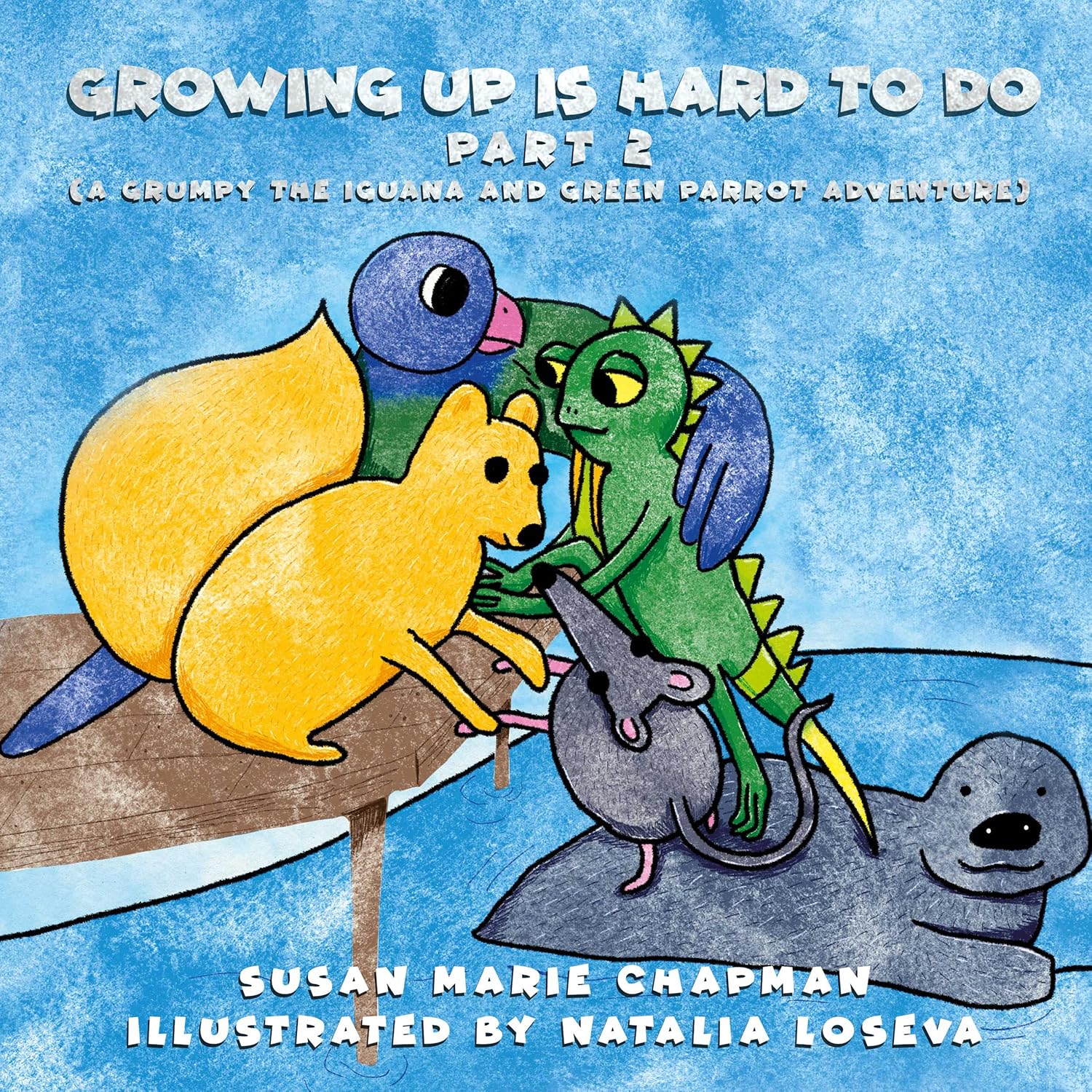

Growing Up Is Hard to Do by Susan Marie Chapman is a cheerful children’s book that brings readers back into the world of Grumpy the Iguana and his animal friends. This time, Grumpy, Green Parrot, Mr. Squirrel, and Little Mouse encounter an unfamiliar creature while spending time near the water. Their new acquaintance is Baby, a friendly young manatee who has plenty to share about herself and her underwater world. What begins as a surprising introduction turns into an opportunity for friendship, exploration, and learning. Chapman creates a welcoming atmosphere where curiosity leads to new experiences, and even the most hesitant characters have a chance to discover something wonderful.
I liked the way the book introduces information about manatees through conversations between the characters. Baby explains what manatees eat, how they breathe, and what makes them different from other marine animals. Young readers also learn about the importance of protecting these gentle creatures, particularly from dangers associated with motorboats. These educational moments fit comfortably into the storyline because the characters are genuinely interested in understanding their new friend. Chapman also explores kindness, courage, and empathy through the animals’ interactions. Mr. Squirrel’s nervous personality adds a relatable touch, while Grumpy demonstrates how a little encouragement can help a friend feel more confident.
The artwork features bright blue water, vivid green plants, colorful fish, and expressive animal characters with exaggerated features that make their emotions easy to recognize. Grumpy’s enormous yellow eyes, Little Mouse’s oversized ears, and Mr. Squirrel’s fluffy tail create a cast that’s immediately recognizable. Baby’s rounded shape and gentle expressions make her especially endearing. The textured, hand-drawn appearance of the illustrations gives the pages a relaxed, whimsical quality. Some spreads feature close-up portraits of the characters, while others open into lively underwater scenes filled with marine life. The changing perspectives keep the visual experience interesting and provide plenty of details for children to explore during repeated readings.
Chapman’s writing is straightforward and conversational, making the story well suited to reading aloud. The dialogue gives each character a distinct presence, and the gentle humor helps maintain an upbeat mood throughout the adventure. There’s also something appealing about the way the animals respond differently to unfamiliar situations. Their personalities create natural opportunities to talk with children about being afraid, asking questions, accepting help, and welcoming someone new. The marine setting adds another layer of interest, especially for young readers fascinated by ocean animals. Growing Up Is Hard to Do: Part 2 combines an engaging animal adventure with accessible lessons about friendship and wildlife conservation. It’s a sweet and informative picture book that encourages children to approach the world with curiosity, compassion, and a willingness to make new friends.
Pages: 44 | ASIN : B0BFZJ974X

Spirits in Plain Sight

The natural world has an extraordinary capacity to surprise us, especially when we pay attention to the details we might ordinarily overlook. In Spirits in Plain Sight, photographer and author Joy M. Lundstrom invites readers to rediscover that sense of curiosity through a delightful collection of photographs revealing unexpected faces, expressions, and personalities in nature. Tree trunks appear to smile, stones take on mischievous expressions, and weathered pieces of wood seem to possess distinct characters. What begins as a collection of curious visual discoveries becomes an engaging exploration of imagination, mindfulness, and the simple pleasures of observation. Lundstrom approaches her subject with warmth and genuine enthusiasm, encouraging readers to experience their surroundings with the openness and playful curiosity of childhood. The result is a charming photographic journey that celebrates the remarkable things waiting to be noticed in everyday environments.
I enjoyed the surprising variety of expressions Lundstrom discovers in natural materials. Across fifty photographs, readers encounter everything from small stones resembling expressive faces to towering trees whose knots, scars, and textured bark suggest recognizable features. Some images inspire immediate laughter, while others invite closer inspection before their hidden personalities emerge. The photographs were taken in locations throughout the United States, including Wisconsin, Illinois, Tennessee, Florida, and North Carolina, giving the collection a broad geographical scope while maintaining a consistent artistic perspective. Particularly memorable are the photographs of trees whose unusual growth patterns create remarkably expressive faces, as well as the smaller discoveries hidden among fallen leaves, pebbles, and decaying wood. Lundstrom’s compositions preserve the natural surroundings of each subject, allowing readers to appreciate both the imaginative resemblance and the beauty of the environment in which it appears.
Beyond its visual appeal, Spirits in Plain Sight carries a thoughtful message about the importance of reconnecting with curiosity and finding joy in ordinary experiences. Lundstrom’s introductory reflections establish the personal significance of following one’s creative instincts and embracing inspiration. Her dedication offers a particularly meaningful observation: “You don’t need to know the entire journey; you only need to take the first step.” This sentiment complements the photographs, which reflect the rewards of remaining receptive to unexpected discoveries. The book also explores the relationship between imagination and emotional well-being, suggesting that playful observation can provide a welcome sense of freedom from daily responsibilities. Its presentation reinforces this philosophy through a straightforward, image-centered format that gives readers time to examine each photograph and make their own discoveries. There’s a refreshing sincerity to Lundstrom’s perspective, and her enthusiasm for the natural world makes the collection feel personal and inviting.
What makes Spirits in Plain Sight especially appealing is its ability to encourage a different way of seeing familiar surroundings. Lundstrom’s photographs demonstrate how easily imagination can transform an ordinary walk through the woods, a visit to the beach, or a moment spent examining a tree into an opportunity for discovery. The book’s accessible approach makes it suitable for readers of different ages, particularly families, nature enthusiasts, photographers, and anyone interested in cultivating a more attentive relationship with the world around them. Its gentle emphasis on happiness and creative expression also gives the collection a meaningful emotional dimension. Near the conclusion, Lundstrom encourages readers to “Walk a little slower. Look a little closer.” Those words capture the spirit of the entire book. With its expressive imagery, playful sensibility, and appreciation for life’s smaller wonders, Spirits in Plain Sight offers readers an enjoyable reminder that curiosity can enrich even the most familiar experiences.
Pages: 61 | ASIN : B0HK76LKQF
Thank You for the Shoes

Thank You for the Shoes by Raffaela Marie Rizzo is a moving work of literary nonfiction that tells an extraordinary story about an ordinary man and the immigrant generation that helped build America. Born in the mountain village of Platania in Calabria, Michelangelo Rizzo grows up in poverty, haunted by questions about the father who died while working in America. As a young boy, he promises himself that someday he’ll find his father’s grave and bring him flowers. That deeply personal longing, combined with the hope of building a better life, draws thirteen-year-old Michele across the Atlantic in 1909. Drawing on family memories, interviews, historical research, and imaginative reconstruction, Rizzo brings his journey to life. His story becomes a window into the experiences of countless immigrants who arrived with little money, limited education, and an enormous willingness to work.
One of the book’s greatest strengths is how vividly Rizzo portrays the world these immigrants encountered. From the poverty-stricken villages of Southern Italy to America’s bustling industrial cities, she recreates a period when newcomers endured dangerous jobs, crowded living conditions, economic uncertainty, and widespread prejudice. These were the laborers who dug tunnels, built roads and railroads, worked in mines, and helped transform a growing nation. Rizzo’s attention to historical detail gives their experiences weight and authenticity. She also captures the warmth of immigrant communities through family conversations, cultural traditions, humor, and the friendships that helped people survive difficult times. Michele emerges as a memorable character, proud, determined, occasionally stubborn, and deeply committed to his responsibilities. His imperfections make him human, while his persistence makes his story compelling.
Perhaps the book’s most important contribution is its celebration of the millions of ordinary immigrants whose lives seldom appear in history books. Michele represents an immigrant everyman, someone who believed that honest labor, personal integrity, faith, and respect for the law were essential to building a meaningful life in his adopted country. His experience challenges the ethnic stereotypes that have long overshadowed the contributions of Italian Americans and other immigrant communities. While organized crime and the Mafia have dominated many popular portrayals of Italian Americans, Rizzo illuminates the much larger population of hardworking families who rejected those influences and devoted themselves to becoming responsible American citizens. Throughout the narrative, family loyalty, sacrifice, gratitude, and the desire to provide opportunities for the next generation give the story its emotional depth. The book’s title beautifully reflects those values, showing how something as simple as a pair of shoes can symbolize dignity, security, and a parent’s love.
I recommend Thank You for the Shoes to readers who enjoy family histories, immigration stories, and accounts of America’s working-class past. Italian American readers may recognize familiar customs and values, but the book’s appeal reaches across ethnic and cultural boundaries. Descendants of Irish, Polish, Jewish, Greek, and countless other immigrant families will recognize the ambitions, struggles, and sacrifices that shaped their own ancestors’ lives. Younger readers may also discover a fuller appreciation of the generations whose hard work created opportunities they now enjoy. Rizzo’s affectionate portrait of her father is also a tribute to the unsung men and women who helped build this country while raising families, respecting its laws, and embracing its promise. It’s a heartfelt reminder that American history belongs just as much to these everyday people as to the famous names recorded in textbooks.
Pages: 332 | ASIN: B0GFB97DRD
The Final Girl

In Final Girl, Debbie McNulty delivers a deeply personal memoir about growing up surrounded by religious fear, family instability, and adults who repeatedly failed to protect her. Raised in Wisconsin during the 1970s and 1980s, McNulty spent much of her childhood within a strict Pentecostal environment where warnings about the Rapture, eternal damnation, and God’s judgment shaped nearly every aspect of her life. Drawing inspiration from horror films, she organizes her experiences around five metaphorical monsters, each representing a different source of childhood trauma. It’s an effective way to frame a story in which the threats often came from people and institutions that were supposed to offer safety. Through vivid memories and candid reflections, McNulty explores how fear became woven into her understanding of love, faith, and her own worth. The result is an intimate portrait of a girl trying to make sense of a world where the rules seemed constantly to change, and the consequences of breaking them felt terrifying.
One of the book’s greatest strengths is McNulty’s ability to recreate childhood experiences with remarkable emotional clarity. She remembers the little things: the excitement of buying school supplies, the comfort of a beloved pet, the pleasure of singing with her mother, and the dread of returning to an unpredictable home. These ordinary details give the memoir much of its emotional weight. Her description of fearing that she’d been left behind in the Rapture simply because her mother wasn’t where she expected her to be is especially affecting. McNulty also captures the complicated feelings children can have toward their parents. She longs for her mother’s affection while worrying constantly about her emotional well-being, and she struggles to reconcile her father’s occasional charm with his destructive behavior. These contradictions feel painfully authentic. Throughout the book, moments of humor, tenderness, and youthful curiosity provide glimpses of the spirited child beneath the anxiety.
McNulty’s conversational writing style makes difficult material feel immediate and accessible. She moves between childhood memories and adult reflections, allowing readers to understand both what she experienced at the time and how those experiences continued to affect her decades later. Her discussions of complex PTSD, therapy, and religious trauma add another dimension to the narrative, revealing how deeply childhood conditioning can influence adult life. The book also offers a troubling examination of religious authority, particularly the ways that shame, obedience, and rigid expectations surrounding sexuality can leave children vulnerable. McNulty approaches these subjects with an openness that gives her account credibility. The repeated descriptions of fear and emotional distress illustrate how relentless these experiences were. Her determination to examine painful memories without minimizing their impact gives the memoir its distinctive voice.
Final Girl: Surviving Church and Childhood will resonate most with readers who appreciate candid memoirs about difficult family relationships, religious trauma, and the lasting effects of childhood abuse. It may be especially meaningful to people who grew up in high-control religious communities or who have struggled to understand how early experiences continue to shape their lives. Parents, educators, counselors, and religious leaders could also gain valuable insight into the emotional needs of children and the consequences of overlooking their distress. Readers should know that the book includes frank discussions of abuse, sexual assault, and psychological suffering. Yet there’s also warmth in McNulty’s storytelling and a genuine affection for the small pleasures that helped sustain her. Her willingness to share painful, deeply personal experiences makes this a moving and thought-provoking memoir. It’s a book that invites readers to consider what children carry into adulthood, how deeply fear can take root, and what it means to begin reclaiming ownership of one’s life.
Pages: 335 | ASIN : B0HK7TYPQX