Fourths going forth

Today, the Fourth of July, marks the 250th anniversary of the United States. My country has made it a fourth of the way to a millennium. May it make it the rest of the way. Also in the world of numbers, have a look at the fourth powers of the first four counting numbers:
1 x 1 x 1 x 1 = 1
2 x 2 x 2 x 2 = 16
3 x 3 x 3 x 3 = 81
4 x 4 x 4 x 4 = 256
Age-wise, I’ve reached another one of those today, which means I’ve lived through close to a third of the time my country has officially been a country. That’s a lot to think about, nationally and personally. (And on a lighter note, Facebook recently took to showing me an ad for a certain website selling T-shirts.)
As we’re marking the country’s 250th anniversary, there’s something you should know (if you don’t already) about what took place on its 50th anniversary. John Adams, a Founding Father who became the country’s first vice-president and second president, died on July 4, 1826. Thomas Jefferson, the Founding Father who was the primary author of the Declaration of Independence and who became the country’s second vice-president and third president, had died hours earlier that same day. People have pointed out that if an author included such a striking coincidence in a novel, readers would find it so implausible they wouldn’t believe it. And yet it happened. Not only that, but on July 4, 1831, James Monroe, the country’s fifth president and the last to have been a Founding Father, also died. Sometimes truth is stranger than fiction.
Not so strangely, I’ve gotten into a little tradition each July Fourth of posting a view that includes red, white, and blue. The photograph above, conspicuously horizontal in its framing, shows a scarlet leatherflower (Clematis texensis) on the north bluff of the South Fork of the San Gabriel River on June 14th, which happens to have been Flag Day. The photograph also offers some green “to grow on,” as we say.
In addition, someone in another venue who saw the close photograph below of a buttonbush (Cephalanthus occidentalis) flower globe enthusiastically described it as “apropos for the Fourth of July,” the implied reference being to fireworks, so I’m following the suggestion and including that portrait here as well.

And let me go back half a century, to when July 4, 1976, marked the bicentennial of the United States. That day found me in New Harmony, Indiana, on my way to settling in Austin, but I’d spent June in New York. One of the things I did during my stay there was to go up into the Statue of Liberty, from whose crown I looked down and took the abstract black and white infrared photograph below. It includes the tablet that Liberty holds in her left hand, with the inscription
JULY
IV
MDCCLXXVI.

As I looked out then, may we all go forth and look with favor on the Fourth.
© 2026 Steven Schwartzman
Bluebell buds and more

A larger and smaller bluebell bud (Eustoma sp.) put on a graceful show for me at the Lady Bird Johnson Wildflower Center on June 22nd. Beyond them you see the purple of already open bluebell flowers and the red from a species of Echinacea. The tiny insect appears to be a thrips. I also made the pleasant portrait below of a bluebell flower with a shaft of sunlight across it and nothing encumbering the background.

© 2026 Steven Schwartzman
Horseweed and handmaidens

An area of ongoing commercial development in northeast Austin on June 27th was home to horseweed plants (Conyza or Erigeron canadensis) in several places. Accompanying the two horseweeds above and likewise still bereft of flowers was what I take to be wireweed (Symphyotrichum subulatum). In the picture below, sunflowers (Helianthus annuus) and horseweeds, both tall, swayed in the prairie breeze.

© 2026 Steven Schwartzman
Close abstractions of Hibiscus laevis flowers

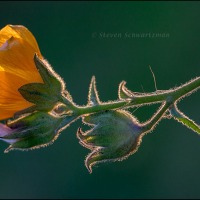
At the Lady Bird Johnson Wildflower Center on June 22nd I made these close abstractions of flowers on a halberd-leaf rose mallow plants, Hibiscus laevis. Though the species isn’t native in Austin, the USDA map shows it not far away in Gonzales County to the south and Lee County to the east.

§
§ § §
§
Harry Warren
The other morning Turner Classic Movies showed the 1934 film “Dames.” As corny as much of the movie seems today (and maybe even back then), it has elaborately staged and filmed dance numbers choreographed by Busby Berkeley. It also includes Dick Powell singing the debut of “I Only Have Eyes for You,” which Wikipedia says CBS News included in its list of the 250 essential American songs of the past 250 years. The words are by Al Dubin and the music by Harry Warren. You may not have heard of Harry Warren, whose very Italian real name was Salvatore Antonio Guaragna. (Do you see how Guaragna, pronounced Gwahranyah, got Anglicized to Warren?) As Wikipedia notes:
Over a career spanning six decades, Warren wrote more than 800 songs. Other well known Warren hits included… “You Must Have Been a Beautiful Baby“, “Jeepers Creepers“, “The Gold Diggers’ Song (We’re in the Money)“, “That’s Amore“, “There Will Never Be Another You“, “The More I See You“, “At Last” and “Chattanooga Choo Choo” (the last of which was the first gold record in history). Warren was one of America’s most prolific film composers, and his songs have been featured in over 300 films.
So now you know.
© 2026 Steven Schwartzman
Two takes on another combination

A recent post showed three examples of something I’ve long been interested in: combinations of our native wildflowers. On June 21st in Great Hills Park I found a basket-flower (Plectocephalus americanus) growing among a colony of American germander (Teucrium canadense). Here are two takes on that combination.

© 2026 Steven Schwartzman
A different partridge pea flower

At the Wildflower Center named after Lady Bird Johnson the Lady Eve
called my attention on June 22nd to a somewhat flattened and otherwise
interestingly shaped partridge pea flower (Chamaecrista fasciculata)
that you might imagine had two horns like those of an animal on it.
§
§ § §
§
And something completely different to follow the different partridge pea flower
“Stendhal syndrome is a rare psychosomatic condition in which individuals experience profound physical and emotional distress—including rapid heartbeat, dizziness, fainting, and hallucinations—when exposed to objects or environments of overwhelming beauty, typically magnificent artworks or historical architecture.” It’s “named after the 19th-century French author Stendhal (pen name of Marie-Henri Beyle). He described feeling intense palpitations and ‘celestial sensations’ while visiting the Basilica of Santa Croce in Florence, Italy, in 1817.”
Somebody used AI to bring the people in old paintings to life and have them sing a rollicking song in Spanish called “Stendhal’s Mambo.” Below the linked video you’ll find the names of the paintings, followed by the song’s Spanish words (which also appear line by line as the video plays). I ran the Spanish lyrics through ChatGPT and got this English translation:
Hello, friend, what a joy!
You get dizzy with emotion.
Your gaze gives us life,
it sets our hearts alight.
So many boring months
on the museum wall,
but you come and I come alive,
through your pulse I see myself.
Oil paint mambo, color mambo!
Art breathes through your great love.
Canvas mambo, heavenly rhythm!
Thank you for your Stendhal syndrome.
Whether I cry or whether I sweat,
you adore every brushstroke.
Come out of your silent swoon,
we’re sending you a hug!
The painter gave us form,
color, and structure,
but you break the rules:
you bring the painting to life!
Oil paint mambo, color mambo!
Art breathes through your great love.
Canvas mambo, heavenly rhythm!
Thank you for your Stendhal syndrome.
If you get dizzy… dance!
If you’re moved… enjoy it!
For the painting is alive, and life is a rose.
Oil paint mambo, color mambo!
Art breathes through your great love.
Canvas mambo, heavenly rhythm!
Thank you for your Stendhal syndrome.
Thank you, friend!
Living painting!
© 2026 Steven Schwartzman
A new slant on good old sunflowers in a different quadrant

After working with a huge colony of sunflowers (Helianthus annuus) at TX 71 and the 130 toll road on June 24th, I drove a few miles to the intersection of FM 973 and Webberville Rd., in whose northwestern quadrant I photographed a smaller but in one way more interesting colony of sunflowers. I, and maybe you, imagine sunflowers in a large colony spreading their yellow across a field, which is indeed how I normally find them. The second sunflower colony differed from the norm by not spreading over level ground but instead rising all the way up the side of a broad hill, providing the novel perspective you see here from the base of the hill.
© 2026 Steven Schwartzman
Most recent hierba de zizotes milkweed encounter

Tina Huckabee’s good post this morning about the milkweed that botanists call Asclepias oenotheroides prompted me to look back and see when I most recently encountered it, which turned out to be on April 24th just outside Bastrop State Park. In the lower part of the first picture you see some drops of the “milk” that gives these plants their common English name. That milky latex irritates some people’s skin, and the Spanish name hierba de zizotes could be translated as ‘plant that causes sores.’ The second picture shows how a low leaf on this milkweed had mostly turned conspicuously yellow-orange.

© 2026 Steven Schwartzman
An even bigger field of sunflowers

Even bigger than the colony of sunflowers (Helianthus annuus) I found in Pflugerville on June 17th was the one I photographed seven days later in the southwest quadrant of TX 71 and the 130 toll road. Invasive Johnson grass had also run rampant there, making it hard for me to get pictures of the sunflowers unalloyed. The edge of the entrance ramp onto southbound 130 ended up offering the best vantage points because that rising ramp let me walk up high enough with my telephoto lens to shoot over the Johnson grass that infested the margins of the field. The picture above gives you a feel for how expansive the sunflowers were. Clicking the panorama to expand it to four times the area lets you better appreciate how many sunflowers made up just that part of the colony.
Before I discovered the virtue of the up-sloping entrance ramp, I’d wandered through the sunflower colony and at one point came upon a flashy spider that the Internet later identified as Argiope trifasciata, the (three-) banded garden spider. The lens I walked around with on the camera was a 100–400mm zoom, so I had no choice but to try making a telephoto portrait, rather than the usual macro one, of the spider. Turned out pretty well, don’t you think?

© 2026 Steven Schwartzman
Looking at horsemints anew, part 2

The fringe of Great Hills Park along Floral Park Dr. offered up a bunch of wildflowers on June 21st, including horsemints (Monarda citriodora). Moving in close, I tried out compositions that were different from ones I’d previously done. You saw an example in a post yesterday, and now here’s another.
One person interpreted the tiny thingie on the flower’s lower cusp as a “bug,” and another person as a “critter.” Zoom in on it by clicking the thumbnail below and see what you make of it.

© 2026 Steven Schwartzman
 Portraits of Wildflowers
