The Bay State offers a warning about treating wealthy residents as an inexhaustible source of revenue. Massachusetts voters approved a constitutional amendment in 2022 imposing an additional 4 percent tax on annual income above $1 million. The tax has raised billions for education and transportation. The costs took longer to appear.
Internal Revenue Service data show that Massachusetts had almost 94,000 tax returns reporting at least $1 million of income in 2021. By 2023, that population had fallen by roughly 12,700, or 13.5 percent. During 2023, the first year of the surtax, Massachusetts lost a net $4.2 billion in adjusted gross income to interstate migration. High earners accounted for a disproportionate share of the lost income.
…..
The Golden State is unusually dependent on a small population of affluent taxpayers and volatile capital-gains income. The richest 1 percent provide roughly 40 percent of California’s personal income-tax revenue. Losing even a handful can punch an enormous hole in future collections.
Their departure also takes more than individual income-tax payments. Entrepreneurs create companies. Investors finance start-ups. Wealthy residents employ people, purchase services and make charitable contributions.
Nor should Californians assume “one time” means the political appetite for wealth taxes disappears. Phineas Baxandall of the Massachusetts Budget and Policy Center, a prominent supporter of Massachusetts’s millionaire surtax, was recently asked about bringing a California-style wealth tax to Massachusetts. “There’s nothing magical about the number 1 billion,” he told the Boston Globe. “Maybe the cutoff is 100 million.”
That’s how the dynamic works: Establish the machinery and political precedent for confiscating wealth, and today’s extraordinary levy on billionaires can become tomorrow’s argument about whether $100 million, or even $1 million, is a more appropriate cutoff.
To understand how mistaken this is, look no further than Texas GOP Senate nominee Ken Paxton. The Texas attorney general has tried to massage issues near and dear to the MAHA movement by targeting makers of toothpaste (for fluoride), cereal (food dyes) and clothing (chemicals), among other businesses.
“Too many corners have been cut by corporations in this country, and I will continue to hold them accountable,” Mr. Paxton said in a press release last month announcing an investigation into Hanes and Fruit of the Loom over—wait for it—potential “toxic chemicals” in children’s underwear.
Maybe Mr. Paxton thinks targeting business will distract voters from his personal baggage, including impeachment on corruption allegations by the GOP-led Texas House. (The Senate acquitted him.) As he has amped up his antibusiness campaign, his polling numbers have slid.
Then there’s Kansas GOP Sen. Roger Marshall, who has sought to tap into anger at Wall Street by assailing big banks and credit card companies as “loan sharks.” He has backed a 10% cap on credit-card interest rates and sponsored a bill with Illinois Democrat Dick Durbin to regulate credit-card payment networks.
Recent polls show the incumbent trailing Democrat Adam Hamilton in a state that hasn’t elected a Democrat to the Senate since 1932 and that Mr. Trump won by 16 points in 2024. One reason is reports that while practicing medicine, Mr. Marshall sued patients over unpaid bills and charged them annual interest up to 18%. Who’s the loan shark?
Like other Republicans in the heartland, Mr. Marshall has been hurt by the Trump tariffs and immigration raids. Taxing imports is unpopular beyond a thin slice of Republican voters. So is demonizing and deporting foreign workers who haven’t committed a crime.
Vice President JD Vance last month announced a suite of actions that make it harder for skilled immigrants to work legally in the U.S. He derided these immigrants as “indentured servants.” What happened to Mr. Trump’s pledge to build a wall with a “big beautiful door”? The door that his team is building goes only one way—out.
Richard Fulmer’s random thoughts are excellent. A slice:
– In a free market economy, voluntary exchanges don’t take place unless each party to a transaction believes that it will benefit them. No violence is involved. By contrast, violence is implicit in a system that forbids such exchanges.
– Auckland’s housing prices were among the highest in the world. Then the city eased its housing regulations. What followed was a building boom and more affordable housing. It turns out that if you make homebuilding legal, people build homes. Who knew?
– A lot of political unrest comes from people with worthless college degrees who have no skills that anyone is willing to pay for.
– Adam Smith warned that businessmen seldom meet without conspiring against the public good. But he went on to say that the government shouldn’t help them do so. Many of the government’s regulations do just that by restricting competition and innovation to protect incumbent firms.
– Progressives see millionaires and billionaires as a policy failure – one they plan to correct. Yet, they propose to pay for their programs by taxing the same people they want to eliminate. Perhaps they’re not as concerned about sustainability as they claim.
María Corina Machado finally made it back to Venezuela after 10 months in exile. After an arduous four-day journey from Panama City, on Oct. 25 the opposition leader walked into the Sanctuary of the Divine Shepherdess in the city of Barquisimeto. It was her eighth return attempt since August. To succeed, she had to overcome threats from the dictatorship in Caracas and U.S. attempts to thwart her homecoming.
After President Trump used the U.S. military to remove dictator Nicolás Maduro from power in January, Venezuelans expected Washington to set up new elections. But the Trump administration has been dragging its feet. Ms. Machado’s sudden and dramatic appearance on a Sunday at one of the most important Catholic shrines in the country could change that. It’s the most hopeful the nation has felt since Mr. Maduro was carried away by the Americans to stand trial for drug trafficking in New York.
Enthusiasm among Venezuelans for Mr. Trump waned this year after he made deputy dictator Delcy Rodríguez the interim president and began cutting sweetheart oil deals with her. He calls her “terrific,” and the U.S. says she’s doing what it asks. But the repression continues and the regime still holds 322 political prisoners according to the nongovernmental organization Foro Penal. In January Mr. Trump said Ms. Machado doesn’t have the “respect” necessary to lead the nation. Events of the last week prove him wrong.
Ms. Machado gets high marks for her determination. Her journey home took her through Colombia and across the Venezuelan border into the state of Táchira. Planners understood that maximum secrecy was crucial. A source confirmed to me that no planes were used on the trip despite press reports to the contrary. In the final phase, the elite international team that escorted her had to dodge Venezuelan security forces and duck police inspections at checkpoints as it smuggled her north.
 There has never been a shortage of people eager to draw up blueprints for running other people’s lives.
 A core component of classical liberalism has always been a belief that people should be allowed by law to pursue their own interests as they see fit, so long as they are respecting the rights of others.
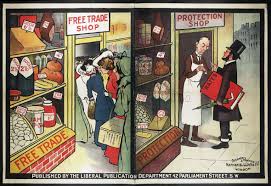 National policy in the economic sphere, as in all other spheres, should be directed to ensure permanent advantages for the population as a whole. The presumption in favour of a policy of Free Trade is that it is so directed – it secures in the long run the use of the national resources of a country in the way shown by experience to be most economical, that is to say, to yield the greatest results for the least effort: the certain advantage of Free Trade is both permanent and general. The advantages, on the other hand, to be obtained by tariffs are either sectional if they are certain, or uncertain if they are general; in each case a strictly temporary gain, if any gain, is far more probable than a permanent one.
 If, for example, a government raises tariffs because it wants to protect particular communities from foreign competition out of a sense of compassion, it often ends up inflicting harm on others, such as consumers who end up paying higher prices or the businesses that experience retaliatory tariffs from abroad.