Log In


Quintinite-2H
A structural variant of Quintinite
This page is currently not sponsored. Click here to sponsor this page.
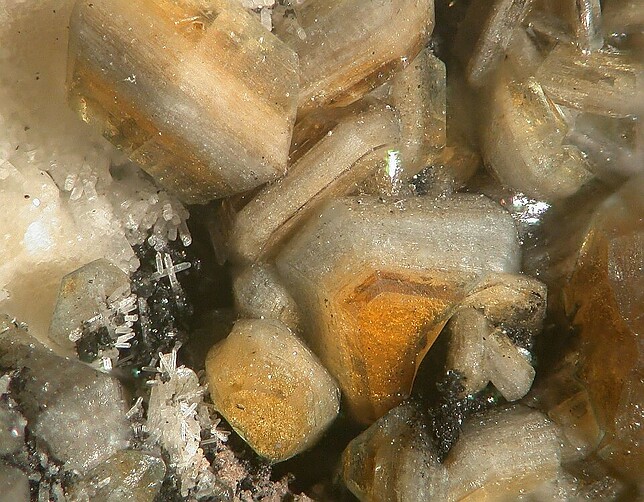


About Quintinite-2H
Formula:
Mg4Al2(OH)12(CO3) · 3H2O
Colour:
Deep orange-red, orange, pale brown
Lustre:
Vitreous
Hardness:
2
Specific Gravity:
2.14
Crystal System:
Hexagonal
Name:
Named in 1997 by George Y. Chao and Robert A. Gault in honor of Quintin Wight [b. April 23, 1935 Canada], of Ottawa, Ontario, Canada, significant contributor to mineral studies at Mont Saint-Hilaire, and author of "The Complete Book of Micromounting" (1993). The 3T polytype was first found at Mont Saint-Hilaire.
A polytype of Quintinite
The 2H polytype was originally described from Jacupiranga alkaline complex, Cajati, São Paulo, Brazil.
The 2H polytype was originally described from Jacupiranga alkaline complex, Cajati, São Paulo, Brazil.
Unique Identifiers
Mindat ID:
31536
Long-form identifier:
mindat:1:1:31536:0
Physical Properties of Quintinite-2H
Vitreous
Transparency:
Transparent
Colour:
Deep orange-red, orange, pale brown
Streak:
White
Hardness:
2 on Mohs scale
Tenacity:
Brittle
Cleavage:
Perfect
{0001}
{0001}
Fracture:
Irregular/Uneven
Density:
2.14(1) g/cm3 (Measured) 2.15 g/cm3 (Calculated)
Optical Data of Quintinite-2H
Type:
Uniaxial (+)
RI values:
nω = 1.533(1) nε = 1.533
Surface Relief:
None to Very Low
Relative to Canada balsam mounting medium (n ≈ 1.537).
Relative to Canada balsam mounting medium (n ≈ 1.537).
This shows the grain boundary and Becke line effect under plane-polarised
light, based on the contrast between this mineral's average refractive
index and the mounting medium. It does not take into account mineral
colouration.
In focus
Interference Figure:
This shows the idealized uniaxial interference figure - the conoscopic
(convergent-light, Bertrand-lens-in) view, for a grain cut with the optic axis
centred and vertical. The coloured rings are isochromatics, computed with the
same physics as the Michel-Lévy bar above; the dark cross is the isogyre.
For a genuinely uniaxial mineral viewed this way, that cross stays perfectly stationary if you rotate the stage - unlike a biaxial mineral, where it splits apart on rotation. That invariance is itself the standard diagnostic test for telling uniaxial and biaxial minerals apart at the microscope.
For a genuinely uniaxial mineral viewed this way, that cross stays perfectly stationary if you rotate the stage - unlike a biaxial mineral, where it splits apart on rotation. That invariance is itself the standard diagnostic test for telling uniaxial and biaxial minerals apart at the microscope.
Pleochroism:
Visible
Comments:
ω = yellow, ε = lighter yellow.
Chemistry of Quintinite-2H
Mindat Formula:
Mg4Al2(OH)12(CO3) · 3H2O
Element Weights:
Crystallography of Quintinite-2H
Crystal System:
Hexagonal
Class (H-M):
622 - Trapezohedral
Space Group:
P6322
Cell Parameters:
a = 10.571 Å, c = 15.171 Å
Ratio:
a:c = 1 : 1.435
Unit Cell V:
1,468.17 ų (Calculated from Unit Cell)
Z:
4
Morphology:
As equant and prismatic crystals displaying the forms {0001} and an {hkil} trapezohedron with or without {1010}.
Twinning:
None observed.
X-Ray Powder Diffraction
Powder Diffraction Data:
| d-spacing | Intensity |
|---|---|
| 7.63 Å | (100) |
| 3.785 Å | (100) |
| 1.825 Å | (20) |
Comments:
Jacupiranga alkaline complex, São Paulo, Brazil. Data are from the type description.
Synonyms of Quintinite-2H
Common Associates
Associations Based on Photo Data:
| 4 photos of Quintinite-2H associated with Strontianite | SrCO3 |
| 4 photos of Quintinite-2H associated with Phlogopite | KMg3(AlSi3O10)(OH)2 |
| 4 photos of Quintinite-2H associated with Magnetite | Fe2+Fe3+2O4 |
| 1 photo of Quintinite-2H associated with Dolomite | CaMg(CO3)2 |
| 1 photo of Quintinite-2H associated with Quintinite | Mg4Al2(OH)12(CO3) · 3H2O |
Fluorescence of Quintinite-2H
Not fluorescent.
Other Information
Notes:
Attacked slightly by 1:1 HCl, more strongly by 1:1 HNO3, and very strongly by 1:1 H2SO4, all with effervescence.
Health Risks:
No information on health risks for this material has been entered into the database. You should always treat mineral specimens with care.
Internet Links for Quintinite-2H
mindat.org URL:
https://www.mindat.org/min-31536.html
Please feel free to link to this page.
Please feel free to link to this page.
Search Engines:
Mineral Dealers:
References for Quintinite-2H
Localities for Quintinite-2H
Showing 4 localities.
 symbol to view information about a locality.
The
Locality List
 - This locality has map coordinates listed.
- This locality has estimated coordinates.
ⓘ - Click for references and further information on this occurrence.
? - Indicates mineral may be doubtful at this locality.
 - Good crystals or important locality for species.
 - World class for species or very significant.
(TL) - Type Locality for a valid mineral species.
(FRL) - First Recorded Locality for everything else (eg varieties).
All localities listed without proper references should be considered as questionable.
Brazil | |
| Chao et al. (1997) |
Russia | |
| Lapis 37 (2) |
| Yakovenchuk et al. (2018) |
Sweden | |
| Strand (2016) |

Kovdor Zheleznyi Mine, Kovdor Massif, Kovdorsky District, Murmansk Oblast, Russia