


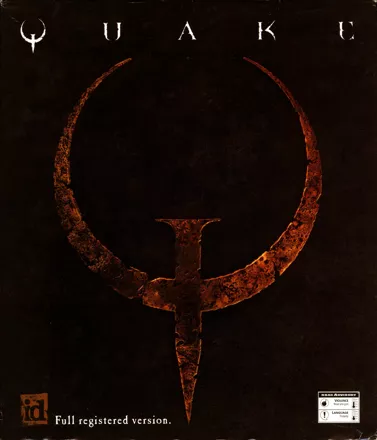
Quake
-
 Quake Mission Pack No. 2: Dissolution of Eternity
(1997)
-
 Quake Mission Pack No. I: Scourge of Armagon
(1997)
-
 Quake: Episode 5 - Dimension of the Past
(2016)
-
 Abyss of Pandemonium
(1998)
-
 Aftershock for Quake
(1996)
-
 Aftershock Toolbox for Quake
(1996)
-
 Dark Hour for Quake
(1996)
-
 Deathmatch Maker
(1997)
-
 Earth-Quake
(1996)
-
 Eternal Darkness: 100 new levels for Quake
(1996)
-
 Level Master V
(1997)
-
 Malice: 23rd Century Ultraconversion for Quake
(1997)
-
 Phenomenon
(1996)
-
 Q!Zone
(1996)
-
 Q2
(1996)
-
 Qu.......ke
(1996)
- Quad Damage (1998)
-
 Quake'em
(1996)
-
 Shrak for Quake
(1997)
- Superdead (1996)
-
 Tremor for Quake
(1997)
-
 Ultra Level Add-On
(1997)
-
 Quake
(2021)
-
 id Anthology
(1996)
-
 id Super Pack
(2007)
-
 Quake and The Ultimate Doom Compilation
(1998)
-
 Quake: The Offering
(1998)
- Resurrection Pack for Quake (1998)
-
 The Quake Collection
(2007)
-
 Ultimate Quake
(2001)
Description official descriptions
An enemy codenamed “Quake,” believed to come from another dimension, is using teleportation gates to invade Earth. The player takes the role of a nameless soldier who arrives at his base only to discover that Quake’s forces have overrun it and killed everyone. Somewhere in the base is a teleporter leading to Quake’s realm. The mission is clear: enter the enemy’s dimension, fight through hordes of monsters, and strike back.
id Software’s follow-up to Doom and Doom II, Quake is a first-person shooter. Its main technological innovation is its use of a true 3D engine: the levels, enemies, and objects are built from polygons rather than sprites and flat level geometry. This allows for more natural level design, smoother character animation, vertical spaces, and more dynamic movement. It also supports gameplay elements such as bouncing grenades, projectiles traveling through three-dimensional space, and enemies attacking from above or below the player. The fully 3D environments make vertical movement more important than in id Software’s earlier shooters, with ledges, lifts, underwater passages, jumping, and enemies positioned at different heights.
The game begins in a start area where the player chooses a difficulty setting and enters gateways leading to the four episodes. In single-player mode, the player progresses through these episodes in search of exits while fighting enemies and collecting weapons, ammunition, health, armor, and keys. Interaction with the game world is minimal: since there is no dedicated use key, buttons and switches are activated by touching or shooting them. As in id Software’s earlier shooters, the levels contain numerous secret areas, including hidden exits that lead to secret levels.
Unlike Doom’s mixture of futuristic technology and demonic imagery, Quake’s setting combines several different styles. Each episode begins in a military base connected to the slipgate network, but later levels shift into environments inspired by medieval fantasy, gothic horror, and dark otherworldly architecture, including castles, dungeons, caverns, crypts, and temples. The visual style is darker and more muted than Doom’s, with many levels dominated by browns, grays, stone, metal, and earth tones. The game’s atmosphere is reinforced by an ambient soundtrack and sound design by Trent Reznor and Nine Inch Nails, emphasizing dread and isolation rather than traditional action music.
The enemy roster reflects this blend of themes. Early levels include human soldiers armed with shotguns or energy weapons, while later areas introduce knights, zombies, ogres with grenade launchers and chainsaws, leaping fiends, floating scrags, and larger supernatural creatures. The player’s weapons are mostly modern or industrial in function but have a rough, brutal feel. The arsenal includes an axe, shotguns, nailguns, grenade and rocket launchers, and the Thunderbolt, which discharges electrical energy.
Quake was one of the early first-person shooters designed with both LAN and Internet play in mind. The single-player levels can be played cooperatively, but the game became especially known for its deathmatch mode. Free-for-all matches, team play, and one-on-one duels are supported, with an emphasis on fast reactions, map knowledge, weapon control, and skillful movement through fully 3D spaces. Single-player maps can be used for multiplayer, and the game also includes maps designed specifically for deathmatch.
Series +
Quake series- Next: Quake II (1997)
Groups +
- 3D Engine: Quake
- 3D Engine: SlaveDriver
- BPjS / BPjM indexed games
- Game feature: In-game screenshot capture
- Gameplay feature: Drowning
- Gameplay feature: Recordable replays
- Games with Dopefish
- Games with officially released source code
- Inspiration: Author - H. P. Lovecraft
- Online Service: Heat.net
- Replay (GT / Infogrames / Atari) releases
- Total Entertainment Network (TEN) multiplay platform
Media
Quake
2 More Videos
Spellings
- 雷神之锤 - Simplified Chinese spelling
Screenshots


Credits (DOS version)
27 People (15 developers, 12 thanks) · View all
| Programming | |
| Tools Programmer | |
| Level / Scenario Design | |
| Music | |
| Sound | |
| Project Manager | |
| Support | |
| Biz | |
| Biz assist | |
| Special Thanks To | |
| [ full credits ] | |
Collaborations
People credited on this game were also credited on:
- Quake, a group of 26 people
- Quake: The Offering, a group of 15 people
- Hexen: Beyond Heretic, a group of 14 people
- And 22 more...
[ Upgrade to MobyPlus to view more! ]
Other Games
In addition to this game, these people were also credited on other games:
- John Romero on 149 other games
- Mike Wilson on 135 other games
- John Carmack on 123 other games
- And 22 more...
[ Upgrade to MobyPlus to view more! ]
Reviews
Critics
Average score: 87% (based on 79 ratings)
Players
Average score: 4.0 out of 5 (based on 516 ratings with 20 reviews)
The Good
This game is a legend, and anyone that even remotely loves online deathmatch, CTF, or other FPS type games should know what I'm talking about.
First of all, the graphics for the time period are simply amazing. I can remember running this game on a 4 meg Diamond Monster 3d card and it was blazing fast and quite simply beautiful. The sound and music are top notch as well, and Trent Reznor (of Nine Inch Nails fame) takes credit for that.
Next, the level design is fantastic. Playing deathmatch and arena or other mods reveals just how well thought out the levels are. American McGee among others are responsible for very well planned environments. You can tell that this game wasn't just thrown together, and one can even imagine Id's offices a big mess with drawings and print outs in regards to level design posted all over the walls.
Furthermore, the game is fully customizable. Quake is either the first, or one of the first games to feature the use of the console in game (something that is now standard on all FPS games). With a little instruction one could enter commands into the console to alter the settings of the game in real time. There was so much versatility and control given to the user, that you could even manipulate the way your online connection functions (like eliminating delta from the tcp/ip function with commands like cl_nodelta 1), what information is given to the player, which models are drawn on the screen and which aren't, the list is exhaustive and goes on and on. The level of customization afforded to the end user was so powerful that Quake could run on just about any machine, and not only that but look and play entirely different on different PC's.
The multiplayer is unbelievably fast. I used to ping 16 with an ISDN connection, and had a friend on 56k that could ping 90. Yes, with some in game tweaking ultra low pings were possible. Furthermore, you could be in a big deathmatch, rockets flying all over the place and 6 or 7 people on your screen with the settings maxed out, and never have your ping move or your framerate drop, all while playing on a p133 with 64mb RAM and a 4meg video card. Phenomenal!
The deathmatch modes are the real meat an potatoes here. I've yet to find any DM type FPS games that are as fast or as hardcore as this game. There isn't much in the way of fancy items or powerups save for some armor, extra health, and occasional quad damage or invulnerability. This game requires raw skill, precision aiming, and knowledge of map layouts all of which take months or even years to perfect.
There are lots of user created maps and add-ons. Clan Arena and Rocket Arena, along with QuakeWorld were my favorite mods, but they also had Team Fortress and other ambitious mods. Now that the game is open source, the sky is the limit.
The Bad
The single player game is weak and mostly worthless. I had first played in single player mode and this made me quit the game for a couple of months until I started hearing from everyone about how untouchable the multiplayer was.
Learning console commands might be discouraging to some, but then again knowledge of their function is not a requirement for play. On the other hand, to have any chance of success during serious competition a working knowledge of the commands is a must, and a .cfg file must be tested and tweaked ad naseum in order to achieve one's full potential. This can be good or bad depending on your disposition.
Some complained that the colors were drab and got old. Lots of shades of brown and gray throughout the levels.
The Bottom Line
Quake is the single best DM game hands down, even today. Even though it was released in 1996, people are still playing it regularly, although the online population is only a fraction of the size it used to be. I played the game from 1996 to 2004 when I finally retired, and there were still big clans, ladders, competitions, and public and private servers available. The speed of the game, multiplayer code, meat and potatoes deathmatch, and customizing options have made this game one I'll never forget.
DOS · by D Michael (222) · 2007
The Good
When Quake came out in 1996, it's technology was simply amazing. 100 percent true 3d in a fast action game was something never accomplished before Quake, so you can imagine the impact it had.
The gameplay was very much like Doom's, except there were some more bits and pieces incorporated into the levels (for example, hidden shootable buttons that were mostly located in dark areas) to add a little puzzle aspect to them. The levels were large and nicely designed, however the textures looked a little ugly when you where in close proximity to them. The soundtrack, which was contributed by Nine Inch Nails (Trent Reznor), was very atmospheric and scary, it contributed a lot to the overall atmosphere of the game (you need to get the CD-ROM release to get it, it is not included in the downloadable version sold by id -- it's a must have!).
The multiplayer was simply astounding when this came out. It was also the first id fps to support internet play out-of-the-box (Doom did not originally support this because the internet was not much used in 1993).
The Bad
There aren't much things not to like about Quake, since there's not that much to it. However, every game has it's faults (well, I'm pretty sure about that anyway), so here are Quake's few.
First of all, the colors. This is a matter of taste of course, but there have been many complaints by gamers in the past about the 'brown' look of the game (lack of variation in color). Look at the screenshots to see what I mean.
Second, little replay value. It's still fun the second (or third) time, but the 'scare' factor will be gone for the most part.
Third, the end game is just bizarre. It sucks, one of the worst endings ever.
Also, some of the levels were plain stupid. But only a handful, and I personally think the good far outweighs the bad in this case.
The Bottom Line
Quake is a great game if you like the kind of first person shooter that doesn't go into too much detail about 'why', 'where', or 'who'. I've still got it installed on my P90 to this day and I get back to it time by time. Quake remains enjoyable even after ten years of aging.
DOS · by PimPamPet (91) · 2006
The next step in the FPS evolutionary process
The Good
Quake literally revolutionized almost every aspect of the FPS genre apart from storytelling and level design. The 3D engine was not simply the first of its kind, it was also the smoothest and fastest for many years to come. It was also one of the most modifiable, giving rise to an endless surge of modifications. It was the first to feature gravity variables, thus opening the portal of physics to videogames.
The game itself was fast and atmospheric at the same time. The rusty, brown colour palette might not appeal to everyone, however it gave the game a distinctive look and oppressive feel. The music by the Nine Inch Nails was equally dark and industrial sounding and fit well with the theme. It was obvious id was trying to leave behind Doom's bright colours in favour of something darker and more subliminal.
Id also simplified the interface somewhat by introducing touch sensitive buttons and walls instead of colour coded keys and toggled switches. The point was to eliminate all the pointless search-button mashing while strafing with the face to the wall, a common practice for veteran Doom players looking for elusive secrets. The real secret of Quake was that it removed most obstacles between action, atmosphere and the player, thus providing an almost exhilarating experience while blowing enemies to bloody chunks, wading through murky water and trying to avoid the traps.
And multiplayer. The only game that could really stop gamers from blasting themselves for endless hours in Doom Deathmatches was Quake. We owe the existence of Capture the Flag, Team Deathmatch and class deathmatch variations to the huge community that the game amassed. However, Quake's own Deathmatch mode was a complete experience into itself and is enjoyable even today.
The Bad
Level design was good, but not quite on par with Doom's masterful levels. Still, it was far from "boring" or repetitive and offered some truly memorable moments. Quake is not "perfect" is the same way that no classic game is: however its strengths far outweigh its shortcomings.
The Bottom Line
Purity of form.
Quake had no story because, much like Doom or Duke Nukem 3d, it did not need one. The fun it offered was pure: when you are really thirsty nothing compares to pure crystal water and there is no replacement for that. It took Epic many years to learn this lesson and reach the peak that UT 2004 has. In effect, the Golden Rule that id set with Doom and Quake is that an FPS needs focus in order to be truly enjoyable. Thus it either has to offer the raw thrill of action that Quake epitomizes or the cinematic experience that Half-Life pursued. Either unhindered, non-stop blasting fun or realism and the restrictions which it imposes. The middle ground does not really work here and the pinnacle of pure action is truly the legacy of Quake.
DOS · by Silverblade (1381) · 2005
Discussion
| Subject | By | Date |
|---|---|---|
| Paul Steed credit | leilei (343) | Aug 13, 2012 |
| What music? | null-geodesic (103) | Jun 12, 2008 |
Trivia
1001 Video Games
The PC version of Quake appears in the book 1001 Video Games You Must Play Before You Die by General Editor Tony Mott.
3D cards support
The original game had software rendering mode only. You could download glquake to use your 3d accelerated card. A special version was made for the intergraph rendition cards called vquake.
Anaconda level
Bizarre product tie-ins: for the release of the movie Anaconda, Sony Pictures released through their website an add-on level for Quake titled Temple of the Mist were the player made their way through an ancient temple searching for the altar that holds the key to escape. Obviously, before escaping, the player has to go mano a mano with the Anaconda itself.
Development
The original Quake was supposed to have a medieval environment, but a few months before its release, most of the medieval-role playing aspects of the game were removed (i.e. one of the weapons was going to be a sword and there was a dragon to fight with) and the result was a game with guns but such enemies like the fiend or the death knight (these were included in the original project). Many original design elements were scrapped -- the kernel idea behind Quake was this massive Thor-like warhammer that you could slam down on the ground to make shockwaves ripple through the game world. This "ultimate weapon" idea followed John Romero to his game Daikatana.
The original concept was inspired by a character named Quake in id's long D&D campaign (which actually ended with demons destroying the universe due to John Romero's greed), DM'd by John Carmack. Because of the switch to sci-fi, Romero was angry enough to leave id after Quake, even though Carmack fired him first. He later used another inspiration from the D&D campaign to make Daikatana.
Deathmatch
Kornelia, a famous female Quake player, won the "TEN GibFest Contest" at the computer game developers conference at Santa Clara. As a result, she was afforded the opportunity to play John Romero in a 1v1 deathmatch. She beat him 22 to 1 and also took home a P200 MMX system.
Dopefish
Quake is yet another of id Software's games that contains the infamous Dopefish. The level where he is located in is E2M3, The Well of Wishes, in a secret location. Incidentally, "The Well of Wishes" is the same title as a Commander Keen 4: Secret of the Oracle level where the Dopefish first appears.
Engine
The engine that iD Software started to make Quake with was called Six Degrees of Freedom
German index
On 31 August 1996, Quake was put on the infamous German index by the BPjS. For more information about what this means and to see a list of games sharing the same fate, take a look here: BPjS / BPjM indexed games.
Guinness World Record
- 1999 - Biggest computer game cult
IFQuake
Taking John Romero's work on the Apple II bootloader for Infocom's Zork Zero: The Revenge of Megaboz as a point of departure, in 2004 Jason Bergman released IFQuake -- the difficulty-selection stage and first level of the shareware version of Quake implemented as a text adventure game, downloadable at http://mirror.ifarchive.org/if-archive/games/zcode/ifquake.zip
Innovations
Almost incidentally, Quake introduced the now-standard concept of a FPS 'console', and popularised 'mouselook' as *the* absolute standard control interface. Although the specifications required a Pentium, Quake ran acceptably well on a 486 DX4/100 and, at a push, the faster 486es. Along with Magic Carpet it was however the game that most established the Pentium as a must-have processor. It was also the first game which offered the opportunity for both Amiga and PC gamers to play online together.
Machinima
Machinima, an animated film using the 3D environment of a game, started with the Quake engine. Doom already had a recording feature, but it wasn't until Quake when people added narrative and called it "movies" that the genre was born. The first known machinima is Diary of a Camper, by a group of players called The Rangers, released on 26 October 1996.
Qtest1
Quake was preceded by Qtest1, a tech demo which was released in February 1996. It consisted of three small, monster-free levels which illustrated the game's engine. Of particular note was Test3, which became the basis for the second level of Quake's first episode (of the other levels, Test2 seemed to be a very, very early incarnation of 'Ziggurat Vertigo', the infamous low-gravity secret level). The engine was almost fully complete, although wall-mounted torches were still sprite-based.
Although the test had no game - rather like the original Doom 'alpha releases' - multiplayer support was, fortunately, included. The infamous 'rocket jump' was discovered quite quickly, as Qtest included both rocket and grenade launchers.
"Chris ([email protected])" eventually discovered that monsters were included in the game's source code, and a patch released in June 1996 allowed players to experience early versions of Quake's beasties.
References
All of the sounds and music for Quake were produced by Trent Reznor, the man behind the industrial/alternative group Nine Inch Nails. The ammo boxes for the nailgun ("nails") have the band's logo (NIN) on the side.
References to the game
One of the songs on Karl Sander's album Saurian Meditation, "Elder God Shrine", was named after the Quake level E4M3 which has the same name.
Saturn version
The Saturn version of Quake is the only version with colored lighting.
Scrapped versions
The Game Boy Advance version of Quake was in development by AGB Games. There were also plans for port to Sony PlayStation by Lobotomy Studios, which was able to work, under some circumstances, in 60 FPS. First one was cancelled for unknown reasons, while second cancellation was caused by fact, that developer failed to find a publisher.
Source code release
In 1999, id Software made the complete source code for Quake freely available to the public. You can download it here.
Speedruns
Quake inspired the art of speedruns: trying to beat a game as fast as possible. The initial release was Quake Done Quick, completed in 19:49 and released on 1997. As of 2012, players still work on breaking the latest records.
Xbox version
In 2003 (to a small audience) and later on 11 December 2012 (publicly), Jayeson Lee-Steere of Titanium Studios showed screenshots from an experimental build of an Xbox port of Quake that was never finished.
Zeebo version
On 15 June 2010, both Quake and Quake II were removed from Zeebo's wireless network, the Brazilian Zeebonet. Both games were offered for 10 Z-credits and each Brazilian Zeebo came with 35 Z-credits, so the games were sold virtually for free. They were replaced for Zeebo Extreme Rolimã and Zeebo Extreme Jetboard as free downloads.
Awards
- Computer Gaming World
- November 1996 (15th anniversary issue) - #36 in the “150 Best Games of All Time” list
- November 1996 (15th anniversary issue) – The Best Way To Die In Computer Gaming (being telefragged)
- November 1996 (15th anniversary issue) –Worst Back Story of All Time
- November 1996 (15th anniversary issue) – #5 Least Rewarding Ending of All Time
- May 1997 (Issue #154) – Action Game of the Year
- May 1997 (Issue #154) – Action Game of the Year (Readers' Choice)
- May 1997 (Issue #154) – Special Award for Technological Achievement (for its engine)
- April 1999 (Issue #177) - Introduced into the Hall of Fame
- March 2001 (Issue #200) - #8 Best Game of All Time
- GameSpy
- 2001 – #5 Top Game of All Time
- GameStar (Germany)
- Issue 12/1999 - #7 in the "100 Most Important PC Games of the Nineties" ranking
- PC Gamer
- April 2000 - #14 in the "All-Time Top 50 Games" poll
- April 2005 - #26 in the "50 Best Games of All Time" list
- Power Play
- Issue 02/1997 – Best Multiplayer Game in 1996 (together with Jagged Alliance: Deadly Games)
- Świat Gier Komputerowych
- February 1997 (Issue #50) – readers' award Hitek'96 for the best foreign game of 1996
Information also contributed by Adam Baratz, Ashley Pomerov, chirinea, Darksaviour69, D Michael, Erkan O; keth, Maw, n-n, PCGamer77, Pseudo_Intellectual; Sciere, Scott Monster, Xoleras, Zack Green and Zovni
Analytics
Related Games

Released 1997 on Windows, Linux, 1999 on Macintosh...

Released 1999 on Windows, Macintosh, Linux...

Released 1999 on Linux, 2022 on Windows

Released 2023 on Windows, PlayStation 4, Xbox One...

Released 2010 on Browser, Windows
Released 2001 on Windows
Released 2016 on DOS, Windows

Released 1985 on Commodore 64

Released 2009 on Linux, Windows
Related Sites +
-
FitzQuake
The most faithful custom engine available. -
Func_Msgboard
An ever-active forum dedicated to custom mapping, primarily focusing on the original game but also covering the following games in the series from time to time. -
GitHub
official source code repository -
GitHub (tools)
official source code repository -
Matt Chat 54
Video interview with John Romero about the development of Quake -
Planet Quake
An exhaustive quake site visit it for news, mods, levels, tips and all you want related to Quake -
Quaddicted
The most comprehensive site for custom singleplayer maps. -
Quake cheat codes
Detailed information on Quake 1 cheat codes for N64, PC and Sega Saturn -
Tenebrae
Tenebrae is a modification of the quake source that adds stencil shadows and per pixel lights to quake. Stencil shadows allow for realistic shadow effects on every object in the game world. Per pixel lighting allows you to have fine surface details correctly lit. These are essentially the same algorithms as used by the new Doom game.
Identifiers +
Contribute
Are you familiar with this game? Help document and preserve this entry in video game history! If your contribution is approved, you will earn points and be credited as a contributor.
Contributors to this Entry
Game added by robotriot.
Zeebo added by chirinea. Nintendo 64 added by Kartanym. Amiga, Windows Mobile, Acorn 32-bit added by Kabushi. Windows added by The cranky hermit. Macintosh added by Ace of Sevens. SEGA Saturn added by quizzley7.
Additional contributors: JubalHarshaw, Andrew Hartnett, Ledmeister, Roedie, Unicorn Lynx, Atomic Punch!, erc, Kabushi, Patrick, Titan10, Karsa Orlong, Plok, MrFlibble, FatherJack, R3dn3ck3r, coltrain5041.
Game added November 3, 1999. Last modified October 24, 2026.
