
By Dennis Crouch
Federal procedure has long used money bonds to price the risk that preliminary relief turns out wrong. Federal Rule of Civil Procedure 65(c) requires a party seeking preliminary injunctive relief to post a security bond to guarantee that the enjoined party will receive compensation if the injunction proves wrongful.
A preliminary injunction is relief granted on a forecast of the merits, issued after abbreviated discovery and a compressed hearing. This is extraordinary relief (removing products from the market before any trial or judgment on the merits). The rule thus requires the movant to provide security "in an amount that the court considers proper to pay the costs and damages sustained by any party found to have been wrongfully enjoined or restrained."
In Otsuka America Pharmaceutical, Inc. v. Hetero Labs Ltd., No. 2025-2016 (Fed. Cir. July 1, 2026), the Federal Circuit rejected a district court order that skipped the injunction bond altogether. Judge Williams (D. Del.) preliminarily enjoined Hetero from launching its FDA-approved generic version of Nuedexta, Otsuka's dextromethorphan and quinidine combination for treating pseudobulbar affect, and then waived the Rule 65(c) security entirely, finding Hetero's risk of financial harm "speculative at best" and expressing concern that a multi-million-dollar bond would create "a chilling effect on access to justice."
Writing for the panel, Judge Bryson affirmed the injunction itself, including a challenged claim construction. Judge Dyk dissented from that construction and would have dissolved the injunction. On the bond, though, the panel was unanimous: Third Circuit law treats Rule 65(c) security as nearly mandatory, and no recognized exception reaches an order blocking a commercial drug launch. The court vacated the waiver and remanded for the district court to set an amount for the bond.
 by Dennis Crouch



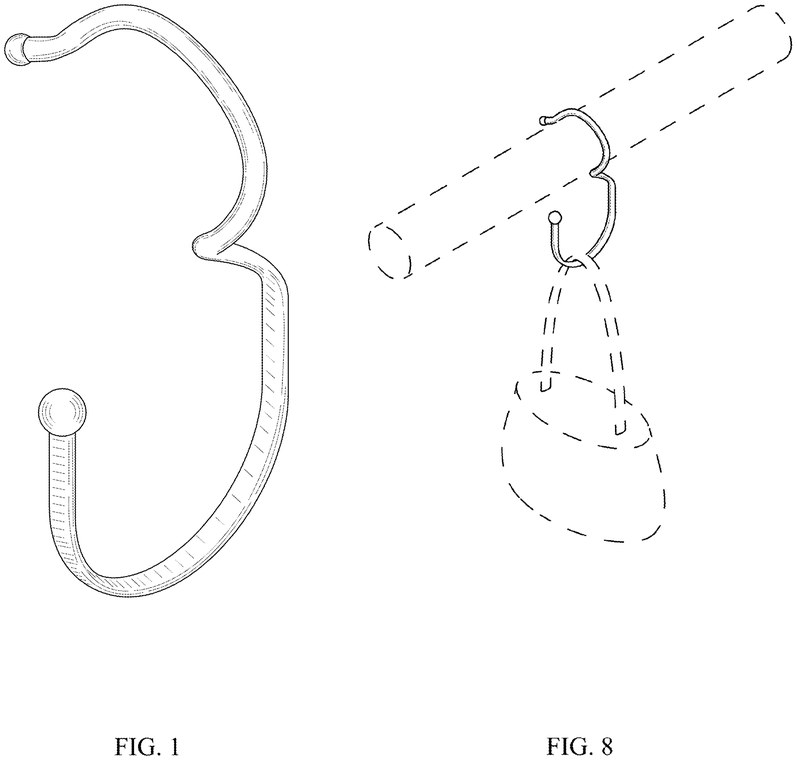 Figs. 1 and 8 of U.S. Design Patent No. D695,526: the claimed handbag hanger hook, and the environmental view showing the rod hook above and the offset purse hook below.


