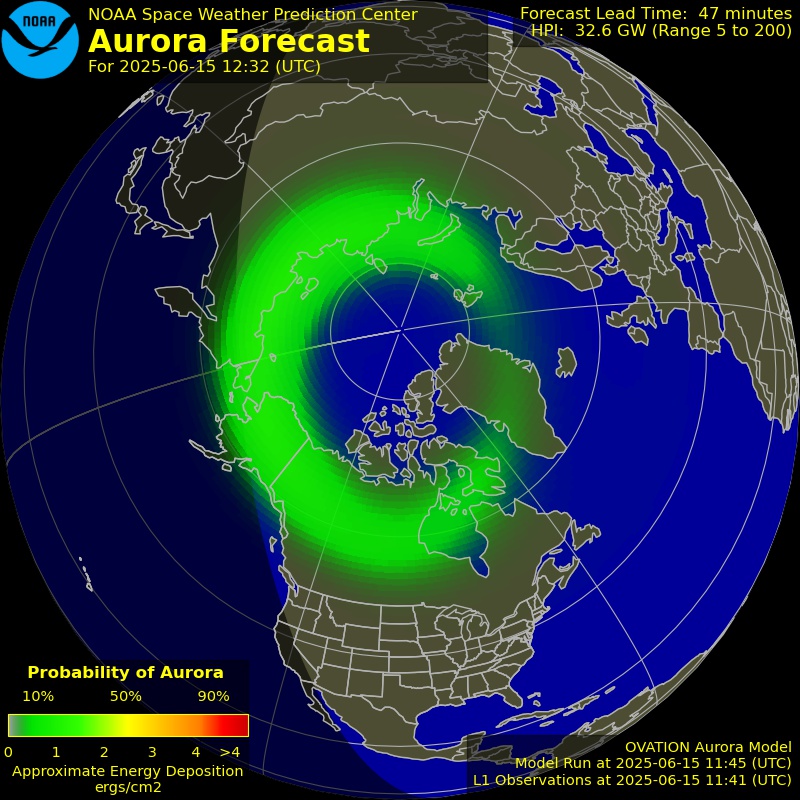
An expected coronal hole stream is now moving past Earth near 600 km/s. The Bz component of the interplanetary magnetic field (IMF) is also currently in a south pointing position and this could help boost aurora activity at higher latitudes in the hours ahead. A minor (G1) geomagnetic storm watch is now in effect.
Solar activity on Friday has been at very low levels with the GOES Solar X-Rays below C-Class range. Two numbered sunspot regions are currently visible in the northeast quadrant, including AR 4564 which showed minor growth today. There is almost no chance for a strong solar flare in the short term. Image by SDO/HMI.
A minor (G1) geomagnetic storm watch remains in effect for the next 24-48 hours when a coronal hole stream is predicted to reach Earth. Aurora sky watchers especially at high latitudes should be alert on Halloween weekend.
23 Years Ago / Great Halloween Storms
October 29, 2026 @ 15:00 UTC
While a minor (G1) geomagnetic storm is forecast for this weekend on Halloween, it will be nothing compared to what occurred 23 years ago this week during the height of Solar Cycle 23. A massive sunspot cluster numbered 486 unleashed several major solar flares, including this X17 explosion on October 28, 2003. This hurled an energetic and fast moving CME that struck Earth`s geomagnetic field less than 24 hours later. This was part of a series of events known as the great Halloween solar storms which included a long lasting extreme (G5) geomagnetic storm and worldwide displays of aurora. On November 4, 2003 while no longer in view off the west limb, 486 produced a historic solar flare that was estimated to measure X28+. Great memories from over two decades ago!
Halloween Geomagnetic Storm Watch
October 29, 2026 @ 00:30 UTC
Coronal hole #07 is now facing Earth and a high speed solar wind stream flowing from this zone is expected to reach our planet by Halloween (Oct 31). A minor (G1) geomagnetic storm watch was officially added for that date. Image below by SDO/AIA using the 193 angstroms channel.
SolarHam.com launched on March 15, 2006 with the purpose of providing real time Space Weather news and data from various sources, all in one location for easy navigation. The site was created and is still maintained solely by amateur (HAM) radio station Kevin VE3EN.
Data Sources
This website relays data and imagery from the following sources.


 1