
Learn more
These promotions will be applied to this item:
Some promotions may be combined; others are not eligible to be combined with other offers. For details, please see the Terms & Conditions associated with these promotions.
Your Memberships & Subscriptions
Download the free Kindle app and start reading Kindle books instantly on your smartphone, tablet, or computer - no Kindle device required.
Read instantly on your browser with Kindle for Web.
Using your mobile phone camera - scan the code below and download the Kindle app.

Follow the author
OK
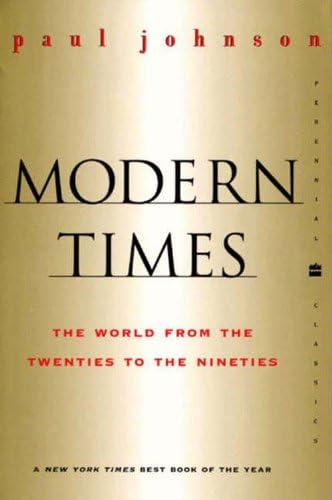
Modern Times Revised Edition: The World from the Twenties to the Nineties – A Monumental Intellectual History Linking Einstein's Relativity to Totalitarian States and other Major Events
The modern world began on May 29, 1919.
In this provocative and sweeping chronicle of 20th century history, acclaimed historian Paul Johnson argues that the confirmation of Einstein’s theory of relativity set in motion a chain of events that replaced moral absolutes with a destructive new era of moral relativism.
This powerful work of intellectual history traces how the ideas of Marx, Freud, and Einstein were tragically twisted into justifications for the terrifying rise of totalitarianism. Johnson uncovers the horrifying consequences of social engineering, from Lenin's and Stalin’s brutal experiments to the collectivist ideologies that swept the globe.
Spanning the decades from the 1920s to the 1990s, Modern Times Revised Edition is a monumental work of modern history that challenges our understanding of a century shaped by gangster-statesmen and secular ideologies.
This monumental work of political and intellectual history offers a stunning re-evaluation of our era, revealing:
- A Relativistic World: How the confirmation of Einstein’s theories in 1919 shattered old certainties and accidentally unleashed an age of moral relativism that shaped the century.
- The First Despotic Utopias: A stunning analysis of Lenin, Mussolini, and the rise of the first “gangster-statesmen” who sought to build heaven on earth through the hell of the police state.
- Legitimacy in Decadence: An examination of the fragile democracies of the 1920s and ’30s, and how their internal weaknesses—and the emergence of Hitler—paved the way for catastrophe.
- Experimenting with Half Mankind: The disastrous consequences of large-scale social engineering, from Stalin’s collectivization to the collectivist ideologies that swept the post-colonial world.
- The Recovery of Freedom: A sweeping account of the post-war world, the failures of the collectivist seventies, and the resurgence of individual liberty in the final decades of the 20th century.
- ISBN-13978-0062010049
- EditionRevised
- PublisherHarper
- Publication dateMay 14, 2010
- LanguageEnglish
- File size1.9 MB
See all supported devices
Kindle E-Readers
- Kindle Scribe Colorsoft (1st Generation)
- Kindle Paperwhite (6th Generation)
- Kindle Scribe (2024 Release)
- Kindle Scribe (3rd Generation)
- Kindle Paperwhite (12th Generation)
- Kindle (7th Generation)
- Kindle Oasis (9th Generation)
- Kindle Oasis (10th Generation)
- Kindle (8th Generation)
- Kindle (11th Generation, 2022 Release)
- Kindle Paperwhite (10th Generation)
- Kindle Colorsoft (1st Generation)
- Kindle Oasis (8th Generation)
- Kindle Voyage (7th Generation)
- Kindle (10th Generation)
- Kindle Paperwhite (7th Generation)
- Kindle Paperwhite (11th Generation)
- Kindle Scribe (1st Generation, 2022 Release)
- Kindle (11th Generation, 2024 Release)
Fire Tablets
- Fire HD 8 (10th Generation)
- Fire 7 (12th Generation)
- Fire 7 (9th Generation)
- Fire HD 10 Plus
- Fire HD 8 (12th Generation)
- Fire HD 8 (8th Generation)
- Fire HD 8 (12th Generation)
- Fire HD 10 (9th Generation)
- Fire HD 8 (12th Generation)
- Fire 10 HD (13th Gen)
- Fire HD 10 (11th Generation)
- Fire Max 11 (13th Generation)
Free Kindle Reading Apps
- Kindle for Android Phones
- Kindle for iPad
- Kindle for Android Tablets
- Kindle for PC
- Kindle for iPhone
- Kindle for Web
- Kindle for Mac
Customers who viewed this item also viewed
Customers also bought or read
- Heroes: From Alexander the Great and Julius Caesar to Churchill and de Gaulle (P.S.)
Kindle Edition$4.99$4.99 - Why the West Rules—for Now: The Patterns of History, and What They Reveal About the Future
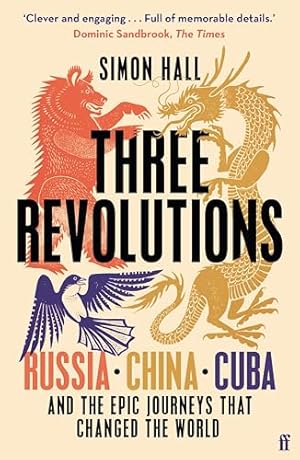
Kindle Edition$14.24$14.24 - Three Revolutions: Russia, China, Cuba and the Epic Journeys that Changed the World
Kindle Edition$17.05$17.05 - Extreme Economies: What Life at the World's Margins Can Teach Us About Our Own Future
Kindle Edition$11.99$11.99 - A World Lit Only by Fire: The Medieval Mind and the Renaissance - Portrait of an Age
Kindle Edition$9.99$9.99
Editorial Reviews
Amazon.com Review
Einstein looms large over Johnson's narrative, as do others who sought to harness the forces of nature and society: men like Mao Zedong, "a big, brutal, earthy and ruthless peasant," and Adolf Hitler, creator of "a brutal, secure, conscience-less, successful, and, for most Germans, popular regime." Johnson takes a contentious conservative viewpoint throughout: he calls the 1960s "America's suicide attempt," deems the Watergate affair "a witch-hunt ... run by liberals in the media," and deems the rise of Margaret Thatcher a critical element in Western civilization's "recovery of freedom"--arguable propositions all, but ones advanced in a stimulating and well-written narrative that provides much food for thought in the course of its more than 800 pages. --Gregory McNamee
Review
"Truly a distinguished work of history...Modern Times unites historical and critical consciousness. It is far from being a simple chronicle, though a vast wealth of events and personages and historical changes fill it....We can take a great deal of intellectual pleasure in this book." -- Robert A. Nisbet,New York Times Book Review
"A work of intellect and imagination." -- Stephen Spender, The Atlantic
"Johnson's insights are often briliant and of value in their startling freshness." -- Peter Loewenberg, Los Angeles Times
"Johnson's insights are often briliant and of value in their startling freshness." -- -- Peter Loewenberg, Los Angeles Times
"A marvelously incisive and synthesizing account." -- -- David Gress, Commentary
"Frequently surprises, even startles us with new views ofd past events and fresh looks at the characters of the chief world movers and shakers, in politics, the military, economics, science, religion, and philosophy of six decades." -- Edmund Fuller, Wall Street Journal
"A marvelously incisive and synthesizing account." -- David Gress, Commentary
"Wide-ranging and quirky, this history of our times (since World War I) hits all the highlights and hot spots: the Russian Revolution, the rise of Hitler, World War II, and the 1980s...A letter-day Mencken, Johnson is witty, gritty, and compulsively readable." -- Foreign Affairs
"A work of intellect and imagination." -- -- Stephen Spender, The Atlantic
From the Back Cover
The classic world history of the events, ideas, and personalities of the twentieth century.
About the Author
Paul Johnson is a historian whose work ranges over the millennia and the whole gamut of human activities. He regularly writes book reviews for several UK magazines and newspapers, such as the Literary Review and The Spectator, and he lectures around the world. He lives in London, England.
Excerpt. © Reprinted by permission. All rights reserved.
Modern Timesrevised Edition
World from the Twenties to the Nineties, theBy Johnson, PaulPerennial
Copyright ©2004 Paul M. JohnsonAll right reserved.
ISBN: 0060935502
Chapter One
A Relativistic World
The modern world began on 29 May 1919 when photographs of a solar eclipse, taken on the island of Principe off West Africa and at Sobral in Brazil, confirmed the truth of a new theory of the universe. It had been apparent for half a century that the Newtonian cosmology, based upon the straight lines of Euclidean geometry and Galileo's notions of absolute time, was in need of serious modification. It had stood for more than two hundred years. It was the framework within which the European Enlightenment, the Industrial Revolution, and the vast expansion of human knowledge, freedom and prosperity which characterized the nineteenth century, had taken place. But increasingly powerful telescopes were revealing anomalies. In particular, the motions of the planet Mercury deviated by forty-three seconds of arc a century from its predictable behaviour under Newtonian laws of physics. Why?
In 1905, a twenty-six-year-old German Jew, Albert Einstein, then working in the Swiss patent office in Berne, had published a paper, "On the electrodynamics of moving bodies", which became known as the Special Theory of Relativity. Einstein's observations on the way in which, in certain circumstances, lengths appeared to contract and clocks to slow down, are analogous to the effects of perspective in painting. In fact the discovery that space and time are relative rather than absolute terms of measurement is comparable, in its effect on our perception of the world, to the first use of perspective in art, which occurred in Greece in the two decades c.500-480 BC.
The originality of Einstein, amounting to a form of genius, and the curious elegance of his lines of argument, which colleagues compared to a kind of art, aroused growing, world-wide interest. In 1907 he published a demonstration that all mass has energy, encapsulated in the equation E = mc2, which a later age saw as the starting point in the race for the A-bomb. Not even the onset of the European war prevented scientists from following his quest for an all-embracing General Theory of Relativity which would cover gravitational fields and provide a comprehensive revision of Newtonian physics. In 1915 news reached London that he had done it. The following spring, as the British were preparing their vast and catastrophic offensive on the Somme, the key paper was smuggled through the Netherlands and reached Cambridge, where it was received by Arthur Eddington, Professor of Astronomy and Secretary of the Royal Astronomical Society.
Eddington publicized Einstein's achievement in a 1918 paper for the Physical Society called "Gravitation and the Principle of Relativity". But it was of the essence of Einstein's methodology that he insisted his equations must be verified by empirical observation and he himself devised three specific tests for this purpose. The key one was that a ray of light just grazing the surface of the sun must be bent by 1.745 seconds of arc -- twice the amount of gravitational deflection provided for by classical Newtonian theory. The experiment involved photographing a solar eclipse. The next was due on 29 May 1919. Before the end of the war, the Astronomer Royal, Sir Frank Dyson, had secured from a harassed government the promise of 1,000 to finance an expedition to take observations from Principe and Sobral.
Early in March 1919, the evening before the expedition sailed, the astronomers talked late into the night in Dyson's study at the Royal Observatory, Greenwich, designed by Wren in 1675-6, while Newton was still working on his general theory of gravitation. E.T. Cottingham, Eddington's assistant, who was to accompany him, asked the awful question: what would happen if measurement of the eclipse photographs showed not Newton's, nor Einstein's, but twice Einstein's deflection? Dyson said, "Then Eddington will go mad and you will have to come home alone." Eddington's notebook records that on the morning of 29 May there was a tremendous thunderstorm in Principe. The clouds cleared just in time for the eclipse at 1.30 pm. Eddington had only eight minutes in which to operate. "I did not see the eclipse, being too busy changing plates...We took sixteen photographs." Thereafter, for six nights he developed the plates at the rate of two a night. On the evening of 3 June, having spent the whole day measuring the developed prints, he turned to his colleague, "Cottingham, you won't have to go home alone." Einstein had been right.
The expedition satisfied two of Einstein's tests, which were reconfirmed by W.W. Campbell during the September 1922 eclipse. It was a measure of Einstein's scientific rigour that he refused to accept that his own theory was valid until the third test (the "red shift") was met. "If it were proved that this effect does not exist in nature", he wrote to Eddington on 15 December 1919, "then the whole theory would have to be abandoned". In fact the "red shift" was confirmed by the Mount Wilson observatory in 1923, and thereafter empirical proof of relativity theory accumulated steadily, one of the most striking instances being the gravitational lensing system of quasars, identified in 1979-80. At the time, Einstein's professional heroism did not go unappreciated. To the young philosopher Karl Popper and his friends at Vienna University, "it was a great experience for us, and one which had a lasting influence on my intellectual development". "What impressed me most", Popper wrote later, "was Einstein's own clear statement that he would regard his theory as untenable if it should fail in certain tests.... Here was an attitude utterly different from the dogmatism of Marx, Freud, Adler and even more so that of their followers. Einstein was looking for crucial experiments whose agreement with his predictions would by no means establish his theory; while a disagreement, as he was the first to stress, would show his theory to be untenable. This, I felt, was the true scientific attitude..."
Continues...Excerpted from Modern Timesrevised Editionby Johnson, Paul Copyright ©2004 by Paul M. Johnson. Excerpted by permission.
All rights reserved. No part of this excerpt may be reproduced or reprinted without permission in writing from the publisher.
Excerpts are provided by Dial-A-Book Inc. solely for the personal use of visitors to this web site.
Product details
- ASIN : B003JBI3AG
- Publisher : Harper
- Accessibility : Learn more
- Publication date : May 14, 2010
- Edition : Revised
- Language : English
- File size : 1.9 MB
- Screen Reader : Supported
- Enhanced typesetting : Enabled
- X-Ray : Not Enabled
- Word Wise : Enabled
- Print length : 1407 pages
- ISBN-13 : 978-0062010049
- Page Flip : Enabled
- Best Sellers Rank: #172,453 in Kindle Store (See Top 100 in Kindle Store)
- Customer Reviews:
About the author

Beginning with Modern Times (1985), Paul Johnson's books are acknowledged masterpieces of historical analysis. He is a regular columnist for Forbes and The Spectator, and his work has also appeared in The New York Times, The Wall Street Journal, and many other publications.
Customer reviews
Customer Reviews, including Product Star Ratings help customers to learn more about the product and decide whether it is the right product for them.
To calculate the overall star rating and percentage breakdown by star, we don’t use a simple average. Instead, our system considers things like how recent a review is and if the reviewer bought the item on Amazon. It also analyzed reviews to verify trustworthiness.
Learn more how customers reviews work on AmazonCustomers say
Generated from the text of customer reviewsSelect to learn more
Top reviews from the United States
- 5 out of 5 stars
Clarifying Major Events of the 20th Century
Reviewed in the United States on October 10, 2004Modern Time, a work of astounding breadth and clarity, identifies three seminal intellectuals at the beginning of the twentieth century-Marx, Freud, and Einstein-whose ideas directly and indirectly lead to communism, totalitarianism, and Nazism, three forms of government that rejected personal responsibility and the Judeo-Christian morality of the West. Marx said, according to Johnson, that society shaped people. Freud said our childhood shaped us. Finally, numerous intellectuals used Einstein's theory of relativity, much to Einstein's chagrin, to diminish the achievements of Western Civilization before the twentieth century and to advocate moral relativism as a new pseudo religion. Johnson then shows how this line of thinking lead to the death, enslavement, and impoverishment of billions of people across the world.
The book covers not just the superpowers but the explosion of the third world, with its copycat Hitlers, Stalins, and Maos. Most enlightening of all, the phalanx of intellectuals the wealth of the West made possible actually aided and abetted the corruption of the Soviet Union, Red China, fascist Germany, and all their dreadful imitators (for additional insight on terrible consequence of intellectuals, see Johnson's book, The Intellectuals). Worse, this scourge of our times has attacked every institution that lead the West to rule the world, from Christianity, to free enterprise, to democracy.
While Johnson finished the book more than a decade ago, his insights clarify the world today, from the chaos of the Middle East to never-ending butchery in Africa and juntas of the Western Hemisphere. Unlike far too many modern historians (who all too often merely illustrate Johnson's theme), Johnson makes bold and accurate declarations time and again and provides an avalanche of facts to make his case.
41 people found this helpfulSending feedback...Sending feedback...HelpfulThank you for your feedback.Sorry, we failed to record your vote. Please try againThanks, we'll investigate in the next few days.Sorry, We failed to report this review. Please try again - 5 out of 5 stars
It takes courage
Reviewed in the United States on July 17, 2015If this were the work of an entire lifetime - the culmination of decades of research - I could understand how one man could do it. But this is just one of his many books. I cannot imagine how he did anything but keep his nose in research books for all this time. Simply amazing. We all knew the general outline of the deeds of such figures (don't want to call them men) as Hitler, Lenin, Stalin, Mao, and the scores of other figures with lesser range did, but to read the details that Johnson provides is as if to have it told us for the first time. Simply amazing.
Some reviewers here and there condemn this writer with their own little version of hatred for the dissemination of these facts and patterns, but I cannot imagine that they actually read the book: are they claiming that these events did not occur? Are they insinuating that Mr. Johnson made them up? One reviewer said he did not mention women or the women's movement and I can only conclude that she did not read the last (long) chapter.
Mr. Johnson does not recount the deeds of big government and simply sit in judgement with a "bad bad bad"; he just recounts the deeds in terms of deaths, imprisonment, and torture. He then "lifts" the historic figures "up" to reveal the similarities among them and also describes the unique shadow each casts upon the term DICTATOR. He leaves the reader to come to his or her own moral conclusions. If you like dictators, you will not like this book.
His critics will be those who still are in favor of big government solutions. They will not have been able to get through the book - they will throw it against the wall. They will continue to "do" history and "do" politics this way: "Wouldn't it be nice if ...." and "Hey, what if we tried to be nice?" Big government is a wish, a hope.
Freedom takes courage, and courage has its source in the individual heart.
It is wonderful to learn that Mr. Johnson is still alive and smiling (WSJ interview from 2011).
21 people found this helpfulSending feedback...Sending feedback...HelpfulThank you for your feedback.Sorry, we failed to record your vote. Please try againThanks, we'll investigate in the next few days.Sorry, We failed to report this review. Please try again - 5 out of 5 stars
Excellent Look at Moral Relativity and Failures of Every Utopia in the 20th Century
Reviewed in the United States on November 29, 2022Every now and then you read a book that changes you. Johnson's ability to frame events, present facts, and tell the story are first rate. Many of the events are well known to me, but lacked the greater, high-level context Johnson puts forth. I was hooked from the very start.
You would think this book would start with WWI. No, he starts with Albert Einstein. He refers to relativity throughout the book. Johnson casts a wide web that shows time and again every utopian experiment in the 20th century ended tragically. The connecting web for all of them is collectivism and concentrated power in the hands of the economic, political, cultural, and military managers, often consolidated into a central manager.
I highly recommend this book. It should shake your world view.
16 people found this helpfulSending feedback...Sending feedback...HelpfulThank you for your feedback.Sorry, we failed to record your vote. Please try againThanks, we'll investigate in the next few days.Sorry, We failed to report this review. Please try again - 4 out of 5 stars
Unabashedly Ideological
Reviewed in the United States on May 23, 2013While working at a public high school in New Jersey I observed a rather interesting pedagogical practice. It looked a little something like this: a band of students acting as undercover ambassadors of their history class would approach an unsuspecting non-history teacher with a historical or geographical trivia question. If the stunned teacher could not, say, identify a particular world destination on a blank map, or name a particular African dictator responsible for such and such event, the students would then report this failure back to their history class, sneering all the way at the ignorance of that unfortunate teacher, who was then labeled by the history class as being representative of a larger pattern of ignorance within our culture.
I'm not here to debate the merits of this type of assignment (although, someone should point out to the annoyingly arrogant students that the only reason why they know the answer is because their history teacher just talked about it last period...). I simply wish to share that the knowledge that, at any time, these students could be on the prowl struck a chord of fear in my heart. Commanding proper attention and authority as a young, female teacher is hard enough as it is; the last thing I need is to not be able to point out the Republic of Djibouti on a blank map in front of my entire class.
I've always been a bit insecure about my flimsy knowledge of historical and world happenings. The last time I took a proper world history class, I was a sophomore in high school. And, it was taught by the high school football coach, whose favorite technique was to distribute pastel colored worksheets, which we were then told to complete on our own. Needless to say, not a whole lot stuck. I can't blame all my ignorance on Coach Small, though. If I had spent my college summer vacations reading about history instead of playing countless hours of Tropico, I would be a much better person today.
Reading Modern Times by Paul Johnson constituted an attempt to better my historically-challenged self. This is not a people's history, nor does it focus in depth on any one particular person or event. Rather, it's the story of the 20th's century's world leaders, the various ideologies they represented and the bloodshed that resulted when utopian visions inevitably imploded. Johnson seems to be particularly fascinated by the 20th century's unique propensity for producing charismatic revolutionaries, visionaries and messiahs whose often whimsical and ill-conceived decisions tragically influenced the lives of millions of people. The law of unintended consequences is a key theme in this book.
One characteristic of Modern Times that I appreciated is that Johnson doesn't claim he's done the impossible task of presenting the cold facts of history in an objective manner, completely free from bias. Rather, he unabashedly analyzes history, massaging the landscape of the 20th century into a narrative arc, replete with characters, themes and tragedies. His basic premise, which drives his analysis, is that Nietzsche's prediction for the 20th came true, that at the dawn of modern times "the belief in the Christian God would no longer be tenable." The vacuum left behind by God's absence inevitably needed to be filled. Johnson goes on to argue, "Nietzsche rightly perceived that the most likely candidate would be what he called the 'Will to Power,' which offered a more comprehensive and in the end more plausible explanation of human behavior than either Marx or Freud. In place of religious belief there would be secular ideology. Those who had once filled the ranks of the totalitarian clergy would become totalitarian politicians. And, above all, the Will to Power would produce a new kind of messiah, uninhibited by any religious sanctions whatever, and with an unappeasable appetite for controlling mankind. The end of the old order, with an unguided world adrift in a relativistic universe, was a summons to such gangster statesmen to emerge. They were not slow to make their appearance" (48).
The fact that a traditional Judeo-Christian worldview undergirds Johnson's argument might not sit well with some readers who disagree with his presuppositions (namely, that a moral fabric is woven into the universe and that man, despite his best efforts and often good intentions, is inherently weak and easily corruptible, which is why attempts at social engineering are doomed to fail). But to those who are open to Johnson's particular angle, Modern Times will prove to be an informative and enlightening read. If I had to take a multiple choice test on it right now, I would likely score no better than a 9%, and I probably still can't find the Republic of Djibouti on a map. So, you might be wondering why I devoted four months of my life to reading this long, boring book. What I can say is that the impoverished picture of the 20th century that I had in my mind prior reading this book has now been edified and enriched, and most importantly, it gave me a solid foundation onto which I will hopefully build.
116 people found this helpfulSending feedback...Sending feedback...HelpfulThank you for your feedback.Sorry, we failed to record your vote. Please try againThanks, we'll investigate in the next few days.Sorry, We failed to report this review. Please try again - 5 out of 5 stars
20th Century History as I've never read it...
Reviewed in the United States on November 1, 2017First, my main criticism...actually, my only criticism. Only twenty chapters in a book of 784 pages of text makes this a difficult book to work through. (In addition to 66 pages of notes and 29 of index.) Chapters of thirty and forty pages without even page breaks on a topic as complex as world politics gets mighty tedious and confusing at times. I can't even count the number of times I started into a new paragraph, and then after a few sentences had to return to the previous paragraph trying to figure out what I missed. The topics change that fast, and that completely. One second we are talking about something or someone in one part of the world, and the next sentence we are on to a new locale and cast of characters entirely.
For this I fault the publisher and not the author. I don't care if the author submitted this work with NO chapters, it is the publisher's responsibility to organize it in a digestible fashion. These twenty chapters should have been UNITS, each divided into at least five or six chapters. As a reader, I like to thumb ahead a few pages to see if I'm close to the end of a chapter or at least near a page break, and as such will continue on so as to complete the train of thought. With this book, that is impossible.
That said, the actual history as written by Paul Johnson is simply stunning in it's detail of not only events and characters, but also the personalities and intricacies of said events and characters. And the writing itself is perfectly comprehensible. As a history buff, I had taken so many History electives in college that I inadvertently ended up with a minor. And yet, so much of what Johnson has written is absolutely news to me. I was continually amazed by how little I actually knew about some of the major historical events of the last century and in particular, the cast of characters responsible. Unfortunately, the RE-writing of history by academics bears a great deal of the blame. Or, as in the case of the legacy media today, much of it was simply never discussed or reported on, effectively sweeping huge swaths of it under the rug.
If this book was a bit more user-friendly logistically, this should be required course material in every college and university in this country, if not the world.
104 people found this helpfulSending feedback...Sending feedback...HelpfulThank you for your feedback.Sorry, we failed to record your vote. Please try againThanks, we'll investigate in the next few days.Sorry, We failed to report this review. Please try again - 5 out of 5 stars
An Unparalleled History of the Entire 20th Century
Reviewed in the United States on January 13, 2022This is one of the most profound and dense books I have ever read. Anyone that has read Paul Johnson knows that he has a very complex stream of conciseness style of writing. It is a very dense, heavy, and fast paced read that requires a lot of focus. The amount of information being conveyed to the reader is staggering. I saw one Amazon review by Leib Gershon Mitchell that said “The amount of information is like trying to drink water through a fire hose”, which I found hilarious and spot on. Also, like most other reviewers, I have to mentioned that the editorial job of this book could have been better by creating more breaks within the chapters - there are none and each chapter is 25-40 pages long. Johnson, switches gears very quickly and will sometimes have you wondering why he didn’t address a certain issue or topic, only to lead up to it in a very clever roundabout way - almost as if he has a complete birds-eye-view type mastery of the information he wants to convey from start to finish, and what directions or paths he would like to choose to get there. The title of this book is a little misleading because it pretty much starts at the very beginning of the 20th century, while frequently referencing the 19th century to bring some context into the events occurring at the onset of the 20th century, and then goes into great depth with the events of WW1 and the Bolshevik Revolution. Anyone who wants an excellent uncensored history of the 20th century (and some 19th century) that you won’t get from the legacy media or much of academia, look no further than “Modern Times”.
31 people found this helpfulSending feedback...Sending feedback...HelpfulThank you for your feedback.Sorry, we failed to record your vote. Please try againThanks, we'll investigate in the next few days.Sorry, We failed to report this review. Please try again - 5 out of 5 stars
Americans need to read this book.
Reviewed in the United States on August 5, 2013Johnson makes the history of the 20th century not only readable, but exciting. Frequently, I found it to be as much of a page-turner as good fiction. Johnson makes sense of a time that was confusing even to those of us who lived through part of it. It is not always immediately clear what is happening in world events because of the bias of the reporting and the limited information that is available at the time. With time, more information comes to light and what happened can be analyzed without the emotion of the moment. Some of the reviews that discredit Johnson's history as a conservative view fail to take into account how skewed the reporting at the time was and how limited or one sided the information was. Between the two world wars, there was a general moment of the American and European intelligentsia away from capitalism and toward socialism, government planning, and social engineering. Because of the the depression, it was easy to convince people that capitalism had failed and the new Russian plan lead by Stalin was the way of the future. Unfortunately, few Americans knew of the horrors taking place inside Russian since information was so tightly controlled. It wasn't until generations later that even part of the truth became known. Since this isn't generally taught, it is easy to see why many people would have a hard time accepting these revelations. However you decide, its very thought provoking to see history from a different perspective.
I highly recommend this book to everyone who loves history or just wants to make better sense of what is happening in the world today.
44 people found this helpfulSending feedback...Sending feedback...HelpfulThank you for your feedback.Sorry, we failed to record your vote. Please try againThanks, we'll investigate in the next few days.Sorry, We failed to report this review. Please try again - 5 out of 5 stars
WOnderfully Written and In-Depth; No Wondewr it was a NY Times Book of the Year!
Reviewed in the United States on March 12, 2023This 784 page book reads very well and is an in-depth History of what went on from the End of WWI through the End of the Cold War (in the Early 1990s). This covers most of the leading nations of the World, including the US, the UK, Russia, China, Japan, Germany and pre-WWII Italy. Even the post colonial Emerging World receives a strong focus as the Century proceeds.
4 people found this helpfulSending feedback...Sending feedback...HelpfulThank you for your feedback.Sorry, we failed to record your vote. Please try againThanks, we'll investigate in the next few days.Sorry, We failed to report this review. Please try again
Top reviews from other countries
Samuel Leal5 out of 5 starsUm inglês de excelente escrita e um estilo literário cativante.
Reviewed in Brazil on May 25, 2022As únicas críticas cabíveis são as dimensões do livro. Por conter quase 850 páginas em uma edição pequena as letras são pequenas também o que pode incomodar alguns leitores.
5 out of 5 starsUm inglês de excelente escrita e um estilo literário cativante.
Reviewed in Brazil on May 25, 2022As únicas críticas cabíveis são as dimensões do livro. Por conter quase 850 páginas em uma edição pequena as letras são pequenas também o que pode incomodar alguns leitores.
Sending feedback...Thanks, we'll investigate in the next few days.Sorry, We failed to report this review. Please try again
Amazon Customer5 out of 5 starsSuper book, super writing by the Journalist-Historian of the Century
Reviewed in the United Kingdom on April 14, 2014Paul Johnson is a talented writer and pens his books in a style and format that crosses the boundary between History and Journalism. The effect is to bring history alive for the masses and for those who might normally dismiss history as dull
Even those who are not interested in history will enjoy this book.The massive scope of this work is impressive.
This book would be great for anyone who desires to spark the interest of history in those who have no desire to study it....(i.e., history teachers and their bored students)
Paul Johnson combines two qualities hard to find in today's historical works - readability and a theocentric world view. He challenges the reader to interpret the facts honestly, abandoning past stereotypes and biases. A fascinating overview of our century. I hope it's updated for the rest of the 1990's. A must read for anyone with an interest in modern history. Secular humanists may not like some of Johnson's conclusions.
Sending feedback...Thanks, we'll investigate in the next few days.Sorry, We failed to report this review. Please try again
Joseph Myren5 out of 5 starsAWESOME
Reviewed in Canada on April 26, 2025AWESOME
Sending feedback...Thanks, we'll investigate in the next few days.Sorry, We failed to report this review. Please try again
F. Olufe5 out of 5 stars... old as the hills than neighter spends time nor waste it' - How one feels after reading a beautiful ...
Reviewed in the United Kingdom on April 9, 2017'We are as old as the hills than neighter spends time nor waste it' - How one feels after reading a beautiful and well informed book such as this.
Sending feedback...Thanks, we'll investigate in the next few days.Sorry, We failed to report this review. Please try again
penelope5 out of 5 starsbrilliant!
Reviewed in Canada on September 23, 2019very dense read - wonderful!
Sending feedback...Thanks, we'll investigate in the next few days.Sorry, We failed to report this review. Please try again