Buy New
-47%
$9.99$9.99
FREE delivery Sunday, May 3 on orders shipped by Amazon over $35
Ships from: Amazon.com Sold by: Amazon.com
Used - Good
$6.63$6.63
FREE delivery May 6 - 8
Ships from: ThriftBooks-Baltimore Sold by: ThriftBooks-Baltimore
Sorry, there was a problem.
There was an error retrieving your Wish Lists. Please try again.Sorry, there was a problem.
List unavailable.
Download the free Kindle app and start reading Kindle books instantly on your smartphone, tablet, or computer - no Kindle device required.
Read instantly on your browser with Kindle for Web.
Using your mobile phone camera - scan the code below and download the Kindle app.
Follow the author
OK
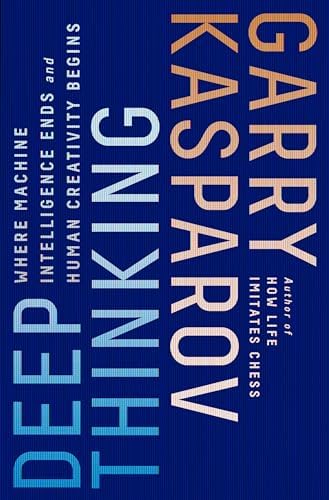
Deep Thinking: Where Machine Intelligence Ends and Human Creativity Begins Paperback – May 8, 2018
Purchase options and add-ons
That moment was more than a century in the making, and in this breakthrough book, Kasparov reveals his astonishing side of the story for the first time. He describes how it felt to strategize against an implacable, untiring opponent with the whole world watching, and recounts the history of machine intelligence through the microcosm of chess, considered by generations of scientific pioneers to be a key to unlocking the secrets of human and machine cognition. Kasparov uses his unrivaled experience to look into the future of intelligent machines and sees it bright with possibility. As many critics decry artificial intelligence as a menace, particularly to human jobs, Kasparov shows how humanity can rise to new heights with the help of our most extraordinary creations, rather than fear them. Deep Thinking is a tightly argued case for technological progress, from the man who stood at its precipice with his own career at stake.
- Print length304 pages
- LanguageEnglish
- Publication dateMay 8, 2018
- Dimensions5.5 x 0.75 x 8.25 inches
- ISBN-101541773640
- ISBN-13978-1541773646
Frequently bought together

Customers who viewed this item also viewed

Winter Is Coming: Why Vladimir Putin and the Enemies of the Free World Must Be StoppedPaperbackFREE Shipping on orders over $35 shipped by AmazonGet it as soon as Sunday, May 3Only 2 left in stock - order soon.
Behind Deep Blue: Building the Computer That Defeated the World Chess ChampionPaperbackFREE Shipping on orders over $35 shipped by AmazonGet it as soon as Sunday, May 3Only 3 left in stock (more on the way).
Deep Work: Rules for Focused Success in a Distracted WorldHardcoverFREE Shipping on orders over $35 shipped by AmazonGet it as soon as Sunday, May 3
Co-Intelligence: Living and Working with AIHardcoverFREE Shipping on orders over $35 shipped by AmazonGet it as soon as Sunday, May 3
Chess: 5334 Problems, Combinations and GamesPaperbackFREE Shipping on orders over $35 shipped by AmazonGet it as soon as Sunday, May 3
Customers also bought or read
- Behind Deep Blue: Building the Computer That Defeated the World Chess Champion
Paperback$14.46$14.46Delivery Sun, May 3 - Kasparov and Deep Blue: The Historic Chess Match Between Man and Machine
Paperback$11.51$11.51FREE delivery Tue, May 5 - The Most Instructive Games of Chess Ever Played: 62 Masterpieces of Chess Strategy
Paperback$14.63$14.63Delivery Sun, May 3 - Rebel Queen: The Cold War, Misogyny, and the Making of a Grandmaster
Hardcover$15.62$15.62Delivery Sun, May 3 - Complete Book of Chess Strategy: Grandmaster Techniques from A to Z
Paperback$17.12$17.12Delivery Mon, May 4 - The Infinity Machine: Demis Hassabis, DeepMind, and the Quest for Superintelligence#1 Best SellerComputers & Technology Industry
Hardcover$29.82$29.82Delivery Sun, May 3 - Superintelligence: Paths, Dangers, Strategies#1 Best SellerArtificial Intelligence
Paperback$17.69$17.69Delivery Sun, May 3 - The Innovators: How a Group of Hackers, Geniuses, and Geeks Created the Digital Revolution
Paperback$12.49$12.49Delivery Sun, May 3 - Perpetual Chess Improvement: Practical Chess Advice from World-Class Players and Dedicated Amateurs
Paperback$17.02$17.02Delivery Sun, May 3 - The Emperor's New Mind: Concerning Computers, Minds, and the Laws of Physics (Oxford Landmark Science)
Paperback$21.99$21.99Delivery May 7 - 11 - Genius Makers: The Mavericks Who Brought AI to Google, Facebook, and the World
Paperback$17.85$17.85Delivery Sun, May 3
Editorial Reviews
Review
"Garry Kasparov's perspectives on artificial intelligence are borne of personal experience - and despite that, are optimistic, wise and compelling. It's one thing for the giants of Silicon Valley to tell us our future is bright; it is another thing to hear it from the man who squared off with the world's most powerful computer, with the whole world watching, and his very identity at stake."―p.p1 {margin: 0.0px 0.0px 0.0px 0.0px; font: 11.0px Calibri}span.s1 {font-kerning: none}Charles Duhigg, bestselling author of Smarter Faster Better
"From the man at the epi-center of one the ten defining moments of the 20th century, a fascinating and insightful overview of how computers came to surpass humans at chess, and what it means for mankind. Deeply research and clearly exposited, it is also a revealing portrait of what it is like to a real-life John Henry pitted against the steam hammer."―Ken Rogoff, bestselling author of This Time is Different
"A highly human exploration of artificial intelligence, its exciting possibilities and inherent limits."
―Max Levchin, cofounder of PayPal, CEO of Affirm, and Silicon Valley angel investor
"Intelligent, absorbing...Thoughtful reading for anyone interested in human and machine cognition and a must for chess fans."―Kirkus Reviews, starred review
"As Kasparov recounts in arresting detail what it felt like to compete cognitively with a machine, he extrapolates his experience into an optimistic perspective on how computerized intelligence can enhance rather than overwhelm human brainpower, and instead of only eliminating jobs and opportunities, can actually generate them."
―Booklist
"Kasparov includes enough detail to satisfy chess enthusiasts, while providing a thrilling narrative for the casual reader. Deep Thinking delivers a rare balance of analysis and narrative, weaving commentary about technological progress with an inside look at one of the most important chess matches ever played."―Demis Hassabis, Nature
"The raw emotion of [the loss to Deep Blue] bursts out of the pages of Kasparov's gripping story, which he fully recounts for the first time in Deep Thinking... What is striking, and reassuring, is that far from raging against the machine, Kasparov marvels at the capabilities of computers and is excited by the possibilities for future collaboration...reads at times like a fast-paced psychological thriller."―John Thornhill, Financial Times
"Deep Thinking is like Kasparov himself: fascinating, razor-sharp, and provocative. In it he finally tells us, twenty years later, what he's learned from participating in the most famous human vs. machine competition since John Henry. The answer is a huge amount, which is also what you'll learn from reading Deep Thinking."―Andrew McAfee, principal research scientist at MIT and coauthor of The Second Machine Age
"Garry Kasparov has been a true pioneer in both the theory and practice of human-machine intelligence. Deep Thinking encompasses his wisdom in these areas in a highly entertaining and informative manner. I couldn't put it down, and don't think you will be able to either."―Tyler Cowen, author of The Great Stagnation
"Few people have a more interesting or illuminating perspective than Garry Kasparov. Deep Thinking is a provocative and fascinating read that will challenge the conventional wisdom about our future."―Bill McDermott, CEO of SAP
About the Author
Mig Greengard is Spokesman and Senior Advisor to Garry Kasparov.
Product details
- Publisher : PublicAffairs
- Publication date : May 8, 2018
- Edition : Reprint
- Language : English
- Print length : 304 pages
- ISBN-10 : 1541773640
- ISBN-13 : 978-1541773646
- Item Weight : 9.6 ounces
- Dimensions : 5.5 x 0.75 x 8.25 inches
- Best Sellers Rank: #124,083 in Books (See Top 100 in Books)
- #54 in Chess (Books)
- #198 in Artificial Intelligence & Semantics
- #3,588 in Memoirs (Books)
- Customer Reviews:
About the author

Garry Kasparov grew up in Baku, Azerbaijan (USSR) and became the youngest ever world chess champion in 1985 at the age of 22. He held that title until 2000. He retired from professional chess in March 2005 to found the United Civil Front in Russia, and has dedicated himself to establishing free and fair elections in his homeland. A longtime contributing editor at The Wall Street Journal, Kasparov travels around the world to address corporations and business audiences on strategy and leadership, and he appears frequently in the international media to talk about both chess and politics. When not traveling he divides his time between Moscow and St. Petersburg.
Customer reviews
Customer Reviews, including Product Star Ratings help customers to learn more about the product and decide whether it is the right product for them.
To calculate the overall star rating and percentage breakdown by star, we don’t use a simple average. Instead, our system considers things like how recent a review is and if the reviewer bought the item on Amazon. It also analyzed reviews to verify trustworthiness.
Learn more how customers reviews work on AmazonCustomers say
Generated from the text of customer reviewsSelect to learn more
Reviews with images
Garry Kasparov – Deep Thinking | Review
Top reviews from the United States
There was a problem filtering reviews. Please reload the page.
- Reviewed in the United States on May 30, 2024Format: PaperbackVerified PurchaseAs a chess player (not a great one), I read with interest this book, which covers not only the computer chess revolution, but recent tech updates including AI and computer learning. Kasparov writes eloquently about the subject, and certainly researched the material in depth, which he combined with his personal competition against machines in the world of competitive chess. The author's strong personality definitely comes through in his writing, and that can either be an enhancement or a slight turnoff. Either way, you are guaranteed to learn a great deal on the variety of subjects covered. Recommended.

- Reviewed in the United States on June 29, 2017Format: HardcoverVerified PurchaseDeep Thinking is Kasparov's story of his match against Deep Blue and the evolution of playing against chess programs. The book tries to touch on the penetration of AI in society today and the author brings his perspective on the benefits of technology to today's world. This book is largely about the author's experience of the improvements in chess programming, how he faced it psychologically and how he prepared for games in this new era. Much of the book is the author detailing his thought process through these headline matches and his narrative on his behavior and the process broadly. If one has followed the career of Kasparov, this book will be very informative. If one is looking for a book on AI in chess programming, it isn't really about that.
The author starts with two goals, to discuss the growth of AI and use of computers in today's society and what it should mean for people given his experience in a job which was directly impacted by it as well as to give an account of the matches he endured against deep blue. The author starts by discussing early AI, the coverage is definitely not comprehensive but it gives the reader a good sense of how computation evolved and early ideas on AI and how to program it. The author discusses early pioneers in computer science and how some viewed chess as an admirable AI project given its complexity. Kasparov gives you a sense of the early computer days and the ideas used to program chess. In particular the easiest and easiest idea was to define an objective function for the computer to maximize in its search that valued chess pieces accurately. The author also discusses how databases were then added so that computers could improve efficiency by looking up positions from these databases. The author spends time on people and pattern recognition and how the mind works. The author's views on the technical subjects are well informed but not the focus. The author then gets into the detailing of his games against deep blue and the developers at IBM. He discusses both matches in great depth and discusses the commentary. It is interesting but probably more interesting to those who followed closely the matches and recall the atmosphere at the time. The author discusses how he focused on avoiding tactical positions where a computer would always be more effective and instead focus on strategic goals which were far harder for a computer to be able to capture in an objective function. One gets a better sense of high level chess and how a world champion thinks. The match against Deep Blue where Kasparov lost is the biggest focus and he discusses various moves and his strategy as well as his thinking on positions which were supposed turning points. Again if one had followed the match I suspect this resonates more but it is entertaining for those who did not. The author then discusses how chess is learned today and the broad use of computers in learning and strategy development. It discusses how computers can aid our development but can also be used as too much of a crutch.
All in all Deep Thinking was an entertaining read. It is definitely more for the chess aficionado than those interested in AI. I also think reading the book gets the reader more interested in chess so that also might be a good reason to read it. The techno optimism part of the book is well reasoned but definitely there is far better material out there on how to think about technology and its impact on the future than a book on how a professional chess player was impacted by it but it is a valuable perspective nonetheless. Entertaining if one has the time.
- Reviewed in the United States on June 22, 2024Enjoyed the perspective from someone who has been a user and receiver of AI capability for more years than many have been alive. A unique view.
- Reviewed in the United States on July 13, 2025Format: HardcoverVerified PurchaseReading this lifts one from the muck of common thinking. Very cleansing in all positive ways. A great gift for us all, thank you.
- Reviewed in the United States on May 28, 2018Format: HardcoverVerified PurchaseThis book was recommended by a work colleague. It sounded like an interesting title and loosely relevant to the A.I. project we were performing. After three weeks, we both admitted that neither of us could get through it. The writing style is painfully repetitive and mostly Kasparov boasting how smart he is, even when he would lose to a computer. I am still only 1/2 done and struggle to read just one more page. 3 stars is generous.
- Reviewed in the United States on June 29, 2017Format: KindleVerified PurchaseI got this book because I am big fan of Kasparov and thought it might be interesting to see his take on artificial intelligence. I was pleasantly surprised by his writing and storytelling abilities. I guess I just assumed that 3/4 of his brain was dedicated solely to chess, but he is really well rounded. There is a large section of the book detailing his side of the story against Deep Blue which is fascinating and illuminating. I highly recommend this book!
- Reviewed in the United States on July 15, 2017This is what Garry Kasparov has to tell in his new book, "Deep Thinking, where machine intelligence ends and human creativity begins".
Garry Kasparov is a Russian born chess world champion and maybe the best grand master in history. After living in the soviet Azerbaijan he and his family escaped during the collapse of the Soviet Union. A democratic leader and opponent to the Putin regime he had to move to the US in 2013. He is the chairman of the Human Rights Foundation and has worked in defense of human rights and freedom for a long time.
This combination of chess master, computer geek and freedom lover permeates in his new book. He is a believer in the potential of humanity under a free systems despite its natural paradoxes.
"Even the most disciplined human mind wanders in the heat of competition. This is both a weakness and a strength of human cognition. Sometimes these undisciplined wanderings only weaken your analysis. Other times they lead to inspiration, to beautiful or paradoxical moves that were not on your initial list of candidates."
In Deep Thinking, Kasparov narrates his experience loosing against Deep Blue, IBM's supercomputer in a chess match in 1997. When a computer beat the world chess champion it became a tipping point for media and the public in the race of machine against humans. Beyond a historic recollection of the events and some inside details that were not made public back then, Kasparov's book is a call for hope. Having experienced in person the overwhelming brute power of a computer he is not naïve in being optimist.
"Few people in the world know better than I do what it’s like to have your life’s work threatened by a machine. No one was sure what would happen if and when a chess machine beat the world champion."
The main thesis of Kasparov is that we can't know what is going to happen in the future but we should start from accepting that progress is unstoppable and desirable, therefore we shouldn't pretend to defend ourselves by holding it back.
"We don’t get to pick and choose when technological progress stops, or where. Companies are globalized and labor is becoming nearly as fluid as capital. People whose jobs are on the chopping block of automation are afraid that the current wave of tech will impoverish them, but they also depend on the next wave of technology to generate the economic growth that is the only way to create sustainable new jobs. Even if it were possible to mandate slowing down the development and implementation of intelligent machines (how?), it would only ease the pain for a few for a little while and make the situations worse for everyone in the long run."
Instead we should embrace change and formulate tougher and deeper questions. The combination of human creativity and machine brute power is super powerful, instead of fear of Artificial Intelligence - AI (machines replacing humans) we need Intelligence Amplification - IA (machines enhancing humans)
"We aren’t competing against our machines, no matter how many human jobs they can do. We are competing with ourselves to create new challenges and to extend our capabilities and to improve our lives. In turn, these challenges will require even more capable machines and people to build them and train them and maintain them—until we can make machines that do those things too, and the cycle continues. If we feel like we are being surpassed by our own technology it’s because we aren’t pushing ourselves hard enough, aren’t being ambitious enough in our goals and dreams. Instead of worrying about what machines can do, we should worry more about what they still cannot do."
It is in the proper combination of humans and machines that we can reach our full potential.
"A clever process beat superior knowledge and superior technology. It didn’t render knowledge and technology obsolete, of course, but it illustrated the power of efficiency and coordination to dramatically improve results. I represented my conclusion like this: weak human + machine + better process was superior to a strong computer alone and, more remarkably, superior to a strong human + machine + inferior process."
But Kasparov positive vision has a caveat. It won't occur unless we have ambitious projects to pursuit and make important changes in politics, R&D, international cooperation and education.
"America still possesses the unique potential to innovate on a scale that can push the entire world economy forward. A world in which America is content with mediocrity is, literally, a much poorer world.
R&D budgets have been slashed over the years as investors take a skeptical view of anything that doesn't feed the bottom line. Government-backed research tends to favor specific budgets to fit an existing need, not ambitious, open-ended mission to answer big questions.
Trade wars and restrictive immigration regulations will limit America’s ability to attract the best and brightest minds, minds needed for this and every forthcoming Sputnik moment."
That our classrooms still mostly look like they did a hundred years ago isn’t quaint; it’s absurd. How can a teacher or even a stack of books be the sole source of information for kids who can access the sum of all human knowledge in seconds from a device in their pockets."
Kasparov's book is recommended to those worried about the future. I rate 4 stars because the book is a little repetitive and circular which makes the message less powerful and the reading a little weary
Top reviews from other countries
-
Cliente de AmazonReviewed in Mexico on September 23, 20174.0 out of 5 stars Very interesting reading / Interesante lectura
Garry walks you through his encounters with computer chess (being a Grandmaster himself) from the very beginnings all the way to IBM's Deep Blue who beat him in the late 90's. Being honest, I always believed that machines were straight up better in chess than any human because of their processing power, however Kasparov explains in a pretty detailed way how this is not correct, there's is in fact some sort of "computer playing style" that can be challenge by "human playing style". I'm not an expert in chess so I won't spoil all that for you but sure is a great read for chess and AI fans.
___
En este libro, Kasparov cuenta su historia enfrentando a "máquinas de ajedrez" o software de ajedrez siendo el uno de los Grandmasters de la disciplina; desde sus primeros encuentros hasta su enfrentamiento (y derrota) contra Deep Blue de IBM a finales de los 90. Siendo honesto, siempre creí que las computadoras eran mejores que los humanos en el ajedrez por su capacidad de procesar movimientos, sin embargo Kasparov demuestra que existe el "estilo de juego de computadora" y el "estilo de juego humano" y que pueden ser igual de competitivos. No entraré en detalles porque no soy experto en ajedrez pero lo recomiendo mucho si eres aficionado del ajedrez o la inteligencia artificial.
Philipp GerbertReviewed in Germany on July 2, 20175.0 out of 5 stars A world history event - described by hte main protagonist
There are many books on AI and observations on what it might mean for us.
But there is only one person that has been the first to be pitted against a machine with the entire world watching in an activity he dedicated his life to and had become a great world champion in. The personal account of the historic 1997 chess match Garry Kasparov vs Deep Blue is rendered even more interesting as Garry was still the stronger player at that stage – and still was beaten.
Chess had already lost its status as the ‘standard organism’ for AI, maintained until the late 80s, before the match, and the specific strengths and weaknesses of ‘brute-force-based’ man vs machine before Deep Learning are of modest relevance for the future of AI. But the personal account of a highly symbolic event in world history will always remain both fascinating and instructive.
Philipp Gerbert
Alex CReviewed in Canada on May 17, 20185.0 out of 5 stars Five Stars
Format: HardcoverVerified PurchaseGood book. Will recommend for every one.
Kindle CustomerReviewed in Brazil on June 29, 20175.0 out of 5 stars Excellent
Well written and full of very useful insights. Mr. Kasparov, please write more books! A must read for every A.I. enthusiast.
-
Guido D'AlessandroReviewed in Italy on June 24, 20204.0 out of 5 stars Una visione strategica del futuro
Kasparov dimostra di essere più che un genio degli scacchi: per l'epoca storica in cui ha vissuto e per tendenze caratteriali ha acquisito una particolare sensibilità nel giudicare grandi processi storici. Il libro aiuta a sfatare facili miti sull'intelligenza artificiale, ampliando con intelligenza la visuale dalle macchine che sconfiggono gli esseri umani sulla scacchiera a quelle che li rimpiazzano poco alla volta; nonostante la sua vicenda personale di primo campione ad essere battuto da un computer in una gara regolare, l'autore ha una visione sobria e non pessimista di un futuro di cooperazione tra uomo e macchina. C'è qualche ripetizione dei concetti, ma è un testo ottimamente scritto, spiritoso e acuto come molta saggistica anglofona e perfettamente leggibile anche per chi non è esperto negli scacchi.