
Photo Credit: Corinne Schroeder
A Note from Dave:

EOARC Burns is incredibly thankful for the excellent hay crop we had this year—and even more grateful for the relatively mild fire season following the large and challenging fires of 2024.
Over the past couple of months, EOARC has been actively engaged in several exciting initiatives.
Eastern Oregon Economic Summit: EOARC helped sponsor the 2025 Eastern Oregon Economic Summit, hosted by the Eastern Oregon Women’s Coalition. It was a great opportunity to support regional collaboration and innovation.
American Society of Animal Science Meeting: EOARC faculty and graduate students attended the ASAS meeting in Hollywood, Florida, where they presented research and connected with colleagues from across the country.
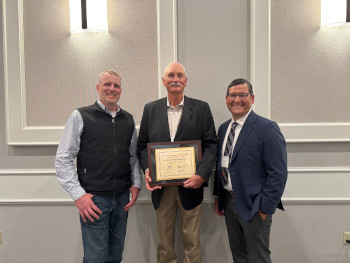
OSU Extension Annual Conference: Extension faculty from EOARC went to Corvallis recently for professional development and networking – and also to recognize Mr. Bill Moore with a Cooperator Award for the generous support he has provided to OSU Extension and EOARC over the years.
Harney County Fair BBQ: EOARC hosted a Hamburger BBQ for the youth exhibitors and their families at the Harney County Fair. It was a fun and meaningful way to acknowledge and support their projects and commitment to the Harney County Fair.
Youth Heifer Placement Program: Ms. Cara Goss-Bodily showed her EOARC-donated heifer at the fair as part of the Harney County Stockgrowers Youth Heifer Placement Program. This was Cara’s second and final year in the program, and she successfully completed all requirements—officially earning ownership of the heifer. We are incredibly proud of Cara and her dedication to the project! Be sure to check out her photos and write-up later in this newsletter.
This issue’s EOARC Stakeholder Spotlight features Dallas Hall Defrees. Dallas is a valued member of the EOARC Union Advisory Committee, Director of Regenerative Ranching with Sustainable Northwest, and serves on the Oregon Fish and Wildlife Commission. We appreciate her leadership and commitment to sustainable agriculture and natural resource stewardship.
In Memoriam: We are saddened to share the passing of Amos Burke, a former EOARC Burns employee. After retiring, Amos remained deeply involved in community events and activities, turning his passion for service into a full-time pursuit. He will be greatly missed.
If you have any comments or suggestions about what you would like to see in future editions of the newsletter please feel free to contact Shellie Tiller ([email protected]) and she will work with us to try get all requests addressed.
I hope you are all well!
David Bohnert
Director, Eastern Oregon Agricultural Research Center (Burns and Union Stations)
Oregon State University
A Note from Chad:

Greetings from Burns! It’s been an amazing growing season in southeast Oregon with unexpected, but much appreciated precipitation, and moderate temperatures for most of the summer (Burns stayed below 100° for the duration of the summer). On top of that, even with fairly high fine fuel loads, we had a very mild wildfire season despite having a fair number of ignitions; which likely has something to do with lower temperatures and timely rains keeping fuel moisture values up.
On the federal calendar, our fiscal year ends on September 30 and I wanted to take a moment to offer up some thoughts of appreciation for everyone who has helped make this a successful year. First off, thank you to the scientists and technicians who made our 2025 field season a success in spite of hiring limitations that resulted in severely downsized field crews. You collectively found a way to make it work by helping each other. Simply put, success is almost always a choice, and you chose to be successful this year. Thank you.
Thanks also to our administrative staff, Dawnetta and Tammi. I’m fond of telling our science staff that in the federal system every science accomplishment is predicated by a whole host of administrative accomplishments. From budgeting and purchasing materials to processing travel and payroll, nothing in the federal system happens without administrative process and Dawnetta and Tammi make it happen. You chose to be successful this year in spite of numerous challenges and for that I am very grateful.
Our OSU (both EOARC and on campus) and TNC partners are a continuing source of synergy and science impact. Thank you for relaying our stories of collective success and for your support of a partnership that is improving land and lives throughout the dry side of Oregon and beyond.
Finally, I want to express my sincere appreciation to all our stakeholders who have gone to great lengths to share with people who matter their thoughts on the value of the stakeholder-driven research that has and will continue to define the work we do here at EOARC. We have served you through science for over 80 years and look forward to doing so in the future.
Our ARS spotlight employee this week is Daav Sannerud. Daav is a Research Technician working with Rory O’Connor where he plays critical roles in field data collection, data processing, and soil analysis. Daav is also a fixture in organizing social activities here at the research station and is an active and valued participant in our youth science outreach program. Thank you for all you do Daav!
Thank you Shellie for getting the newsletter together, and as always, please feel free to reach out to me any time we can be of help.
Chad Boyd
Research Leader, Eastern Oregon Agricultural Research Center, Burns
USDA-Agricultural Research Service
A Note from Cameron:

Hello all and happy fall, This week marks a bittersweet moment for myself and the Burns TNC shop as my colleague Corinne Schroeder leaves her position as Lead Restoration Technician. Corinne started with us in spring 2023 and was the mighty linchpin of our restoration work. Field research succeeds or fails with a crew lead, and Corinne’s grit, flexibility, leadership, and uncommon common sense in the face of unexpected challenges kept us on a straight path that disguised the sometimes rocky roadbed we traveled over. Though this is an appropriate time to reflect on Corinne’s essential contributions to our work, I don’t need to mourn her loss too heavily because she isn’t going far! Starting this week, Corinne will be working for Stella Copeland at the EOARC. Congratulations Corinne and I’m happy we will be able to keep your talents in Burns.
Though our staff has changed a bit, we continue to work towards building sagebrush rangeland resiliency by supporting local collaboratives and empowering working lands and ranchers. A primary focus of our work has been developing and refining strategies for prioritizing management activities to mitigate the threats of annual grass invasion, destructive wildfires, and conifer encroachment. Along with USDA ARS and Oregon State University, we have taken broad-scale frameworks used to identify and prioritize core sagebrush landscapes, such as Threat-Based Strategic Conservation, and downscaled them to help land stewards make decisions about where to work (and where to consider not working!) using support from remote sensing data. These frameworks can be used to plan restoration actions in the wake of wildfire, such as locations for seeding and herbicide projects where plant communities likely need help to recover and have the best chances of successful intervention. Using similar frameworks, managers can allocate activities across priority landscapes before fire to make coordinated decisions in service of keeping intact vegetation in good condition and lessening the impact of future fire events.
Developing, testing, and providing training on the use of these frameworks is important, but it is only the first step. The EOARC has been partnering with groups such as the Frenchglen RFPA, the Harney County Wildfire Collaborative, the Tri-Corner Community Collaborative, the Oregon Desert Land Trust, and the Malheur Rangeland Partnership to implement these frameworks on the ground. Though these frameworks are backed by sound science, the real measure of success is in their usefulness for advancing working lands conservation. Implementation will also allow us to demonstrate the ‘extra-ecological benefits’ of our frameworks, including things like a streamlined planning process, increased competitiveness of funding applications, the ability to pinpoint and address possible social and administrative barriers to effective management, and a pathway to shared understanding and the crafting of unified objectives.
Through implementation we will also be able to incorporate new management actions effectively into our spatial frameworks. As a particularly exciting example, the Oregon Desert Land Trust will be implementing virtual fencing on their Trout Creek Ranch property and BLM allotments. With help from the Forest Service, together we will be assessing fine fuel loads using remote sensing and combining these data with stocking information to inform locations for targeted grazing activities. We hope to use this process to inform flexible grazing management to reduce wildfire risk to intact sagebrush vegetation and infrastructure while operating within the logistical constraints of livestock operations. Important research has provided the tools and proof of concept to make this process a reality, but getting it done on large multi-ownership landscapes is where the rubber meets the road.
In addition to our upland restoration work, my colleague Jessie Griffen is implementing low-tech process based riparian restoration techniques to reconnect incised floodplains within our rangelands. Using a bevy of tools including beaver dam analogues and post-assisted log structures Jessie and her crew are restoring riparian vegetation, extending streamside vegetation greenness, and providing habitat for sagebrush riparian obligate species. This work has the additional benefit of low-cost techniques with a lower permitting burden than typical methods using heavy machinery. In contrast to the technologically simple practices used in the field, Jessie is using novel remote sensing methods to scope out suitable restoration sites and conduct outcome monitoring once projects are installed. Last year Jessie’s team partnered with Anabranch consulting to restore over 2 miles of Cottonwood Creek on Trout Creek Ranch property and is in the process of drafting project plans for future work in Harney County. This work is a part of a multistate riparian restoration network in partnership with the BLM, and will allow for sharing of successes, insights, and exportable models for rehabilitating the ‘wet stuff’ that is key for sagebrush wildlife, livestock, and recreation.
As always, thank you for letting me ramble about the cool work I get to be a part of, and please reach out if there is anything I can do for you!
Cameron Duquette
Rangeland Scientist, The Nature Conservancy
A Note from Bryan:

Greetings from Union. As another busy summer draws to a close, I want to share some updates about our activities over the past several months.
Infrastructure projects at the Station continue to improve our working environment, which enables us to continue our mission. The Native Plant Propagation Lab is nearing completion- in fact we have already moved in and starting utilizing the space as the last touches are finished. This greatly expands our lab capabilities and allows us to expand our work on seeds which informs management and restoration efforts in the region. Additionally, a new shop is under construction; this will greatly improve the working conditions for our ranch staff as they care for our facilities, livestock and pastures.
Accompanying the infrastructure improvements is an expansion of our faculty at EOARC Union. In October, we will welcome two new faculty to the station: Dr. Sandra DeBano and Dr. David Wooster. Sandy’s research and outreach focuses on how human activities affect terrestrial invertebrate communities and the ecosystem services they provide, with a special interest in riparian and grassland ecology, food webs, native bees, and invertebrate predators. David’s work focuses on stream ecology, aquatic invertebrate biology, restoration effectiveness monitoring, stream food webs, stream and riparian linkages. They come to us from the Hermiston Agricultural Research and Extension Center where they have worked for many years. We are thrilled to have them join the station!
In September, Union Station had the pleasure of hosting OSU President Jayathi Murthy, Vice Provost for Extension and Engagement Krisopher Elliot, the Dean of the College of Agricultural Sciences Dr. Staci Simonich, and many others. During the visit, OSU faculty and staff from the region had a chance to highlight research, outreach and education efforts while a diverse group of partners and stakeholders had a chance to discuss ways to continue and expand OSU’s strong work in the region. It was a productive event and we certainly appreciate all who were able to participate and share their perspectives.
Fall is upon on us, classes have started and we are preparing for all that comes with winter- feeding, calving, snow plowing and more. I hope you all have a chance to slow down after a busy summer and fall and please do not hesitate to reach out if you have any questions.
Bryan Endress
Assistant Director EOARC - Union
EOARC Union Stakeholder Spotlight - Dallas Hall Defrees

I am the Director of Regenerative Ranching with Sustainable Northwest, where I work to connect science-based research with practical tools that support ranchers and healthy landscapes. My journey began with the Eastern Oregon Agricultural Research Center - Union while working on the Starkey Experimental Forest and Range during my Master’s program in Rangeland Ecology and Management at Oregon State University. That experience not only deepened my knowledge of rangeland systems but also gave me the opportunity to learn directly from EOARC staff and participate in a number of collaborative studies.
Since then, I’ve continued to carry EOARC’s research into my professional roles. As the Baker County Sage-grouse Local Implementation Team Coordinator, I worked with local partners to apply science-driven solutions to habitat conservation and management challenges. Now, in my role at Sustainable Northwest, I continue to build on this foundation—bringing applied research and innovative practices to ranchers across the state through regenerative approaches.
What drives me is a passion for land stewardship and sustainability. I believe the most meaningful solutions come from the intersection of science and land management, where research meets the day-to-day realities of ranchers. My goal is to help bridge that gap—supporting ranchers, improving ecological outcomes, and ensuring working lands remain resilient for future generations.
Upcoming Events:
Central Oregon Ranching Academy - Prineville, OR, Beef Quality Assurance (BQA) Training - November 8, 2025
Collecting Calves for OSU Steer-a-Year Program - November 7-8, 2025
Producers Wolf/Livestock Survey - December 4, 2025
Oregon Cattlemen's Association Meeting - Pendleton, OR - December 4-6, 2025
ARS Employee Spotlight - Daav Sunnerud


Hey all, I’m Daav Sannerud. I was born in Minneapolis and grew up in a nearby suburb. I worked in an Ecosystem Ecology lab for two years after graduating from the University of Minnesota. During the pandemic I moved out to Mt. Shasta, California to work for the Forest Service’s Forest Inventory and Analysis program, then the next year I moved up to Grants Pass, Oregon to continue working in that position. During that time, I found myself deeply interested with the landscapes and ecology of Eastern Oregon. So I looked around to see if I could find a job involving research in Eastern Oregon, and, as luck would have it, I found one. I started as a Rangeland Technician working for Rory O’Connor in the Spring of 2022. The work has involved a significant amount of soil processing and plant community monitoring. Most recently our research has focused on applications of virtual fence, and rangeland restoration practices for Wyoming Big Sagebrush communities. Currently we are working on setting up a project for this winter that will study the interactions between small scale local environments, moss, and the soils beneath them.

Outside of work I spend much of my time cooking and enjoying outdoor activities with my girlfriend, Anna, and our dog, Kota. Anna recently moved to Hood River, Oregon to start a new job, so we’ve been able to spend the weekends exploring a new area and picking fruit from all the orchards. When I’m not off adventuring, I spend the time learning to drum, reading cookbooks, and endlessly pulling bindweed from the garden. With the best season of the year coming up in a few months; I’m looking forward to cross country skiing, learning to snowboard, and brewing beer.
OSU Employee Spotlight - Lucy Boyle

Lucy Boyle joined EOARC Union in 2023 as a student technician while completing her bachelor’s degree in natural resources at Oregon State University. In November 2024, she transitioned into her current position as a Faculty Research Assistant.
Lucy is currently supporting research on summer mule deer forage availability in partnership with Oregon Department of Fish & Wildlife (ODFW). Over the past year, she has developed and implemented vegetation and scat sampling protocols across the Malheur National Forest.
Having grown up in the Puget Sound region, Lucy is enjoying the opportunity to explore the dry forest and sagebrush ecosystems in eastern Oregon. Outside of work, she enjoys trail running, cross country skiing and playing the piano.
TNC Employee Spotlight - Corinne Schroeder


Hello everyone, my name is Corinne Schroeder and I have been here at the EOARC in Burns working with The Nature Conservancy (TNC) since March of 2023. I was born and raised in New Jersey where I spent my childhood running around the woods (yes, Jersey has forests!), enjoying summer day trips to the shore, and playing soccer. Not knowing what I wanted to do after graduating high school, I enrolled at my community college and took a whole bunch of random courses that included an ecology class. After realizing that I looked forward to this class more than any other class that semester, I decided to pursue biology as a major, eventually transferring to SUNY ESF in Syracuse, New York where I graduated with a BS in Environmental Biology.
Post college, I landed my first seasonal technician gig in Buffalo, Wyoming in 2016. At first I panicked at the lack of trees, no ocean nearby, and the wildly different social culture. However, the sagebrush landscape and the Bighorn Mountains became not only my office but some of my favorite places to explore in my free time. Since then, I have lived in five different states, including Oregon, doing many seasonal and short-term botany/vegetation technician jobs for various federal and private agencies.
Since landing in Burns, I have continued to hike around as much as possible in my free time looking for plants and enjoying the views. In my free time I have begun to lean into some new hobbies like snowshoeing, cross-country skiing, learning ceramics at the art studio in town, and birding.

My work with TNC at the station has mostly consisted of being a part of the herbicide protection seed technology research that many talented people have been working on for years. My main role has been to manage the field crew as we collect data, implement project sites, and do lab trials in the name of rangeland restoration. A highlight of my work at TNC was last fall when we used one of the range drills that the station owns to seed 4 “demo” sites that were overwhelmed by invasive grasses with our activated carbon coated seeds after the area was sprayed with herbicide. It was a big effort that took a lot of collaboration, planning, troubleshooting, and timing of weather windows to pull off. Being able to monitor those sites this spring and then again during late summer was also neat, and to see what kind of progress each site made has been very interesting!
I really appreciate the partnership that TNC has with ARS and how welcoming everyone at the station has been. I’m looking forward to staying here and continuing to work in these landscapes!
Bill Moore Recipient of OSU Extension Association Cooperators Award

Bill Moore is a former president of Oregon Cattlemen’s Association and operates Moore Ranches, LLC in Baker and Malheur Counties. After the Cow Valley Fire in 2024, Bill partnered with EOARC and OSU Extension to develop a post-fire management plan for his property. This plan was pivotal in advancing what became a post-fire planning framework for landowners, agencies, and other organizations seeking to prioritize resources and actions after rangeland wildfires. His property was used as a real-life example at 25 educational events, and Bill co-presented with Extension at a Society for Range Management’s Workshop, engaging an international audience with on-the-ground realities livestock producers face following wildfire. He also advocated on behalf of OSU Extension, OSU Agricultural Experiment Station, and OSU Forest Research Lab at the Joint Ways and Means Subcommittee on Higher Education in 2025. His generosity sharing his experience and knowledge propelled OSU Extension in developing new ways to support landowners and agencies in strategically acting after rangeland wildfires.
In Memory of Amos Burk

Amos Burk worked in maintenance at EOARC, where he was known for his artistic
touch and skills in a wide range of handyman tasks, from repairs to creative projects.
Official Obituary of Michael "Amos" Burk
Outreach, Educational Activities & More

American Society of Animal Science (ASAS-CSAS) Annual Meeting, July 6-10, 2025, Hollywood, FL - The Ranches lab attended the 2025 ASAS-CSAS Annual Meeting in Hollywood, Florida. This is the major event for their scientific society. The event brings together scientists, educators, and industry leaders to discuss cutting-edge research and innovation in Animal Science. The students did a fantastic job presenting the latest findings of their work! They also had the opportunity to catch up with old friends and make new ones, and to celebrate Dr. Kris Johnson from Washington State University at her Presidential Reception!

Branch Experiment Station Directors Meeting, July 23-24, 2025, Hood River, OR - The College of Agricultural Sciences Branch Experiment Station Directors traveled to Hood River this past July for a Branch Experiment Station Director’s meeting. Brian Pearson, Director of the Mid-Columbia Agricultural Research and Extension Center (MCAREC), was a wonderful host. We had a productive meeting and got to tour the MCAREC facility and meet its OSU and USDA-ARS faculty. In addition, we were able to visit Pearl’s Place Fruit Stand, Mt. Adam’s Packing, pFriem Brewing, and Sunshine Mill Winery. It always amazes me to see the diverse agriculture of Oregon and the people, many of whom are OSU alumni, involved in growing, harvesting, and producing Oregon’s bounty.

Eastern Oregon Economic Summit, July 24-25, 2025, Wildhorse Resort & Casino, Pendleton, OR. The Summit kicked off with a field and industry tour on Thursday, followed by the General Session on Friday in Pendleton, OR. This year’s theme, “Deep Roots, Stronger Futures,” brought together regional leaders, policymakers, and community members to address key issues and strengthen collaboration.

OSU-BLM Wild Horse & Burro Experience, July 25, 2025 - Katie Wollstein and Chad Boyd hosted a group of students in this program at Burns EOARC where they learned about the ecology of sagebrush steppe plant communities and how that knowledge can be used to strategically manage for desired rangeland conditions. EOARC was one stop in this 10-week course that aims to equip selected students with knowledge needed to effectively manage horses and burros in ecologically and socially challenging rangeland environments.

Steens Mountain Rim Run and Walk, August 2, 2025 - EOARC showed up strong at the Steens Rim Run & Walk! We had an awesome turnout—and some of our folks even placed in their age groups! Way to represent!



Recent Publications
Nest Predators of Sagebrush‐Obligate Songbirds in the Northern Great Basin
Schroeder, Vanessa M., W.D. Robinson, J.B. Dinkins
Does Applying Indaziflam and Imazapic Together Improve Restoration of
Annual Grass-invaded Rangelands?
Davies, Kirk W., T.S. Prather, L.C. Jones, C.H. Guetling
How Does the Presence of Wolves Affect Oregon’s Livestock Producers?
Delbridge, Tim, D.W. Bohnert
Effects of Cattle Grazing on Food Web Dynamics: Meso-predators and
Rodents in a Sagebrush Ecosystem
Schroeder, Vanessa M., D.D. Johnson, W.D. Robinson, D.W. Bohnert, J.B. Dinkins
Wyoming Sagebrush Rangeland Soils are a Weak Methane Sink
O’Connor, Rory C., D.A. Sannerud, E.P. Hamerlynck, J. Ranches, D.W. Bohnert
Deeper Seeding Allows Bunchgrass Establishment While the Pre-emergent Herbicide Indaziflam Controls Invasive Annual Grasses
Davies, Kirk W., D.R. Clenet, P.J. Olsoy, C.S. Boyd, S.M. Copeland, E.P. Hamerlynck, R.C. O’Connor, J.D. Bates
Spotlight
It’s always good to be thinking about preparing for wildfire. Check out the Extension Fire Program’s webinars, readiness checklists, and other resources related to wildfire preparedness here.
Social Media:
sagehabitatteam & thecattlecorner


