#1.军训排队
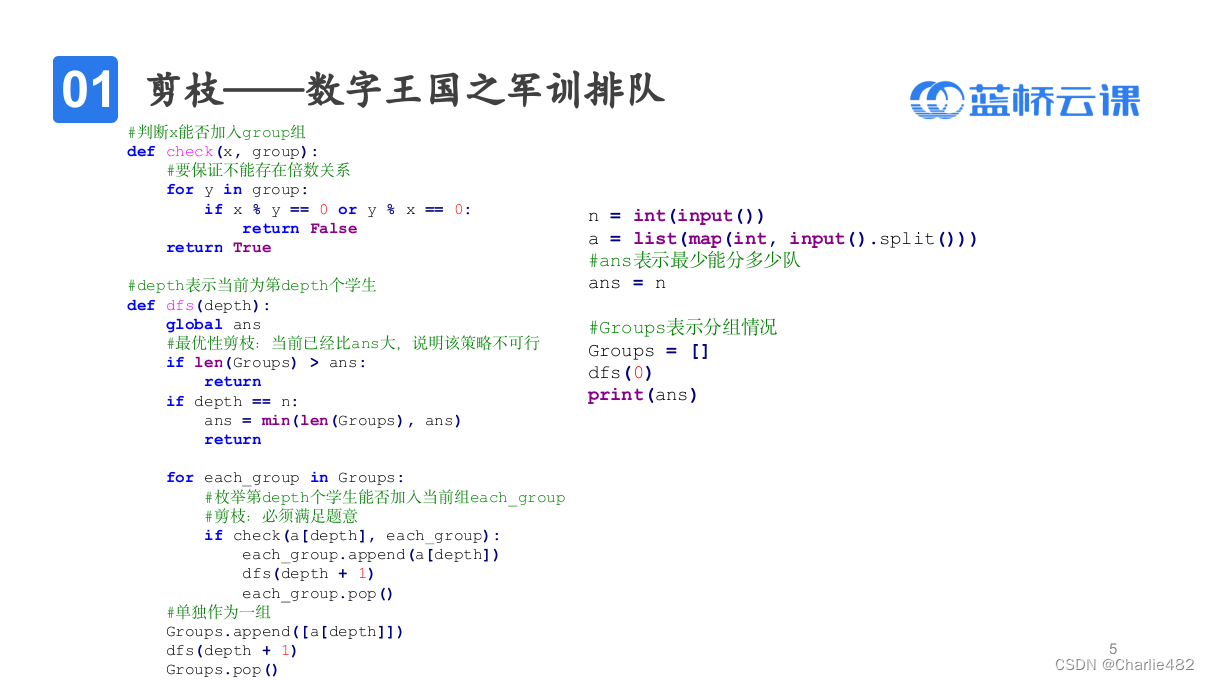
# 判断x能否加人group组
def check(x, group):
    # 要保证不能存在倍数关系
    for y in group:
        if x % y == 0 or y % x == 0:
            return False
    return True

# depth表示当前为第depth个学生
def dfs(depth):
    global ans
    # 最优性剪枝:当前已经比ans大,说明该策略不可行
    if len(Groups) > ans:
        return
    if depth == n:
        ans = min(len(Groups), ans)
        return
    for each_group in Groups:
        # 枚举第depth个学生能否加人当前组each_group
        # 剪枝:必须满足题意
        if check(a[depth], each_group):
            each_group.append(a[depth])
            dfs(depth + 1)
            each_group.pop()
    # 单独作为一组
    Groups.append([a[depth]])
    dfs(depth + 1)
    Groups.pop()

n = int(input())
a = list(map(int, input().split()))
# ans表示最少能分多少队
ans = n
# Groups表示分组情况
Groups = []
dfs(0)
print(ans)


#2.特殊多边形
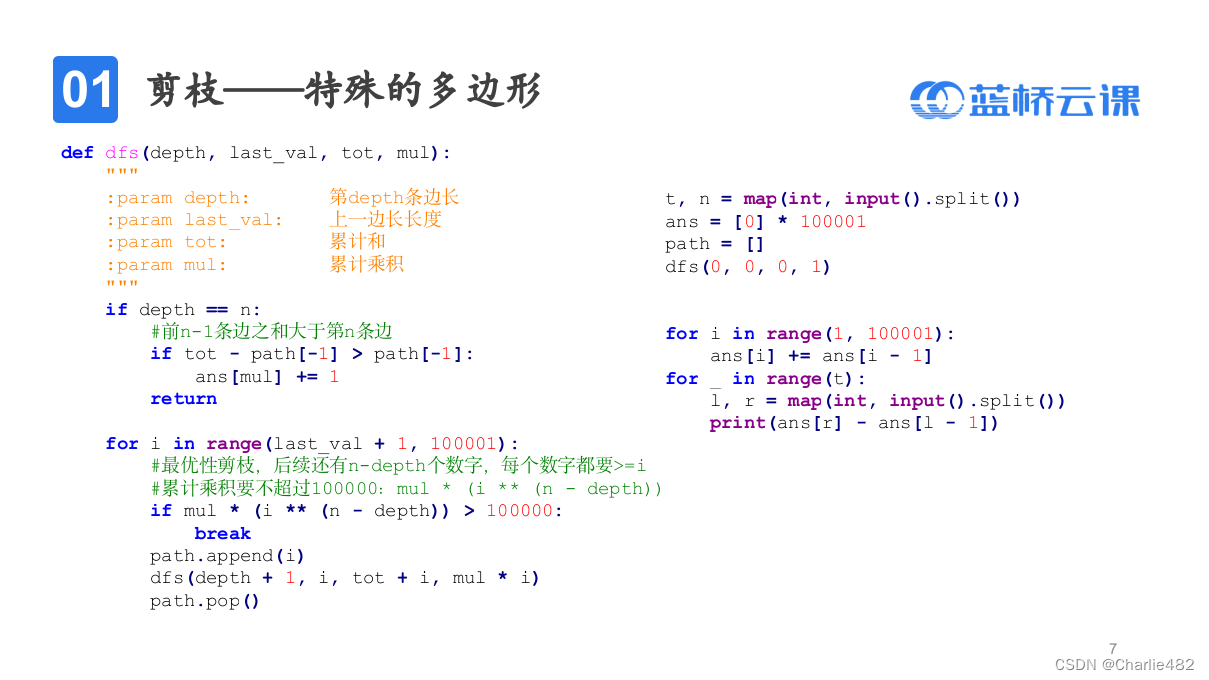
def dfs(depth, last_val, tot, mul):
    '''
    :param depth:第depth条边长
    :param last_val:上一边长长度
    :param tot:累计和
    :param mul:累计乘积
    '''
    if depth == n:
        # 前n-1条边之和大于第n条边
        if tot - path[-1] > path[-1]:
            ans[mul] += 1
        return

    for i in range(last_val + 1, 100001):
        # 最优性剪枝,后续还有n-depth个数字,每个数字都要>=i
        # 累计乘积要不超过100000:mul*(i*(n-depth))
        if mul * (i ** (n - depth)) > 100000:
            break
        path.append(i)
        dfs(depth + 1, i, tot + i, mul * i)
        path.pop()

t, n = map(int,input().split())
ans = [0] * 100001
path = []
dfs(0, 0, 0, 1)
for i in range(1, 100001):
    ans[i] += ans[i - 1]
for _ in range(t):
    l, r = map(int,input().split())
    print(ans[r] - ans[l - 1])












 扫一扫
扫一扫


第 2 期 11.2剪枝&spm=1001.2101.3001.5002&articleId=136441265&d=1&t=3&u=8bf2230f88164116ac46a3b7c62f2093)
 898
898

 被折叠的 条评论
为什么被折叠?
被折叠的 条评论
为什么被折叠?
 到【灌水乐园】发言





