



 本文介绍了Codeforces Round #199的一道问题,涉及几何知识。题目要求计算在特定尺寸的柜子中,半径为r/2的球形气球能存放的最大数量。解题方法包括考虑柜子的形状和气球可以放置的位置,利用几何原理确定最大容量。
A girl named Xenia has a cupboard that looks like an arc from ahead. The arc is made of a semicircle with radius r (the cupboard's top) and two walls of height h (the cupboard's sides). The cupboard's depth is r, that is, it looks like a rectangle with base r and height h + r from the sides. The figure below shows what the cupboard looks like (the front view is on the left, the side view is on the right).

Xenia got lots of balloons for her birthday. The girl hates the mess, so she wants to store the balloons in the cupboard. Luckily, each balloon is a sphere with radius
 . Help Xenia calculate the maximum number of balloons she can put in her cupboard.
You can say that a balloon is in the cupboard if you can't see any part of the balloon on the left or right view. The balloons in the cupboard can touch each other. It is not allowed to squeeze the balloons or deform them in any way. You can assume that the cupboard's walls are negligibly thin.
The single line contains two integers r, h (1 ≤ r, h ≤ 107).
Print a single integer — the maximum number of balloons Xenia can put in the cupboard.
1 1
3
1 2
5
2 1
2
题目链接:http://codeforces.com/problemset/problem/342/C
题目大意:给出如图所示的柜子的正面和侧面投影图,在柜子里放气球,气球半径的r/2,求最多能容纳多少个气球。
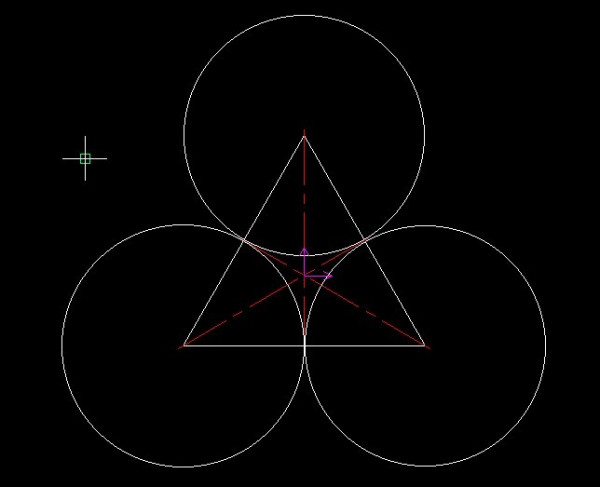
解题思路:根据柜子宽度和长度可知高度为m个 r 时可容纳2*m个气球,关键在半圆顶部,气球由底向上放时,设气球刚好超出长方形部分进入半圆部分的长度为hh,若hh小于r,则还能容纳2个气球,如图,若hh小于上圆底部到下圆顶部的距离,就还能再多容纳1个气球,也就是还能容纳三个气球,这段距离用勾股定理不难求得:d=(2-√3)*R。(这里最好自己画图理解,R是r/2,即气球的半径)
代码如下:
#include <cstdio>
#include <cstring>
#include <cmath>
using namespace std;
int main()
{
	int r,h;
	scanf("%d%d",&r,&h);
	if(h%r)
	{
		if(r-h%r<=r/2)
		{
			double r1=(double)r/2;
			double d=(2-sqrt(3))*r1;
			double hh=(double)r-double(h%r);
			if(hh<=d)
				printf("%d\n",2*(h/r+1)+1);
			else
				printf("%d\n",2*(h/r+1));
		}
		else
			printf("%d\n",2*(h/r)+1);
	}
	else
		printf("%d\n",2*(h/r)+1 );
}





 扫一扫
扫一扫


 1886
1886

 被折叠的 条评论
为什么被折叠?
被折叠的 条评论
为什么被折叠?
 到【灌水乐园】发言





