


说明
-
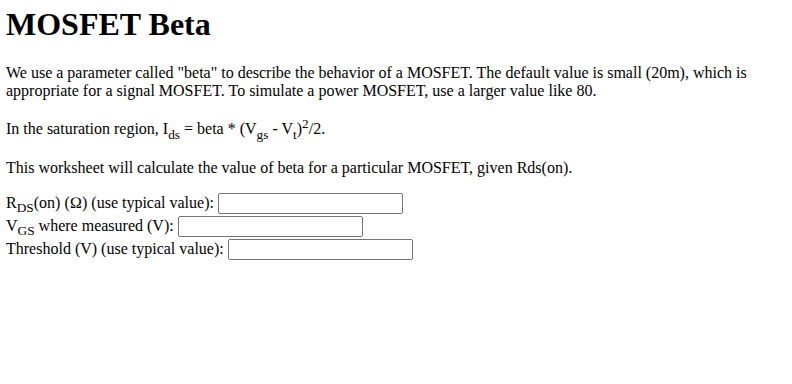
https://www.falstad.com/circuit/mosfet-beta.html 提供了一个根据 MOSFET 的导通电阻粗略计算Beta参数的方法:
-
在简化的 MOSFET 模型中,β表示晶体管的跨导能力(导电能力)。
-
对于 NMOS,在饱和区:
I D S = β 2 ( V G S − V t ) 2 I_{DS}=\frac{\beta}{2}(V_{GS}-V_t)^2 IDS=2β(VGS−Vt)2
-
其中:
- I D S I_{DS} IDS:漏极电流
- V G S V_{GS} VGS:栅源电压
- V t V_t Vt:阈值电压(Threshold Voltage)
- β \beta β:MOSFET增益参数
-
β越大,同样的栅压下能流过的电流越大。
由 RDS(on) 求 β
MOSFET 完全导通时,相当于一个很小的电阻:
R D S ( o n ) = V D S I D S R_{DS(on)}=\frac{V_{DS}}{I_{DS}} RDS(on)=IDSVDS
在小 V D S V_{DS} VDS条件下,MOSFET处于线性区:
I D S ≈ β ( V G S − V t ) V D S I_{DS}\approx \beta (V_{GS}-V_t)V_{DS} IDS≈β(VGS−Vt)VDS
代入欧姆定律:
R D S ( o n ) = V D S β ( V G S − V t ) V D S R_{DS(on)} =\frac{V_{DS}} {\beta (V_{GS}-V_t)V_{DS}} RDS(on)=β(VGS−Vt)VDSVDS
约掉 V D S V_{DS} VDS:
R D S ( o n ) = 1 β ( V G S − V t ) R_{DS(on)}=\frac{1}{\beta(V_{GS}-V_t)} RDS(on)=β(VGS−Vt)1
因此,计算公式:
β = 1 R D S ( o n ) ( V G S − V t ) \beta=\frac{1}{R_{DS(on)}(V_{GS}-V_t)} β=RDS(on)(VGS−Vt)1
示例
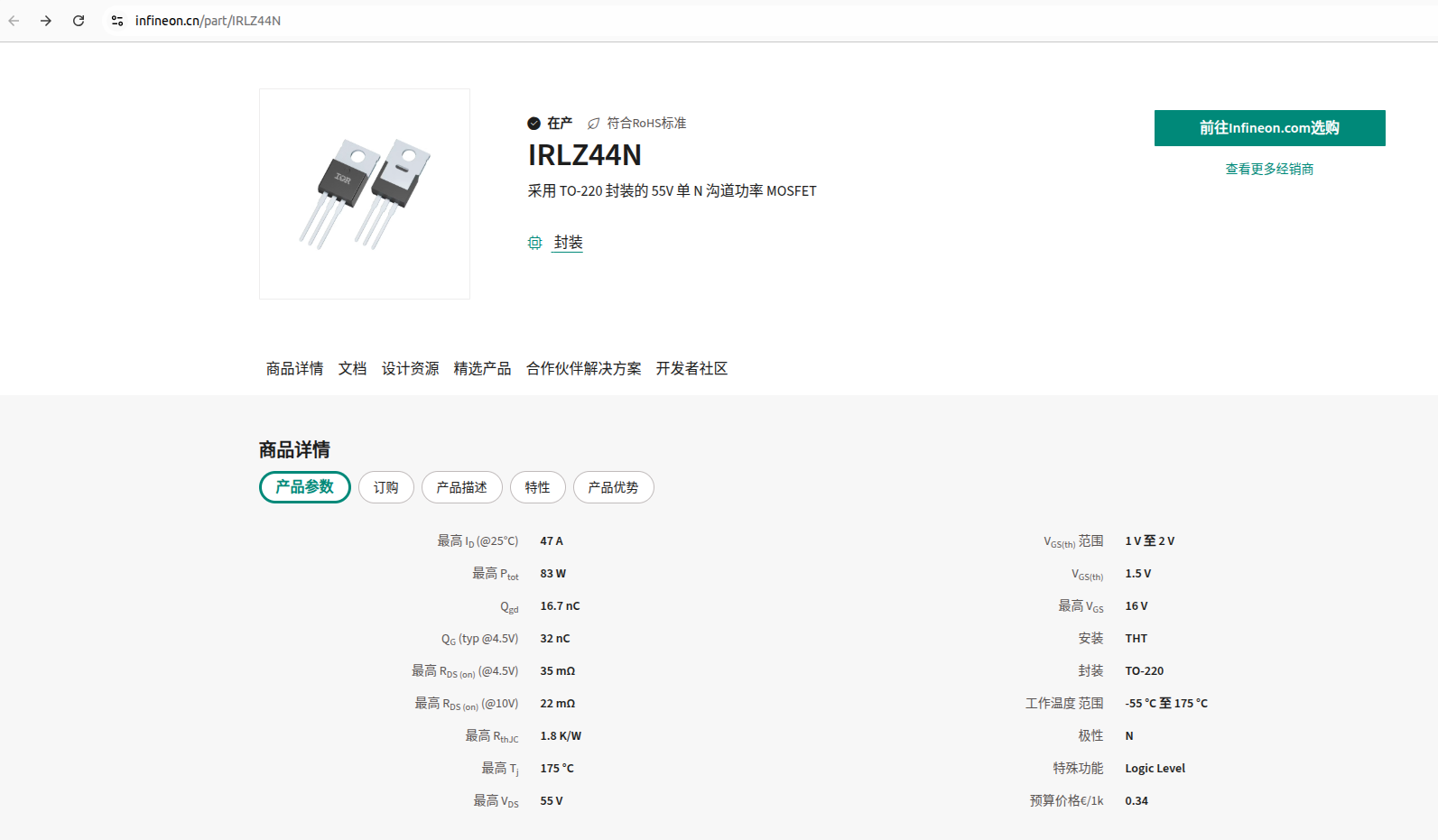
按 10V 驱动计算
数据:
R D S ( o n ) = 22 m Ω R_{DS(on)}=22m\Omega RDS(on)=22mΩ
V G S = 10 V V_{GS}=10V VGS=10V
V t = 1.5 V V_t=1.5V Vt=1.5V
代入:
β = 1 0.022 ( 10 − 1.5 ) = 5.35 \beta =\frac1{0.022(10-1.5)} = 5.35 β=0.022(10−1.5)1=5.35
按 4.5V 驱动计算
代入:
β = 1 0.035 ( 4.5 − 1.5 ) = 9.52 \beta =\frac1{0.035(4.5-1.5)} = 9.52 β=0.035(4.5−1.5)1=9.52
代码实现
<html><head>
<meta http-equiv="content-type" content="text/html; charset=windows-1252"><style>#header + #content > #left > #rlblock_left,
#content > #right > .dose > .dosesingle,
#content > #center > .dose > .dosesingle
{display:none !important;}</style><style>img[src="http://s05.flagcounter.com/count/pTvk/bg=FFFFFF/txt=000000/border=CCCCCC/columns=6/maxflags=36/viewers=0/labels=0/"]
{display:none !important;}</style></head><body><h1>MOSFET Beta</h1>
We use a parameter called "beta" to describe the behavior of a MOSFET.  The default value is small (20m), which is appropriate for a signal MOSFET.  To simulate
a power MOSFET, use a larger value like 80.
<p>
In the saturation region, I<sub>ds</sub> = beta * (V<sub>gs</sub> - V<sub>t</sub>)<sup>2</sup>/2.
</p><p>
This worksheet will calculate the value of beta for a particular MOSFET, given Rds(on).
</p><p>

<script>


function units(x) {
	 x = x.trim();
   if (x.match(/m$/)) {
       x = x.replace(/m$/, "");
  	return .001 * x;
   }
   // don't think we need this but you never know
   if (x.match(/u$/)) {
       x = x.replace(/u$/, "");
       return 1e-6 * x;
   }

   return x;
}

function calc() {
   var rds = units(document.getElementById('rds').value);
   var vgs = units(document.getElementById('vgs').value);
   var vt = units(document.getElementById('vt').value);
   var beta = Math.abs(1/(rds*(vgs-vt)));
   document.getElementById('result').innerHTML = "beta = " + beta;
}

</script>
</p><form action="/action_page.php">
  R<sub>DS</sub>(on) (Ω) (use typical value): <input type="text" id="rds" oninput="calc()"><br>
  V<sub>GS</sub> where measured (V): <input type="text" id="vgs" oninput="calc()"><br>
  Threshold (V) (use typical value): <input type="text" id="vt" oninput="calc()"><br>
</form>
<div id="result">

</div>


</body></html>
units()
function units(x) {
    x = x.trim();

    if (x.match(/m$/)) {
        x = x.replace(/m$/, "");
        return .001 * x;
    }

    if (x.match(/u$/)) {
        x = x.replace(/u$/, "");
        return 1e-6 * x;
    }

    return x;
}
用于处理单位:
| 输入 | 返回 |
|---|---|
20m | 0.02 |
50m | 0.05 |
10u | 0.00001 |
4 | 4 |
calc()
var rds = units(...);
var vgs = units(...);
var vt  = units(...);

var beta = Math.abs(
    1/(rds*(vgs-vt))
);





 扫一扫
扫一扫


参数的公式&spm=1001.2101.3001.5002&articleId=161936625&d=1&t=3&u=52977bf1e4c6468e8f453f8fa8a45bd2)
 396
396

 被折叠的 条评论
为什么被折叠?
被折叠的 条评论
为什么被折叠?
 到【灌水乐园】发言





