

算法导论 Exercises 23.1

本文解析了《算法导论》第三版中关于最小生成树的一系列习题,包括证明和反例构造等内容,深入探讨了最小生成树的性质及算法实现的相关理论。

Exercises 23.1 - 算法导论.英文第3版 

如有不足或疑问, 欢迎指正. 


Exercises 23.1-1
Let (u, v) be a minimum-weight edge in a connected graph G. Show that (u, v)  belongs to some minimum spanning tree of G.

根据定理 Theorem 23.1 可知, 利用 cut (S, V-S) 将 u, v 两点分割开来, 由于 (u, v) 是最轻边, 所以 (u, v) 属于最小生成树.  


Exercises 23.1-2
Professor Sabatier conjectures the following converse of Theorem 23.1. Let G = (V, E) be a connected, undirected graph with a real-valued weight function w defined on E. Let A be a subset of E that is included in some minimum spanning tree for G, let (S, V - S) be any cut of G that respects A, and let (u, v) be a safe edge for A crossing (S, V - S). Then, (u, v) is a light edge for the cut. Show that the professor's conjecture is incorrect by giving a counterexample.

由分析可得知, 任何无向连通图, 穿过 cut 的最轻边一定是安全的, 但非最轻边同样有可能安全, 如下.
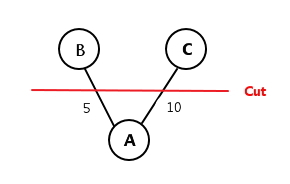
对于该 cut 来说, 虽然 (A, C) 是安全的, 但不是最轻边. 


Exercises 23.1-3
Show that if an edge (u, v) is contained in some minimum spanning tree, then it is a light edge crossing some cut of the graph.

(u, v) 属于最小生成树 A, 假设 cut 不影响 A 中除 (u, v) 外的其他边, 既 A 中只有 (u, v) 穿过该 cut,    
所以 (u, v) 对该 cut 是最轻边, 否则 (u, v) 不属于 A. 


Exercises 23.1-4
Give a simple example of a connected graph such that the set of edges { (u, v) : there exists a cut (S, V - S) such that (u, v) is a light edge crossing (S, V - S) } does not form a minimum spanning tree.

三角形三条边权重相同的情况, 每条边在某种 cut 中均是最轻, 既结果中存在环, 所以不是最小生成树.  


Exercises 23.1-5
Let e be a maximum-weight edge on some cycle of connected graph G = (V, E). Prove that there is a minimum spanning tree of G' = (V, E - {e}) that is also a minimum spanning tree of G. That is, there is a minimum spanning tree of G that does not include e.

因为在某些圈中 e 是权重最大的边, 去掉 e 后圈中的顶点仍然可连通. 假设最小生成树 A 中不包含 e, 边集合 是 T, 同样假设包含 e 的情况, 边集合为 T', 既 T' 是 T 去除某条边 x, 并加入 e. (最小生成树边数是常量 V-1)
w(T') = w(T) - w(x) + w(e),
          >= w(T)
所以可知最小生成树 A 不包含 e.


Exercises 23.1-6
Show that a graph has a unique minimum spanning tree if, for every cut of the graph, there is a unique light edge crossing the cut. Show that the converse is not true by giving a counterexample.

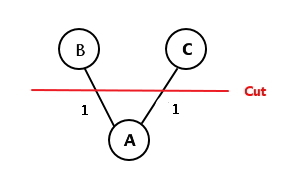
假设存在两个最小生成树 T 和 T'. 任何边 e 属于 T, 如果从 T 中移除 e, 则 T 变得不连通, 形成 cut (S, V - S), 根据练习 23.1-3 可知, e 是穿过 cut(S, V - S) 最轻边. 假设边 x 属于 T', 并穿过 cut (S, V - S), 则 x 同样是最轻边. 由于穿过 cut(S, V - S) 的最轻边唯一. 既 e 和 x 是同一条边. 所以 e 也属于 T', 由于我们选择 e 是任意的, 所有在 T 中的边, 同样在 T' 中. 既最小生成树唯一.  
将条件和结论调换则不成立, 如下.

Exercises 23.1-7
Argue that if all edge weights of a graph are positive, then any subset of edges that connects all vertices and has minimum total weight must be a tree. Give an example to show that the same conclusion does not follow if we allow some weights to be nonpositive.

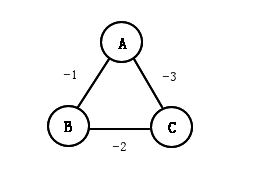
假设边的子集 T 中存在环, 则某两点之间存在多条通路, 移除其中一条通路, 子集 A' 仍然连通所有点. 因为边的权重为正, 既 w(A') < w(A), 结论与条件矛盾, 所以 T 是树. 
如果边的权重准许为负, 则子集 T 不一定是树, 图中三条边总权重最小, 如下.

Exercises 23.1-8
Let T be a minimum spanning tree of a graph G, and let L be the sorted list of the edge weights of T . Show that for any other minimum spanning tree T' of G, the list L is also the sorted list of edge weights of T'.

假设最小生成树有 n 条边, 存在两个最小生成树 和 T', 用 w(e) 表示边的权值.
T 权值递增排列 w(a1) <= w(a2) <= ... w(an)
T' 权值递增排列 w(b1) <= w(b2) <= ... w(bn)
假设 i 是两个列表中, 第一次出现边不同的位置, 既 ai ≠ bi, 先假定 w(ai) >= w(bi).

情况1, 如果 T 中含有边 bi, 由于 ai 和 bi 在列表 i 位置之前都是相同的, 若含有 bi 则一定在 i 位置后, 既有 j > i 使得 w(aj) = w(bi). 得到 w(bi) = w(aj) >= w(ai) >= w(bi), 既 w(bi) = w(aj) = w(ai), 故 i 位置处边的权值相同.

情况2, 如果 T 不包含边 bi, 则把 bi 加到 T 中, 会在某处形成一个圈. 由于 T 是最小生成树, 圈内任何一条边的权值都小于等于 w(bi), 另外这个圈中必定存在 aj 不在 T' 中, 得出 w(aj) <= w(bi) 且 j > i. 因此 w(bi) <= w(ai) <= w(aj) <= w(bi), 既 w(bi) = w(aj) = w(ai), 故 i 位置处边的权值仍相同.


Exercises 23.1-9
Let T be a minimum spanning tree of a graph G = (V, E), and let V' be a subset of V. Let T' be the subgraph of T induced by V', and let G' be the subgraph of G induced by V'. Show that if T' is connected, then T' is a minimum spanning tree of G'.

用 cut (V', V - V') 分割图 G, 该 cut 一定不影响 T', 且 T' 是 T 的子集, 所以 T' 对于 G' 是安全的. 如果 T' 是连通的, 则 T' 一定是 G' 的最小生成树.


Exercises 23.1-10
Given a graph G and a minimum spanning tree T , suppose that we decrease the weight of one of the edges in T . Show that T is still a minimum spanning tree for G. More formally, let T be a minimum spanning tree for G with edge weights given by weight function w. Choose one edge (x, y) ∈ T and a positive number k, and define the weight function w' by

Show that T is a minimum spanning tree for G with edge weights given by w'.

由于 w(T) - k = w'(T) 且 k 是正数,  假设 X 是任意其他生成树, 有 w(T) <= w(X). 如果 X 含有 (x, y), 则 w'(T) <= w'(X), 如果 X 不含有 (x, y), 则 w'(T) <= w'(X) - k, 两种情况 w'(T) 均最小. 另外, 减少权值后 T 的其他属性无变化, 仍然连通所有顶点, 并且无环. 所以使用 w' 计算权值, T 依然是最小生成树.   


Exercises 23.1-11 *
Given a graph G and a minimum spanning tree T , suppose that we decrease the weight of one of the edges not in T . Give an algorithm for finding the minimum spanning tree in the modified graph.

假设 (u, v) 不在最小生成树 T 中, 减小 (u, v) 权值后, 形成新的最小生成树 T'. 可能的情况是 T' 包含 (u, v) 或者 T' = T 保持不变. 算法只需寻找 T 中 u -> v 路径中权值最重边 x, 如果该边权值大于 (u, v), 则 T' = T - x + (u, v). 如果 (u, v) 权值大于 x, 则 T' = T. 路径可用 DFS 算法求得, 从 u 开始 v 结束. 因为 T 是最小生成树, 所以路径唯一, 时间 O(V+E).


中文名: 算法导论 原名: Introduction to Algorithms 作者: Thomas H. Cormen Ronald L. Rivest Charles E. Leiserson Clifford Stein 资源格式: PDF 版本: 文字版 出版社: The MIT Press书号: 978-0262033848发行时间: 2009年09月30日 地区: 美国 语言: 英文 简介: 内容介绍: Editorial Reviews Review "In light of the explosive growth in the amount of data and the diversity of computing applications, efficient algorithms are needed now more than ever. This beautifully written, thoughtfully organized book is the definitive introductory book on the design and analysis of algorithms. The first half offers an effective method to teach and study algorithms; the second half then engages more advanced readers and curious students with compelling material on both the possibilities and the challenges in this fascinating field." —Shang-Hua Teng, University of Southern California "Introduction to Algorithms, the 'bible' of the field, is a comprehensive textbook covering the full spectrum of modern algorithms: from the fastest algorithms and data structures to polynomial-time algorithms for seemingly intractable problems, from classical algorithms in graph theory to special algorithms for string matching, computational geometry, and number theory. The revised third edition notably adds a chapter on van Emde Boas trees, one of the most useful data structures, and on multithreaded algorithms, a topic of increasing importance." —Daniel Spielman, Department of Computer Science, Yale University "As an educator and researcher in the field of algorithms for over two decades, I can unequivocally say that the Cormen book is the best textbook that I have ever seen on this subject. It offers an incisive, encyclopedic, and modern treatment of algorithms, and our department will continue to use it for teaching at both the graduate and undergraduate levels, as well as a reliable research reference." —Gabriel Robins, Department of Computer Science, University of Virginia Product Description Some books on algorithms are rigorous but incomplete; others cover masses of material but lack rigor. Introduction to Algorithms uniquely combines rigor and comprehensiveness. The book covers a broad range of algorithms in depth, yet makes their design and analysis accessible to all levels of readers. Each chapter is relatively self-contained and can be used as a unit of study. The algorithms are described in English and in a pseudocode designed to be readable by anyone who has done a little programming. The explanations have been kept elementary without sacrificing depth of coverage or mathematical rigor. The first edition became a widely used text in universities worldwide as well as the standard reference for professionals. The second edition featured new chapters on the role of algorithms, probabilistic analysis and randomized algorithms, and linear programming. The third edition has been revised and updated throughout. It includes two completely new chapters, on van Emde Boas trees and multithreaded algorithms, and substantial additions to the chapter on recurrences (now called "Divide-and-Conquer"). It features improved treatment of dynamic programming and greedy algorithms and a new notion of edge-based flow in the material on flow networks. Many new exercises and problems have been added for this edition. As of the third edition, this textbook is published exclusively by the MIT Press. About the Author Thomas H. Cormen is Professor of Computer Science and former Director of the Institute for Writing and Rhetoric at Dartmouth College. Charles E. Leiserson is Professor of Computer Science and Engineering at the Massachusetts Institute of Technology. Ronald L. Rivest is Andrew and Erna Viterbi Professor of Electrical Engineering and Computer Science at the Massachusetts Institute of Technology. Clifford Stein is Professor of Industrial Engineering and Operations Research at Columbia University. 目录: Introduction 3 1 The Role of Algorithms in Computing 5 1.1 Algorithms 5 1.2 Algorithms as a technology 11 2 Getting Started 16 2.1 Insertion sort 16 2.2 Analyzing algorithms 23 2.3 Designing algorithms 29 3 Growth of Functions 43 3.1 Asymptotic notation 43 3.2 Standard notations and common functions 53 4 Divide-and-Conquer 65 4.1 The maximum-subarray problem 68 4.2 Strassen's algorithm for matrix multiplication 75 4.3 The substitution method for solving recurrences 83 4.4 The recursion-tree method for solving recurrences 88 4.5 The master method for solving recurrences 93 4.6 Proof of the master theorem 97 5 Probabilistic Analysis and Randomized Algorithms 114 5.1 The hiring problem 114 5.2 Indicator random variables 118 5.3 Randomized algorithms 122 5.4 Probabilistic analysis and further uses of indicator random variables 130 II Sorting and Order Statistics Introduction 147 6 Heapsort 151 6.1 Heaps 151 6.2 Maintaining the heap property 154 6.3 Building a heap 156 6.4 The heapsort algorithm 159 6.5 Priority queues 162 7 Quicksort 170 7.1 Description of quicksort 170 7.2 Performance of quicksort 174 7.3 A randomized version of quicksort 179 7.4 Analysis of quicksort 180 8 Sorting in Linear Time 191 8.1 Lower bounds for sorting 191 8.2 Counting sort 194 8.3 Radix sort 197 8.4 Bucket sort 200 9 Medians and Order Statistics 213 9.1 Minimum and maximum 214 9.2 Selection in expected linear time 215 9.3 Selection in worst-case linear time 220 III Data Structures Introduction 229 10 Elementary Data Structures 232 10.1 Stacks and queues 232 10.2 Linked lists 236 10.3 Implementing pointers and objects 241 10.4 Representing rooted trees 246 11 Hash Tables 253 11.1 Direct-address tables 254 11.2 Hash tables 256 11.3 Hash functions 262 11.4 Open addressing 269 11.5 Perfect hashing 277 12 Binary Search Trees 286 12.1 What is a binary search tree? 286 12.2 Querying a binary search tree 289 12.3 Insertion and deletion 294 12.4 Randomly built binary search trees 299 13 Red-Black Trees 308 13.1 Properties of red-black trees 308 13.2 Rotations 312 13.3 Insertion 315 13.4 Deletion 323 14 Augmenting Data Structures 339 14.1 Dynamic order statistics 339 14.2 How to augment a data structure 345 14.3 Interval trees 348 IV Advanced Design and Analysis Techniques Introduction 357 15 Dynamic Programming 359 15.1 Rod cutting 360 15.2 Matrix-chain multiplication 370 15.3 Elements of dynamic programming 378 15.4 Longest common subsequence 390 15.5 Optimal binary search trees 397 16 Greedy Algorithms 414 16.1 An activity-selection problem 415 16.2 Elements of the greedy strategy 423 16.3 Huffman codes 428 16.4 Matroids and greedy methods 437 16.5 A task-scheduling problem as a matroid 443 17 Amortized Analysis 451 17.1 Aggregate analysis 452 17.2 The accounting method 456 17.3 The potential method 459 17.4 Dynamic tables 463 V Advanced Data Structures Introduction 481 18 B-Trees 484 18.1 Definition of B-trees 488 18.2 Basic operations on B-trees 491 18.3 Deleting a key from a B-tree 499 19 Fibonacci Heaps 505 19.1 Structure of Fibonacci heaps 507 19.2 Mergeable-heap operations 510 19.3 Decreasing a key and deleting a node 518 19.4 Bounding the maximum degree 523 20 van Emde Boas Trees 531 20.1 Preliminary approaches 532 20.2 A recursive structure 536 20.3 The van Emde Boas tree 545 21 Data Structures for Disjoint Sets 561 21.1 Disjoint-set operations 561 21.2 Linked-list representation of disjoint sets 564 21.3 Disjoint-set forests 568 21.4 Analysis of union by rank with path compression 573 VI Graph Algorithms Introduction 587 22 Elementary Graph Algorithms 589 22.1 Representations of graphs 589 22.2 Breadth-first search 594 22.3 Depth-first search 603 22.4 Topological sort 612 22.5 Strongly connected components 615 23 Minimum Spanning Trees 624 23.1 Growing a minimum spanning tree 625 23.2 The algorithms of Kruskal and Prim 631 24 Single-Source Shortest Paths 643 24.1 The Bellman-Ford algorithm 651 24.2 Single-source shortest paths in directed acyclic graphs 655 24.3 Dijkstra's algorithm 658 24.4 Difference constraints and shortest paths 664 24.5 Proofs of shortest-paths properties 671 25 All-Pairs Shortest Paths 684 25.1 Shortest paths and matrix multiplication 686 25.2 The Floyd-Warshall algorithm 693 25.3 Johnson's algorithm for sparse graphs 700 26 Maximum Flow 708 26.1 Flow networks 709 26.2 The Ford-Fulkerson method 714 26.3 Maximum bipartite matching 732 26.4 Push-relabel algorithms 736 26.5 The relabel-to-front algorithm 748 VII Selected Topics Introduction 769 27 Multithreaded Algorithms Sample Chapter - Download PDF (317 KB) 772 27.1 The basics of dynamic multithreading 774 27.2 Multithreaded matrix multiplication 792 27.3 Multithreaded merge sort 797 28 Matrix Operations 813 28.1 Solving systems of linear equations 813 28.2 Inverting matrices 827 28.3 Symmetric positive-definite matrices and least-squares approximation 832 29 Linear Programming 843 29.1 Standard and slack forms 850 29.2 Formulating problems as linear programs 859 29.3 The simplex algorithm 864 29.4 Duality 879 29.5 The initial basic feasible solution 886 30 Polynomials and the FFT 898 30.1 Representing polynomials 900 30.2 The DFT and FFT 906 30.3 Efficient FFT implementations 915 31 Number-Theoretic Algorithms 926 31.1 Elementary number-theoretic notions 927 31.2 Greatest common divisor 933 31.3 Modular arithmetic 939 31.4 Solving modular linear equations 946 31.5 The Chinese remainder theorem 950 31.6 Powers of an element 954 31.7 The RSA public-key cryptosystem 958 31.8 Primality testing 965 31.9 Integer factorization 975 32 String Matching 985 32.1 The naive string-matching algorithm 988 32.2 The Rabin-Karp algorithm 990 32.3 String matching with finite automata 995 32.4 The Knuth-Morris-Pratt algorithm 1002 33 Computational Geometry 1014 33.1 Line-segment properties 1015 33.2 Determining whether any pair of segments intersects 1021 33.3 Finding the convex hull 1029 33.4 Finding the closest pair of points 1039 34 NP-Completeness 1048 34.1 Polynomial time 1053 34.2 Polynomial-time verification 1061 34.3 NP-completeness and reducibility 1067 34.4 NP-completeness proofs 1078 34.5 NP-complete problems 1086 35 Approximation Algorithms 1106 35.1 The vertex-cover problem 1108 35.2 The traveling-salesman problem 1111 35.3 The set-covering problem 1117 35.4 Randomization and linear programming 1123 35.5 The subset-sum problem 1128 VIII Appendix: Mathematical Background Introduction 1143 A Summations 1145 A.1 Summation formulas and properties 1145 A.2 Bounding summations 1149 B Sets, Etc. 1158 B.1 Sets 1158 B.2 Relations 1163 B.3 Functions 1166 B.4 Graphs 1168 B.5 Trees 1173 C Counting and Probability 1183 C.1 Counting 1183 C.2 Probability 1189 C.3 Discrete random variables 1196 C.4 The geometric and binomial distributions 1201 C.5 The tails of the binomial distribution 1208 D Matrices 1217 D.1 Matrices and matrix operations 1217 D.2 Basic matrix properties 122
评论
添加红包

请填写红包祝福语或标题

红包个数最小为10个

红包金额最低5元

当前余额3.43前往充值 >
需支付:10.00
成就一亿技术人!
领取后你会自动成为博主和红包主的粉丝 规则
hope_wisdom
发出的红包
实付
使用余额支付
点击重新获取
扫码支付
钱包余额 0

抵扣说明:

1.余额是钱包充值的虚拟货币,按照1:1的比例进行支付金额的抵扣。
2.余额无法直接购买下载,可以购买VIP、付费专栏及课程。

余额充值


