



 本文介绍了一道小学奥林匹克数学题目,通过给定正方形边长来计算特定图形中阴影部分的面积。利用三个圆之间的交集计算阴影面积,提供了一个C++实现代码示例。
Problem Description
cjj is fun with math problem. One day he found a Olympic Mathematics problem for primary school students. It is too difficult for cjj. Can you solve it?
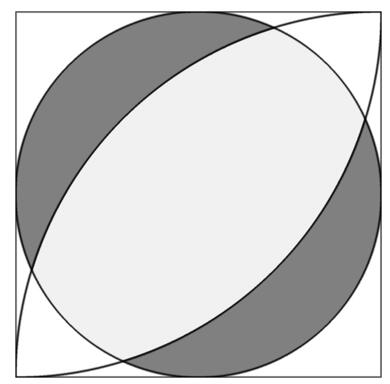
Give you the side length of the square L, you need to calculate the shaded area in the picture.
The full circle is the inscribed circle of the square, and the center of two quarter circle is the vertex of square, and its radius is the length of the square.
Input
The first line contains a integer T(1<=T<=10000), means the number of the test case. Each case contains one line with integer l(1<=l<=10000).
Output
For each test case, print one line, the shade area in the picture. The answer is round to two digit.
Sample Input
1
1
Sample Output
0.29
Author
BUPT
Source
2016 Multi-University Training Contest 10
题意:给你正方形的边长,求阴影部分的面积。。。
解法:中间那个圆的非阴影部分就是。3个圆的的面积交。。所以阴影部分的面积就是圆的面积-3个圆的交面积。。。
#include<bits/stdc++.h>
using namespace std;

const double eps=1e-8;
int cmp(double x){
    if(fabs(x)<eps) return 0;
    if(x>0) return 1;
    return -1;
}
const double pi=acos(-1.0);
inline double sqr(double x){
    return x*x;
}
struct point{
    double x,y;
    point(){};
    point(double a,double b):x(a),y(b){};
    void input(){
        scanf("%lf %lf",&x,&y);
    }
    friend point operator + (const point &a,const point &b){
        return point(a.x+b.x,a.y+b.y);
    }
    friend point operator - (const point &a,const point &b){
        return point(a.x-b.x,a.y-b.y);
    }
    friend bool operator == (const point &a,const point &b){
        return cmp(a.x-b.x)==0&&cmp(a.y-b.y)==0;
    }
    friend point operator * (const point &a,const double &b){
        return point(a.x*b,a.y*b);
    }
    friend point operator * (const double &a,const point &b){
        return point(a*b.x,a*b.y);
    }
    friend point operator / (const point &a,const double &b){
        return point(a.x/b,a.y/b);
    }
    double norm(){
        return sqrt(sqr(x)+sqr(y));
    }
};
double det(const point &a,const point &b){
    return a.x*b.y-a.x*b.y;
}
double dot(const point &a,const point &b){
    return a.x*b.x+a.y*b.y;
}
double dis(const point &a,const point &b){
    return (a-b).norm();
}
point rotate_point(const point &p,double A){
    double tx=p.x,ty=p.y;
    return point(tx*cos(A)-ty*sin(A),tx*sin(A)+ty*cos(A));
}
int dcmp(double k){
    return k<-eps?-1:k>eps?1:0;
}
double cross(const point &a,const point &b){
    return a.x*b.y-a.y*b.x;
}
double abs(const point &o){
    return sqrt(dot(o,o));
}
struct Circle{
    point p;
    double r;
    bool operator < (const Circle &o) const{
        if(dcmp(r-o.r)!=0) return dcmp(r-o.r)==-1;
        if(dcmp(p.x-o.p.x)!=0){
            return dcmp(p.x-o.p.x)==-1;
        }
        return dcmp(p.y-o.p.y)==-1;
    }
    bool operator == (const Circle &o) const{
        return dcmp(r-o.r)==0&&dcmp(p.x-o.p.x)==0&&dcmp(p.y-o.p.y)==0;
    }
};

//圆的交面积
double area(Circle &x,Circle &y){
    double a=dis(x.p,y.p),b=x.r,c=y.r;
    double cta1=acos((a*a+b*b-c*c)/2/(a*b)),
           cta2=acos((a*a+c*c-b*b)/2/(a*c));
    double s1=b*b*cta1-b*b*sin(cta1)*(a*a+b*b-c*c)/2/(a*b);
    double s2=c*c*cta2-c*c*sin(cta2)*(a*a+c*c-b*b)/2/(a*c);
    return s1+s2;
}

//圆的面积并。
point rotate(const point &p,double cost,double sint){
    double x=p.x,y=p.y;
    return point(x*cost-y*sint,x*sint+y*cost);
}
pair<point,point> crosspoint(point ap,double ar,point bp,double br){
    double d=(ap-bp).norm();
    double cost=(ar*ar+d*d-br*br)/(2*ar*d);
    double sint=sqrt(1.0-cost*cost);
    point v=(bp-ap)/(bp-ap).norm()*ar;
    return make_pair(ap+rotate(v,cost,-sint),ap+rotate(v,cost,sint));
}
inline pair<point ,point> crosspoint(const Circle &a,const Circle &b){
    return crosspoint(a.p,a.r,b.p,b.r);
}
Circle tc[10]; //待求圆
int m;         //待求圆的个数
struct Node{
    point p;
    double a;
    int d;
    Node(const point &p,double a,int d):p(p),a(a),d(d){};
    bool operator <(const Node &o)const{
        return a<o.a;
    }
};
double arg(point p){
    return arg(complex<double>(p.x,p.y));
}
double solve(){   //返回并面积
    int n=0;
    Circle c[10];
    sort(tc,tc+m);
    m=unique(tc,tc+m)-tc;
    for(int i=m-1;i>=0;--i){
        bool ok=true;
        for(int j=i+1;j<m;j++){
            double d=(tc[i].p-tc[j].p).norm();
            if(dcmp(d-abs(tc[i].r-tc[j].r))<=0){
                ok=false;
                break;
            }
        }
        if(ok) c[n++]=tc[i];
    }
    double ans=0;

    for(int i=0;i<n;i++){
        vector<Node>event;
        point boundary=c[i].p+point(-c[i].r,0);
        event.push_back(Node(boundary,-pi,0));
        event.push_back(Node(boundary,pi,0));
        for(int j=0;j<n;++j){
            if(i==j) continue;
            double d=(c[i].p-c[j].p).norm();
            if(dcmp(d-(c[i].r+c[j].r))<0){
                pair<point,point> ret=crosspoint(c[i],c[j]);
                double x=arg(ret.first-c[i].p);
                double y=arg(ret.second-c[i].p);
                if(dcmp(x-y)>0){
                    event.push_back(Node(ret.first,x,1));
                    event.push_back(Node(boundary,pi,-1));
                    event.push_back(Node(boundary,-pi,1));
                    event.push_back(Node(ret.second,y,-1));
                }
                else{
                    event.push_back(Node(ret.first,x,1));
                    event.push_back(Node(ret.second,y,-1));
                }
            }
        }
        sort(event.begin(),event.end());
        int sum=event[0].d;
        for(int j=1;j<(int)event.size();++j){
            if(sum==0){
                ans+=cross(event[j-1].p,event[j].p)/2;
                double x=event[j-1].a;
                double y=event[j].a;
                double area=c[i].r*c[i].r*(y-x)/2;
                point v1=event[j-1].p-c[i].p;
                point v2=event[j].p-c[i].p;
                area-=cross(v1,v2)/2;
                ans+=area;
            }
            sum+=event[j].d;
        }
    }
    return ans;
}
int main(){

    int t;
    scanf("%d",&t);
    while(t--){
        double n;
        Circle a,b,c;
        scanf("%lf",&n);
        a.p.x=(n/2);
        a.p.y=n/2;
        a.r=n/2;

        b.p.x=n;
        b.p.y=0;
        b.r=n;

        c.p.x=0;
        c.p.y=n;
        c.r=n;
        double temp=2*pi*(n/2)*(n/2)-area(a,b)-area(a,c);
        printf("%.2f\n",temp);
    }
    return 0;
}





 扫一扫
扫一扫


&spm=1001.2101.3001.5002&articleId=52245336&d=1&t=3&u=892e3a4155fd4ea39974ae55cfa94292)
 6080
6080

 被折叠的 条评论
为什么被折叠?
被折叠的 条评论
为什么被折叠?
 到【灌水乐园】发言





