Car

A car, also named an automobile, is a four-wheeled vehicle powered by an engine (running on gasoline, electricity, gas, etc.). It is used for the land transport of people or goods and is one of the most widespread means of transport on Earth.
The word automobile means "that which moves by itself".
History[edit | edit source]

Cugnot's Fardier[edit | edit source]
The first automobile was a three-wheeled wooden chassis powered by a steam engine, with rudimentary steering and brakes, and a bench to sit on: In 1769, the French engineer Joseph Cugnot invented a steam-powered fardier, a heavy cart designed to haul cannons for the army. The steering wheel, which also served as the drive wheel, supported the weight of the boiler. It is said that during its first test run, the fardier knocked down a wall. In 1771, Cugnot tested a second fardier. It could pull 5 tons and had a speed of 3.5 km/h. However, to build up pressure in the boiler—and thus supply it with fuel—it was necessary to stop every 10 minutes. This invention came far too early to be practical, and the idea lay dormant for a century. Yet it was the direct ancestor of trucks, automobiles, and even locomotives. The first steam-powered automobiles were created in 1882.
First Traffic Code[edit | edit source]
Between 1861 and 1865, in the United Kingdom, government decrees (the Locomotives Acts) were enacted to limit the speed of steam-powered locomobiles: they were not to exceed 6 km/h on roads and 3.5 km/h in towns. They had to be preceded by an assistant walking on foot and waving a red flag to warn of danger.
Internal Combustion Engine: The Patent-Motorwagen[edit | edit source]
In 1862, the Frenchman Alphonse Beau de Rochas outlined the principle of the engine with a four-stroke cycle. In 1864, the German Nikolaus August Otto developed the first four-stroke internal combustion engine.
In 1886, the German Carl Benz built his tricycle "Patent-Motorwagen", the first automobile in history powered by an internal combustion engine. Like modern cars, the Patent-Motorwagen had a gasoline engine, electric ignition, a carburetor, a water-cooled radiator, and a true steel chassis. Its top speed was 15 km/h.
Gottlieb Daimler had already conducted the first test of a motorcycle made of wood in 1885. In 1886, he adapted gasoline engines to a boat and a four-wheeled, wooden calèche .
.
The first commercially available cars appeared in the early 1890s, with the small series of Benz's Patent-Motorwagen tricycle.
Next came the first cars from Peugeot, Renault, and many others.
-

-
 A replica of the "Patent-Motorwagen", on a street in Frankfurt am Main.


Steam cars[edit | edit source]
At the same time, steam-powered cars were built, but mainly steam trucks.
In 1872, Amédée Bollée, a bell founder in Le Mans, built a steam-powered carriage called "L'Obéissante," capable of carrying 12 passengers. In 1875, L'Obéissante traveled from Le Mans to Paris—a distance of 230 km—in 18 hours. In 1879, a new steam-powered automobile nicknamed "La Marie-Anne" towed 100 tons at 10 km/h.
In 1886, the Marquis Albert de Dion put the first steam-powered tricycle into service. In 1889, Léon Serpollet built his first steam-powered car.
Steam trucks were produced until the mid-20th century, mainly in England.
Inventions promoting automotive progress[edit | edit source]
In 1895, the Michelin brothers from Clermont-Ferrand, France, invented the removable pneumatic tire.
In 1895, Louis Renault developed the direct-drive gearbox with reverse gear.
In 1905, Alexandre Darracq invented disc brakes.
In 1912, the American manufacturer Cadillac installed the first electric starters in its cars.
Mass Production: The Ford Model T[edit | edit source]

To reduce costs and increase sales, Henry Ford, based in Detroit (Michigan), pioneered the assembly line with the Model T, a simple, sturdy, and easy-to-repair vehicle that remained virtually unchanged for two decades, from 1908 to 1927.
These cars, with their wooden artillery wheels, remained in service in rural America well into the 1940s, often converted into pickup trucks by simply adding a wooden bed to the rear. The engine was large (2.9-liter displacement) and consumed a lot of fuel (15 to 18 liters of gasoline per 100 km), but that didn’t matter, since at that time, American oil was flowing freely. The car could reach a speed of 72 km/h.
It was a worldwide success: 15 million Model Ts were built. The car was also assembled in England, Germany, Denmark, Ireland, Brazil, and Argentina. Ford manufactured replacement engines until 1941.
 To learn more, read the article: Henry Ford. To learn more, read the article: Ford.
Technical Advances: The Citroën Traction[edit | edit source]
The Citroën Traction, which went into production in 1934, featured a number of innovations that are still found in today's cars: monocoque body (no chassis), aerodynamic and low-slung, overhead valve engine (valves at the top of the engine), front-wheel drive (the front wheels are the drive wheels), and hydraulic brakes. The Traction handles well, goes faster, and uses less fuel. Depending on the model, it can reach speeds of 95 to 130 km/h. Only the DS managed to dethrone it starting in 1955.
To learn more, read the article: Citroën.
The Volkswagen, the People's Car[edit | edit source]
The Volkswagen ("People's Car" in German) was intended to be a car for everyone. It was unveiled in 1936, but production did not truly begin until 1948. With its two-door body, rear-mounted air-cooled engine, stiff suspension, and poor handling, it was the complete opposite of the Traction, but it served as a model for other small rear-engine cars that were very popular until the 1960s, such as the Renault 4 CV, the Dauphine, and the Simca 1000.
To learn more, read the article: Volkswagen.Luxury cars[edit | edit source]

From the very beginning of the automobile era, luxury cars appeared in Europe and America:


- Isotta Fraschini (1900–1949)
- Fiat
To learn more, read the article: Sports car.After 1945[edit | edit source]
After World War II, automobiles became more sophisticated and widespread, and infrastructure (such as highways, parking lots, and garages) proliferated. During the Glorious Thirty, in the West, the consumer society made it easy to buy a car using credit and advertisements that highlighted the idea of freedom that a car provides. A luxury item at the beginning of the 20th century, the automobile became more accessible and came to symbolize freedom and mobility. Cars were featured in the arts (songs, American films, sculptures by César) and as art in their own right (automotive design). In East Germany, the Trabant car was one of the symbols of communist society. Automobile companies became multinational corporations and came to symbolize capitalism. In the 1970s and 1980s, a new production system emerged: Toyotism, which prioritized quality and manufactured according to demand to avoid excess inventory. Robotization and the use of electronics transformed factory work, and specialized workers disappeared. Starting in the 1980s and with the emergence of China and other countries (Mexico, Brazil, India, etc.), there was a growing awareness of the challenges facing the automotive industry: dependence on oil, air pollution, traffic congestion, land use by roads and parking lots, and urban sprawl.
In the 21st century, the automotive industry is shifting toward the production of electric vehicles.
Technology and construction[edit | edit source]
Body styles[edit | edit source]
Cars come in different body styles depending on their intended use:
- sedan, a car with four side doors (and a rear hatchback)
- station wagon, a car whose rear section resembles that of a van but is glazed
- coupe, a closed car, usually a two-seater
- convertible, a car with a removable roof
- utility vehicle, a car designed for transporting people or goods and featuring a large cargo area
- minivan
-
 A Rolls-Royce sedan
 -
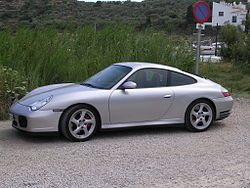 A Porsche coupe
 -
 A Rolls-Royce convertible


.jpg)
Drive system[edit | edit source]
The engine drives either the front wheels (front-wheel drive) or the rear wheels (rear-wheel drive) or all four wheels (4x4).
Electronics[edit | edit source]
Modern cars contain dozens of microchips, which allow for better control of braking, assist with steering, or correct trajectory errors, and manage the engine.[1]
Social role[edit | edit source]
A Means of freedom[edit | edit source]
Most often, the automobile is considered a form of personal transportation. To drive a car, one must obtain a driver's license.
Cars or public transportation?[edit | edit source]
A car can carry two to nine people, but on average carries only one or two. It allows a person to go wherever and whenever they want, which makes it more convenient than public transportation (such as the bus). The car is reinventing itself with a new form of public transportation that is more eco-friendly and less expensive (sharing the costs of motorized travel): carpooling (with 3 to 4 passengers in one car, carpooling signals the end of traffic jams with fewer vehicles on the roads and thus a reduction in CO2 emissions). People who carpool would not have to buy a car or maintain it on their own at a professional garage.
Cars and the environment[edit | edit source]
Cars are generally polluting (emitting greenhouse gases such as carbon dioxide).
Related articles[edit | edit source]
- Taxi
- Car passenger
- List of the world's fastest production cars
- Blue Flame
- Automotive mechanic
- Kartcross
- Bugatti Bolide
- Audi Q5
References[edit | edit source]
- ^ The shortage is not about to ease, April issue of the British journal New Scientist, cited by Courrier International No. 1590, April 22–28, 2021, p. 34
|

