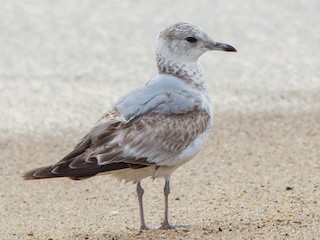
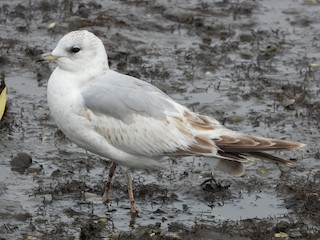
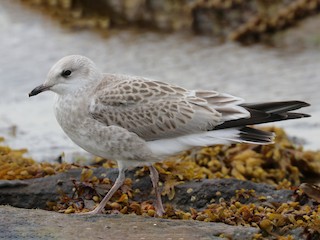
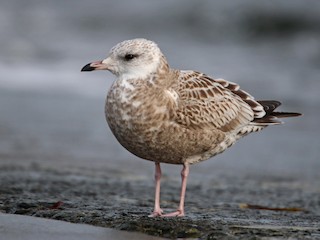
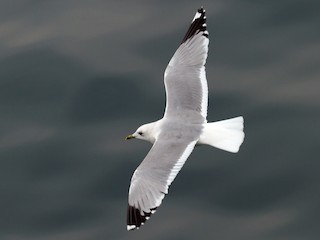
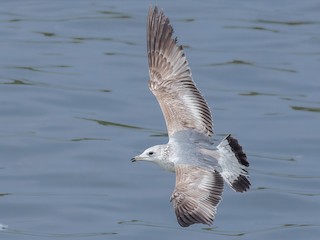
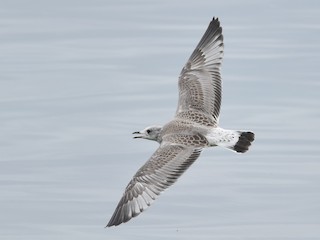
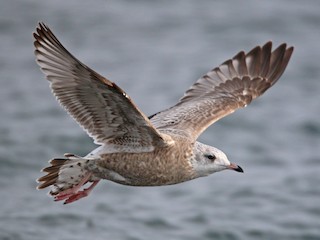
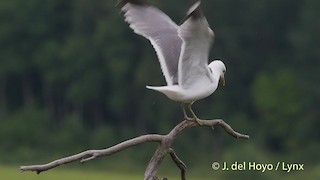

Common Gull Larus canus Scientific name definitions
- Names (59)
- Subspecies (3)
Revision Notes
Sign in to see your badges
Species names in eBird-supported languages
| Language | Common name |
|---|---|
| Afrikaans | Stormmeeu |
| Albanian | Pulëbardha e përhime |
| Arabic | نَوْرَسٌ شائع |
| Armenian | Թխակապույտ որոր |
| Asturian | Gaviota cana |
| Azerbaijani | Boz qağayı |
| Basque | Kaio mokohoria |
| Bulgarian | Чайка буревестница |
| Catalan | gavina cendrosa |
| Chinese | 歐亞海鷗 |
| Chinese (Hong Kong SAR China) | 海鷗 |
| Chinese (SIM) | 普通海鸥 |
| Croatian | burni galeb |
| Czech | racek bouřní |
| Danish | Stormmåge |
| Dutch | Stormmeeuw |
| English | Common Gull |
| English (AVI) | Common Gull |
| English (United States) | Common Gull |
| Estonian | kalakajakas |
| Faroese | Skatumási |
| Finnish | kalalokki |
| French | Goéland cendré |
| Galician | Gaivota cana |
| Georgian | ვეჟანი თოლია |
| German | Sturmmöwe |
| Greek | Θυελλόγλαρος |
| Gujarati | મ્યુ ધોમડો |
| Hebrew | שחף אפרורי |
| Hungarian | Viharsirály |
| Icelandic | Stormmáfur |
| Italian | Gavina |
| Japanese | カモメ |
| Kazakh | Көк шағала |
| Korean | 갈매기 |
| Kyrgyz | Көк чардак |
| Latvian | Kajaks |
| Lithuanian | Paprastasis kiras |
| Malayalam | മ്യൂ കടൽക്കാക്ക |
| Mongolian | Үүлэн цахлай |
| Nepali (Nepal) | मिउ गङ्गाचील |
| Norwegian | fiskemåke |
| Persian | کاکایی نوکسبز |
| Polish | mewa siwa |
| Portuguese (Portugal) | Famego |
| Punjabi (India) | ਧੂਮਰ ਡਮਰਾ |
| Romanian | Pescăruș sur |
| Russian | Сизая чайка |
| Serbian | Sivi galeb |
| Slovak | čajka sivá |
| Slovenian | Sivi galeb |
| Spanish | Gaviota Cana |
| Spanish (Spain) | Gaviota cana |
| Swedish | fiskmås |
| Tajik | Моҳихураки кабуд |
| Thai | นกนางนวลปากเหลือง |
| Turkish | Küçük Gümüş Martı |
| Ukrainian | Мартин сивий |
| Welsh | gwylan gweunydd |
Revision Notes
Pamela C. Rasmussen standardized the account's content with Clements taxonomy.
Larus canus Linnaeus, 1758
Definitions
- LARUS
- canus
The Key to Scientific Names
Legend Overview
Content Partner

Full content is available exclusively to Birds of the World subscribers. Sign in Learn more
Introduction
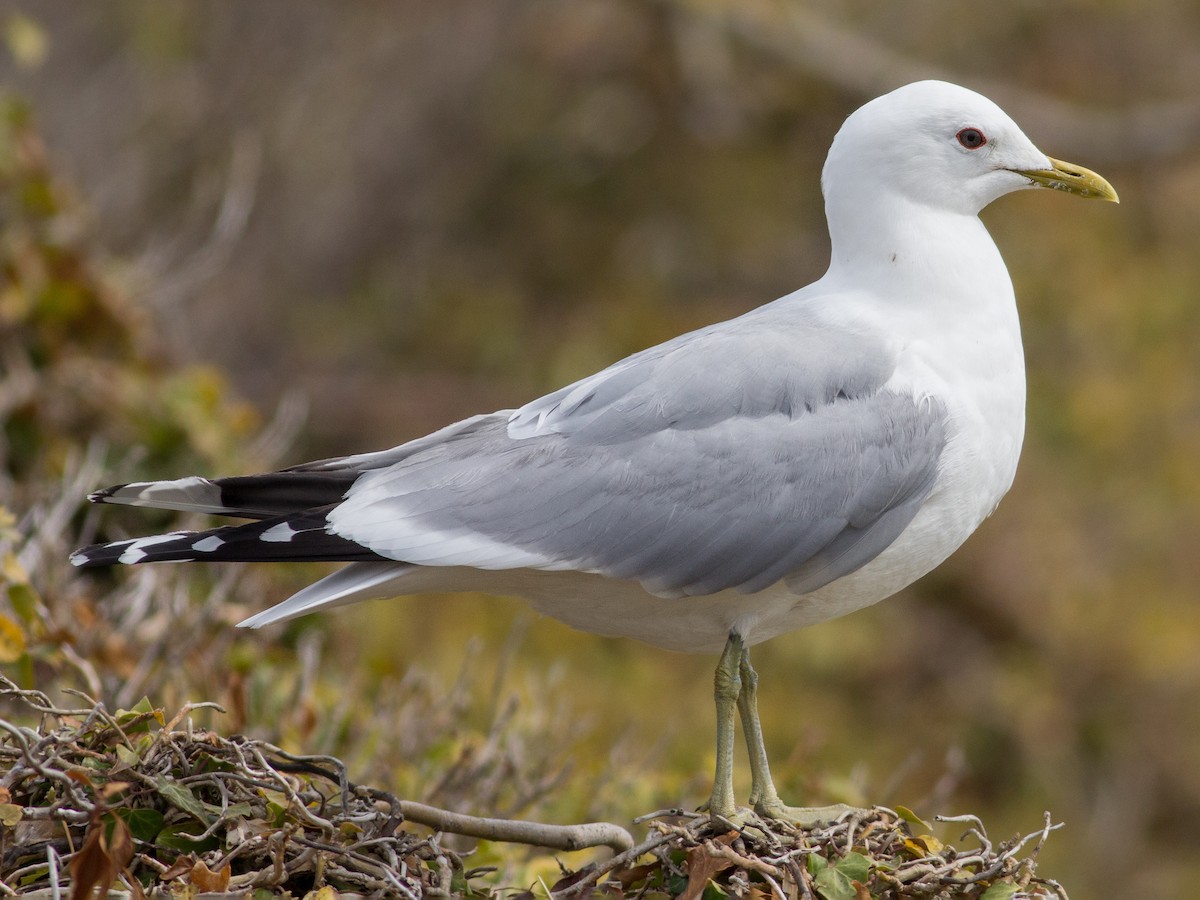
The Common Gull is a rather small white-headed gull with no distinct bill spot that is very familiar across much of Eurasia. When lumped with the Short-billed Gull L. brachyrhynchus, as has long been the case until very recently, the combined species has also been called Mew Gull in some global sources, but this has never gained wide usage in the Old World. The northeast Asian form known as "Kamchatka Gull" has also sometimes been considered a separate species but is evidently more closely related to the nominate than to L. brachyrhynchus.
Many aspects of the biology of the Common Gull have been studied, including the relationship between sexual and agonistic behavior (1), breeding behavior in Ireland (2), growth energetics (3), habitat selection in Poland (4), nest-site selection in Finland (5), population ecology in Estonia (6), and nest-defense behavior in Finland (7).
Subspecies
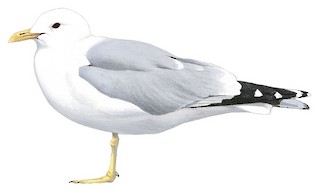
Common Gull (European) Larus canus canus Scientific name definitions
Systematics History
L. c. canus Linnaeus, 1758; type locality restricted to Sweden.
Distribution
Breeds Iceland and British Isles east to White Sea, Russia; winters across Europe to n. Africa east to Persian Gulf; rare in winter (Sep-May) along Atlantic Seaboard, with a few summering records in recent years from Quebec attributed to this race. Specimens of L. c. canus have been taken in Greenland and Massachusetts (35, 36). Occurrence along Atlantic coast of North America also supported by many sight reports supported with identifiable photographs showing characters of this subspecies; most records are from Newfoundland and e. Quebec (B. Mactavish unpubl., Quebec regional summaries in North American Birds and predecessors), whereas scattered records exist from Nova Scotia, New Brunswick, Maine, Massachusetts, New York, Maryland, Virginia, and N. Carolina (37, 35, 38, LRB). One specimen, from Lock's Cove, Newfoundland, 19 Apr 1956 was of a bird banded as a chick on the White Sea (37); another individual banded as a chick in Iceland returned to Newfoundland for at least 6 winters (B. Mactavish pers. comm.). So far, all North American records identifiable as L. c. canus are from the immediate coastal region, but with increasing populations in Iceland and consequent increase in records in recent decades along the east coast, records from farther inland in e. North America might be expected.
Field Identification
Medium size, similar to L. brachyrhynchus but perhaps slightly heavier and with slightly bigger bill; adult has black extending to near tips of primary coverts on P8-P9; usually lacks white spot between gray and black on primaries, although this highly variable, and many specimens show some small white spots similar to L. brachyrhynchus (LRB); mantle medium to pale gray, with w. European birds averaging paler than L. brachyrhynchus (some almost as pale as Ring-billed Gull); eye generally dark (averages darker than L. brachyrhynchus).
Larus canus canus Linnaeus, 1758
Definitions
- LARUS
- canus
The Key to Scientific Names
Legend Overview
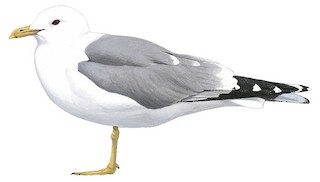
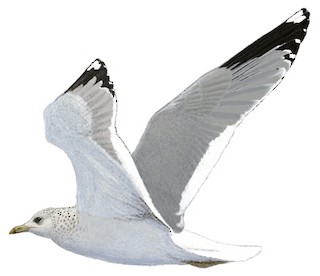
Common Gull (Russian) Larus canus heinei Scientific name definitions
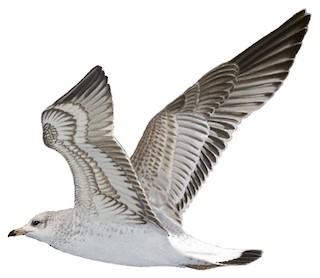
Systematics History
L. c. heinei Homeyer, 1853; type locality based on wintering bird from Greece (synonyms L. c. var. major Middendorff and L. c. stegmanni Brodkorb).
Distribution
Breeds across a vast region from central Russia (Kanin Peninsula and Moscow region) east to w. and central Siberia (Lena River); winters Baltic Sea, se. Europe, Black and Caspian Seas, Persian Gulf, and, to lesser extent, e. Mediterranean basin, n. Red Sea, and perhaps also se. China. Diagnosability of this taxon from L. c. canus needs to be reexamined; many birds not certainly identifiable (e.g., see 30). Birds showing wing characters of this subspecies reported over 1,200 km east of Lena River on Omolon River (10).
Field Identification
Similar to L. c. canus, but averages larger and darker on mantle; tends to be whiter-headed in Basic plumages, being more sparsely marked on head and neck; intermediates with L. c. canus frequent in Israel (39).
Larus canus heinei Homeyer, 1853
Definitions
- LARUS
- canus
- heinei
The Key to Scientific Names
Legend Overview
Common Gull (Kamchatka) Larus canus kamtschatschensis Scientific name definitions
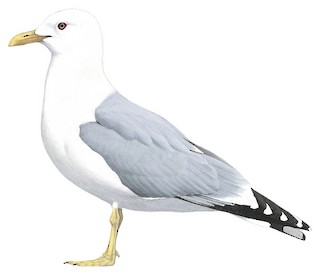
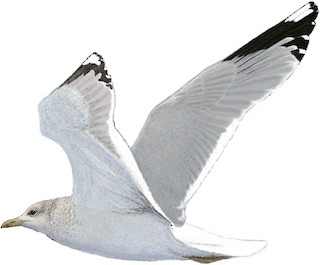
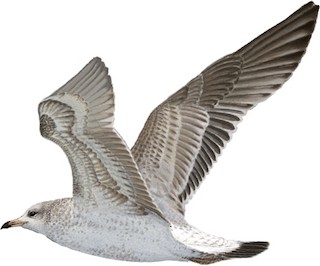
Systematics History
L. c. kamtschatschensis (Bonaparte, 1857); substitute name for Gavina Kamtchatchensis Bonaparte, 1854; type locality Kamchatka.
Distribution
Breeds ne. Siberia from Lena River east to Anadyrland and Koryakland, south to Sakhalin, Kamchatka, and Kuril Is.; winters coastal e. Asia (China, Taiwan, Japan, and islands south of Japan). Vagrant to w. Aleutians (Attu, Shemya), St. Lawrence I., and Pribilof Is. (St. Paul), based on photographs and specimens (40). Other reports along west coast of North America remain uncertain.
Field Identification
Largest subspecies, with relatively more robust bill that is thicker and more parallel-sided than other races; black extends basally to near tips of primary coverts on P8-P9; P1-P7 usually with white spot between gray and black; mantle medium gray; eye generally pale yellow.
Larus canus kamtschatschensis (Bonaparte, 1857)
Definitions
- LARUS
- canus
- kamschaticus / kamschatkensis / kamtschatica / kamtschaticus / kamtschatkensis / kamtschatschensis
The Key to Scientific Names
Legend Overview
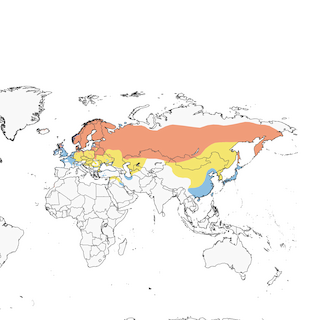
- Year-round
- Migration
- Breeding
- Non-Breeding
Map last updated 12 December 2023.