

How to Answer Network Outage Questions
Lower the stress of network outage discussions with these business-friendly answers to two common questions: What happened? When will it be fixed?
Join the DZone community and get the full member experience.
Join For FreeEnterprise network outages are a big deal. When a company’s network goes down, the employees or customers can’t do what they need to do. The impact ranges from minor frustration to major loss of income for a business.
One thing all network outages come with is stress. Business teams and company leaders descend on network teams demanding answers to their network outage questions.
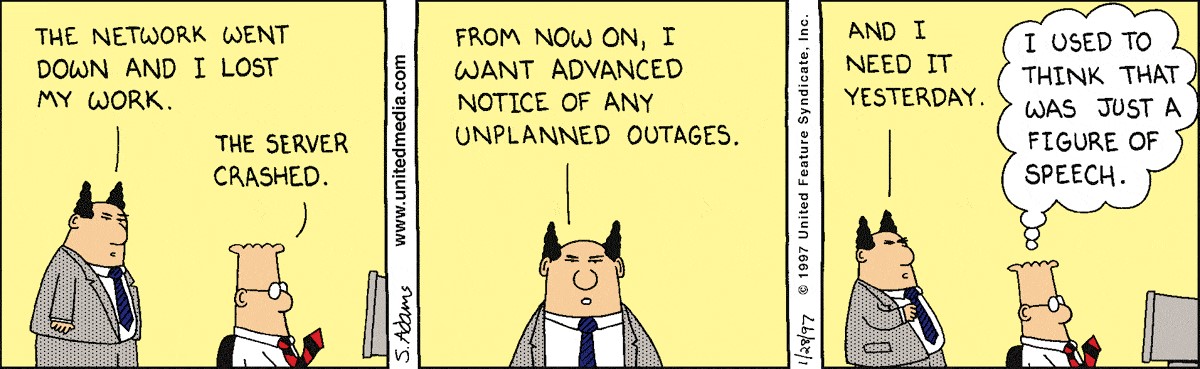
These conversations are difficult. The pressure caused by network outages will never go away. But if you want to make the conversations easier, it helps to know how to answer the two most common questions business stakeholders will ask.
- Why is the network down?
- When will it be fixed?
If you can answer these questions in a way the business teams understand, you’ll have shorter, less stressful conversations. That means you get more time to focus on solving the problem.
Common Network Outage Question 1: Why Is the Network Down?
Business stakeholders often ask this question even when they don’t really care why it is down. What they actually care about is when will the network be working again. However, when they ask a question it’s a good idea to answer it.
If you know the reason for the outage, your answers should be a single sentence stating the cause. You should always describe the cause in terms the business understands. You might know that a PoE switch/injector failed, but that is meaningless to the business. Instead, simplify the failure into basic terms. Often, it is enough to say something like, “One of the network boxes died."
Here's how to describe some common causes of network outages in business-friendly terms:
- Hardware failure = “One of the network boxes died.”
- Physical damage to cables = e.g., “A mouse chewed through a cable.”
- Network congestion = “Too many users doing too many things.”
- Power outages = “The power went out.” (This one is simple!)
- Security attacks, such as denial of service (DoS) = “Someone tried to hack into the network.”
These all avoid technical detail and make sense to a non-technical person.
If human error caused the outage the simplest thing to say is, “We made a mistake, and are fixing it now.”
What to Say When You Don’t Yet Know the Cause of the Outage
When asked, “Why is the network down?” and you don’t yet know why the simple way to respond is, “We don’t know but are looking into it.”
This isn’t a satisfying answer and usually leads to them asking, “Why don’t you know?” After taking a deep breath and trying not to roll your eyes, here’s how to respond in a way the business teams should understand.
“When the lights go out in a room, you don’t know if it is the bulb, the fuse, or if the power is out in the building or on the street. You don’t immediately know the cause, so you go around checking things. That takes time. We are doing the same thing. We are searching for the problem in the network. As soon as we know, we will let you know the expected time to fix it.”
Using an analogy like this helps give context to the search for the issue. Most people can relate to searching for the cause when the lights go out. It doesn’t stop the network outage from being a problem, but it can help business teams understand why you don’t have an instant answer.
Common Network Outage Question 2: When Will It Be Fixed?
This is the question most people want to be answered. When will life return to normal? It is also a common cause of frustration between tech and business teams. The business wants to know how long they have to wait and the tech teams don’t always know.
If you know when the outage will be fixed, great. Tell the business team, “It’ll take 2 hours” (or whatever length of time you expect).
If you don’t know how long the fix will take, that’s a trickier conversation. It is tempting to say “It’ll be fixed when it’s fixed.” Unfortunately, that leads to more frustration and escalation to more senior leaders.
The first thing to do is be open about not knowing. It is far better to say you don’t know than to make up a time. If you give a made-up time, the business will then expect the solution in that timeframe. If you later find out the fix will take longer, you have to go back and give a new timeline. That’s never a fun conversation.
Be open if you don't know how long a fix will take.
Second, you should give a timeline for when you expect to know. No one likes an open-ended timeline. Anyone hearing, “We don’t know when it will be fixed,” imagines days and days without access to their work email.
To avoid causing panic, however fun that may seem in the moment, you should always give a timeline. You might not know how long it will take to fix the issue, but you probably know when you'll have better information. Share than information. Give the business teams a timeline for the next step in the process. It will help.
Always give a timeframe for the next step.
Instead of saying, “We don’t know how long it will take,” say, “We are looking into the cause and hope to know the cause in X hours’ time. Then we'll tell you how long the fix should take.” You are not committing to a deadline for fixing the whole network outage. Instead, you are giving a timeline for when more or better information will be available.
The benefit of setting a timeframe like this is you give a deadline for your next update. Instead of having people ask you every 15 minutes, you state when more info will be available. Then you can focus on finding and fixing the problem.
Conclusion
The pressure caused by network outages will never go away. However, talking to business teams about them can be easier when you know how to answer their questions. The two most common questions business stakeholders will ask are:
- Why is the network down?
- When will it be fixed?
Answer these network outage questions in a way the business teams will understand, and you’ll have less stressful conversations. That means you get more time to focus on solving the problem.
Opinions expressed by DZone contributors are their own.

Comments