Sponsored
This item cannot be dispatched to your selected delivery location. Please choose a different delivery location.
Added to

Sorry, there was a problem.

There was an error retrieving your Wish Lists. Please try again.

Sorry, there was a problem.

List unavailable.
Kindle app logo image

Download the free Kindle app and start reading Kindle books instantly on your smartphone, tablet or computer – no Kindle device required.

Read instantly on your browser with Kindle for Web.

Using your mobile phone camera - scan the code below and download the Kindle app.

QR code to download the Kindle App

  • The Life You Can Save: How to play your part in ending world poverty

Follow the author

Follow authors for new release and deal updates, plus improved recommendations. See updates from all followed authors in Your Books.
Something went wrong. Please try your request again later.

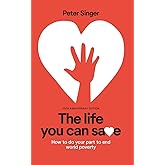
The Life You Can Save: How to play your part in ending world poverty

4.3 out of 5 stars (2)

This is an explosive manifesto on the responsibilities of the developed West in the face of unchecked global poverty.What is a human life worth? Can we put a figure on it? We say we believe in the equality of each individual life, but do our actions bear this out?From acclaimed philosopher Peter Singer comes a radical challenge to Western affluence and apathy, and a series of seaching questions. Writing on ethics for more than 30 years, he was nonetheless astonished to discover that if the top 10 per cent of America's rich were to give 10 per cent or their earnings in aid, world poverty could in theory be eliminated. And in a world in which more than a billion people are richer than ever previously known, yet more than a billion others struggle to survive on less than a dollar a day, he believed this to be not simply an arresting statistic, but a burning moral issue.In his groundbreaking new book, Singer argues, with unerring logic, against the traditional view that it is good to practise charity but that it's not wrong if you don't. Exploring the ethics of philanthropy and the implications of a demanding morality for what we know of human nature - its drive towards self-interest, its limited capacity for altruism - he exposes the vagaries of our thought processes and interactions. More than an emotive call to arms, "The Life You Can Save" is a persuasive, rigorous and searing philosophical lesson in how we might, and why we should, mobilize ourselves to give.
Sponsored

Product description

About the Author

Peter Singer is Ira W. DeCamp Professor of Bioethics at Princeton University. Author, co-author, or editor of forty books on a range of topics, Singer is best known for Animal Liberation, widely considered to be the founding statement of the animal-rights movement. In 2005, Time magazine voted him 'one of the 100 most influential people in the world.' He lives in Melbourne, Australia, and is married with three daughters.

Product details

  • Publisher ‏ : ‎ Picador
  • Publication date ‏ : ‎ 20 Mar. 2009
  • Edition ‏ : ‎ Open Market
  • Language ‏ : ‎ English
  • Print length ‏ : ‎ 224 pages
  • ISBN-10 ‏ : ‎ 0330479806
  • ISBN-13 ‏ : ‎ 978-0330479806
  • Item weight ‏ : ‎ 248 g
  • Dimensions ‏ : ‎ 13.5 x 1.8 x 21.6 cm
  • Best Sellers Rank: 3,446,535 in Books (See Top 100 in Books)
  • Customer reviews:
    4.3 out of 5 stars (2)

About the author

Follow authors for new release and deal updates, plus improved recommendations. See updates from all followed authors in Your Books.
Peter Singer
Brief content visible, double tap to read full content.
Full content visible, double tap to read brief content.

Peter Singer is sometimes called "the world’s most influential living philosopher" although he thinks that if that is true, it doesn't say much for all the other living philosophers around today. He has also been called the father (or grandfather?) of the modern animal rights movement, even though he doesn't base his philosophical views on rights, either for humans or for animals.

Singer is known especially for his work on the ethics of our treatment of animals, for his controversial critique of the sanctity of life doctrine in bioethics, and for his writings on the obligations of the affluent to aid those living in extreme poverty.

Singer first became well-known internationally after the publication of Animal Liberation in 1975. In 2011 Time included Animal Liberation on its “All-TIME” list of the 100 best nonfiction books published in English since the magazine began, in 1923. In 2023, Singer published Animal Liberation Now, in order to bring the book fully up to date.

Singer has written, co-authored, edited or co-edited more than 50 books, including Practical Ethics; The Expanding Circle; How Are We to Live?, Rethinking Life and Death, The Ethics of What We Eat (with Jim Mason), The Point of View of the Universe (with Katarzyna de Lazari-Radek), The Most Good You Can Do, Ethics in the Real World and Utilitarianism: A Very Short Introduction (with Katarzyna de Lazari-Radek). His works have appeared in more than 30 languages.

Singer’s book The Life You Can Save, first published in 2009, led him to found a non-profit organization of the same name. In 2019, Singer regained the rights to the book and granted them to the organization, enabling it to make the eBook and audiobook versions available free from its website, www.thelifeyoucansave.org.

Peter Singer was born in Melbourne, Australia, in 1946, and educated at the University of Melbourne and the University of Oxford. After teaching in England, the United States and Australia, he has, since 1999, been Ira W. DeCamp Professor of Bioethics in the University Center for Human Values at Princeton University. He is married, with three daughters and four grandchildren. His recreations include hiking and surfing. In 2012 he was made a Companion of the Order of Australia, the nation’s highest civic honour, and in 2021 he was awarded the Berggruen Prize for Philosophy.

Customer reviews

4.3 out of 5 stars
2 global ratings

Top reviews from the United Kingdom

  • 3 out of 5 stars
    Preaching to the choir
    Reviewed in the United Kingdom on 22 March 2009
    Brief content visible, double tap to read full content.
    Full content visible, double tap to read brief content.

    The author of this book is a philosopher and that bugged me. I would rather he was an economist or a christian or a muslim or Bill Gates or Paul Farmer. So what does he know? We all can work out that we could and should give a heck of a lot more to the poor people of the world. We all also know that the reasons that we don't are the merest excuses. If, knowing this, you are still brave enough to pick up the book and read it you will be dealt some very interesting (and horrifying) facts and figures, a few swift kicks to the conscience and some slight opportunities to tut-tut at the even more selfish and extravagant than you are. Ultimately unedifying. Go and make peace with your own conscience. Better yet, give to the poor and quit the navel-gazing.

    2 people found this helpful
    Sending feedback...
    Thank you for your feedback.
    Sending feedback...
    Thank you. We’ll investigate in the next few days.

    We’ll check if this review meets our community guidelinesOpens in a new tab. If it does not, we will remove it.