
"The study of business prosperity that is connected by faith" - The "prosperity" that Rennyo Shonin spoke of, and its modern management interpretation [Column] The Joyful Science of Thinking (part 107)

絆マガジン追加用に、こちらの記事をGoogleで英語に訳した記事です🌟
"The accumulation of one person's faith creates the future."
During the Obon festival, I visited a temple with my mother and heard a comment from the head priest that changed the meaning of "prosperity in business" for me.
"Prosperity is not about gathering many people. It is about gaining the trust of even one person. In this column, we will look again at what lies between "trust" and "numbers" and explore the essence of "prosperity"
that can be applied to modern business and organizational management .
🧠 Three things you will learn from this column
① The difference in meaning between "prosperity" and "flourishing"
→ Learn from Buddhist thought that prosperity is not just about sales and attracting customers.② A value circulation model that starts with trust
→ Understand how the trust of one person leads to gratitude and referrals, and leads to sustainable prosperity.③ A “two-wheel management” approach that connects numbers and ideals
→ By balancing KPIs and KEIs (engagement indicators), you can gain a perspective that makes your organization and business sustainable.
🟨Prologue | On Obon Day, I heard with my mother the true meaning of "prosperity"

■ At the Obon festival under the scorching sun
On a Sunday in July, I took my mother to the temple where my father rests for the Obon festival.
The temple is a Jodo Shinshu temple built halfway up a hill, and has a slightly unusual structure.
The first floor is a parking lot, and as soon as you enter the entrance there are stairs that lead up to the main hall on the second floor.
My mother slowly climbed the stairs, watching her step.
The sound of cicadas echoed in the distance, and the scent of incense melted gently into the humid summer air.
After exchanging a slight bow with the parishioners who had arrived earlier,
my mother quietly sat in front of the Amida Buddha statue, the temple's principal image, with a calm expression on her face as she placed her hands together in prayer.
■ Words of "prosperity" spoken by the chief priest
After the sutra chanting finished, silence returned to the main hall,
and the head priest's soft yet strong voice resonated.
First, he expressed his gratitude to the members of the Gojikai who supported the Obon festival.
Then, touching on the chairman's concern about the small number of participants until the last minute, the chief priest introduced a word - the teachings of Rennyo Shonin.
"Prosperity is not about gathering many people.
It is about gaining the trust of even one person."
These words quietly but powerfully changed the atmosphere in the main hall.
These words also left a deep impression on me.
■ What exactly does "prosperity" mean?
On the way home, as I was driving with my mother in the car, I couldn't help but mutter to myself:
" Prosperity is not the same as sales or popularity."
It was also a question I asked myself.
We use the word "prosperity" in our daily lives and pray for "prosperity in business.
" However, the "prosperity" that Rennyo was talking about may be something quieter, deeper, and
more prosperity supported by the invisible roots of "faith."
■ "Prosperity" and "Prosperity" - Similar but different
"Prosperity" is the visible success of increasing sales and attracting people.
However, "prosperity" is a richness on a different level.
It is having just one person believe in you, reaching the heart of just one person.
It is something that is hard to see, but is unshakable.
Perhaps it is in these differences that there lies something important for business, education, and human activities.
■ Theme of this article: From "prosperity in numbers" to "prosperity in trust"
A comment I heard at the temple that day sparked a new question in me.
What does "prosperity in business" really mean?
Have we come to the point where we just mean "people gathering" or "numbers going up" as "success"?
However, the words of Rennyo Shonin gently but fundamentally shake up that premise.
In this article, I would like to start by examining the difference between "prosperity" and "flourishing," and explore from my own perspective how "quiet prosperity"
based on the faith of one person can be applied to business and management.
🟦 Chapter 1 | "Prosperity" and "Prosperity": Between numbers and trust

■ What is the first thing that comes to mind when you hear the words "prosperous business"?
When people hear "prosperous business," most people think of easy-to-understand images of success, such as "sales are growing," "customers are constantly coming," and "business is expanding."
On the votive plaques that businessmen dedicate to shrines, there are many prayers related to numbers and attracting customers, such as "prosperous business," "flocks of customers," and "improved performance."
These are entirely legitimate, and there is no doubt that they are important elements that support real-life management.
However, in light of the words of Rennyo Shonin, the question arises as to whether there is something that is overlooked in this view of prosperity.
■ Renyo's prosperity: One person's "faith" is the beginning of everything
Rennyo Shonin once said, "Prosperity is not about gathering a large number of people. Gaining the trust of even one person is what constitutes prosperity."
The exhibits are as follows:
✅ Source information
📖 Goichidaikikigaki (Records of a Life of a Sect)
is a document that is said to have been recorded by disciples of Rennyo Shonin's words and deeds.
It was created around the beginning of the Edo period. It is a collection of oral records intended to convey Rennyo Shonin's teachings to the common people in an easy-to-understand way.
One passage from the book reads as follows:
The prosperity of a sect does not mean that many people gather together or that it is powerful. Even
if there is only one person, it is said that the sect is prosperous when there is a person who truly gains the trust of others.
(※Modern translation: The prosperity of a sect does not mean that many people gather together or that it is powerful. Even if there is only one person, it is said that the sect is prosperous when there is a person who truly gains the trust of others.)
In other words, the paradox is that prosperity is not about "liveliness" that can be seen from the outside, but about gaining the "trust" of just one person .
This may seem "inefficient" in terms of marketing.
However, when just one customer truly thinks "I'm glad I chose this store,"
when just one employee thinks "I want to devote my life to this philosophy ," quiet prosperity begins with the "faith"
of that one person .
■ Numbers without the character "trust" won't last long
Modern business can sometimes be seduced by the allure of numbers.
Sales, KPIs, page views, ROI...
These are certainly necessary, but without the core belief of "Who are we doing this for?", no matter how high the numbers go, they will eventually become hollow.
For example, it is not uncommon to hear stories of popular stores that spread by word of mouth, but then lose their philosophy after rapid expansion, lose the trust of their customers, and go into decline.
Prosperity without trust cannot be sustained.
■ "Prosperity" is the "outward result" and "prosperity" is the "hidden value"
Here, I would like to summarize these two points once again.
Prosperity: External results such as sales, customer numbers, and growth
Prosperity: Inner values such as trust, empathy, and ideals
In other words, "prosperity" is the signboard or decoration on the front of a building, while
"flourishing" is the foundation that supports that building.
The visible "bustle" does not fall because it has the "invisible roots"
of prosperity. However, if the roots wither, the branches and leaves of prosperity will also wither.
■ Reintegration, not separation: Redefining the two wheels
We tend to think in binary terms: "Ideas or numbers?"
However, from the perspective of Renyo's prosperity, what is important is the integration of the two.
Prosperity is the "proof" of prosperity, and prosperity is the "soul" of prosperity.
The true value lies in the process by which one person's faith is transformed into numerical values.
In this chapter, we have clarified the difference between "prosperity" and "flourishing" and how they support each other.
In the next chapter, we will finally consider how a "circulation of trust" can bring "prosperity" to a business or organization.
🟩Chapter 2 | The Circulation of Trust: Prosperity Begins with One Person
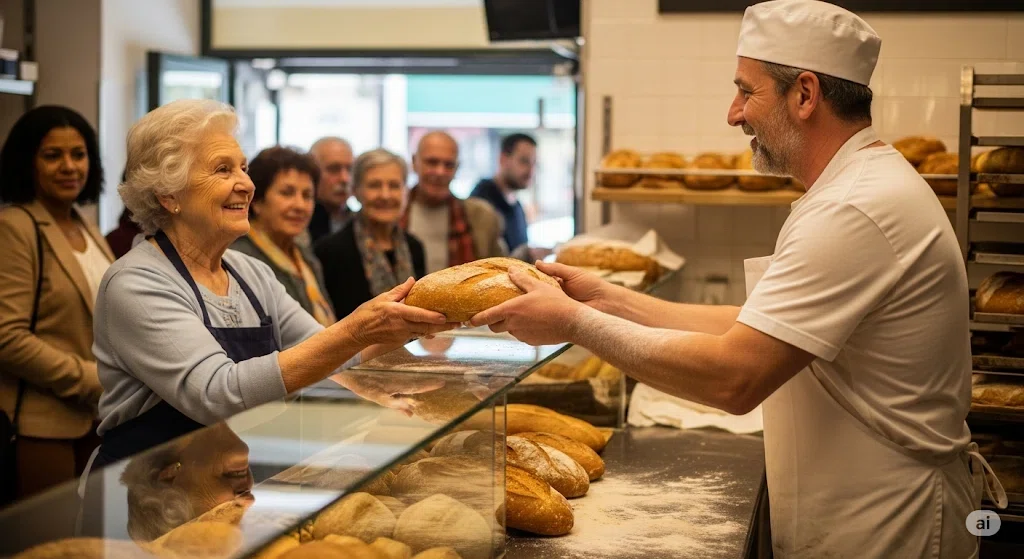
■ Business begins with the trust of just one person
Prosperity does not come from flashy advertising or momentary popularity, but
from getting just one person to "believe in" you.
It's not about getting customers to buy something.
It's about making them happy, remembering you, and making them want to come back.
Getting them to take that first step is surely the "starting point for prosperity" in business and management.
The words of Rennyo Shonin hit the nail on the head.
"Even if it's just one person, gaining their trust is the key to prosperity."
If we were to apply this to modern times, we could say that
"If there is just one customer who thinks, 'it was really great,' then that is the beginning of prosperity."
■ Faith → Joy → Gratitude → Referral → Faith ...When this cycle begins
Gaining trust makes people feel happy.
That joy eventually turns into gratitude, and
gratitude becomes an experience people want to talk about , leading to people introducing you to others.
The person who is introduced to you will then have trust, feel happy, be grateful, and introduce you to others.
This structure is the "circulation of trust" and the quiet engine of prosperity.
Sales can be visualized in numbers, but the circulation of trust can only be seen in "people's memories" and "relationships."
That is why it is the prosperity of "quality."
■ Memories over numbers: memorable business leads to prosperity
In modern society, efficiency and speed tend to be emphasized,
but trustworthy business starts with memorable experiences rather than numbers.
For example, there is an old coffee shop in front of a station. It
is not exactly social media-friendly, but there are regulars who continue to visit because they are touched by the owner's thoughtfulness in placing coffee at their usual seat.
Or the memory of a small bookstore owner selecting books to suit a child's tastes.
Even if that memory doesn't show up in the average customer spending, it remains as an unforgettable seed of trust.
It is these experiences that create the confidence to come back again or tell someone about it.
In fact, this idea of "trust" has been deeply rooted in Japanese corporate culture since ancient
times. The fact that there are so many long-lived companies in Japan is proof that this "trust" has been passed down through the ages.
■ "Prosperity of Trust" also applies to education and community development
This "circulation of trust" is not limited to business, but also applies to education and community activities.
When a student thinks, "I'm glad I met this teacher," and
a parent feels reassured that "I can trust this school,"
this is talked about and introduced to the local community, and new "trust" is born.
Even before you have any sales or success stories, you first develop trust.
This will lead to future prosperity.
■ Connection with Rennyo's thought: The faith of one person changes the whole
When Rennyo Shonin spoke, "Even if it's just one person, we should gain faith," he
was not simply talking about religious faith.
This is also connected to the belief that in an organization or society, the sincerity of one person can move the whole.
"One person who has gained trust" conveys the teachings, supports his colleagues, and fosters the trust of the next generation.
Just like the spread of fire, quietly but surely.
■ The value of "invisible prosperity" brought about by the circulation of trust
If we think about it this way, prosperity is surely something that begins to circulate between people before it is reflected in numbers.
"Faith → Joy → Gratitude → Referral → Faith" -
where there are places and people who can carefully create this cycle, quiet, certain prosperity will grow.
In the next chapter, I would like to consider "factorization of prosperity" in order to further clarify this "structure of faith."
🟫Chapter 3 | Factorization of "prosperity" and the recommendation of "two-wheel management"

■ Trying to grasp invisible prosperity structurally
So far, I have said that "prosperity is a circulation of trust."
However, to apply this to actual management or education, a more structurally focused perspective is needed.
Therefore, in this chapter, I would like to "factorize" the quality of prosperity and visualize its composition as a mathematical formula.
■ Prosperity = Trust × Continuity × Empathy
The structural formula I would like to propose is as follows:
Prosperity = Trust x Continuity x Empathy
If any of these three factors are zero, prosperity as a whole will not be achieved.
Conversely, if the three enhance each other, prosperity will deepen and expand exponentially.
Below, we will briefly define each factor.
■ Factor 1 | Trust: First of all, "no lies"
Trust is when people think, "I can trust this person (company, store, school)." It means
being consistent in quality and service, and keeping promises.
An honest attitude, polite language, face-to-face relationships -- the accumulation of these things builds trust.
This is where it all begins, and prosperity without trust is just "bustling."
■ Factor 2 | Continuity: A relationship that doesn't end in one go
Continuity means that customers or users want to come back and use your services again, and the relationship continues.
It is not a short-term transaction, but a long-term repeat relationship. In the educational field, it is a "bond"
that continues even after graduation .
It's not just about "selling and then it's over," but about whether there is a system for "continuity."
To prosper, it is essential to have something that grows over time.
This element is surely alive in a century-old company .
■ Factor 3 | Empathy: Sharing "why we are here"
Empathy is when you feel that you "understand" or "feel the same way" about values and principles.
It is a shared meaning, such as "I like the ideas of this store" or "I agree with the way this school thinks."
Empathy is the deciding factor for choosing a product among products with the same price and functionality.
Empathy also acts as a kind of "glue" that connects trust and continuity.
■ KPI and KEI: Looking at both "numbers" and "trust"
We usually manage our business with KPIs (Key Performance Indicators).
Sales, repeat rate, number of successful applicants...
Of course, these are necessary, but there must be other things to look at at the same time.
I would like to propose this as KEI (Key Engagement Indicator), an indicator of the quality of empathy and trust.
How many customers agree with your philosophy?
How many employees feel like they want to work here?
Are the alumni proud of their school?
KPI is the visualization of "results" and KEI is the visualization of "meaning."
By measuring both "prosperity" and "success" at the same time, it becomes possible to manage business in a stable manner.
■ "The telekinesis of the surviving younger brother" - the existence of someone who inherited the faith
Rennyo Shonin also said:
"The prosperity of the exclusive practice of Nembutsu is due to the power of the disciples' minds."
Modern translation:
"The reason why the teaching of the exclusive practice of Nembutsu (= the exclusive practice of Nembutsu) spread and flourished is due to the sincere faith and hard work of the disciples."
In terms of an organization, this corresponds to the power of the "middle man" who continues to convey the philosophy .
Even if only the top speaks out, the philosophy will not take root if it does not reach the field.
In modern terms, the key is whether or not middle management can become "evangelists of faith."
Someone else will inherit and spread the faith of one person.
Those people are the ones who will nurture the "culture of prosperity" of the organization.
■ Prosperity comes from a balance between the inside and the outside
The formula for prosperity shows an integrated structure of visible external results (prosperity) and internal trust (prosperity).
Even if you have trust, it's a one-time thing if there's no continuity.
Even with continuity, if there is no empathy, it will just be inertia
Even if you have empathy, if you lose trust, it will be counterproductive
In other words, what is needed is two-wheeled management, which involves first deepening the internal prosperity of "trust x continuity x empathy" and then
visualizing the results of that trust with KPIs.
In the next chapter (the summary chapter), based on this two-wheel model, I would like to return to the question, "What does 'business prosperity' mean
to you ?"
🟪 Summary | Prosperity in business and life begins with faith

■ Numbers without faith cannot continue. Faith without numbers also cannot take shape.
Numbers are certainly important. Sales and attracting customers are like blood flow to business.
However, no matter how many numbers you pile up, if there is no trust in them, they will soon become hollow.
Conversely, no matter how much trust you have, if it is not tangible in numbers, your business will not survive.
Numbers without faith cannot continue.
Faith without numbers also cannot take shape.
That is why we must maintain a balance between numbers and trust, which are the twin wheels of our business and help nurture each other.
■ Prosperity begins with "being trusted by one person and trusting one person"
Prosperity is not about attracting a large number of people.
Rather, it is about having just one person truly believe in you ,
and then truly believing in that person .
This mutual trust becomes the root that supports a business, a school, an organization, and life itself.
It cannot be measured in numbers, but the "invisible trust" that exists there is certainly the root of prosperity.
■ Prosperity comes from the desire to see that person again.
Prosperity is not about sales or reputation, but
about customers, business partners, students, and families.
"I want to see that person again."
"I want to be involved with that person again."
It is something that sprouts from the "warmth of a relationship" where they feel this way .
It is not conveyed through products or services, but through people.
This is why business, education, and even the way of life itself are all arts of faith.
■ Today's "one good thing" will foster tomorrow's prosperity
In the end, prosperity is not about grand strategies or innovative models.
It is just one person's "really good" that quietly cultivates the future.
Did you share faith with the person in front of you today?
Today, were you a "trustworthy person" to someone ?
The accumulation of such small actions creates a cycle of trust.
Prosperity is not something that can be achieved overnight.
It is a shape that slowly emerges from the accumulation of trust . The number 100 is not just a quantity, but an accumulation of 100 trusts that are carefully layered by the existence of each individual .
✏️Something like an afterword
The impetus for writing this column came from a summer day when I visited the Obon festival with my mother.
In the silence that filled the main hall, the chief priest introduced a few words about Rennyo Shonin, and I couldn't help but sit up straight.
"Prosperity is not about gathering many people.
It is about gaining the trust of even one person."
For me, these words completely redefined the meaning of "prosperity in business," and at the same time, quietly posed the question, "What kind of person do I want to be?"
Due to the nature of my position, I spend a lot of time dealing with numbers in my daily work, such as management, marketing, and financial statements
. That's why I suddenly had a question in my mind: "Am I facing something I can truly believe in?"
If this article can plant within you a small seed of the perspective that "it starts with faith,"
then I quietly believe that this is what "prosperity" means to me.
Profile | Kazuomi Matsunaga
🧭Thinking Navigator
Biography: Graduated from Kyushu University Faculty of Engineering (Materials Engineering) ⇒ Engineer (Production Technology) at a metal material manufacturer in the Chukyo region ⇒ Local free paper advertising sales in Nagasaki Prefecture ⇒ School corporation employee (← here now). 50s, living in Nagasaki Prefecture. Both children have become university students and are living with his wife.
A writer who plays with his thoughts every day at the intersection of "questions" and "curiosity". Recently, he has been writing his unique thoughts on themes such as education, stories, psychology, AI, and design, mainly in the serial column series "Shikou no Kagaku (Science of Thought)". He is searching for "free design of knowledge" that goes beyond existing frameworks. His motto is "Imagination opens the world".
While working in universities and education-related jobs in his main job, he values carefully observing "the moment when people "like" something" and "the scene where a question sprouts".
🧭 I would be happy if I could deliver an article that will give you a "new perspective" after reading it.
📮 Your comments and messages of support are always welcome!
いいなと思ったら応援しよう!
 「クリエイティブの世界へようこそ!」
創造・表現することが好きで、日々新しいものを生み出しています。応援が次の創作の力になります!
「クリエイティブの世界へようこそ!」
創造・表現することが好きで、日々新しいものを生み出しています。応援が次の創作の力になります!