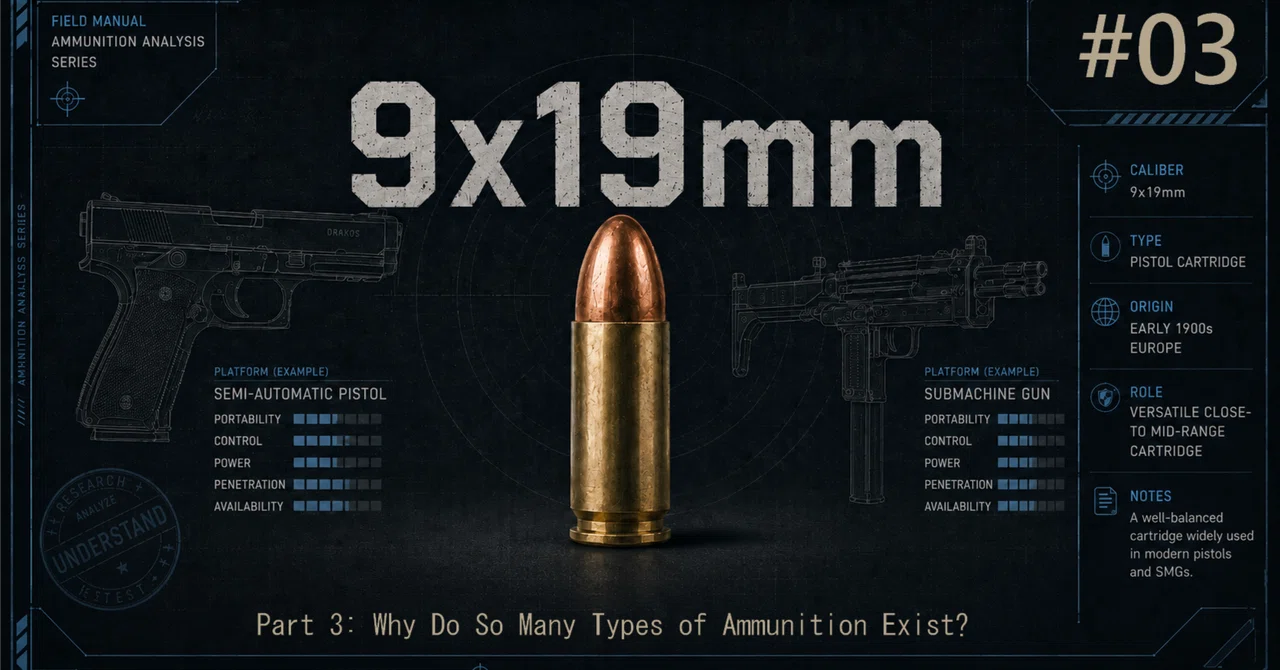
Looking at Tarkov’s 9x19mm Ammunition Through the Real World Part 3: Why Do So Many Types of Ammunition Exist?

First part available here:
In the previous part, we looked at how 9x19mm Parabellum spread beyond pistols and into SMGs.
9x19mm was originally born as a pistol cartridge.
However, once it began to be used in SMGs, it also gained another meaning: a cartridge for close-range automatic fire.
When fired from a pistol, it is a sidearm cartridge.
When fired from an SMG, it becomes close-range firepower.
Even when the cartridge is the same, its role changes depending on the weapon that uses it.
That is one of the interesting things about 9x19mm.
And when the weapons and missions using the same cartridge increase, the performance required from that cartridge also begins to branch out.
That is the theme of this part.
Tarkov includes several types of 9x19mm ammunition.
Pst gzh.
PSO gzh.
FMJ M882.
AP 6.3.
PBP gzh.
RIP.
QuakeMaker.
Luger CCI.
Green Tracer.
Inside the game, it is easy to look at these rounds and ask, “Which one is the strongest?” or “Which one should I use?”
Of course, in Tarkov, that matters.
But if we look at ammunition from a real-world perspective, different types of ammunition are not simply about stronger or weaker.
The different types of ammunition are the result of different answers to this question:
What was this cartridge supposed to do?
Even Within 9x19mm, Different Users Need Different Things
9x19mm became a cartridge used widely around the world.
However, not everyone uses 9x19mm for the same purpose.
9x19mm used by the military.
9x19mm used by police.
9x19mm used by civilians.
9x19mm used in competition shooting.
9x19mm used for training.
9x19mm used in pistols.
9x19mm used in SMGs.
Even though the cartridge is still 9x19mm, the required performance changes depending on who uses it and where it is used.
For military use, reliability and mass production are important.
The cartridge needs to be produced consistently, stored easily, and function reliably in many different environments.
For police use, reducing danger to bystanders can become an important issue.
If a bullet passes through the target, it may endanger someone behind them or someone on the other side of a wall.
For civilian use, the roles branch out even further.
There may be inexpensive ammunition for practice, defensive ammunition designed for effect on target, or competition ammunition tuned for recoil and accuracy.
For SMG use, reliability during rapid fire and stable operation become important.
In this way, even within the same 9x19mm cartridge family, the personality of the ammunition changes depending on what it is supposed to do.
That is why more types of ammunition appear.
This is not simply a matter of making many similar rounds for no reason.
The ammunition branches out because the roles branch out.
The Idea of Standard Ammunition
The first category to think about is standard ammunition.
In Tarkov, rounds such as Pst gzh, PSO gzh, and FMJ M882 are close to this idea.
Inside the game, these rounds may not look especially powerful.
They do not penetrate armor like AP rounds.
They do not have extreme flesh damage like RIP or QuakeMaker.
However, in real-world ammunition systems, standard ammunition has its own importance.
It can be produced reliably.
It can be fired reliably.
It works in many firearms.
Its cost can be kept relatively low.
It is useful for both training and practical use.
Standard ammunition is not the strongest ammunition.
Rather, it is ammunition that can be used in the widest range of situations.
I think this is also an important idea in Tarkov.
When we look at an ammunition chart, our eyes naturally go to the higher-tier rounds.
But in the real world, training, logistics, and everyday operation are possible because standard ammunition exists.
Standard ammunition may look plain.
But it is the foundation of an ammunition system.
Ammunition That Increases Penetration
Next, there are rounds designed to increase penetration.
In Tarkov, AP 6.3 and PBP gzh belong to this direction.
9x19mm is a pistol cartridge.
By nature, it is not a cartridge with the same penetration potential as rifle ammunition.
However, in the real world, there are situations where ammunition needs to deal with armor, vehicles, or barriers.
To answer that need, bullet cores and projectile designs can be modified to increase penetration.
But here, one point is very important.
9x19mm does not become a rifle cartridge.
The question is how much penetration can be gained within the limits of a pistol cartridge.
And in exchange, what must be sacrificed?
Cost.
Recoil.
Availability.
Stress on the firearm.
Effect on soft targets.
This is a trade-off.
In Tarkov, AP-type 9x19mm rounds look attractive because they give the player more possibility against armor.
But that does not mean 9x19mm becomes a universal cartridge.
Penetration-focused 9x19mm rounds are best understood as pistol cartridges pushed toward penetration within their natural limits.
There Is Also Meaning in Not Penetrating
On the other hand, some ammunition does not focus on penetration.
In Tarkov, rounds such as RIP, QuakeMaker, and Luger CCI belong to this category.
In the game, these rounds are often treated as “flesh damage” rounds.
They have low ability to penetrate armor.
However, if they hit an unarmored body part, they can deal significant damage.
In Tarkov, this leads to ideas such as aiming for the legs or targeting unarmored areas.
In the real world as well, higher penetration is not always better.
For police or defensive use, overpenetration can become a serious problem.
If a bullet passes through the target, it may injure someone behind them or damage something beyond the intended target.
For that reason, some ammunition is designed to expand, deform, or transfer energy inside the target rather than pass through.
Of course, real-world ammunition design and Tarkov’s damage calculations are not the same.
Even so, the idea is important.
A round that does not penetrate still has a reason to exist.
RIP and QuakeMaker are not simply weak rounds.
They are rounds that give up penetration in order to focus on a different effect.
In Tarkov, that characteristic is expressed in a very clear and exaggerated way.
The Special Role of Tracer Ammunition
There are also tracer rounds, such as Green Tracer.
A tracer round is ammunition whose flight path can be seen.
Because the shooter can see where the bullet is going, tracers can help with correcting fire and understanding the path of rounds during automatic fire.
Especially with machine guns, night shooting, or coordinated group fire, being able to visually confirm where rounds are traveling has meaning.
However, if the bullet’s path is visible, the shooter’s position can also become easier for the enemy to identify.
Being visible is both an advantage and a risk.
In Tarkov, tracer rounds also stand out.
They make it easier to see the direction of fire, but they also make the shooter’s position easier to notice.
This is another very Tarkov-like trade-off.
Useful things often come with a cost.
Tracer ammunition is a clear example of that.
The Ammunition Chart Is Not Just a Strength Ranking
When you first start Tarkov, the ammunition chart can be confusing.
Why are there so many types of 9x19mm?
Which one should I use?
Which one is strong?
Should I only use expensive rounds?
It is natural to think that way.
But once we look at how ammunition develops in the real world, the chart begins to look different.
The ammunition chart is not simply a strength ranking.
It is closer to a list of roles.
A standard round.
A round designed for penetration.
A round designed for effect on soft targets.
A round that shows its flight path.
A cheap round for practical use.
A round made for a special purpose.
Each one has a role.
Of course, inside Tarkov as a game, there are strong rounds, weak rounds, easy-to-use rounds, and difficult-to-use rounds.
Their performance can also change with patches.
Even so, the foundation remains the same:
Ammunition branches out according to purpose.
If we keep this perspective, choosing ammunition in Tarkov becomes a little easier.
We do not need to memorize every single round at once.
First, we can simply ask what direction the round is designed toward.
Is it standard?
Is it penetration-focused?
Is it flesh-damage-focused?
Is it a tracer?
Is it inexpensive?
Just being able to classify ammunition this way makes the chart much easier to read.
Roughly Classifying Tarkov’s 9x19mm Rounds
Here, let’s roughly classify the 9x19mm rounds that appear in Tarkov.
First, there are standard and practical-use rounds.
Pst gzh, PSO gzh, and FMJ M882 can be understood as basic 9x19mm rounds.
Next, there are penetration-focused rounds.
AP 6.3 and PBP gzh can be seen as 9x19mm rounds designed to prioritize penetration.
Next, there are flesh-damage-focused rounds.
RIP, QuakeMaker, and Luger CCI are rounds that aim for effect on unarmored body parts rather than penetrating armor.
Finally, there is tracer ammunition.
Green Tracer has the special role of making the bullet’s flight path visible.
When we classify them this way, 9x19mm ammunition is no longer just a large list of similar rounds.
Each round has a different direction.
Tarkov brings these ammunition differences into the game in a very strong and sometimes exaggerated way.
That is why the ammunition chart can feel confusing at first.
However, if we view it from the real-world perspective of role specialization, the reason these different types exist becomes much easier to understand.
Part 3 Summary
The number of 9x19mm ammunition types increased not because people simply wanted to make many similar rounds.
They increased because the weapons and missions using 9x19mm increased.
Used in pistols.
Used in SMGs.
Used by the military.
Used by police.
Used by civilians.
Used for training.
Designed to respond to armor.
Designed to reduce overpenetration.
Designed to show the bullet’s flight path.
As weapons and missions increased, multiple personalities appeared within the same 9x19mm family.
The 9x19mm rounds in Tarkov become much easier to understand if we see them not simply as stronger or weaker, but as rounds with different purposes.
Standard rounds.
Penetration rounds.
Flesh-damage rounds.
Tracer rounds.
Just having this classification changes the ammunition chart from something to memorize into something to read.
Tarkov brings ammunition differences into the game in great detail.
That is why it is difficult.
But at the same time, once you begin to understand that system, it becomes very interesting.
In the next part, I want to start with the most basic category: standard 9x19mm rounds.
Rounds such as Pst gzh, PSO gzh, and FMJ M882 may look plain compared to high-performance ammunition in Tarkov.
But from a real-world perspective, standard ammunition has its own meaning.
It is not the strongest ammunition.
It is ammunition that can be used in the widest range of situations.
In the next part, we will take a closer look at the idea of standard ammunition.
Part 4 is available here (may not be published yet)
Note: I also talk about the background behind this series, as well as what I am actually thinking during play, in the streams I do on Twitch almost every day.
Some things are harder to fully convey in writing alone, so watching the streams may help give a better feel for the atmosphere.
Past stream archives are also available on my YouTube channel, so if you are interested, please feel free to check those out as well.
▶ YouTube: B.K. Gaming
▶ Twitch: kaz_the_minotaur
いいなと思ったら応援しよう!
 読んでくださってありがとうございます。
サポートは、今後の制作を続けるための大きな力になります。
無理のない範囲で、応援していただけたら嬉しいです。
読んでくださってありがとうございます。
サポートは、今後の制作を続けるための大きな力になります。
無理のない範囲で、応援していただけたら嬉しいです。