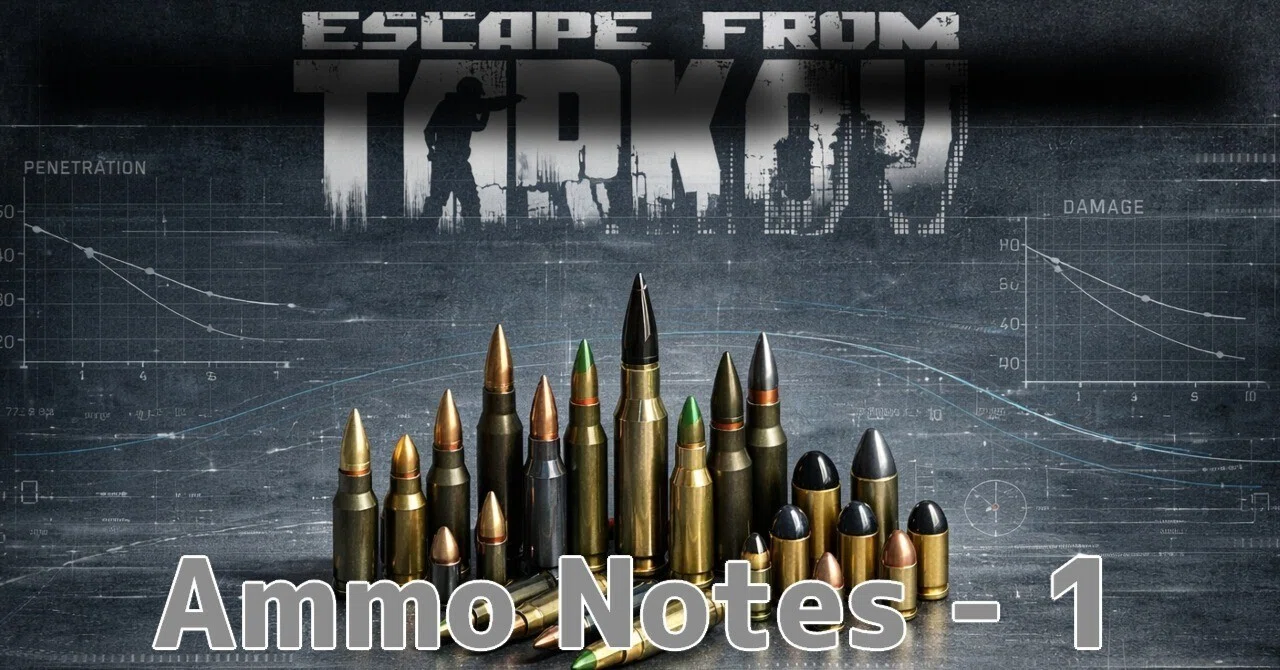
Escape from Tarkov ― Ammo History

The Scavenger Game, and the Problem of Bullets
While playing Escape from Tarkov, there is a phrase that stuck with me.
Scavenger game.
And honestly, it fits.
This game has a very strong scavenging core. You rummage through junk, grab what helps you survive or what sells, and you grow your account that way.
Ammo is no exception.
You either buy it or you pick it up. If you cannot secure ammo, the game simply does not move forward.
But the moment you try to stock up, you run into a problem.
In a world where you can get jumped at any time, you open a dead enemy’s inventory and find something that looks like ammunition, labeled with names like:
PS
BT
Names that mean nothing to you at first glance.
On top of that, these rounds are not even interchangeable.
They belong to slightly different calibers and specifications, and before you know it, you are stuck in a state of total confusion.
In this series, I want to do two things.
First, I want to organize my own understanding.
Second, I want to write with a hope in mind: that the same confusing road I walked might actually help someone else.
Some people might ask, shouldn’t you explain the guns first?
But without ammunition, a gun is just an object.
If you cannot obtain ammo, you cannot shoot.
That is why this article starts from the perspective that ammo is the most important thing.
Start with the Specifications
To be honest, I did not even know where to begin.
So I started asking ChatGPT questions and tried to sort things out. And what I found was unexpected.
The first thing you should do is not memorize names like PS or BT.
The first thing you should do is look at the cartridge specifications, the physical standard, such as:
5.56×45
5.45×39
Once you take that step, a bigger question naturally follows.
Why are there so many different standards in the first place?
And when you chase that question down, the answer leads into something much older.
The history of weapons, stretching all the way into the modern era.
Some people hear history and immediately back off, but stay with me for a moment.
The Big Split: West and East
Broadly speaking, the weapons and ammunition in Tarkov can be divided into two major streams:
NATO standards, the West
Former Soviet standards, the East
If we use assault rifles as an example:
NATO: 5.56×45
Former Soviet: 5.45×39
These standards did not appear randomly.
They were born out of a reflection that came from World War II.
Let’s dig in a little.
The History of Assault-Rifle Ammunition: The NATO Side
During World War II, the rifle cartridges commonly used in Western countries included rounds like:
7.92×57 (Germany)
.30-06 (United States)
Inch-based naming. In metric terms it is roughly 7.62mm.
The 06 indicates the adoption year, 1906.
These were full-size rifle cartridges.
After the war, a simple question began to surface.
Isn’t this round too heavy?
Isn’t it too powerful?
And while we are at it, isn’t the recoil too much?
Combat experience suggested that real fights often turned into mid-range suppression battles.
But these cartridges were optimized for long-range shooting.
As a result, two problems became obvious.
The ammo is heavy
You cannot carry much of it
And in mid-range combat, it is often more rational to overwhelm the enemy with volume of fire than to rely on single-shot lethality.
Out of that reflection came the 5.56×45 NATO cartridge.
This round:
does not reach as far as full-size rifle rounds
but it is lighter
which means you can carry a lot more
In other words, it was built for mid-range suppression through sustained fire.
The History of Assault-Rifle Ammunition: The Eastern Side
So what about the East, the former Soviet sphere?
Here too, the starting point is World War II.
At the time, the Soviet Union relied heavily on a full-size rifle cartridge called:
7.62×54R
This cartridge is still used today in certain sniper rifles, but back then it was widely used as standard infantry ammunition.
In terms of raw performance:
high power
long range
It had the same strengths as Western full-size rifle rounds.
But it also suffered from the same problems.
Heavy.
Harsh recoil.
Too dependent on the shooter’s skill.
And for the Soviet Union in particular, there was an additional requirement.
Their military doctrine emphasized mass mobilization. Which meant they needed equipment that worked reliably even when handled by a wide range of soldiers.
Whoever carries it should be able to use it, more or less the same way.
That mattered a lot.
The AK Mindset
This is where the AK series enters the story.
The AK mindset is brutally pragmatic.
Some loss in accuracy is acceptable
Some extra weight is acceptable
It must not break
Anyone should be able to shoot it
To match that mindset, the cartridge chosen was:
7.62×39
A middle cartridge, not full-size rifle ammo, not pistol ammo either.
This round:
is lighter than full-size rifle cartridges
has more manageable recoil
delivers enough power for close to mid-range combat
And paired with the AK platform, it spread widely.
From There, 5.45×39 Was Born
As time went on, the Soviet side developed a similar set of questions.
Can we make it lighter?
Can we reduce recoil further?
Can we make it easier to control?
The answer became:
5.45×39
Its direction looks similar to NATO’s 5.56×45, but the design emphasis differs.
The West emphasized squad-level suppression power
The East emphasized low recoil and ease of shooting
As a result, 5.45×39 developed a reputation for:
extremely low recoil
controllability in full-auto
reduced performance gap between skilled and unskilled shooters
One Sentence Summary of the Eastern Approach
If I had to summarize it in one line:
While the West moved toward dividing ammunition by roles,
the East pushed harder toward stability and consistency in the hands of whoever is holding the gun.
That is why 5.45×39 is strongly associated with traits like:
low recoil
fewer quirks
suitability for large-scale deployment
Where We Are So Far
So, to summarize:
West: 5.56×45
A lightweight, high-velocity round shaped by squad combat and suppressionEast: 5.45×39
A round shaped by low recoil and ease of use
This is not about which one is better.
They are different answers to different ways of war.
And once you see that, the strange ammo names in Tarkov start to look a little different.
That is enough for today.
Next time, I want to dig into something more specific.
NATO ammo naming, such as M855 and M856.
The next article is available here: Escape from Tarkov ― NATO rounds pt.1
Note:
The background ideas and actual gameplay experience discussed in this series are also touched on during my weekly streams every Friday.
The format is different from writing, but it may help deepen your understanding from another angle.
If you’re interested, feel free to stop by.
▶ YouTube : B.K. Gaming Channel
▶ Twitch : kaz_the_minotaur
いいなと思ったら応援しよう!
 読んでくださってありがとうございます。
サポートは、今後の制作を続けるための大きな力になります。
無理のない範囲で、応援していただけたら嬉しいです。
読んでくださってありがとうございます。
サポートは、今後の制作を続けるための大きな力になります。
無理のない範囲で、応援していただけたら嬉しいです。