
Tarkov | Hideout Side Hustle #3: What a Used IFAK Taught Me About the Med Station

I mainly play in PvE and consider myself more of a casual enjoyer than a hardcore player, so I would be happy if you kept that in mind while reading.
For the first article in this series, click here: How the VPO-136 Changed the Way I See the Workbench
As I kept playing Tarkov, Stash Level 3 was finally starting to come into view.
And then, all of a sudden, I found myself needing money.
The problem was, I could not always set aside enough time to go on proper raids.
So while absentmindedly looking through the Hideout, I had a sudden thought:
Wait… couldn’t this be turned into a business?
When I actually tried it, my funds — which had been sitting at around 8 million roubles — reached 10 million in a single day without going on a single raid.
This series began with that simple realization.
Let me say this first:
this is not a “here’s the perfect money-making method” kind of article.
The more people learn about a method like this, the more downward pressure it will naturally put on prices.
So this is not meant to say, “Do this and you will definitely make money.”
What I want to say instead is that the way you look at the Hideout can completely change how you build up your funds.
This Time: The Med Station
For the third entry in this series, I want to talk about the Med Station.
In the previous article about the Nutrition Unit, I wrote about how even leftover materials could start to look like something sellable.
The Med Station is a little different.
At first, it seemed even more plain to me.
To be honest, my first impression was something like this:
“Medical supplies are just things you either use or sell, right?”
You take them into raid and use them.
If you have extras, you sell them.
If they are partly used, they just kind of sit in your stash.
That was more or less how I used to see medical items.
But the more I stared at the Hideout, the more I started to realize that there was another layer here too.
Medical Supplies Are Not Just Consumables — They Can Be Materials Too
At first, medical items in Tarkov naturally look like things that exist to be used.
And of course that is not wrong.
You need them to survive in raids, and if you run out, you are in trouble.
But once I started looking at the Hideout more carefully, that way of seeing them began to change.
Take a partly used IFAK, for example.
After using one in raid and leaving it half spent, I used to think of it as something like:
“This feels a bit too low for my next raid.”
“But it also feels wasteful to throw away.”
In the same way, something like a CALOK-B just looked like a medical item you use up and finish.
An Aluminum Splint looked like a plain little item for fixing fractures, nothing more.
But when you start looking at the Med Station, even those half-used items and plain-looking materials turn out to have somewhere else they can go.
That is when medical items stop looking like simple consumables and start looking like materials somewhere in the middle of a process.
That shift in perspective feels quite significant.
A Partly Used IFAK Can Become an AFAK
The clearest example of this is the fact that a partly used IFAK can be turned into an AFAK.
To be honest, I used to think:
“If AFAK exists, wouldn’t it be better to just use AFAK from the start?”
AFAK has more healing capacity, and it looks like the more advanced medkit.
So from that older point of view, it seemed like the simple upgrade.
But after looking at the Hideout, that way of thinking changed a little.
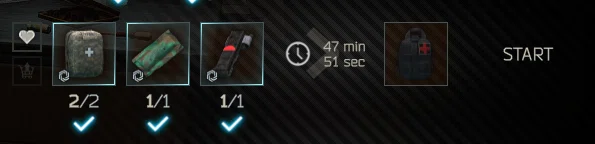
Once an AFAK becomes partly used, it does not feel like it has much of a meaningful next step.
An IFAK, on the other hand, can still move forward — even after being used — because it can become part of an AFAK craft.
That means an IFAK is no longer just something that loses value once you use it.
Instead, it starts to look like something that can shift into another kind of value after use.
Once I noticed that, the way I actually use my medical items began to change.
Now, instead of thinking:
“Why not just use AFAK from the beginning?”
I started thinking more like this:
“Use the IFAK first, and once it is partly used, turn it into an AFAK.”
Of course, if you only look at raw healing capacity, 300 vs. 400 is still a real difference.
But in actual fights, I have come to feel that as long as I have backup medical supplies, that gap is usually manageable.
And once I started thinking about what happens after the item has been used, the IFAK actually began to feel more practical.
At that point, IFAK stopped looking like a lower-tier medkit.
It started looking like something that does not merely become awkward once used, but something that can keep moving toward the next stage.
CALOK-B Does Not End with “Use It and It Is Gone”
That same feeling does not apply only to IFAKs.
Take CALOK-B, for example.
Normally, it looks like exactly what it is: a medical item for stopping bleeding.
You take it into raid, you use it, and it gets used up.
That would usually be the end of the story.
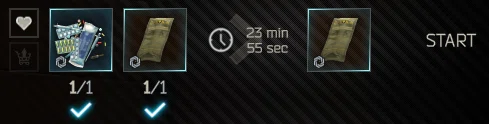
But a partly used CALOK-B can also be combined with Pile of Meds and turned back into something fresh again.
So even here, the way of seeing it changes from:
“You used it, so it is done.”
to:
“You used it, so now it enters the next craft line.”
And that, to me, is one of the most interesting things about the Med Station.
Medical items naturally tend to look like things that only go down.
They shrink, they get consumed, and that is it.
But when you start looking at the Hideout, you realize that even after being used, some of them can still move into another use — and in that sense, some of that value comes back.
Even Something Plain Like an Aluminum Splint Leads to a Grizzly
What becomes even more interesting is something plain like an Aluminum Splint.
At first, I saw it as exactly what it looked like: a tool for treating fractures, and not much else.
To be honest, on its own it feels like a very plain item.
But even that can connect to something bigger.
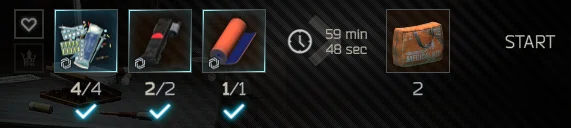
When combined with CAT and Pile of Meds, it can lead into a Grizzly.
At that point, the whole picture starts to change.
An Aluminum Splint is no longer just a fracture item
CAT is no longer just a bleeding item
Pile of Meds is no longer just an in-between material
Each one of them looks plain or limited when viewed alone.
But inside the Hideout, they are connected by actual lines that lead toward a higher-tier medical item.
Once you start seeing those lines, it becomes difficult to look at items only in terms of their standalone price.
The Med Station Is Not Just Where You “Make Supplies” — It Is Also Where Things Circulate
At first, I thought of the Med Station as little more than:
“the place where you craft healing items.”
Now it looks a little different to me.
It is not just a place to refill medical supplies.
It is also a place where you can:
carry partly used items into their next stage
turn plain-looking materials into a different kind of value
circulate medical supplies that would otherwise sit in your stash doing nothing
If the Nutrition Unit feels like a place where leftover food can become something sellable, then the Med Station feels like a place where half-used medical items and unremarkable materials can be turned into something one level higher.
The examples of the IFAK, CALOK-B, and Aluminum Splint all point in that direction.
When the Way You See Things Changes, the Way You Organize Your Stash Changes Too
Once that happens, even the way you organize your stash begins to change.
Things that once looked like:
partly used and awkward
plain and unimportant on their own
just taking up space
start to look more like:
what could this become next?
is there a reason to keep this?
would it be better to craft this rather than sell it as-is?
So what changes when you understand the Med Station is not just your knowledge of crafting.
What changes is the meaning of the medical supplies sitting in your stash.
That feels very similar to what happened with the Workbench and the Nutrition Unit too.
The Hideout does not just change the price of things.
It changes the way things look to you.
This Still Feels Like Just the Entrance
That said, the Med Station feels even deeper than the Nutrition Unit.
Some examples are easy to understand, like partly used medical items leading into better ones.
But then there are other questions, like:
Should I craft Pile of Meds, or is it actually better to buy it?
And beyond that, there are Injectors — things that at first glance can feel mysterious, until suddenly their material lines start making sense all at once.
So this article still feels like standing only at the entrance.
Even so, just seeing this much has already changed the whole landscape for me.
Medical items that once looked like simple consumables now look like things with multiple possible futures:
use them, keep them, craft with them, or sell them.
There Is Still More Ahead in the Hideout
In the Sausage article, leftover food became something sellable.
This time, with the Med Station, I started to see that partly used medical items and plain-looking medical materials also have somewhere else they can go.
At this point, the Hideout starts to feel less like a manufacturing facility and more like a machine that changes the way the contents of your stash look.
And even within the Med Station, there is still a lot left to dig into:
whether Pile of Meds should be crafted or bought
why Injector materials are so expensive
why certain syringes sell for so much
and what kinds of items become easy to cash out once you realize they can be crafted later anyway
The 4th story in this series is available here: Piles of Meds Made Me See the Med Station Differently
If this interests you, I would be very happy if you followed or turned on notifications.
And if you have your own way of looking at certain materials in the Hideout, I would love to hear about it.
Note: I also talk about the background behind this series, as well as what I am actually thinking during play, in the streams I do on Twitch almost every day.
Some things are harder to fully convey in writing alone, so watching the streams may help give a better feel for the atmosphere.
Past stream archives are also available on my YouTube channel, so if you are interested, please feel free to check those out as well.
▶ YouTube: B.K. Gaming
▶ Twitch: kaz_the_minotaur
いいなと思ったら応援しよう!
 読んでくださってありがとうございます。
サポートは、今後の制作を続けるための大きな力になります。
無理のない範囲で、応援していただけたら嬉しいです。
読んでくださってありがとうございます。
サポートは、今後の制作を続けるための大きな力になります。
無理のない範囲で、応援していただけたら嬉しいです。