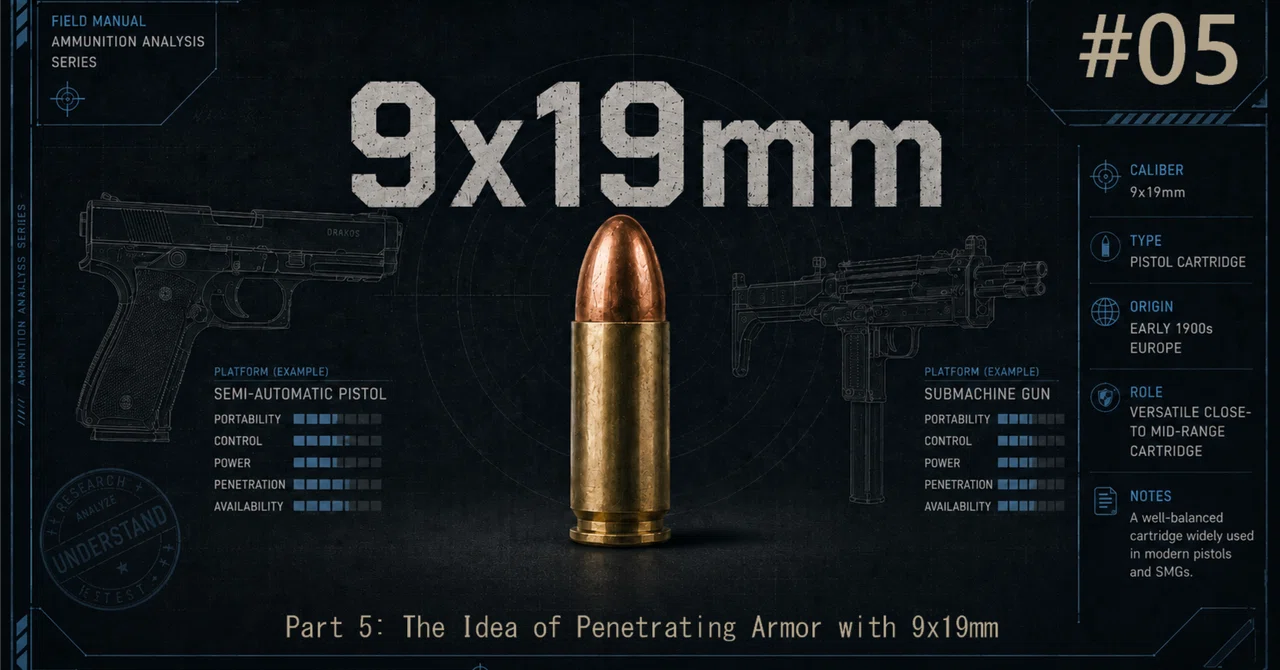
Looking at Tarkov’s 9x19mm Ammunition Through the Real World Part 5: The Idea of Penetrating Armor with 9x19mm

First part available here:
In the previous part, we looked at standard 9x19mm ammunition.
Pst gzh.
PSO gzh.
FMJ M882.
These rounds do not look especially flashy inside Tarkov.
They do not penetrate armor like AP rounds.
They do not have extreme flesh damage like RIP or QuakeMaker.
However, when we look at real-world ammunition systems, standard ammunition has its own meaning.
It can be produced reliably.
It can be used in many firearms.
It circulates widely.
Its cost can be kept relatively low.
It can be used for both training and practical use.
It becomes the baseline for understanding other rounds.
Standard ammunition is not the strongest ammunition.
But it is the foundation of an ammunition system.
This time, I want to look at the opposite direction: 9x19mm rounds designed to increase penetration.
In Tarkov, that means AP 6.3 and PBP gzh.
These two rounds are easy to understand as attractive options within the 9x19mm family.
That is because, in Tarkov, whether or not a round can penetrate armor often directly affects whether you live or die.
However, from a real-world perspective, there is an interesting problem here.
9x19mm was originally a pistol cartridge.
It is not a rifle cartridge.
So how far can a pistol cartridge go when trying to defeat armor?
In this part, I want to think about the idea of trying to penetrate armor with 9x19mm.
What Does AP Mean?
First, let’s look at the name AP.
AP stands for Armor-Piercing.
In Japanese, this is usually translated as a type of armor-piercing or penetrating round.
In Tarkov’s ammunition chart, when a round has “AP” in its name, it is easy to understand that the round is focused on penetration.
9x19mm AP 6.3 is also treated as a 9x19mm round designed to increase penetration.
An AP round is not simply a cartridge made stronger by adding more powder.
Rather, it is a round designed to penetrate hard targets through the structure of the bullet itself.
A hard core may be placed inside the bullet.
The shape or structure of the projectile may be changed.
Effect against soft targets may be sacrificed in order to prioritize penetration against hard targets.
That is the basic design idea behind AP ammunition.
In other words, AP does not simply mean “a stronger round.”
It means a round whose performance is pushed toward penetration.
This is very important when trying to understand ammunition in Tarkov.
Inside the game, high-penetration rounds naturally look like “higher-tier” ammunition.
Of course, they are extremely important when fighting armored opponents.
But from the perspective of real-world ammunition design, it is easier to understand AP ammunition not as a universal round, but as a round specialized for a specific purpose.
The Name AP 6.3
The number “6.3” in AP 6.3 is interesting.
It is 9x19mm ammunition, so why is the number 6.3 used?
At first, this may seem a little strange.
This “6.3” is easier to understand if we connect it not to the outer diameter of the cartridge, but to the hard penetrator inside the bullet.
In Tarkov’s description, AP 6.3 is treated as a round with a 6.3mm hardened steel penetrator.
In other words, inside the outer 9x19mm cartridge, there is a smaller, hard 6.3mm core.
This is a very interesting detail.
When we see the name 9x19mm, it is easy to imagine that a 9mm bullet simply flies as one solid projectile.
But in AP-type ammunition, the outer bullet structure can contain a smaller and harder core designed to punch through armor.
The name AP 6.3 becomes easier to remember when we see it as referring to that internal structure.
Inside 9x19mm, there is a hard 6.3mm core.
That is AP 6.3.
Once we think about it this way, the number is no longer just a random number.
Ammunition names can look like codes, but when we understand their meaning, they become much easier to remember.
The Name PBP gzh
Next is PBP gzh.
In Tarkov, PBP gzh is treated as one of the strongest penetration-focused rounds in the 9x19mm family.
The name PBP can be understood as a Latin-letter version of the Russian abbreviation ПБП.
ПБП is generally explained as an abbreviation of “Патрон с пулей повышенной пробиваемости.”
A fairly direct translation would be:
“a cartridge with a bullet of increased penetration.”
In other words, the name PBP itself already tells us what kind of round it is.
At first glance, PBP may look like a simple product name.
But in reality, it carries the meaning of a round designed for increased penetration.
9x19mm PBP gzh is also connected to the designation 7N31.
7N31 can be understood as a kind of management or index number used for Russian or Soviet-style military ammunition.
Such numbers are used to systematically manage ammunition and equipment.
If we break down the name, it becomes much easier to remember.
PBP = a round with increased penetration.
gzh = a bimetallic-case-related notation.
7N31 = a Russian-style military ammunition designation.
So PBP gzh can be understood as:
a Russian-style high-penetration 9x19mm round treated as 7N31.
If AP 6.3 is a round that clearly says “Armor-Piercing” in English, PBP gzh is a round that declares its penetration-focused nature through Russian terminology.
This contrast is very interesting.
AP 6.3 is a penetration round with a Western-looking name.
PBP gzh is a penetration round whose name shows its purpose through Russian-style notation.
Both are high-penetration 9x19mm rounds, but their names express that idea differently.
One reason Tarkov’s ammunition chart is hard to remember is that Western-style and Russian-style names appear side by side in the same list.
However, once we break the name down a little, PBP gzh becomes much easier to remember.
PBP means increased penetration.
gzh gives information about the case.
7N31 is the Russian-style military designation.
Seen this way, PBP gzh is not just a mysterious string of letters.
It becomes quite straightforward to read it as a high-penetration 9x19mm round.
Looking Again at the gzh Notation
Here, it is worth returning to the notation “gzh.”
The Pst gzh and PSO gzh rounds from the previous part also had the same ending.
Pst gzh.
PSO gzh.
PBP gzh.
In this way, gzh appears several times in Russian-style ammunition names.
It is easier to understand gzh as information related to the cartridge case rather than the bullet itself.
Roughly speaking, it can be remembered as bimetallic-case-related notation.
We do not need to memorize every detail of Russian ammunition terminology perfectly.
But just thinking like this is already useful:
The first part, such as Pst, PSO, or PBP, tells us about the bullet or the purpose.
The second part, gzh, gives us information about the case.
With this view, Tarkov’s ammunition names become much easier to read.
Pst gzh is a basic round with a steel-type bullet.
PSO gzh is a sport and hunting-oriented round.
PBP gzh is a high-penetration round with increased penetration.
Even when the same gzh ending appears, the character of the round changes depending on the first part of the name.
Once we can look at ammunition names this way, the ammunition chart stops being just a code.
The Difficulty of Penetrating Armor with 9x19mm
Now we reach the main issue.
AP 6.3 and PBP gzh are very attractive inside Tarkov.
9x19mm SMGs have light recoil and are easy to fire rapidly.
If we put high-penetration ammunition into them, they can look very strong at close range.
However, from a real-world perspective, trying to penetrate armor with a pistol cartridge has limits.
9x19mm is a pistol cartridge.
The projectile is relatively small, and the amount of propellant is not as large as in rifle ammunition.
The muzzle velocity is also lower than that of rifle cartridges.
Range and energy are limited.
Because of that, even if the bullet is designed to improve penetration, 9x19mm does not become a rifle cartridge.
This point is very important.
AP-type 9x19mm ammunition is pistol ammunition whose penetration has been increased within the limits of a pistol cartridge.
It is not a substitute for rifle ammunition.
I think this feeling is also very important in Tarkov.
Using AP 6.3 or PBP increases the number of situations where a 9x19mm SMG can fight armored opponents.
However, that does not mean it can do the same job as 5.56mm or 7.62mm rifle ammunition.
Its strength is still strength as 9x19mm.
When You Focus on Penetration, You Lose Something Else
Ammunition involves trade-offs.
If performance is pushed in one direction, something else is affected.
To increase penetration, the bullet needs to be made harder.
A hard core may need to be inserted.
The projectile structure becomes more complicated.
The cost may increase.
Availability may become worse.
The firearm may experience more stress.
Effect against soft targets may be less impressive than with other types of ammunition.
In other words, AP-type ammunition is not universal ammunition.
It is ammunition whose performance is focused on the purpose of penetrating armor.
This way of thinking is also very important in Tarkov.
Inside Tarkov, high-penetration rounds are easy to understand as strong.
However, if we include price, availability, recoil, weapon durability loss, damage, and effective range, they are not always universal solutions that can be used without thought.
For example, Tarkov’s PBP gzh has high penetration, but it also has modifiers related to increased recoil, durability burn, and heat.
This is a game balance element, of course.
But it also connects to the real-world idea that gaining penetration can come with other costs.
I think Tarkov expresses this kind of trade-off in a very clear way.
What Do AP-Type 9x19mm Rounds Make Possible?
So what do AP 6.3 and PBP gzh make possible?
They expand the range of opponents and situations that a 9x19mm SMG can handle.
They give some possibility against armor that would be difficult for standard rounds.
They create more situations where damage can pass through armor during close-range rapid fire.
They give more hope against face shields and lighter protection than standard rounds.
When combined with the low recoil and rapid fire of an SMG, they can apply strong pressure at close range.
This is a major advantage.
In Tarkov especially, whether or not a round passes through armor can greatly change the result of a fight.
A 9x19mm SMG is already easy to handle.
By loading AP-type ammunition, you can partly compensate for the weakness of being easy to control but weak against armor.
However, “partly” is the important word here.
AP-type 9x19mm does not completely erase the weaknesses of 9x19mm.
It only helps compensate for them.
If you misunderstand that difference, Tarkov will punish you.
How to Remember AP 6.3 and PBP
From the point of view of remembering ammunition names, AP 6.3 and PBP gzh make a useful contrast.
AP 6.3 is easy to understand by name.
AP = Armor-Piercing.
6.3 = a hard 6.3mm penetrator.
So it can be remembered as:
a 9x19mm round with a hard 6.3mm core designed to penetrate armor.
PBP gzh is harder to understand at first.
But once we know that ПБП means “a cartridge with a bullet of increased penetration,” it becomes much easier to remember.
PBP = increased penetration.
gzh = case-side information.
7N31 = Russian-style military ammunition designation.
In other words:
AP 6.3 is a penetration round whose meaning is easy to see in English.
PBP gzh is harder to read at first because it uses Russian-style notation, but its name also indicates increased penetration.
This contrast makes the two rounds much easier to organize in memory.
Trying to memorize every Tarkov ammunition name by force is difficult.
But if we break the names down:
AP means penetration.
A number may give a clue to the internal structure.
PBP indicates increased penetration through Russian terminology.
gzh points to case-side information.
7N31 is a Russian-style military ammunition number.
Then the names become much easier to remember.
How to Think About AP-Type 9x19mm in Tarkov
When looking at AP-type 9x19mm in Tarkov, I think the most important thing is not to overtrust it.
AP 6.3 and PBP gzh are powerful within the 9x19mm family.
But they are not rifle ammunition.
That means when using these rounds, we need to combine them with the strengths of 9x19mm SMGs.
Use them at close range.
Take advantage of low recoil.
Take advantage of rapid fire.
Do not overestimate your ability to defeat armor.
Do not force fights at medium range and beyond.
Do not try to fight rifle ammunition on the same terms from the front.
These points matter.
AP-type 9x19mm rounds expand the role of 9x19mm.
But they do not expand that role without limit.
In Tarkov, when we get access to strong ammunition, it can feel as if that ammunition will solve everything.
But in reality, every round has distances and opponents it is good or bad against.
AP 6.3 and PBP gzh are no different.
They add penetration to the handling advantages of 9x19mm SMGs.
But they do not remove the basic limits of 9x19mm as a cartridge.
If we keep that feeling in mind, these rounds become much more realistic and useful to work with.
Part 5 Summary
AP 6.3 and PBP gzh are 9x19mm rounds focused on penetration.
In Tarkov, whether or not ammunition can penetrate armor often determines life or death, so AP-type rounds look very attractive.
However, from a real-world perspective, AP-type 9x19mm ammunition is still pistol ammunition whose penetration has been increased within the limits of that cartridge.
AP 6.3 is, as the name Armor-Piercing suggests, a round that uses a hard penetrator to fight armor.
The number 6.3 also becomes easier to remember when we connect it to the 6.3mm hard penetrator inside the bullet.
PBP gzh corresponds to the Russian abbreviation ПБП, which carries the meaning of a cartridge with a bullet of increased penetration.
It is also connected to 7N31, a Russian-style military 9x19mm ammunition designation.
In other words, PBP gzh is a round whose name already tells us that it is a high-penetration round.
AP 6.3 shows its penetration role clearly in English.
PBP gzh shows its penetration role through Russian-style notation.
Remembering this contrast makes Tarkov’s ammunition chart much easier to read.
However, AP-type 9x19mm is not universal ammunition.
To gain penetration, it accepts trade-offs in areas such as cost, availability, recoil, stress on the firearm, and flesh damage.
And most importantly, 9x19mm is not rifle ammunition.
AP 6.3 and PBP gzh expand the possibilities of 9x19mm SMGs.
But they do not turn 9x19mm into a replacement for 5.56mm or 7.62mm.
If you use AP-type 9x19mm in Tarkov, you need to take advantage of close range, low recoil, rapid fire, and good handling.
You do not win only because the ammunition is strong.
You win by fighting according to the role of the ammunition.
That is one of the interesting things about ammunition choice in Tarkov.
In the next part, we will look at rounds pushed in the opposite direction from penetration.
Rounds such as RIP, QuakeMaker, and Luger CCI.
In Tarkov, these are often seen as flesh-damage rounds.
But from a real-world perspective, there is also meaning in ammunition that does not penetrate.
Next time, we will think about 9x19mm rounds that give up penetration in exchange for a different kind of effect.
Part 6 is available here (may not be published yet)
Note: I also talk about the background behind this series, as well as what I am actually thinking during play, in the streams I do on Twitch almost every day.
Some things are harder to fully convey in writing alone, so watching the streams may help give a better feel for the atmosphere.
Past stream archives are also available on my YouTube channel, so if you are interested, please feel free to check those out as well.
▶ YouTube: B.K. Gaming
▶ Twitch: kaz_the_minotaur
いいなと思ったら応援しよう!
 読んでくださってありがとうございます。
サポートは、今後の制作を続けるための大きな力になります。
無理のない範囲で、応援していただけたら嬉しいです。
読んでくださってありがとうございます。
サポートは、今後の制作を続けるための大きな力になります。
無理のない範囲で、応援していただけたら嬉しいです。