
The Ground Beneath AI Is Shifting — CPU, GPU, Memory, Networks, and the Next Tectonic Shift Called Agent OS

Which OS are you running right now?
Windows, macOS, Linux — most of you answered without hesitation. Now try this one: which OS is your AI agent running on?
Almost no one has a clean answer to that. Because the battle to define that answer is happening right now, all over the world, simultaneously.
In early 2026, the concept of "Agent OS" is gaining serious traction among a growing circle of researchers and engineers. The AIOS paper from Rutgers University was accepted at COLM 2025 (GitHub: agiresearch/AIOS). Blueprint architecture proposals for AgentOS are appearing on arXiv in rapid succession (TechRxiv, September 2025). And engineers in the trenches are starting to say out loud: "We're building DOS again" (Vonng Blog, January 2026).
This is not an academic thought experiment. From the physical layer of hardware all the way up to the design philosophy of operating systems, the geological strata of IT are shifting — quietly, but without question.
This piece is a conceptual sequel to the earlier deep-dive "The AI Factory Is Quietly Dismantling IT's Conventional Wisdom." It builds the contrast between traditional IT and AI infrastructure layer by layer, starting from hardware — and then traces the horizon where Agent OS begins to emerge. The goal is technical rigor without sacrificing readability.
Prologue: What "Using a Computer" Has Always Meant
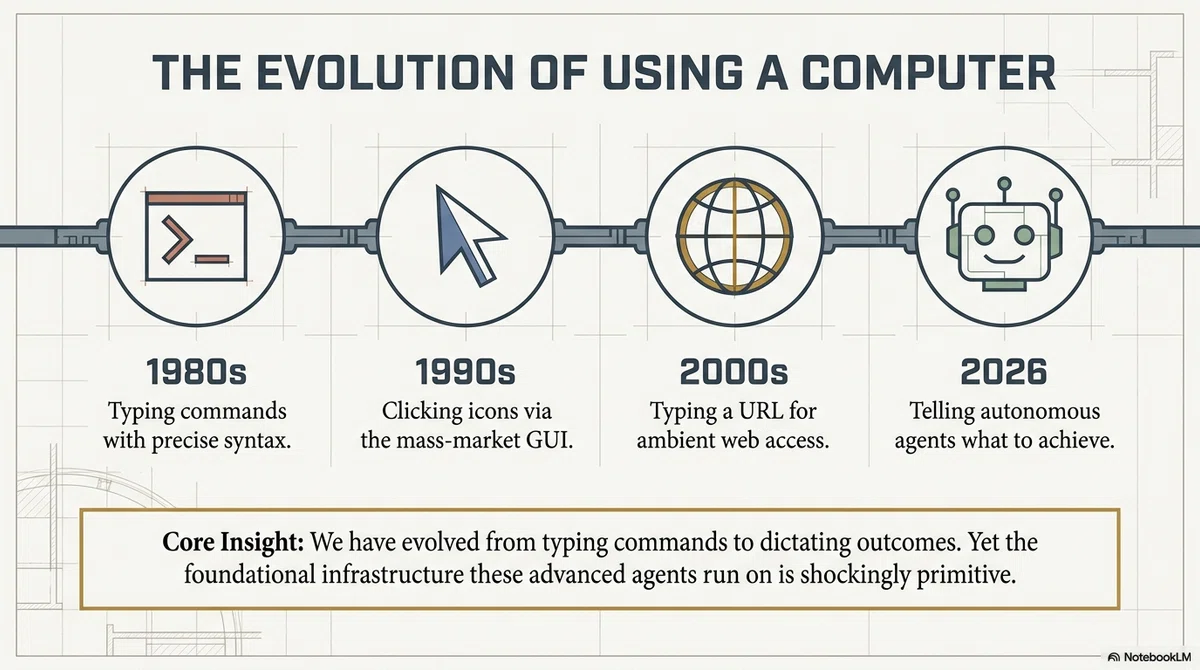
What does it mean to use a computer?
In the 1980s, it meant typing commands. You faced a DOS prompt and entered syntax precisely. A mistake gave you an error. That was it.
The 1990s brought the GUI. "Using a computer" became clicking icons. The mouse transformed computing from an expert's instrument into a mass-market product.
In the 2000s, the web became ambient. "Using a computer" meant opening a browser and typing a URL.
And now, 2026. "Using a computer" is becoming telling an AI agent what you want to achieve. Claude Code writes code, runs tests, and fixes bugs. Devin handles in an hour what used to take a full workday. Manus autonomously researches, plans, and books a trip end-to-end.
But look closely at the foundation these agents run on. You'll notice something striking: it is shockingly primitive.
To understand that primitiveness — and what it implies — you have to start at the deepest layer. You have to start with hardware.
Part I: The Deepest Strata — Hardware Has Fundamentally Changed
1. From "Universal Tool" to "Purpose-Built Factory"
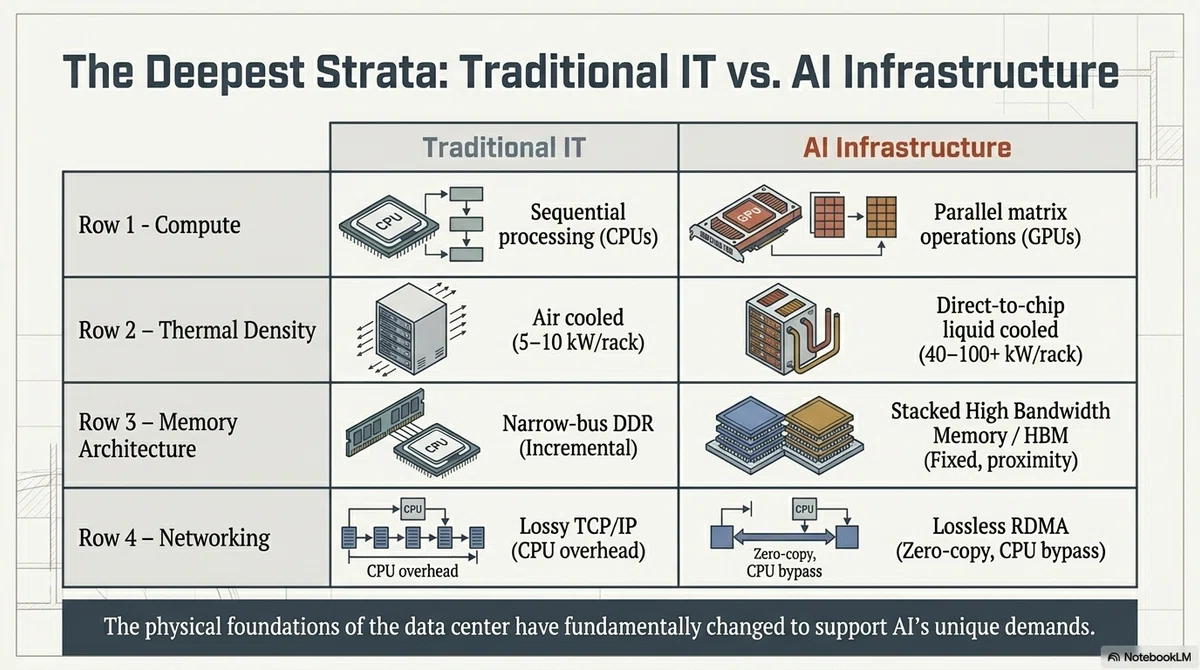
Traditional servers were general-purpose machines. ERP, email routing, web serving, CRM — the same CPU, the same DDR memory, the same Ethernet switch handled all of it. That was sufficient. The workload fit the machine.
Neural network training and inference are fundamentally incompatible with this general-purpose design philosophy.
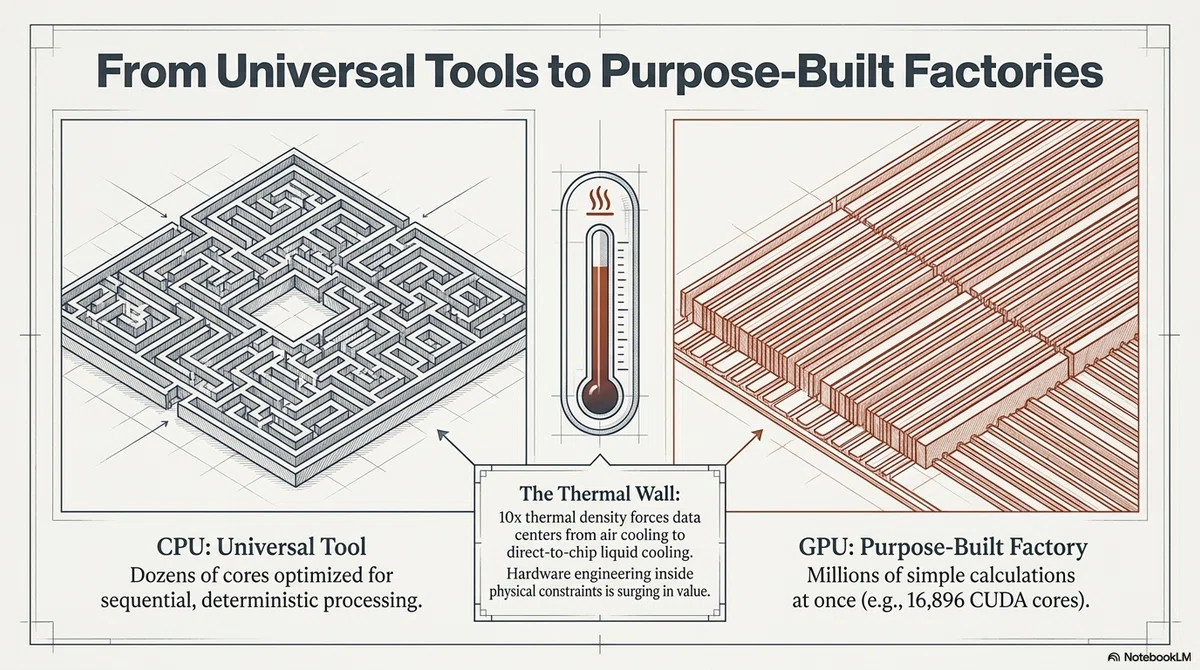
The reason lies in the nature of the computation. Traditional IT workloads — database transaction processing, OS scheduling, web request routing — demand that complex operations be executed sequentially and with extremely low latency. This is precisely what CPUs are optimized for. Branch prediction, pipeline execution, multilevel cache hierarchies — modern CPUs have spent fifty years evolving toward exactly this: sequential, deterministic processing.
Neural networks demand the opposite. They need millions and hundreds of millions of simple calculations executed simultaneously. Specifically, they need matrix multiply-accumulate (MAC) operations performed at staggering scale. Generating a single token in GPT-4 inference triggers trillions of multiplications and additions. The workload is not a long chain of complex steps — it is an ocean of trivially simple steps, all at once.
GPUs were born to fill this gap. Originally designed for rendering graphics — computing the color of each pixel on a screen independently and simultaneously — their massive parallelism proved a perfect match for neural network matrix operations.
CPU cores: Dozens (Intel's highest-end Xeon tops out around 60)
GPU cores: Thousands to tens of thousands (NVIDIA H100: 16,896 CUDA cores)
This order-of-magnitude difference in parallelism is what gives GPUs their decisive advantage for AI workloads (NVIDIA H100 official page).
2. The Physical Crisis in the Data Center: Heat
This hardware revolution is inflicting serious consequences on the physical design of data centers.
Traditional server racks consumed 5–10 kW per rack. Standard air conditioning handled the heat without difficulty. Modern AI training clusters demand 40–100+ kW per rack. That is roughly ten times the thermal density of legacy infrastructure — a regime where air cooling is physically incapable of removing enough heat.
The answer is liquid cooling. Direct-to-chip cooling — circulating coolant directly against the chip package — is rapidly becoming the standard specification for AI-era data centers. Liquid's thermal conductivity dwarfs that of air, carrying heat away efficiently to external heat exchangers.
Here a striking paradox appears. As AI accelerates the automation of software development, the value of hardware engineering — liquid cooling system design, RF circuit debugging, FPGA development, PCB layout — is surging. AI cannot yet substitute for engineering that lives inside physical constraints. Work that requires touching silicon will remain a human domain for a good while yet (Royal Institution).
3. The Memory Wall: HBM as the Answer
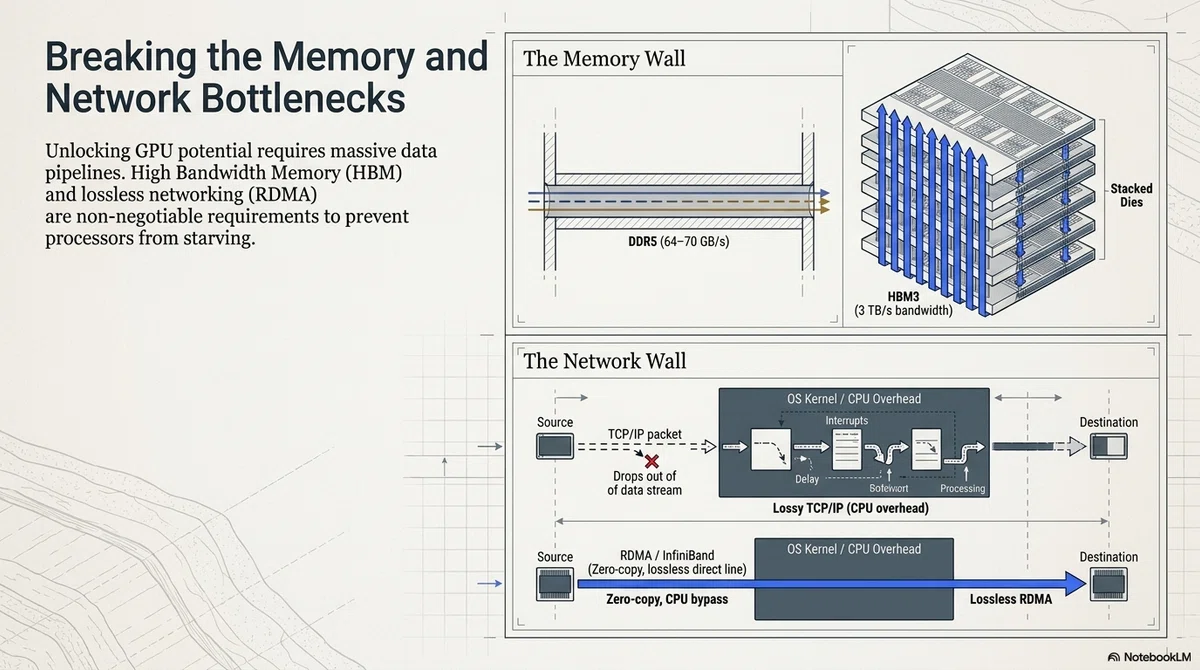
No matter how fast the processor, it starves if memory bandwidth cannot keep up. This is the "Memory Wall" — the dominant physical bottleneck of the AI era.
The standard for conventional main memory has long been DDR SDRAM. Inserted as DIMM modules into motherboard slots, DDR offers flexibility and cost efficiency: you can add capacity incrementally after the fact. But even the latest DDR5 delivers only 64–70 GB/s per module. The bus width is constrained to 64 bits, and there are hard physical limits to how far clock frequency can be pushed (IntuitionLabs).
HBM (High Bandwidth Memory) breaks through this wall at the root. The idea is conceptually simple; the manufacturing challenge is anything but.
In HBM, multiple DRAM dies are stacked vertically and connected through TSVs (Through-Silicon Vias) — vertical holes etched through the silicon, just a few micrometers in diameter. This stacked assembly is placed on the same silicon interposer as the GPU, in ultra-close proximity, dramatically shortening signal propagation distances.
The result: a bus width exceeding 1,024 bits — sixteen times DDR's 64. HBM3 achieves approximately 819 GB/s of bandwidth per stack. The NVIDIA H100 (with five HBM3 stacks) delivers a total memory bandwidth exceeding 3 TB/s (IntuitionLabs).
HBM is not without trade-offs. Manufacturing costs are high. Capacity is fixed at packaging time — you cannot add a DIMM stick later. Thermal management is demanding, since the memory sits adjacent to the massive heat source of the GPU itself. HBM is a purpose-built component, optimized for exactly this one use case: AI processing.
4. Reinventing the Network: Lossless as a Non-Negotiable Requirement
Training a large generative AI model exceeds the memory and compute of any single GPU by orders of magnitude. Distributed training across thousands or tens of thousands of GPUs — tightly coupled, acting as one enormous computer — is required. In that regime, network communication determines total system throughput.
Traditional TCP/IP assumes a "lossy" environment: packets are dropped, and reliability is restored via retransmission. But in an AI cluster, the latency of even a subset of nodes can stall the computation of the entire cluster — the "tail latency" problem. TCP/IP communication also transits the OS kernel, meaning every data transfer burns CPU cycles on context switches and buffer copies, eroding the compute budget.
RDMA (Remote Direct Memory Access) resolves this elegantly. The NIC writes directly into the memory of a remote machine, bypassing the CPU and OS entirely. Zero copies, zero context switches, zero CPU overhead.
InfiniBand implements RDMA natively on a lossless-by-design fabric, making it the choice when squeezing every bit of performance out of an AI cluster. RoCE (RDMA over Converged Ethernet) delivers RDMA semantics over existing Ethernet infrastructure — Meta's clusters use RoCE — trading some absolute performance for compatibility with existing data center ecosystems. Both choices embody the same hard truth: lossless networking is a non-negotiable requirement for AI workloads.
Part II: "Why Today's AI Agents Look Like DOS" — The Idea of Agent OS
Step back for a moment.
We've traced the physical changes in hardware: GPU, HBM, RDMA, liquid cooling. These are transformations in the physical foundation. But in a different dimension, an equally fundamental question is now rising:
Who — or what — manages the AI agents running on top of all this hardware? And how?
The answer to that question is what "Agent OS" is reaching for.
5. Today's AI Agents Are Running on DOS
In January 2026, Ruohang Feng (Vonng), a PostgreSQL core contributor and creator of the Pigsty distribution, published an essay. Its title: "Agent OS: We're Building DOS Again" (Vonng Blog).
The observation is sharp.
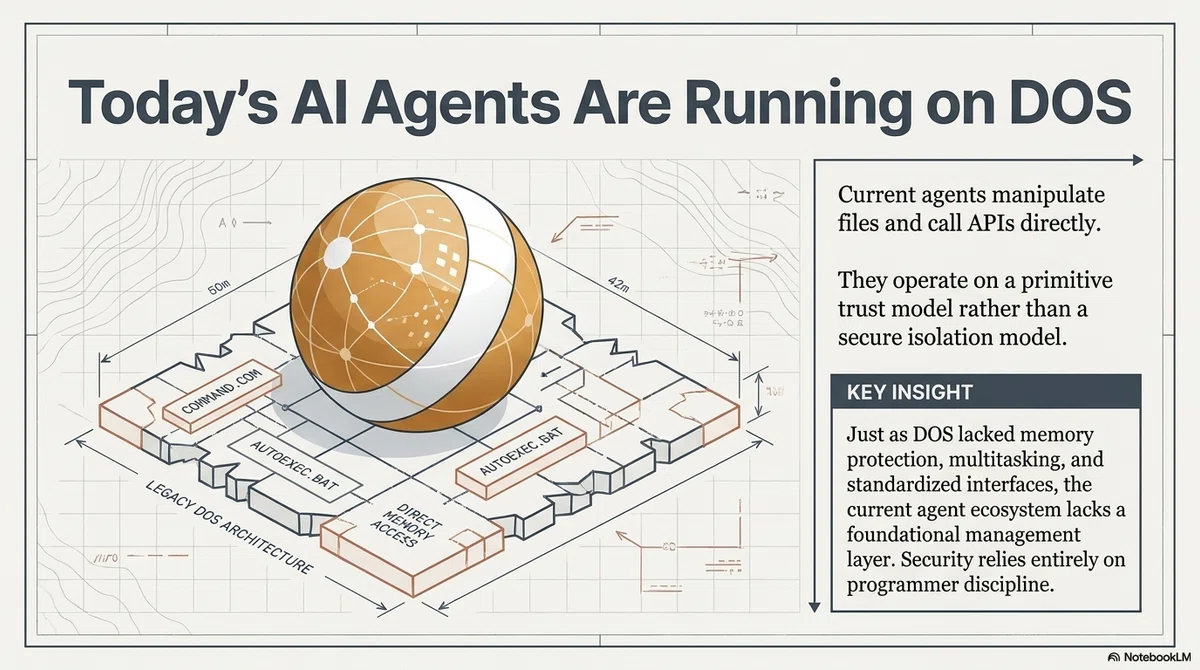
Watch how current AI agents actually operate — Claude Code, Devin, Cursor — and you notice something. They directly manipulate the filesystem. They hit the terminal. They call external APIs. Yes, confirmation mechanisms exist. But the fundamental operating principle is a trust model, not an isolation model. Agents touch the system directly, the way early programs could overwrite arbitrary memory addresses. Security depends entirely on the agent behaving itself.
This is 1980s DOS.
DOS worked. You could write documents, play games, run spreadsheets. But it lacked everything we now expect from a modern OS: no memory protection, no multitasking, no standardized device interfaces. Applications touched hardware directly. Security was programmer discipline.
Today's AI agents are standing at the same starting point.
It took thirty years to evolve from DOS to modern operating systems. The agent ecosystem is speedrunning that same history. And if you know your OS history, you can predict what has to come next.
6. LLM = CPU. Context = RAM. Database = Disk.
There is an analogy that makes Agent OS immediately intuitive.
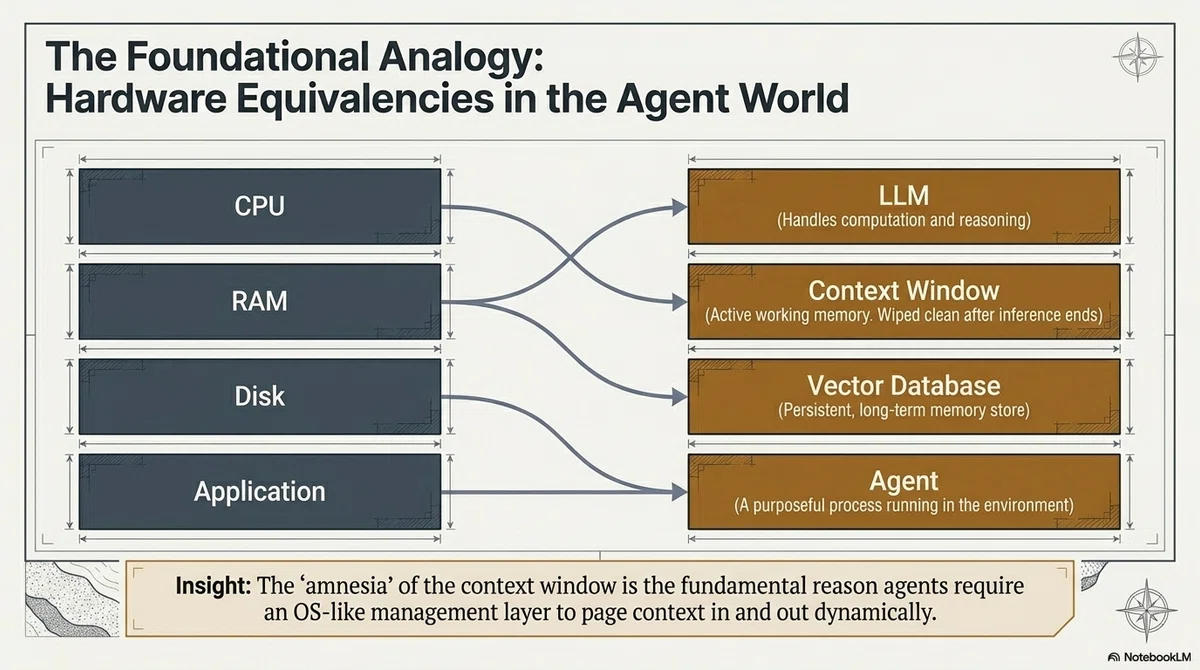
In a traditional computer, the CPU computes, RAM provides temporary storage, and the disk provides persistent storage. In the agent world, this mapping holds with surprising precision:
LLM (Large Language Model) = CPU (handles reasoning and computation)
Context window = RAM (active working memory)
Database / vector store = Disk (persistent, long-term memory)
Agent = Application (a process with purpose, running in the environment)
The most telling correspondence is between the context window and RAM. When an LLM finishes an inference, every intermediate state vanishes. The same way RAM is wiped when you cut the power. This "amnesia" is the fundamental reason agents need an OS-like management layer (Vonng Blog).
Just as an operating system sits between applications and hardware resources — managing memory, scheduling processes, abstracting I/O — an Agent OS must sit between agents and their resources, managing context, scheduling tasks, and brokering access to tools.
7. Five Subsystems of Agent OS — OS History as a Prediction Engine
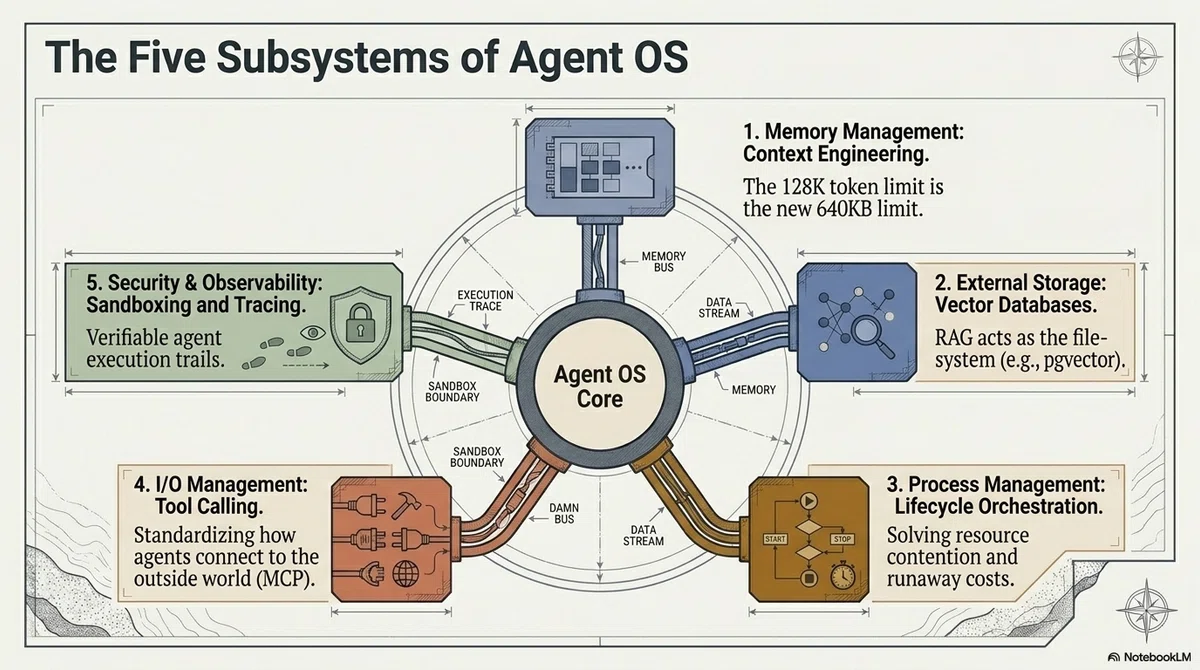
According to Vonng's analysis, Agent OS maps onto five subsystems that parallel the classical OS architecture (Vonng Blog):
① Memory Management (Context Engineering) — The Biggest Technical Battlefield
In 1981, IBM's PC designers thought 640 KB "ought to be enough for anybody." It became one of computing's most famous wrong predictions. Today, when engineers say "128K tokens is already pretty large," they are making precisely the same mistake.
128K tokens sounds generous. But consider the real breakdown: system prompts consume 10–20K, tool definitions consume another 10–20K, reference documents eat 50–80K. The actual conversation space can shrink to tens of thousands of tokens. Congratulations — you've reinvented the 640 KB problem.
How did the OS solve this? Virtual memory. Every program gets the illusion of an unlimited address space. The OS handles page swapping transparently in the background, moving cold data to disk and paging it back when needed. This was one of Unix's great innovations, and it unleashed an enormous productivity leap — programmers stopped worrying about physical memory limits.
The agent world needs the same revolution. Dynamically paging relevant context in and out of the context window — what is now called Context Engineering — is the most technically complex and highest-value problem in agent infrastructure.
The Manus team rewrote their agent framework four times. Their conclusion, distilled from those iterations: "Most agent failures are not model failures — they are context failures" (Manus Context Engineering Blog). The single most important metric is KV-cache hit rate. On Claude, cached tokens cost one-tenth of uncached tokens. Context architecture directly determines unit economics.
② External Storage (Databases) — The Highest-Certainty Opportunity
If the context window is "RAM," the external database is "disk." The Rutgers AIOS project formalizes vector stores as an agent's long-term memory and positions RAG (Retrieval-Augmented Generation) as the equivalent of filesystem access (AIOS GitHub). The emergence of PostgreSQL's pgvector extension as a first-class component in Agent OS storage layers makes complete sense in this framing.
③ Process Management (Agent Lifecycle and Orchestration) — Already Crowded
Run multiple agents simultaneously and the problems surface immediately: resource contention for LLM access, runaway costs, context overload, unpredictable behavior. These are exactly the problems OS process management was designed to solve (Markovate).
LangGraph, CrewAI, AutoGen, and similar frameworks occupy this space, but standardization is nowhere close. The "Hierarchical Supervisor Pattern" — an orchestrator agent managing a set of specialized sub-agents — is emerging in 2026 as the most reliable implementation pattern (Medium: Rise of Agentic OSes).
④ I/O Management (Tool Calling, MCP, A2A) — The Active Standards War
For AI agents calling external APIs, reading files, and interoperating with services, two new protocol standards have emerged: MCP (Model Context Protocol), released by Anthropic in November 2024, and A2A (Agent-to-Agent Protocol). MCP defines a standardized interface for agents connecting to tools and data sources — analogous to how standardized device drivers abstracted hardware diversity for application developers.
⑤ Security and Observability — About to Explode
Isolation and observability are the twin pillars of Agent OS security. Current agents operate on DOS-style trust models, touching the system directly. Sandbox technologies like E2B and Firecracker are emerging, but standardization is years away.
Vonng predicts that "Agent Observability" will become an independent, exploding market category by 2026–2027 — the way APM (Application Performance Monitoring) exploded in the cloud-native era. Whoever provides complete agent traces — input, reasoning, action, result — will own a critical position in the enterprise market (Vonng Blog).
Part III: AI Infrastructure Security — Where Conventional Wisdom Breaks Down
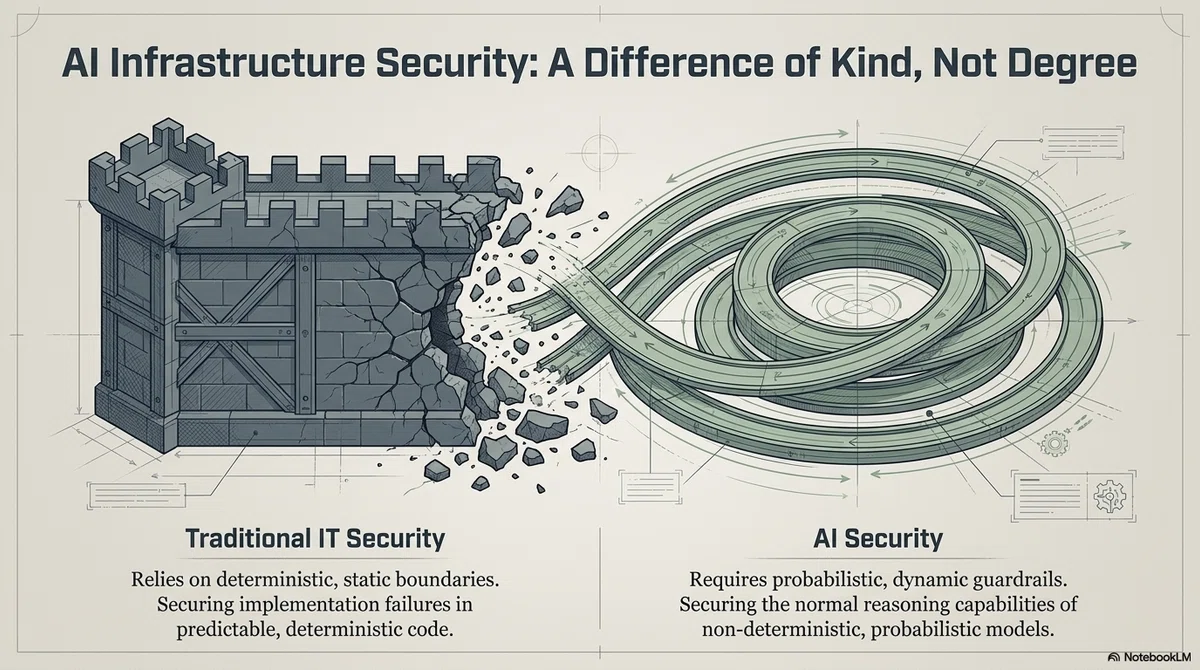
With the hardware shift (Part I) and the Agent OS philosophy (Part II) in place, the security layer comes into focus with much greater clarity. The contrast between traditional IT security and AI security is not a difference of degree. It is a difference of kind.
8. The Philosophical Shift in IAM: From "Humans" to "Agents"
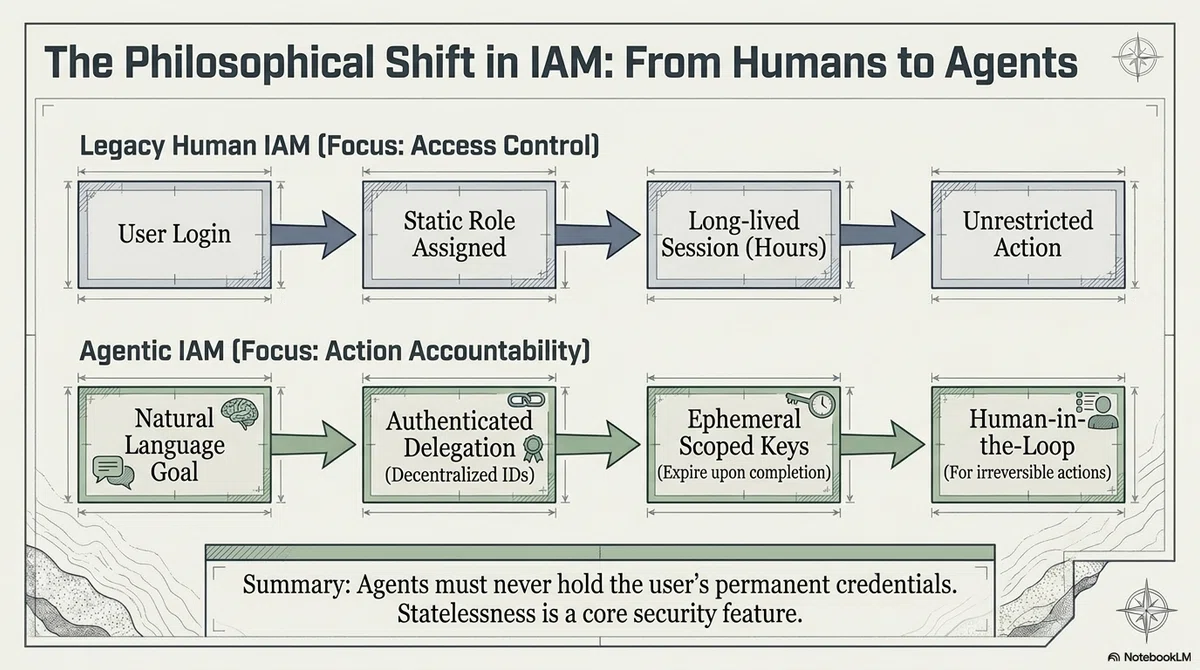
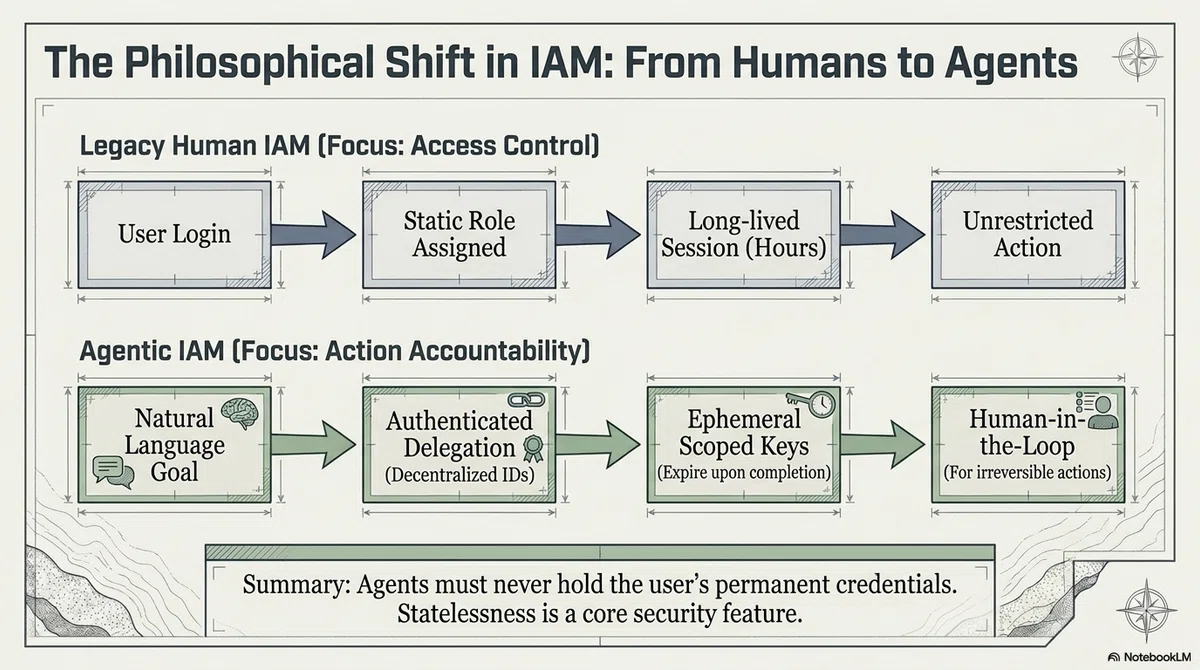
Traditional Identity and Access Management — SAML, OAuth, RBAC — was designed with human users as the assumed principal. Authentication happens once, at login. Permissions are static roles. Sessions persist for hours. The mental model: a person consciously deciding to do something within a defined boundary.
AI agents shatter this model. An agent receives a natural-language goal, makes autonomous decisions at machine speed, and traverses multiple systems in pursuit of that goal. The permissions required shift in real time, depending on the current task, the sensitivity of data being touched, and the ambient threat context.
The Agentic IAM framework proposed by the Cloud Security Alliance (RAND Corporation) responds with three principles.
First, Authenticated Delegation: agents must never use the user's own credentials. Instead, agents hold their own identities — DIDs (Decentralized Identifiers) and VCs (Verifiable Credentials) — and carry an auditable delegation chain traceable back to the authorizing human.
Second, Ephemeral Credentials: agents should never hold long-lived API keys or persistent passwords. Just-in-time permissions scoped to the current task, expiring the moment the task completes. Notably, this mirrors Agent OS's memory management principle — context state disappears after inference. Statelessness is a security feature.
Third, Human-in-the-Loop (HITL): for irreversible operations (large-scale data deletion, production deployment), the agent must request real-time human approval before proceeding — the equivalent of an escalation path in Agent OS process management.
The deeper shift these principles encode: the focus of identity management has moved from access control (can this entity enter?) to action accountability (who authorized this, on whose behalf, with what scope?).
9. Vulnerability Management Upended: From CVE to AI Guardrails
Traditional cybersecurity has always dealt with "implementation failures in deterministic code." SQL injection, buffer overflows — binary defects that either exist in a codebase or do not. Assign a CVE, apply the patch. This cycle has functioned for thirty years.
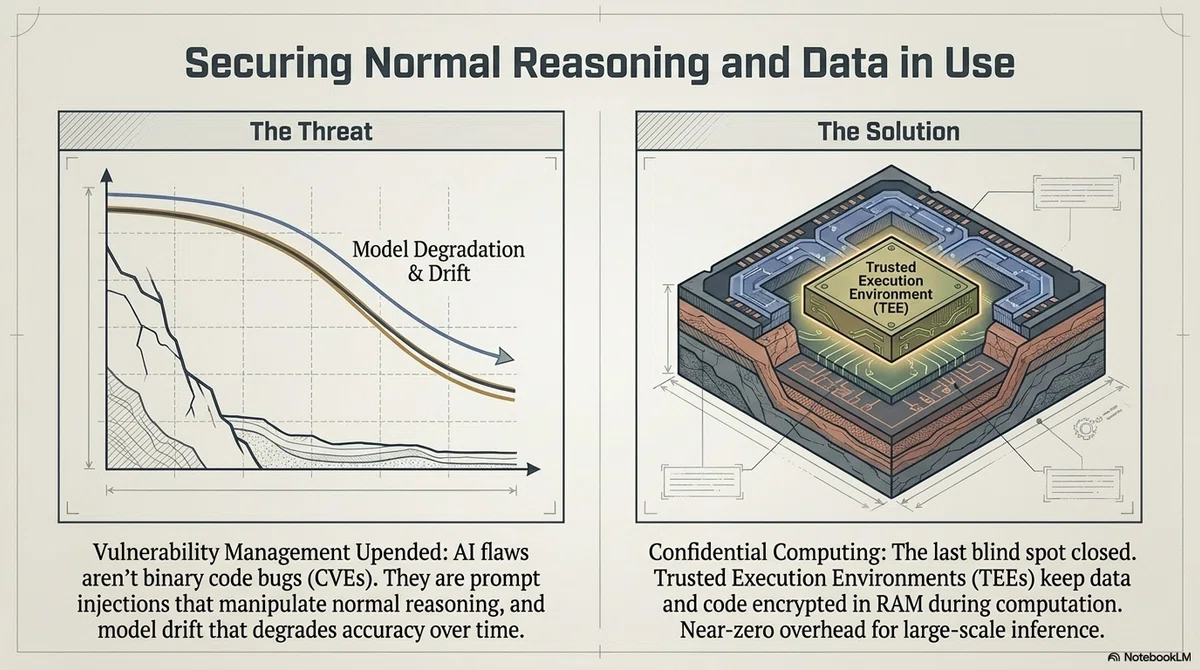
AI systems break the model entirely. Prompt injection does not exploit a bug in code. It manipulates the LLM's normal reasoning capability — the very thing the model is supposed to do — and weaponizes it in an unsafe application context. There is no CVE to assign. There is no patch to apply. The attack surface is the model's intelligence itself.
Then there is model drift. A machine learning model is trained on data from a specific point in time, then deployed statically. But the world keeps moving. The distribution of real-world inputs diverges from the training distribution. Model accuracy degrades — quietly, persistently — while every CPU and network monitoring dashboard stays green.
A joint Stanford / UC Berkeley study found that GPT-4's accuracy on a prime-number identification task dropped from 97.6% in March 2023 to 2.4% by June of the same year. Software bugs are failures of implementation. Model drift is a failure of adaptation. The monitoring metrics required to detect each are fundamentally different.
The response to these new threats is the AI guardrail stack and continuous observability: pre-inference input filtering, in-flight monitoring, post-inference output filtering, and semantic logging that tracks not just what happened but why that reasoning occurred (RAND Corporation).
This is structurally identical to the Security and Observability subsystem of Agent OS. Observability that makes the agent's decision process legible, combined with guardrails that enforce the boundary — these are the twin pillars of AI-era security.
10. Confidential Computing: The Last Blind Spot
Data exists in three states. At rest in storage. In transit across a network. In use — actively being processed by a CPU or GPU, loaded into RAM.
Disk encryption and TLS have covered the first two for decades. "Data in use" has had no equivalent protection. The moment data is read from encrypted storage and loaded into RAM for computation, it exists in plaintext. A cloud provider's system administrator, in principle, can access a tenant's RAM. So can an attacker who has escalated to kernel privileges.
Confidential Computing closes this last blind spot. It constructs a hardware-enforced isolated region inside the processor — a TEE (Trusted Execution Environment) — within which code and data remain encrypted in memory even while being actively processed. The host OS, the hypervisor, the cloud provider: none can read or tamper with the contents of a TEE from outside (Confidential Computing Consortium).
From an Agent OS perspective, this is the ultimate realization of execution environment isolation. When an agent reasons over sensitive data, the entire processing pipeline is isolated and protected at the hardware level.
NVIDIA's H100 GPU was the first GPU to natively support confidential computing (NVIDIA Developer Blog). General availability launched in June 2024 (NVIDIA, 2024). Benchmark research shows the TEE mode performance overhead averages under 7% (Phala/arXiv) — and for large-scale LLM inference, where GPU-internal computation time dominates data transfer time, the overhead approaches zero.
Part IV: "Linux Doesn't Exist Yet" — Where Agent OS Stands in 2026
11. The Present State: The Parts Are Here. The Kernel Is Missing.
Vonng's most pointed observation is about what is absent.
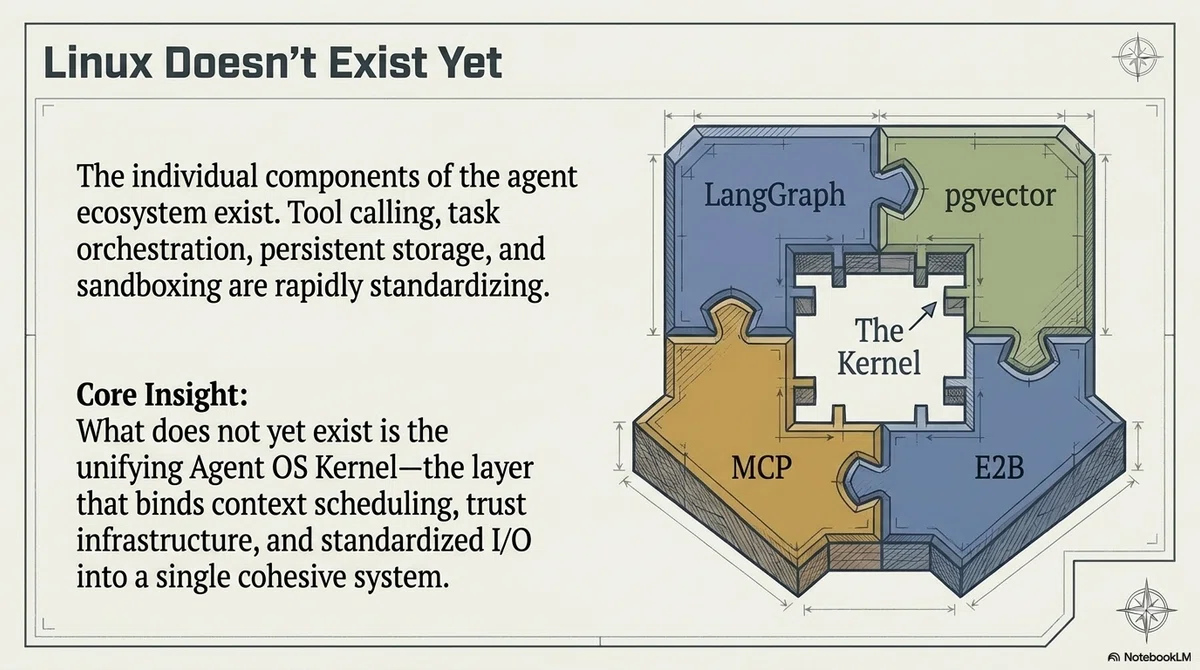
The 2025–2026 agent ecosystem already has pieces. Task orchestration: LangGraph, CrewAI. Tool calling: MCP and A2A are standardizing. Persistent storage: PostgreSQL + pgvector. Security sandboxing: E2B and Firecracker. The components exist.
What does not yet exist is the Agent OS kernel — a layer that binds everything together with unified context scheduling, recoverable process state, standardized I/O interfaces, complete trust infrastructure, and observability. Nobody has built it yet (Vonng Blog).
This is the DOS era. Unix existed, but Windows and Linux did not.
Academia has recognized the gap. Rutgers's AIOS (accepted at COLM 2025) proposes an architecture where LLMs serve as the OS kernel and agents are treated as applications (AIOS GitHub). A comprehensive Agent OS blueprint architecture paper on TechRxiv (TechRxiv, 2025) introduces a latency taxonomy classifying agent real-time requirements as HRT (Hard Real-Time), SRT (Soft Real-Time), and DT (Delay-Tolerant) — directly analogous to how real-time OS scheduling has always been classified.
The arXiv paper "AgentOS" (arXiv, March 2026) pushes further: it envisions replacing the traditional GUI desktop with an NUI (Natural User Interface) centered on unified natural language input, with an Agent Kernel interpreting user intent, decomposing tasks, and coordinating agents, while applications evolve into modular "Skills." The argument: just as the shift from CLI to GUI transformed who could use a computer, the shift from GUI to NUI will transform what a computer can be asked to do.
Researchers describe a three-stage evolutionary roadmap for AI-OS (EmergentMind):
Stage 1 — AI-Powered OS: ML and LLM agents integrated as loosely coupled plugins; isolated enhancements to schedulers and CLI copilot interfaces. This is where we are today.
Stage 2 — AI-Refactored OS: OS subsystems co-designed with AI. Semantic prefetching, ML-optimized memory management, natural language-driven system configuration.
Stage 3 — AI-Native OS: AI and OS become inseparable. Natural language is the primary programming and interaction modality. Agents are first-class processes. System calls evolve into semantic APIs.
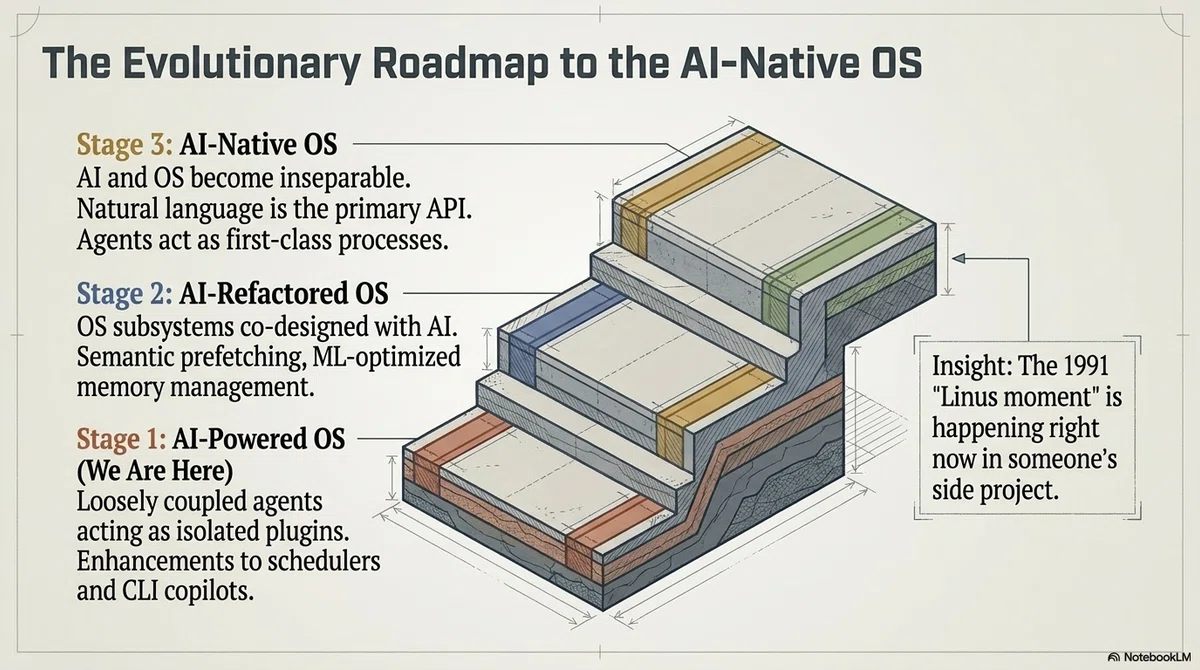
12. The 1991 Moment Is Inside Someone's Side Project
In 1991, Linus Torvalds posted to Usenet: "I'm doing a (free) operating system (just a hobby, won't be big and professional like GNU)."
That hobby project became Linux.
Vonng invokes this moment: the next Agent OS kernel is probably sitting inside someone's side project right now. Unnoticed. The author might be calling it "just a hobby." But it will change the future (Vonng Blog).
This is not romantic speculation. Gartner predicts that the number of enterprise applications featuring task-specific AI agents will jump from under 5% in 2025 to 40% by 2026 (Markovate). The infrastructure to govern that explosion — the OS that makes it coherent, secure, and observable — does not yet exist. That gap is real, and it will be filled.
Epilogue: Tectonic Shifts Always Start at the Bottom
The map of territory this piece has covered:
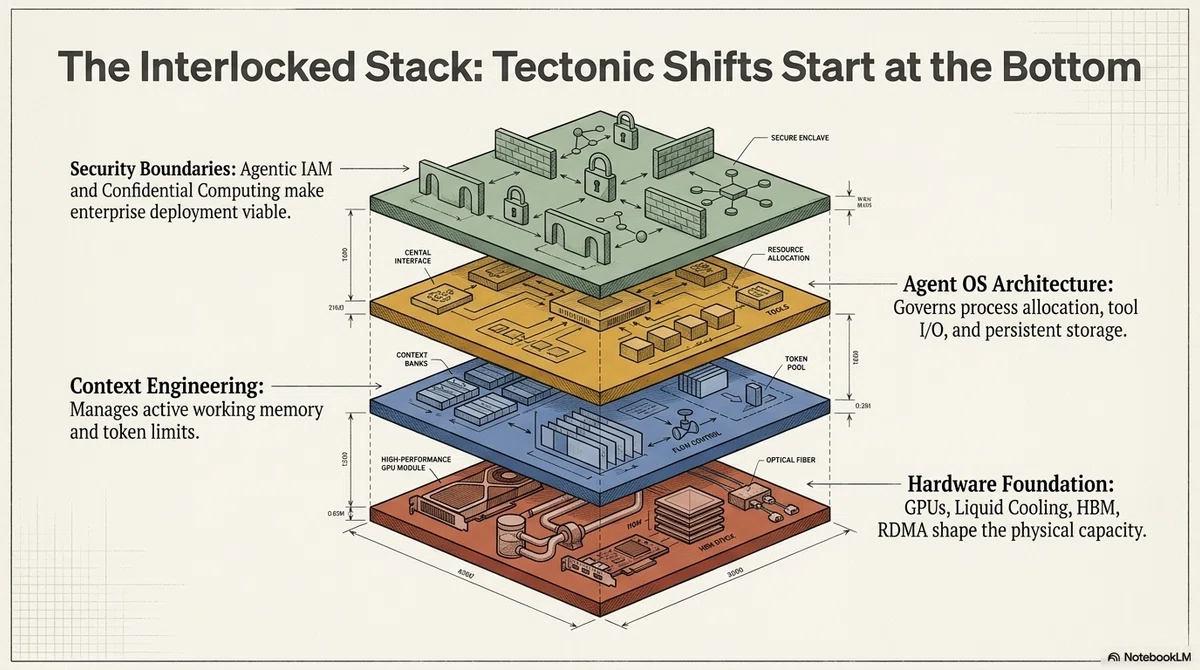
At the deepest layer, hardware. The architectural revolution from CPU to GPU. The order-of-magnitude leap in memory bandwidth from DDR to HBM. The philosophical pivot in networking from TCP/IP to RDMA. The physical battle against heat, fought with liquid. These transformations are already underway — some essentially complete.
Above that, software. A new class of process — the AI agent — has arrived, and the OS that should manage it does not yet exist. Context Engineering has emerged as the discipline of managing the context window the way an OS manages RAM. Databases are becoming the long-term memory of agents. The analogy to classical OS architecture is almost uncanny in its precision.
At the top layer, security and trust. The principal of identity management has shifted from human to agent. Vulnerability management has shifted from patching deterministic code flaws to dynamically guardrailing probabilistic model behavior. Confidential Computing has finally extended hardware-level isolation to data while it is actively being processed.
These layers are not independent. They are deeply interlocked. The physical capacity of the hardware shapes what agents can do. The Agent OS architecture governs how that capacity is allocated and managed. The security and trust layer determines whether any of it can be deployed in production at enterprise scale.
Tectonic shifts always start at the bottom. The surface — ChatGPT, Claude, Gemini — is visible to everyone. But the strata shifting beneath that surface — hardware, OS philosophy, the theory of agent identity and trust — will determine everything about the next decade, and most people are not watching them.
To anyone who still thinks AI is "just a smart search engine": consider that someone is right now designing infrastructure where databases serve as agent long-term memory, context windows serve as agent RAM, and LLMs serve as agent CPUs. Does that sound like a search engine to you?
OS history has one consistent lesson. The next revolution always starts in a place that doesn't have a name yet.
📚 References and Sources
Hardware Foundations
Royal Institution: "What's the Difference Between AI and Regular Computing?" — Foundational contrast between conventional and AI computing (2023)
IntuitionLabs: "HBM vs. DDR: Key Differences in Memory Technology Explained" — Detailed technical comparison of HBM and DDR (updated January 2026)
NVIDIA H100 Tensor Core GPU — Official Product Page — H100 specifications and confidential computing capabilities
Confidential Computing Consortium: Hardware-Based Trusted Execution Whitepaper — Technical foundations of TEE
Agent OS and Agent Architecture
Vonng Blog: "Agent OS: We're Building DOS Again" — A practitioner's analysis of Agent OS through the lens of OS history (January 2026)
GitHub: agiresearch/AIOS — Rutgers University AIOS implementation, accepted at COLM 2025
TechRxiv: "Agent Operating Systems (Agent-OS): A Blueprint Architecture for Real-Time, Secure, and Scalable AI Agents" — Formal blueprint architecture for Agent OS (September 2025)
arXiv: "AgentOS: From Application Silos to a Natural Language-Driven Data Ecosystem" — Vision paper on NUI and Agent Kernel (March 2026)
EmergentMind: "AI-Driven Operating Systems" — Research landscape overview of AI-driven OS (updated November 2025)
Markovate: "Agentic Operating System: The Future of Enterprise AI Orchestration" — Enterprise implementation guide for Agentic OS
MindStudio: "What Is the Agentic OS Architecture? How to Stack Context, Memory, Collaboration, and Self-Learning" — Four-layer architecture: context management, shared memory, skill collaboration, self-learning (March 2026)
Medium: "The Rise of Agentic Operating Systems" — Practical implementation patterns for Agentic OS in 2026 (February 2026)
EMA.ai: "Understanding AI Agent Operating Systems: A Comprehensive Guide" — AIOS Kernel and SDK architecture in detail (June 2025)
Picovoice: "Complete Guide to AI OS in 2025" — Types, examples, and use cases of AI OS (December 2025)
Manus: "Context Engineering for AI Agents — Lessons from Building Manus" — Practical insights on KV-cache, external memory, and context architecture
Security and AI Risk
RAND Corporation: "The AI Threat Landscape: Common Attack Vectors" — Systematic taxonomy of AI-specific attack vectors
NVIDIA Developer Blog: "Confidential Computing on H100 GPUs for Secure and Trustworthy AI" — H100 confidential computing technical details (2023)
NVIDIA Developer Blog: "Announcing Confidential Computing General Access on NVIDIA H100" — General availability announcement (June 2024)
Phala Network / arXiv: "Confidential Computing on nVIDIA H100 GPU: A Performance Benchmark Study" — Quantitative measurement of TEE mode performance overhead (September 2024)
🏷️ Tags
#AgentOS #AIInfrastructure #AIOS #GPU #HBM #ConfidentialComputing #ContextEngineering #RDMA #AISecurity #ZeroTrust #ModelDrift #AIGuardrails #AIFactory #EnterpriseAI #GenerativeAI #MCP #IAM #Observability #TEE #AIArchitecture #NextGenOS #DistributedSystems #MachineLearning #DataCenter
This piece is a conceptual sequel to "The AI Factory Is Quietly Dismantling IT's Conventional Wisdom." Reading both together gives a layered view of the transformation — from the physics of silicon all the way up to the philosophy of Agent OS.
If this was useful, a like ❤️ or bookmark goes a long way. And if there's a topic you'd like to see explored next, drop a keyword in the comments — it may well become the next piece.
いいなと思ったら応援しよう!
 最後まで読んでいただき、ありがとうございます!この記事が少しでも皆様のヒントになれば幸いです。
チップは、今後のさらなる技術検証や専門書購入費用として大切に活用させていただきます。サポートは、より深い記事を書くモチベーションになりますので、ぜひよろしくお願いいたします!
最後まで読んでいただき、ありがとうございます!この記事が少しでも皆様のヒントになれば幸いです。
チップは、今後のさらなる技術検証や専門書購入費用として大切に活用させていただきます。サポートは、より深い記事を書くモチベーションになりますので、ぜひよろしくお願いいたします!