
Agents Are Defined by Their Environment, Not Their Model — Where Agent OS and Harness Engineering Intersect, and What Is Being Built There

"65% of enterprise AI agent failures trace back to Harness defects — not model limitations." — Adnan Masood, PhD. / Medium, April 2026
When you read that, two reactions split the room. Half the engineers nod and say "of course." The other half ask: "What's a harness?"
In February 2026, Mitchell Hashimoto — co-founder of HashiCorp and creator of Terraform — published a short piece. The core habit he described: every time an AI agent made a mistake, he engineered a permanent fix into the agent's environment, ensuring the same mistake could not happen again. He called it "Harness Engineering" (Software Improvement Group).
Within weeks, engineering blogs from OpenAI and Anthropic extended the idea. Martin Fowler's Thoughtworks platform carried it into the software engineering mainstream. By April 2026, at the AI Engineer World's Fair, three independent speakers independently named agent harnesses and context engineering as the single highest-priority next frontier — not model capability, not prompt design (Atlan, 2026).
This piece integrates Harness Engineering as a discipline with the Agent OS philosophy explored in the previous series — technically, precisely, and from the perspective of the people who build these environments rather than the people who use them. The question is not "which model should I pick?" It is "what kind of environment should I build?"
Prologue: The 88% Production Gap and What It Actually Tells Us
Start with the numbers. They are uncomfortable.
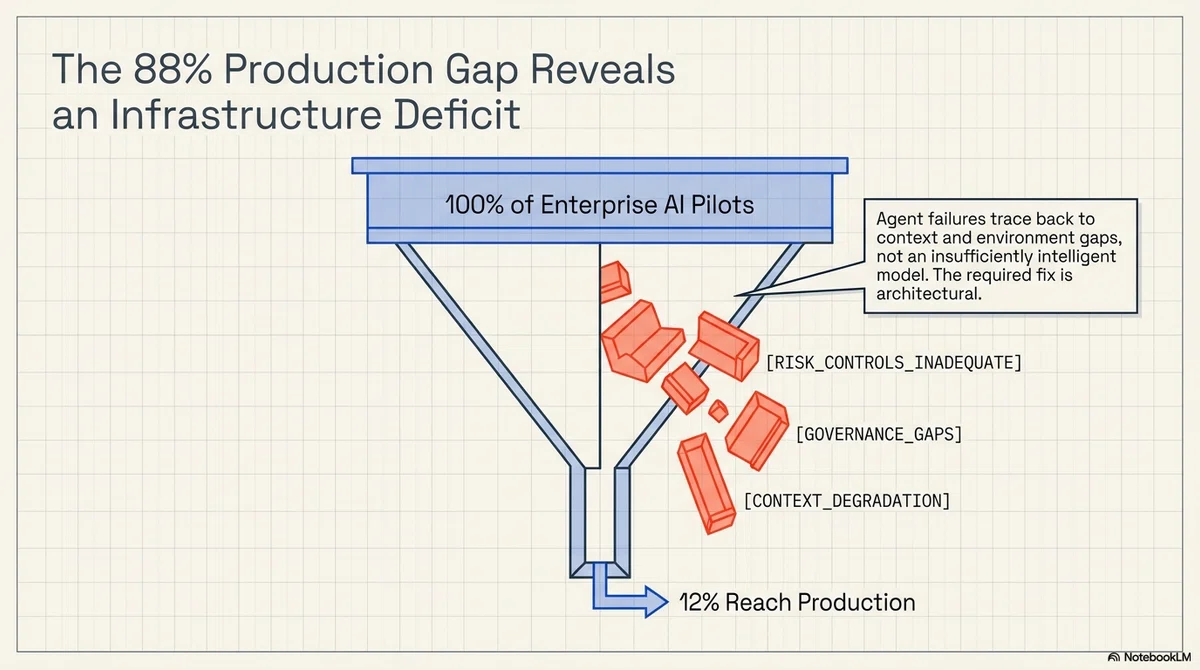
88% of enterprise AI agent projects never reach production (Medium: Adnan Masood, 2026). An MIT study from 2025 found that 95% of enterprise AI pilots generated zero measurable ROI — and traced the root cause not to model limitations but to context gaps (Atlan, 2026). Gartner predicted in June 2026 that more than 40% of agentic AI projects will be cancelled by end of 2027 — for reasons that have nothing to do with the technology: inadequate risk controls, unclear business value, governance gaps (SIG, 2026).
These numbers converge on a single conclusion. Agent failures are not caused by models being insufficiently intelligent. They are caused by the environments those models operate in being broken.
Agent OS is the architectural philosophy that recognizes "agents need a management layer that treats them as processes." Harness Engineering is the engineering practice that answers "so how, concretely, do you design and build the environment those processes run in?" The relationship between the two is close to the relationship between OS kernel design philosophy and userspace systems engineering — one provides the conceptual architecture, the other provides the implementation. Where they intersect is where this piece lives.
Part I: "Agent = Model + Harness" — What the Formula Actually Means
1. What Hashimoto's Formula Encodes
The formula is terse:
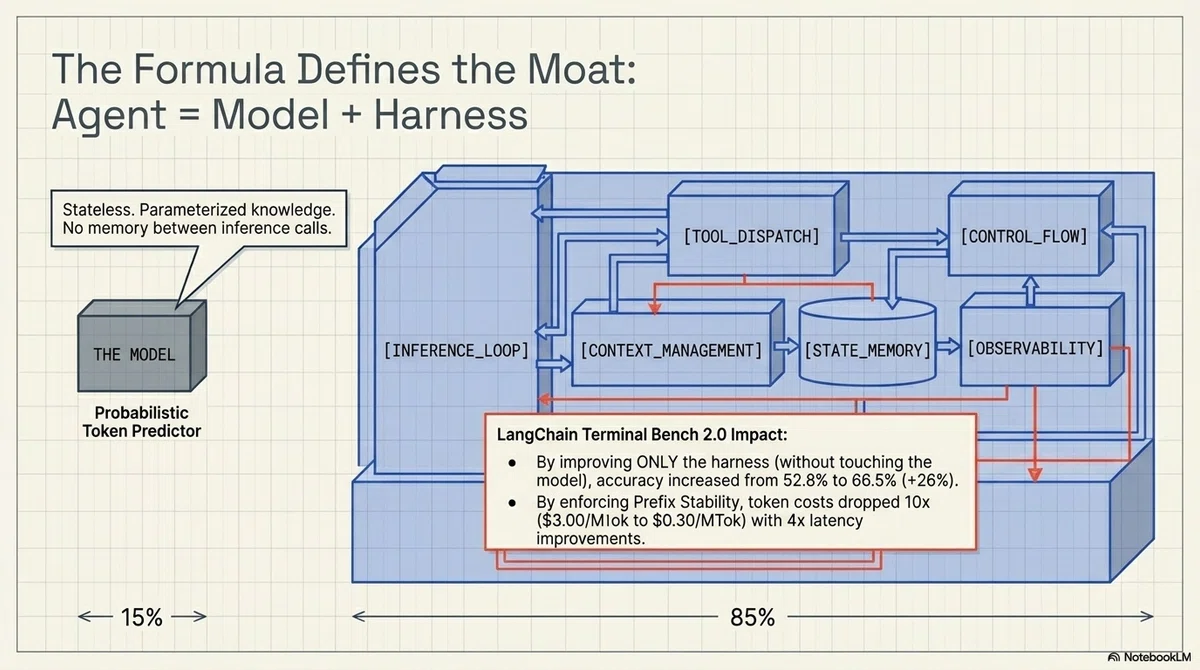
Agent = Model + Harness
The model is a stateless token predictor. Given a context, it probabilistically predicts the next token — that is all. It holds no state between inference calls. It does not remember across sessions. It does not decide which tools to call or when to stop. It has knowledge baked into parameters, but how that knowledge gets applied is entirely determined by what surrounds it.
The harness is "the runtime software infrastructure that wraps the LLM with everything it needs to survive a production environment" (Medium: Adnan Masood). Concretely, it handles:
The inference loop: repeatedly calling the model, parsing its output, executing tool calls, feeding results back into context, deciding when to stop
Tool and function dispatch: routing the model's requests to the appropriate tools — search, code execution, API calls, MCP servers
Context management: system prompts, conversation history, retrieved documents, compaction and summarization when the window fills
State and memory: scratchpads, task lists, short- and long-term memory across turns
Control flow: retries, error handling, timeouts, maximum step limits, budget caps, stop conditions
Safety and observability: guardrails, permission checks, approval gates, logging, tracing
The mapping to Agent OS subsystems — memory management, process management, I/O management, security and observability — is striking. The harness is, in effect, the userspace implementation of Agent OS.
2. Models Are Commoditizing — Which Makes the Harness the Moat
By 2026, the performance differential between frontier models has narrowed to the point where model selection is rarely the determining factor in production outcomes. Claude, GPT-4, Gemini, and capable open-source alternatives now cluster within a narrow performance band on standard benchmarks (Medium: Adnan Masood). The model is no longer the source of competitive advantage.
LangChain quantified this on Terminal Bench 2.0: without changing the underlying model, they improved a coding agent's accuracy from 52.8% to 66.5% — a 26% gain — by improving only the harness (Y Build, 2026).
The economics tell the same story. By implementing KV-cache locality and semantic routing in the harness, organizations have reduced token costs from $3.00/MTok to $0.30/MTok — a 10× reduction — while simultaneously achieving 4× latency improvements. Without touching the model (Medium: Adnan Masood).
One concrete engineering technique: removing dynamic elements like second-level timestamps from the top of the prompt. That single harness-level change dramatically improves KV-cache hit rates. This is the Prefix Stability principle — keeping system instructions and conversation history stable prevents the cache from breaking and keeps the model operating as a high-margin tool rather than a prohibitive expense.
Part II: The Three Root-Cause Failure Modes and Their Design Responses
3. The 65% Problem: Context Drift, Schema Misalignment, State Degradation
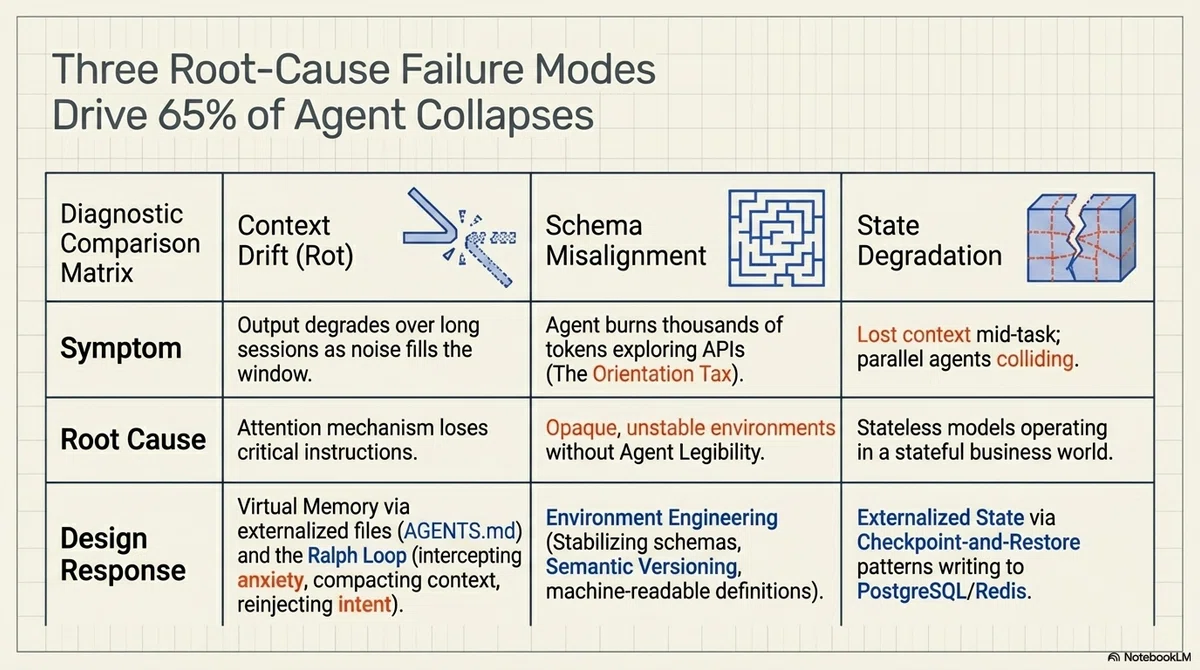
65% of enterprise AI agent failures trace to three specific harness defects (Medium: Adnan Masood). Optimizing the model without stabilizing the harness yields rapidly diminishing returns. These failure modes require harness fixes, not better models.
① Context Drift — The Silent Death Called "Context Rot"
As conversations and tasks grow longer, the output of tool calls accumulates in the context window. This is what practitioners now call "Context Rot." The LLM's attention mechanism begins to lose track of critical instructions when the window is filled with stale, noisy information from earlier in the session.
This is structurally identical to the memory management problem in Agent OS. Just as physical RAM fragmentation causes excessive swapping and degrades throughput, a context window fragmented with noise degrades the quality of inference.
Design Response: Context Management as Virtual Memory
Mature harnesses solve this by externalizing memory to a virtualized filesystem — standardized artifacts like AGENTS.md or todo.md files serve as the "disk" that context pages in and out from, managed dynamically the way an OS manages physical memory pages.
Beyond that, there is the Ralph Loop recovery pattern. When an agent exhibits "Context Anxiety" — attempting to abandon a task prematurely because its context has become degraded — the harness intercepts this, compacts the context window, and reinjects the original intent into a clean working context. This is what enables Long-Horizon Task continuity: agents survive network outages and session suspensions without losing their objective (Medium: Adnan Masood).
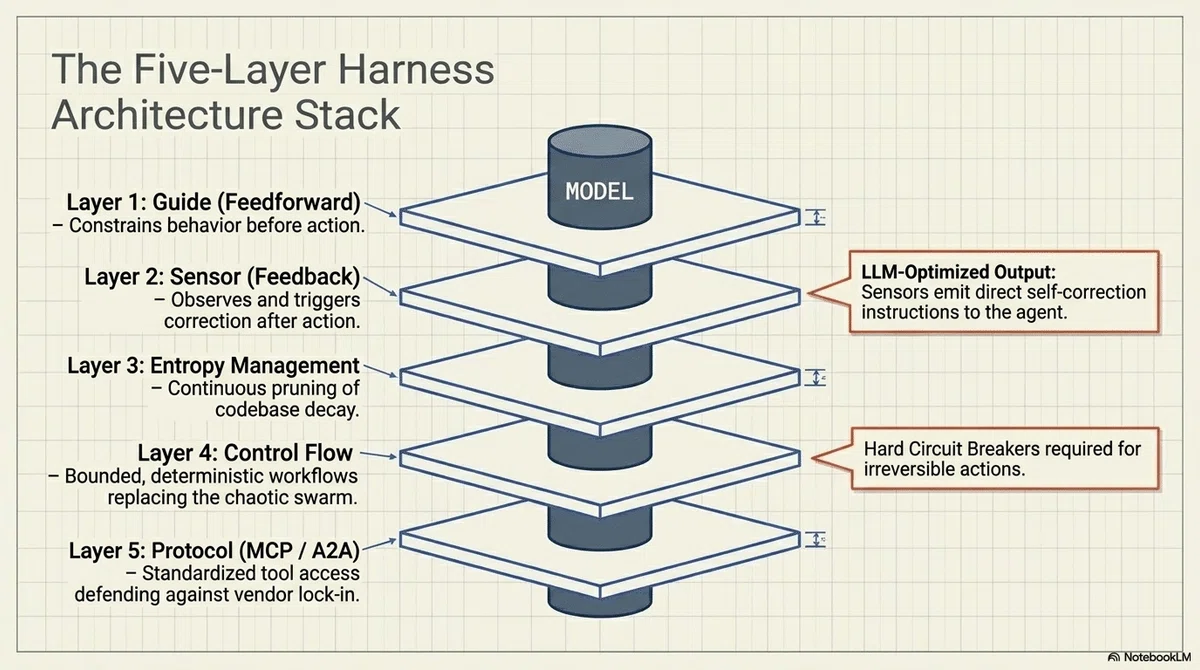
Birgitta Böckeler's paper on Thoughtworks / Martin Fowler's platform (Thoughtworks, 2026) provides the rigorous framework: harness mechanisms divide into Guides (feedforward control) that steer the agent before it acts, and Sensors (feedback control) that observe and trigger self-correction after it acts. Guides without sensors: the agent keeps repeating the same mistakes. Sensors without guides: the agent has rules but no way to verify they worked. Both together form a closed-loop self-correction system — exactly the control theory principle behind any robust feedback controller.
Sensors themselves split into two execution types. Computational Sensors — static analysis, linters, architecture fitness functions — are deterministic, cheap, and fast: they reliably catch duplicate code, cyclomatic complexity violations, and test coverage drops. Inferential Sensors — LLM-based review agents — address semantic problems like over-engineered solutions and misunderstood specifications, but are expensive and probabilistic. The design decision is which class of sensor to gate with which: running inferential sensors only on changes that have already cleared computational sensors is a standard cost-control strategy (Thoughtworks, 2026).
Böckeler highlights a particularly powerful pattern: LLM-optimized sensor output. Rather than emitting human-readable error messages, custom linters emit messages formatted specifically for LLM consumption — including instructions for self-correction embedded in the error text. The sensor becomes part of the self-correction loop rather than a mere detector. This is, as she frames it, "a beneficial form of prompt injection."
② Schema Misalignment — An Environment Without Agent Legibility Is an Adversary
When an agent calls APIs, queries databases, and integrates with external services, opaque or unstable interface schemas force the agent to spend enormous token budgets just trying to orient itself. This is the Orientation Tax.
The agent burns thousands of tokens running what amounts to a Grep-spree: exploring the codebase, reading documentation fragments, reverse-engineering API behavior through trial and error. No amount of model intelligence resolves this — the fix is increasing the environment's Agent Legibility (Medium: Adnan Masood).
Design Response: Environment Engineering as the Next Frontier
As harness capabilities mature, the bottleneck shifts outward — from building the harness to engineering the environment the harness operates in. This means re-architecting internal APIs, codebases, and databases to be inherently legible to autonomous agents:
Stabilize schemas: avoid frequent changes to externally visible API schemas. Enforce Semantic Versioning rigorously.
Make context explicit: maintain AGENTS.md (agent-facing design documents), API specifications, and type definitions in machine-readable, continuously current form.
Minimize tool side effects: reduce non-idempotent API calls. Make the effects of every tool call predictable and bounded.
The build vs. buy decision has a clean framework here: buy managed runtimes, basic telemetry, and control planes from hyperscalers or existing frameworks. Build domain-specific tools, custom evaluation datasets, and environment maps (Medium: Adnan Masood).
③ State Degradation — Where Stateless Models Meet a Stateful World
LLMs are fundamentally stateless. Every inference call is independent. But real business processes are stateful: multi-step workflows, interruptions and resumptions, concurrent execution requiring synchronization.
This mismatch produces State Degradation — state that fails to persist coherently across sessions, context that is lost mid-task, state conflicts between parallel agents competing over shared resources.
In Agent OS terms, this is "virtual memory management without a swap file" — a filesystem that cannot persist state across power cycles.
Design Response: Externalized, Recoverable State
Rather than asking the LLM's context to "remember" state, the design must write state to external persistent storage:
Persist intermediate task state to PostgreSQL or Redis, reloading it on session resumption
Record the agent's action history as auditable logs in an external database
Implement a Checkpoint-and-Restore pattern — the agent process equivalent of OS process suspend — into agent workflow execution
Part III: The Five-Layer Harness Architecture
4. The Guide Layer (Feedforward Control)
Guides are preventive design elements that constrain agent behavior before the agent acts. Following Böckeler's classification (Thoughtworks, 2026), two types:
Computational Guides
Language servers, CLIs, scripts, codemods — deterministic tools that enforce structural patterns. Where a TypeScript compiler enforces type constraints, a computational guide physically enforces architectural boundaries. No LLM tokens consumed. Completely reproducible. Cheap to run on every commit.
Inferential Guides
AGENTS.md (agent-facing design principle documents), Constraints for Resilience (CfR) specifications, rules files, reference documentation, how-to guides. These define the scope of what the agent "knows it should do" before it begins.
A critical implementation note: static guide files degrade rapidly (SIG, 2026). Writing AGENTS.md once and leaving it is the agent-environment equivalent of documentation that drifts away from the codebase it describes. A mature harness treats guide files as structured, versioned artifacts that are actively maintained — not static documents.
The Harness Template concept follows naturally: for specific task categories (REST API implementation, data migration, UI component creation), pre-configure a reusable bundle of guides and sensors matched to that task type. Reuse the template rather than re-engineering the harness from scratch for every new project (Thoughtworks, 2026).
5. The Sensor Layer (Feedback Control)
Sensors observe quality after the agent acts and trigger self-correction.
Computational Sensors — Concrete Examples
Static analysis (ESLint, SonarQube), test suites (unit, integration), architecture fitness functions (ArchUnit, Structurizr), CI/CD pipeline output. These are cheap and deterministic, but cannot catch semantic problems — over-engineering, misunderstood requirements, logic that passes all tests but misses the intent.
Inferential Sensors — Concrete Examples
LLM-based review agents that detect semantic issues. Because these are expensive and probabilistic, the standard gating strategy is: run them only on changes that have already cleared computational sensors. This prevents token budgets from being consumed on changes that would have failed static checks anyway.
LLM-Optimized Sensor Output
Böckeler's most distinctive contribution to sensor design: format sensor output for LLM consumption, not human consumption (Thoughtworks, 2026). A custom linter that emits "Error: variable naming violates convention — rename x to userId to comply with the naming policy defined in AGENTS.md" gives the agent everything it needs to self-correct in a single inference pass. The sensor becomes part of the correction loop, not just a detection tool.
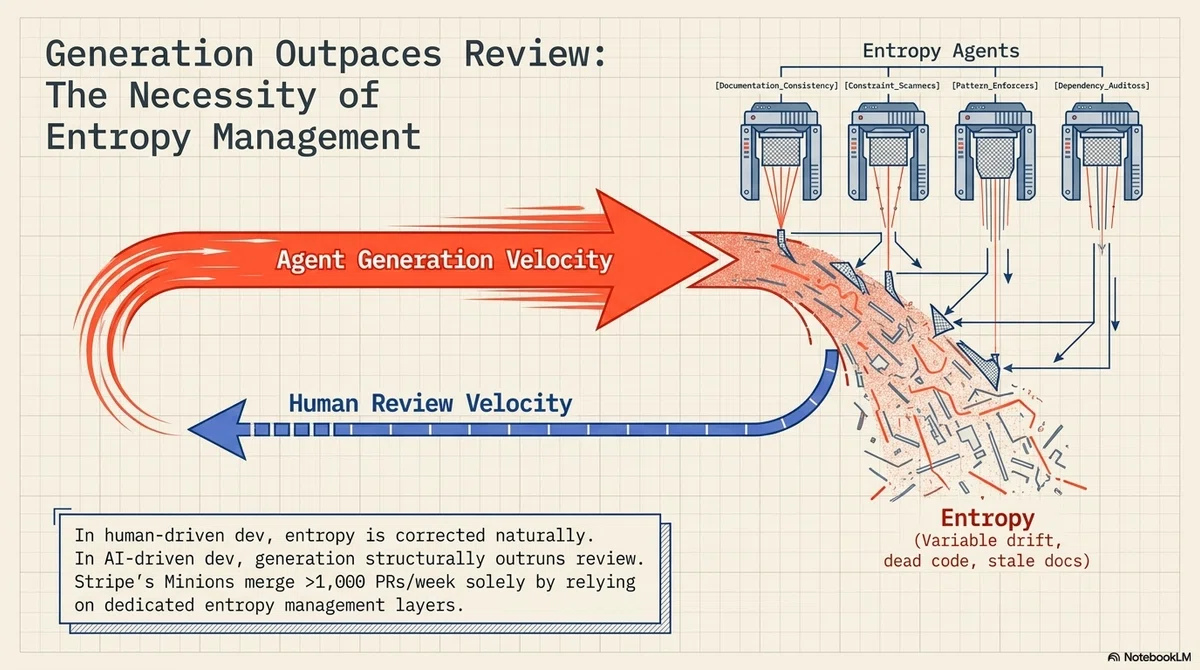
6. The Entropy Management Layer — The Invisible Enemy of AI-Driven Development
This is Harness Engineering's most original contribution — a problem that has no clean analogue in Agent OS architecture: Entropy Management (NxCode, 2026).
AI agents generate code at near-realtime speed. When generation velocity exceeds review velocity — which is structurally guaranteed in agent-driven development — entropy accumulates in the codebase. Variable naming drifts. Documentation diverges from implementation. Dead code accumulates. Test coverage drops.
In human-driven development, entropy is corrected naturally through code review, refactoring sessions, and knowledge sharing. In agent-driven development, generation structurally outruns review, and entropy compounds without explicit intervention.
SIG's research quantifies the gap. Agent-only code scored 1.1/5 on maintainability and 2.2/5 on architecture. Human-in-the-loop code scored 3.1/5 and 4.4/5 respectively. The difference came down to four factors: design boundaries, test strategy, dependency hygiene, and scope control (SIG, 2026).
Entropy Management Design Patterns
The solution is dedicated agents whose sole purpose is entropy management, running on scheduled or event-triggered cadences:
Documentation consistency agents: verify and correct drift between code and its documentation
Constraint violation scanners: find code that slipped through earlier checks and remediate it
Pattern enforcement agents: detect and correct deviations from established conventions
Dependency auditors: track and resolve circular or unnecessary dependencies
These agents run daily, weekly, or triggered by specific events (NxCode, 2026). Stripe's internal coding agents — called Minions — are now producing more than 1,000 merged pull requests per week. That throughput is only sustainable because dedicated entropy management agents maintain codebase health for both human reviewers and the next agent iteration.
7. The Control Flow Layer — The Death of the Chaotic Swarm
In 2025, unconstrained multi-agent meshes were theoretically appealing. By 2026, production environments have converged sharply toward Bounded, Deterministic Workflows (Medium: Adnan Masood).
Field reports are consistent: "Highly autonomous swarms are brittle, prohibitively expensive, and nearly impossible to debug in production. The prevailing pattern overwhelmingly favors a single, well-scoped agent with highly deterministic tool access."
Supervisor Pattern Implementation
The hierarchical structure is the most reliable implementation pattern available:
An Orchestrator Agent receives the goal and decomposes it into subtasks
Specialized Worker Agents execute individual subtasks within explicit scope boundaries
The Orchestrator integrates results and determines the next step
The critical design point is scope boundaries. Each Worker Agent has a clearly defined toolset and permission boundary it cannot cross — the agent process equivalent of process isolation in Agent OS process management.
Hard Circuit Breaker Design
Before high-risk remediation actions, the harness inserts a hard interrupt requiring human authorization. This is the Human-on-the-loop operations model — distinct from Human-in-the-loop. Human-on-the-loop: humans intervene only when the harness determines human authorization is required. Human-in-the-loop: humans participate in every step.
Design criteria for which actions require a Hard Circuit Breaker:
Irreversibility: data deletion that cannot be undone, production deployment, commits to external systems
Blast radius: bulk operations, broadcast actions that touch many records or systems simultaneously
Sensitivity: transfer of PII or confidential data across trust boundaries
8. The Protocol Layer — MCP and A2A as the "USB-C Moment"
Where the harness and the Agent OS I/O management subsystem intersect most directly is the protocol standardization problem.
MCP (Model Context Protocol), released by Anthropic in November 2024, and A2A (Agent-to-Agent Protocol), led by Google, are functioning as the "USB-C moment" for the agent ecosystem (Medium: Adnan Masood):
MCP standardizes vertical Agent-to-Tool interactions. It separates tool implementation from agent logic — analogous to how standardized device drivers separated hardware specifics from application code.
A2A enables horizontal delegation. It allows agents running on different frameworks to collaborate without a single shared runtime.
This standardization creates Procurement Leverage: adopting MCP and A2A gives organizations a structural defense against vendor lock-in. Swap the model, swap the tool, without rebuilding the infrastructure.
From an environment design perspective, adopting MCP requires several non-trivial design decisions:
How to scope MCP servers (an overly broad toolset makes agent behavior unpredictable — narrow is almost always better)
How to implement authentication and authorization in MCP (integration with ephemeral credential patterns)
MCP server versioning strategy (managing the impact of schema changes on active agents)
Part IV: The Integrated Architecture — Mapping Agent OS to Harness Engineering
9. Formalizing the Correspondence
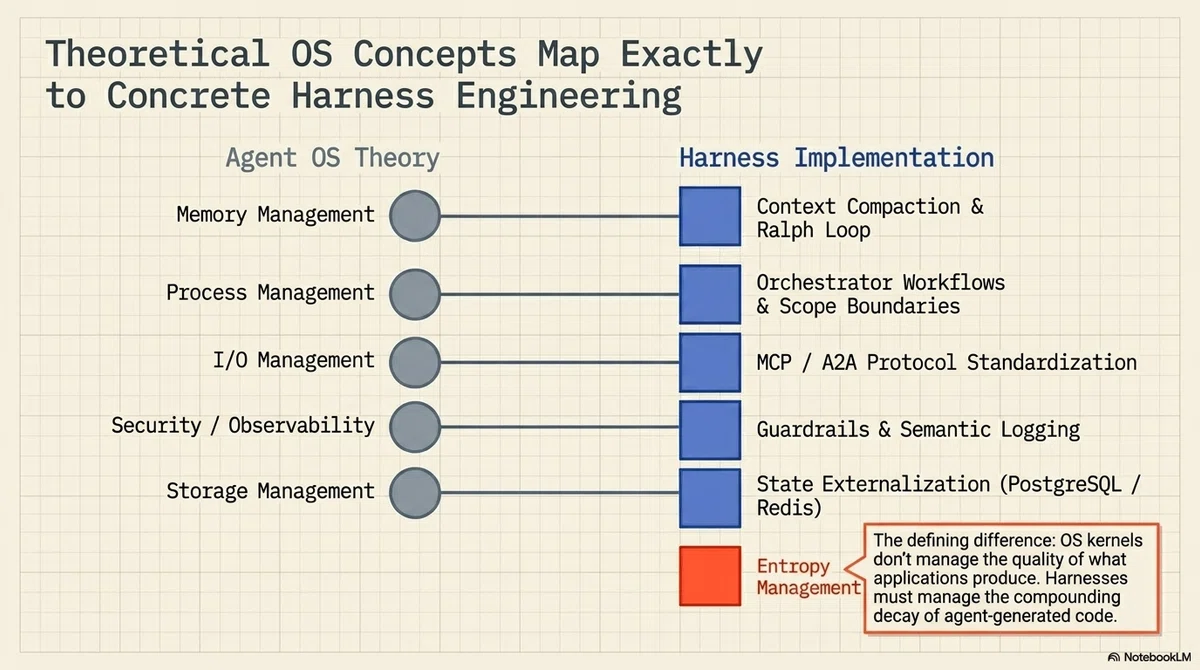
The mapping between Agent OS subsystems and Harness Engineering design elements is precise enough to be operationally useful.
① Agent OS Memory Management ↔ Harness Context Management
When Agent OS says "the context window is the agent's RAM," Harness Engineering provides the implementation specification: KV-cache prefix stability, context rot detection and compaction, Ralph Loop continuity for long-horizon tasks, page-out to external vector stores. These are the concrete realization of Agent OS "virtual memory management."
② Agent OS Process Management ↔ Harness Control Flow
The Supervisor Pattern, scope boundary definitions, Hard Circuit Breakers, escalation paths — these are the implementation of Agent OS "process scheduling" and "process isolation." The Orchestrator is the scheduler. The Worker's scope boundary is the process isolation boundary. The Hard Circuit Breaker is the supervisor-level kill signal.
③ Agent OS I/O Management ↔ Harness MCP/A2A Integration
The standardized interfaces provided by MCP and A2A are the agent ecosystem's equivalent of standardized device drivers. The harness manages access to external tools and data sources through these protocols, exactly as an OS kernel manages hardware access through driver abstractions.
④ Agent OS Security and Observability ↔ Harness Guardrails and IAM
The agentic IAM principles discussed in the previous series — ephemeral credentials, delegation chains, Human-in-the-loop gates — are implemented as the harness's security layer. Guardrails operate at both the input (pre-filtering) and output (post-filtering) layers. Semantic logging — tracking not just what happened but why the reasoning went where it did — is the concrete form of Agent OS observability infrastructure.
⑤ Agent OS Storage Management ↔ Harness State Externalization
The agent's long-term memory (vector stores, PostgreSQL), Checkpoint-and-Restore patterns, and auditable action history logs — these are the implementation of Agent OS "disk management." The database is the agent's persistent filesystem.
10. Entropy Management: The Concept Agent OS Does Not Have
The most intellectually interesting observation is that Entropy Management has no clean analogue in the Agent OS architectural model.
Traditional operating systems do not manage the quality of what applications produce. An OS manages process execution. It provides no guarantee about, and takes no responsibility for, the quality of the artifacts those processes create.
But in Harness Engineering, the harness itself must manage the cumulative quality degradation of what agents produce. The OS analogy breaks down here — and that is precisely the point.
If Agent OS answers the structural question "how do you manage agents as processes," Harness Engineering answers the dynamic question "how do you maintain the quality of what those processes produce over time." The first is architectural. The second is operational. Both are necessary. Neither is sufficient alone.
Part V: "Harnessability" — The New Dimension of Environment Design
11. Designing for Agent Legibility
Böckeler's concept of Harnessability is one of the most practically important frameworks for environment designers (Thoughtworks, 2026).
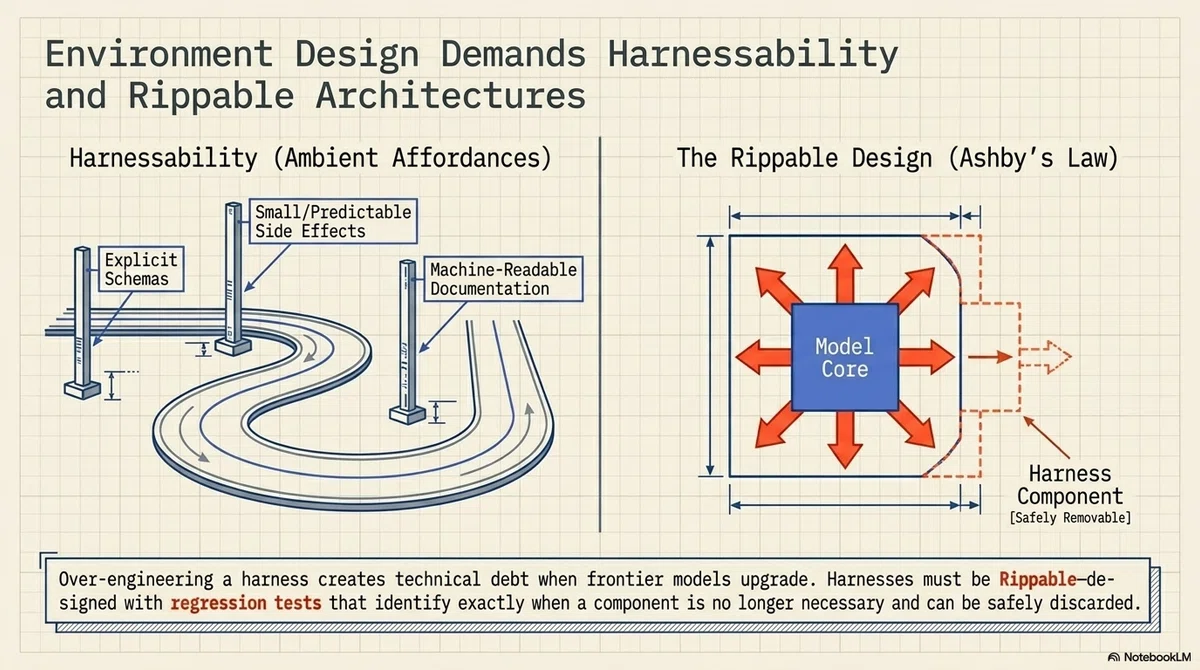
Harnessability is the degree to which an environment, codebase, or API is easy for a harness to work with. Systems with high Harnessability:
Have tool invocation results that are clear, with small and predictable side effects
Expose schemas and types that are explicit and stable
Surface error messages in formats that LLMs can process directly without interpretation overhead
Are highly testable, so agents can verify their own outputs against deterministic assertions
Maintain documentation that is machine-readable and continuously current
The related concept of Ambient Affordances is equally important: cues embedded in the environment itself — file naming conventions, directory structure, type annotations — that naturally guide agent behavior in the correct direction before the agent ever consults a guide document. This is the agent-environment equivalent of Developer Experience (DX) for humans: the environment is designed so that the right action is the path of least resistance.
However, Harnessability and human maintainability can be in genuine tension. "Flat, verbose code" that an LLM can navigate without inference overhead often conflicts with "abstract, concise code" that a human engineer finds easy to reason about. This tradeoff has no universal resolution — it depends deeply on the tooling choices and organizational context (Thoughtworks, 2026).
Ashby's Law applies directly here: a control system must have complexity at least equal to the complexity of the system it controls. As the scope of what you ask agents to do expands, the harness must grow to match. Conversely, narrowing the agent's scope (reducing problem complexity) reduces harness complexity proportionally. This is the engineering basis for why scope management appears consistently in failure-mode analyses as one of the four critical factors.
12. The Rippable Harness Design Philosophy
A design principle from NxCode's analysis that deserves its own section: over-engineering a harness creates problems when the model improves (NxCode, 2026).
Model capabilities are evolving rapidly. Tasks that required elaborate prompt engineering six months ago are now handled trivially by next-generation models. An overly complex harness built around a model's current limitations becomes technical debt — and then an active obstruction — when the model's capabilities advance past those limitations.
Therefore: harnesses should be Rippable. When model capability improves, harness components should be removable without dismantling the entire system. This is a modularity problem, and simultaneously a test strategy problem. A regression test suite that can evaluate, when you change the model, which harness components are now unnecessary — and can safely be removed — is a first-class engineering deliverable, not an afterthought.
Part VI: Current Position and the Final Frontier — The Data Layer
13. The Other Reason 88% Fail
Even with a well-architected harness, one problem remains unsolved. The data layer.
Teams that are shipping reliable agents at scale in 2026 share a common characteristic: they have solved not just the harness architecture problem but the data layer problem — ensuring that data is certified, current, and drift-aware before it ever reaches the harness (Atlan, 2026).
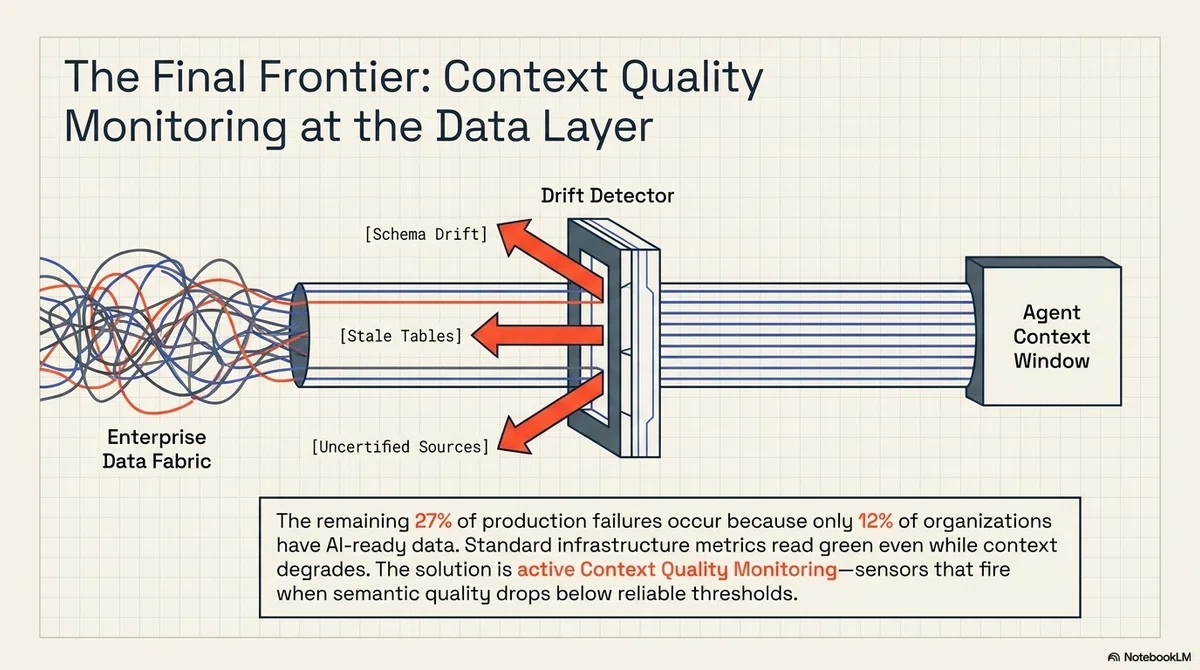
Harness frameworks like LangGraph assume inputs are clean. In real enterprise environments, schema drift, stale tables, and uncertified data sources are the norm, not the exception. This is why 27% of agent failures are attributed specifically to data quality issues (Atlan, 2026).
Atlan's research found that only 12% of organizations have data of sufficient quality for AI as of 2025. The 88% production gap is partly a harness architecture problem — and partly a data fabric quality problem that no harness can compensate for.
Context Quality Monitoring as a Sensor Category
Anthropic's engineering team, in their work on harness design for long-running applications, identified a pattern worth naming explicitly: Context Window Degradation is a sensor problem (Atlan, 2026). Without sensors that monitor context quality over time, agents accumulate stale, noisy information and their output degrades — while every infrastructure metric continues reading green.
The fix is not a better model. It is a sensor that detects when context quality has dropped below the threshold for reliable operation — a drift detector that fires when the agent's behavior changes unexpectedly due to degraded context, not when underlying infrastructure metrics change.
14. "The Kernel Still Doesn't Exist" — But the Central Nervous System Is Taking Shape
In the previous series, I wrote: "Linux doesn't exist yet." In April 2026, that remains true. A unified Agent OS kernel does not exist.
But the title of Adnan Masood's piece says something important: the harness is evolving from "brittle exoskeleton" to "central nervous system of the automated enterprise" (Medium, 2026).
In the brittle exoskeleton phase (2024–2025), the harness was an additive structure built around the agent for protection. It was understood as an extension of prompt engineering.
In the central nervous system phase (2026–), the harness is the essential connective infrastructure that translates the LLM's probabilistic reasoning into dependable, deterministic action in the real world. The LLM is increasingly treated as a component of the harness rather than the other way around. What the LLM experiences as its "world" — the environment design — is what determines competitive outcomes.
Epilogue: The Questions That Now Matter
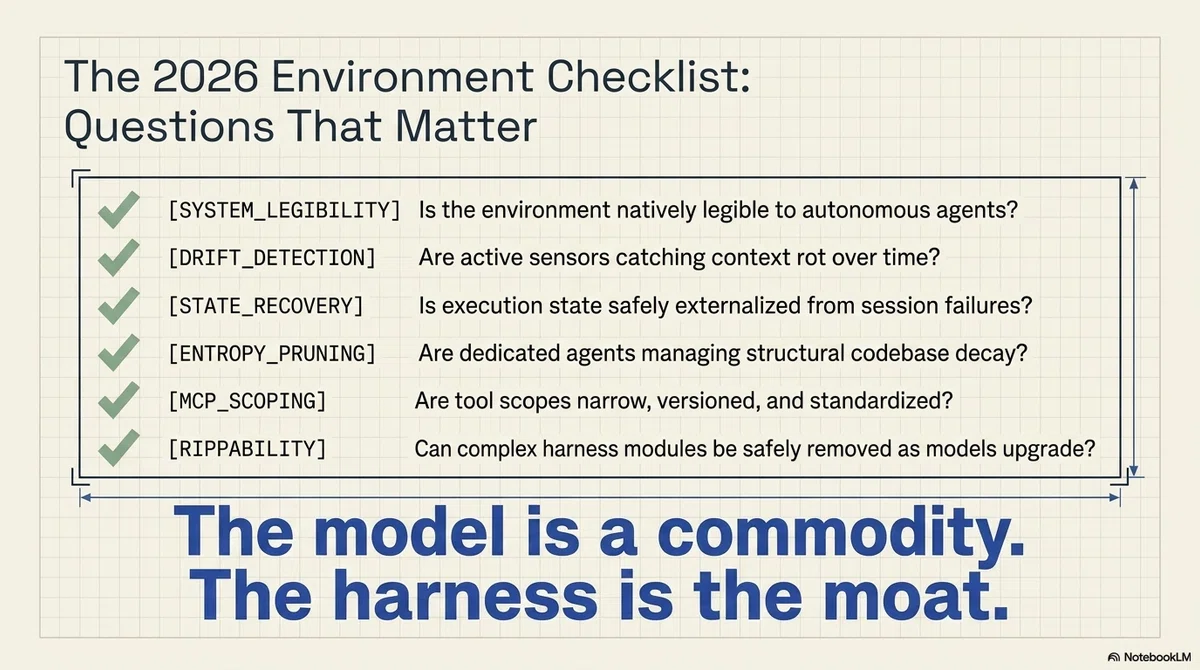
"Which model should I pick?" has become, in 2026, nearly the wrong question.
The questions that matter now:
Is the environment the agent operates in legible to the agent?
Are there sensors that detect and correct context drift over time?
Is state externalized and recoverable from session failure?
Are there scheduled entropy management agents keeping the codebase healthy?
Are MCP server scopes appropriately narrow, with stable, versioned schemas?
Is the harness rippable — designed so components can be removed as model capability improves past their necessity?
Is the data layer certified, current, and drift-aware before it reaches the harness?
The organizations that can answer these questions are the ones shaping the agent ecosystem for the next five years.
"The model is commodity. The harness is the moat." That sentence compresses the entire landscape as seen from the designer's perspective.
Most organizations have not yet begun digging the moat.
📚 References
Harness Engineering — Primary Sources
Software Improvement Group: "What is Harness Engineering?" — From Hashimoto's February 2026 coinage to production implementation patterns (April 2026)
Martin Fowler / Thoughtworks: "Harness Engineering for Coding Agent Users" — Feedforward/feedback control taxonomy, Computational vs. Inferential classification (Birgitta Böckeler, April 2026)
Medium: Adnan Masood PhD. "Agent Harness Engineering — The Rise of the AI Control Plane" — Context Drift / Schema Misalignment / State Degradation definitions; 10× cost reduction case study (April 2026)
Atlan: "What Is Harness Engineering AI? The Definitive 2026 Guide" — 88% production gap data, data layer problem, drift detectors (April 2026)
Y Build: "Harness Engineering: Build Systems Around AI Agents (2026)" — LangChain Terminal Bench 2.0 experiment (52.8% → 66.5% accuracy improvement, harness only) (March 2026)
NxCode: "Harness Engineering: The Complete Guide (2026)" — Entropy management, Rippable Harness philosophy, Stripe Minions case study (March 2026)
QubitTool: "Complete Guide to Harness Engineering" — 2026 AI architecture configuration, four core modules (March 2026)
QubitTool: "Agent Harness Engineering Guide: Evaluating AI Agents in Production" — Sandbox evaluation, infinite loop detection, tool mocking (March 2026)
HarnessEngineering.Academy: "What is Harness Engineering? A Complete Introduction" — Entropy management, demo-to-production transition (March 2026)
Milvus Blog: "What Is Harness Engineering for AI Agents?" — Hashimoto's habit, how the term spread through the engineering community (April 2026)
Augment Code: "Harness Engineering for AI Coding Agents" — Architecture drift, deterministic security enforcement at the CI layer (April 2026)
Atlan: "Top AI Agent Harness Tools and Frameworks 2026" — LangGraph and CrewAI schema drift handling, comparative framework analysis (April 2026)
Agent OS — Prior Series References
Vonng Blog: "Agent OS: We're Building DOS Again" — Five Agent OS subsystems, Ralph Loop, LLM-as-CPU analogy (January 2026)
GitHub: agiresearch/AIOS — Rutgers University AIOS implementation (accepted at COLM 2025)
Manus: "Context Engineering for AI Agents" — KV-cache hit rate, practical lessons from four harness rewrites
Security and IAM
RAND Corporation: "The AI Threat Landscape: Common Attack Vectors" — Agentic IAM, MAESTRO framework
Anthropic Engineering: "Effective Harnesses for Long-Running Agents" — Harness design for long-running applications (official Anthropic engineering blog)
🏷️ Tags
#HarnessEngineering #AgentOS #AIInfrastructureDesign #AgenticAI #ContextEngineering #LLM #EntropyManagement #AIArchitecture #MCP #ContextDrift #SchemaAlignment #AIObservability #AIGuardrails #SupervisorPattern #EnterpriseAI #DevOps #AISecurity #FeedbackLoops #AIProduction #ZeroTrust #IAM #AIEnvironmentDesign #GenerativeAI #SystemsEngineering #ModelDrift #DistributedSystems #SoftwareArchitecture
This is the third piece in the series. The first — "The AI Factory Is Quietly Dismantling Everything IT Thought It Knew" — covered the hardware layer. The second — "The Ground Beneath AI Is Shifting" — covered Agent OS as a design philosophy. This piece addresses the engineering practice that implements it: Harness Engineering, and where the two frameworks intersect.
If this was useful, a like ❤️ or bookmark is always appreciated 🙇 Drop a keyword in the comments if there's a topic you'd like to see explored next — it may become the subject of a future piece.
いいなと思ったら応援しよう!
 最後まで読んでいただき、ありがとうございます!この記事が少しでも皆様のヒントになれば幸いです。
チップは、今後のさらなる技術検証や専門書購入費用として大切に活用させていただきます。サポートは、より深い記事を書くモチベーションになりますので、ぜひよろしくお願いいたします!
最後まで読んでいただき、ありがとうございます!この記事が少しでも皆様のヒントになれば幸いです。
チップは、今後のさらなる技術検証や専門書購入費用として大切に活用させていただきます。サポートは、より深い記事を書くモチベーションになりますので、ぜひよろしくお願いいたします!