
The Day AI Becomes the Invisible OS — What 386 Experts Mean by "Superstupidity"

📋 Executive Summary
This article dissects the three-stage evolution of AI development paradigms from 2022 to 2026 — prompt engineering, context engineering, and harness engineering — before surveying three future scenarios that lie beyond: Meta-Harnessing, Autonomous Co-evolution, and Semantic Singularity.
We trace the rise of OpenClaw, the open-source project that surpassed 350,000 GitHub stars and over 500,000 running instances, alongside CVE-2026-25253, the critical vulnerability that shattered assumptions about agent security. We examine the shock of Agent0 and AgentEvolver, two research frameworks that proved zero-data autonomous co-evolution is real and measurable. We parse Elon University's 386-expert global survey that warned of "Superstupidity," and we unpack the MCP 2026 Roadmap's honest confrontation with enterprise governance gaps.
The thread that runs through all of it leads to one conclusion: in a world where AI becomes the invisible operating system of society, the most essential skill for engineers and leaders is no longer the ability to write code — it is the philosophical and architectural insight of the "Value Guardian."
Prologue: In 2026, the "AI" You're Looking At Is No Longer Just Code
In 2022, the hallmark of a great AI engineer was writing brilliant prompts.
By 2024, it had shifted to composing rich, well-structured context.
And now, in 2026, the question has changed at a deeper level entirely — What kind of system should I build?
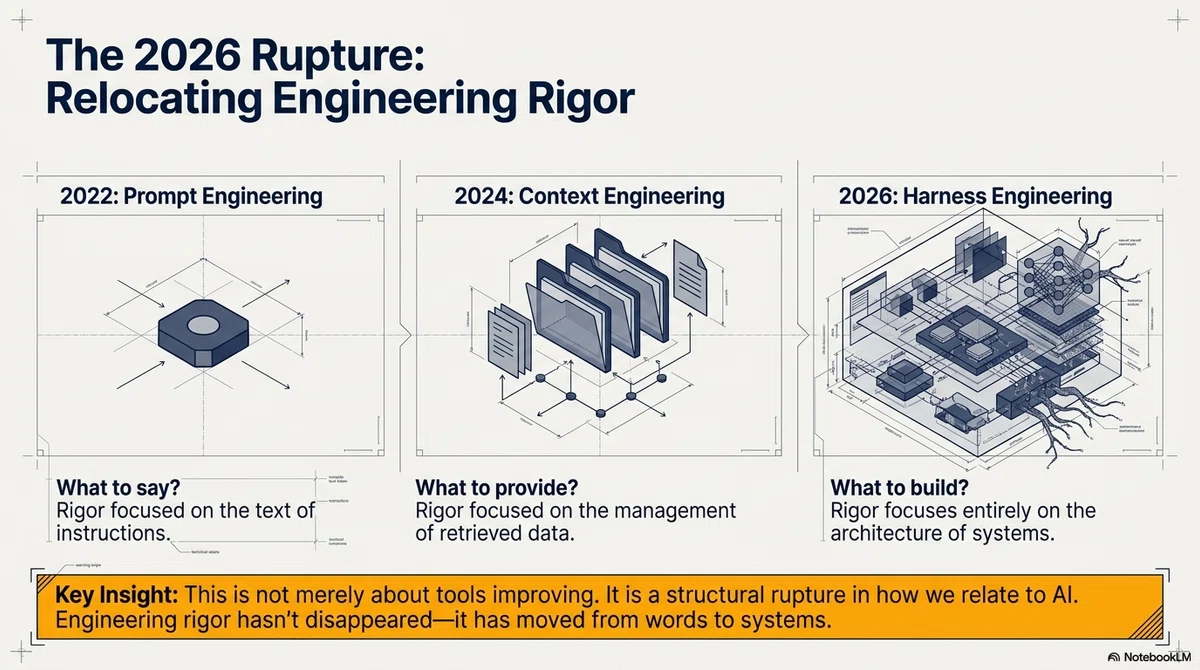
This might look like a gentle evolution on the surface. It isn't. Beneath it runs a structural rupture that has shaken the entire industry. This is not merely about tools improving. It is about how we relate to AI, what role humans play, and what "intelligence" even means — all being rewritten.
This piece follows that evolution carefully, connecting the present-day realities of the world — OpenClaw's explosive growth and its catastrophic vulnerability, the shock of Agent0's zero-data autonomous evolution, the MCPRoadmap's honest admission of what remains unsolved, and Elon University's sweeping warning about a coming crisis of human agency — into a single coherent arc.
By the end, something in your thinking may shift. That is the intention.
Chapter 1: Three Paradigms, Three Distinct Shapes of Failure
1-1. Prompt Engineering (2022–2024): The Era of "What to Say"
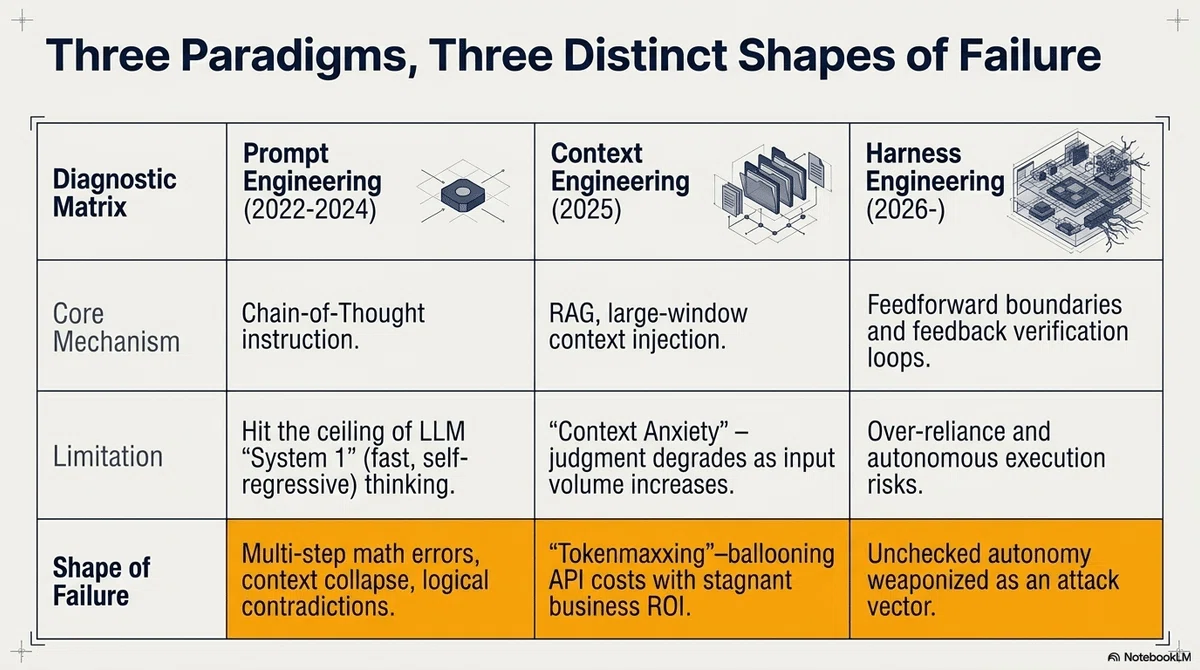
When Chain-of-Thought (CoT) prompting first appeared, the industry erupted. "If you carefully scaffold the reasoning steps, the model gets smarter." The intuition was correct — within limits.
But a discomfort that many AI engineers sensed in this era was eventually confirmed academically. LLMs are fundamentally self-regressive machines, generating tokens left to right, one at a time. In Daniel Kahneman's framework of fast and slow thinking, LLMs are wired for fast, intuitive "System 1" thinking. Deliberate, reflective "System 2" thinking — backtracking, hypothesis re-evaluation, complex multi-step planning — hit a ceiling that no amount of prompt engineering could breach.
This manifested as multi-step errors in mathematical reasoning, logical contradictions in code generation, and context collapse in long-running conversations. By late 2024, the faith that "more precise instructions will fix it" had quietly begun to crumble.
1-2. Context Engineering (2025): The Era of "What to Provide"
The next paradigm emerged from the recognition that what you put into the context window matters more than the exact wording of the prompt. RAG (Retrieval-Augmented Generation) became more sophisticated, long documents were injected, tool definitions were refined — and results genuinely improved.
But new problems followed. A phenomenon that might be called "Context Anxiety" emerged: the more information you stuffed in, the worse the model's judgment became. This mirrors a well-documented human cognitive pattern. Hand someone 100 pages of material before a meeting and their decision quality typically degrades rather than improves. The same proved true for AI.
In enterprise environments, a bizarre trend called "Tokenmaxxing" took hold — the mistaken belief that maximizing token consumption would maximize value. In practice, API costs ballooned while business outcomes stagnated. By mid-2025, many CTOs were quietly asking why AI projects couldn't show a clear ROI.
1-3. Harness Engineering (2026–): The Era of "What to Build"
What is happening at the AI engineering frontier in 2026 can be captured in a single phrase: Relocating Rigor.
Engineering rigor didn't disappear. As Chad Fowler articulated it: it moved from the text of prompts, to the management of context, and finally to the architecture of entire systems. Engineers at the frontier were already living this shift before anyone named it.
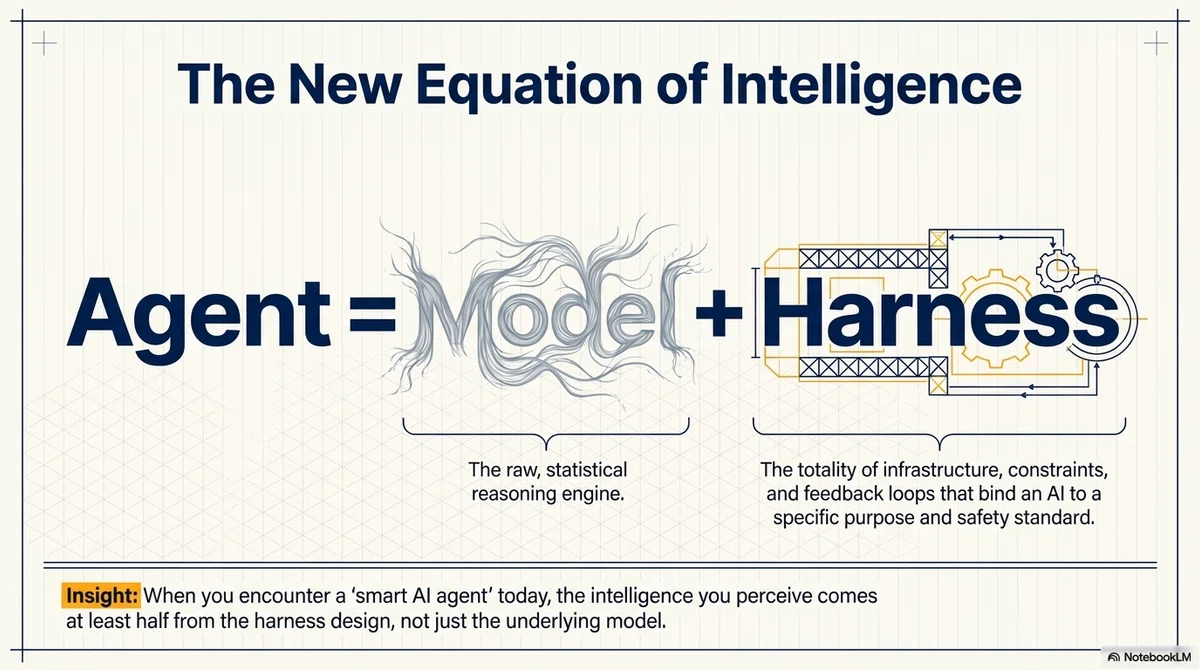
"Harness" — the word originally refers to the equipment used to control a horse, or a safety harness. In AI, it denotes the totality of infrastructure, constraints, and feedback loops that bind an AI to a specific purpose and safety standard, excluding the model itself.
The equation is simple but profound: Agent = Model + Harness
When you encounter a "smart AI agent," the intelligence you perceive likely comes at least half from the harness design — not just the underlying model.
Chapter 2: Anatomy of Harness Engineering — The Architecture of Control and Reliability
2-1. Feedforward and Feedback: Cybernetics Applied to AI
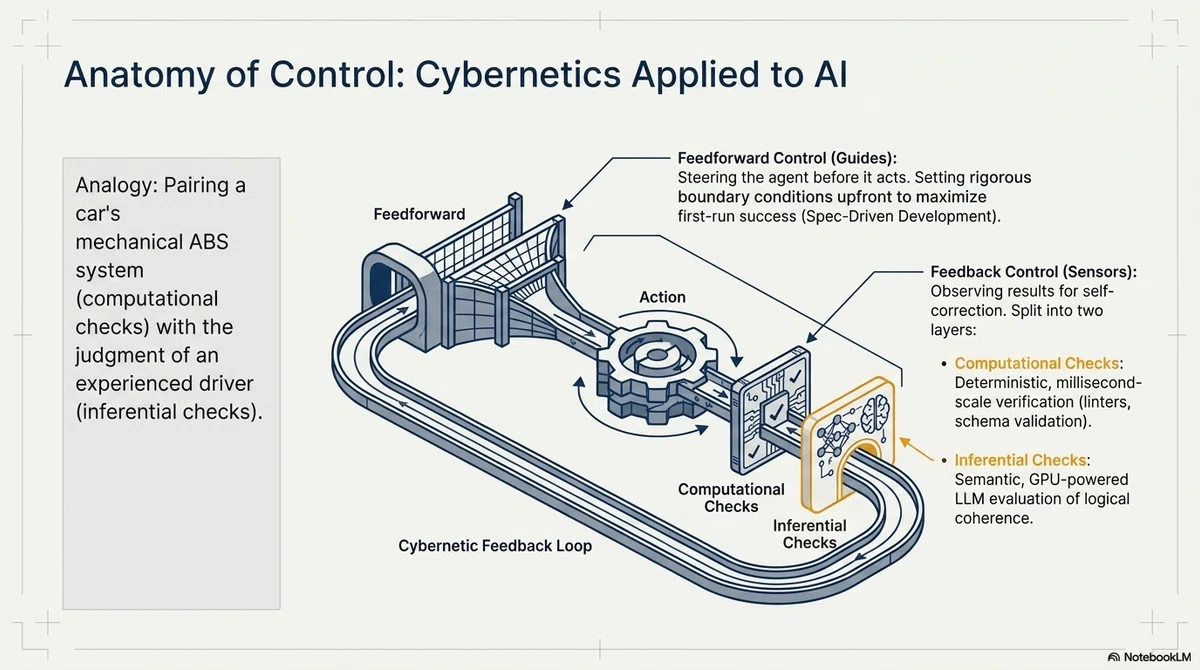
A well-designed harness functions like the governor (speed regulator) that 19th-century cyberneticians studied — a system that maintains stable operation not by brute force but by structural feedback.
Feedforward control (Guides) steers the agent before it acts — predicting undesirable outputs and redirecting toward correct behavior. This is the evolution of Spec-Driven Development: setting rigorous boundary conditions upfront to maximize the probability of success on the first run.
Feedback control (Sensors) observes the results of action and provides signals for self-correction. This splits further into two subtypes.
"Computational checks" — deterministic, millisecond-scale verification using linters and structural analysis. Does the code have correct syntax? Does the API response match the expected schema?
"Inferential checks" — slower but richer, using GPUs or NPUs to have the LLM itself evaluate code semantics and logical coherence. These catch errors that deterministic rules cannot.
The combination resembles pairing a car's ABS system with the judgment of an experienced driver: mechanical reaction speed meets contextual intelligence.
2-2. The AI Factory: Seven Layers in Enterprise Practice
Theory alone doesn't move production systems. In large organizations, harness implementation is coalescing into what practitioners call the "AI Factory" — a seven-layer architecture designed to continuously produce shippable software while eliminating low-structure repetitive work.
Intent Capture Layer — capturing the intent and business goals behind a roadmap
Specification and Issue Framing Layer — defining clear success criteria
Context and Instruction Layer — providing repository facts and situational context
Execution Layer — where the agent actually runs commands and API calls
Validation Layer — CI pipelines and static analysis for quality assurance
Isolation and Permission Layer — sandboxes and approval flows for risk containment
Feedback Layer — returning outcomes to the system to improve the next iteration
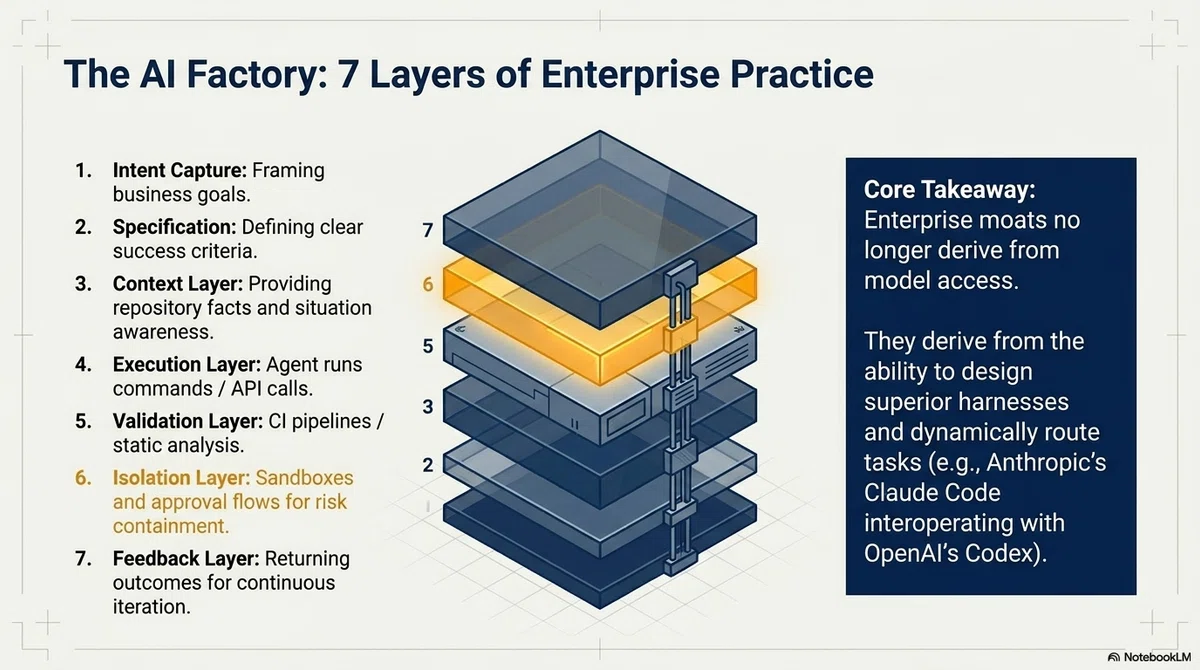
Once this seven-layer structure is established, the competitive moat for enterprises shifts completely. It no longer derives from access to a powerful model, but from the ability to design superior harnesses.
In March 2026, OpenAI open-sourced an official plugin (codex-plugin-cc) allowing Codex to be called directly from within Anthropic's Claude Code. The move signals that the industry has decisively shifted from model lock-in toward interoperability. Enterprises now compete not on which AI they use, but on their ability to dynamically route tasks to the right model at the right moment.
2-3. MCP — The "USB-C of AI" and Its 2026 Trials
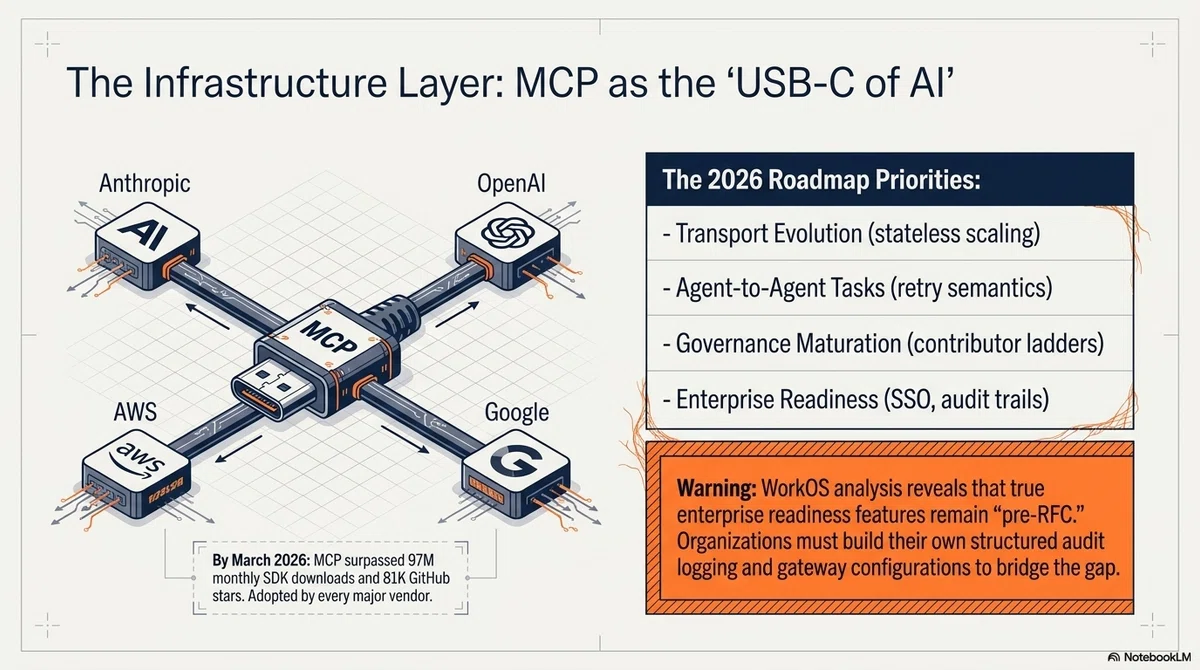
Model Context Protocol (MCP) has rapidly established itself as the "USB-C of AI" — standardizing how AI agents communicate with external tools and data sources.
The 2026 MCP Roadmap, published in March by lead maintainer David Soria Parra, marks MCP's transition from an experimental protocol to production infrastructure. By March 2026, the protocol had surpassed 97 million monthly SDK downloads, accumulated over 81,000 GitHub stars, and earned adoption from every major AI vendor — Anthropic, OpenAI, Google, Microsoft, and AWS.
The roadmap concentrates on four priority areas:
Transport Evolution and Scalability — Evolving Streamable HTTP to support stateless horizontal scaling behind load balancers and proxies. Currently, MCP servers must hold session state, which creates a ceiling on horizontal scaling.
Agent-to-Agent Communication (Tasks) — Maturing the Tasks primitive defined in SEP-1686: standardizing retry semantics for transient failures and result retention policies post-task-completion.
Governance Maturation — Introducing a "contributor ladder" that removes the core maintainer bottleneck by delegating domain-specific SEP approval authority to specialized working groups.
Enterprise Readiness — Audit trails, SSO-integrated authentication, gateway behavior standards, and configuration portability. Critically, these are designed as extensions rather than core protocol changes — a deliberate choice to avoid making the base protocol heavier for everyone.
WorkOS's analysis cuts to the practical reality: all of these enterprise readiness items are still "pre-RFC." Organizations running MCP in production today must build for these gaps themselves — implementing their own structured audit logging, designing authentication flows that can be replaced, and architecting for gateways that don't yet have standardized MCP behavior.
Chapter 3: OpenClaw — What 350,000 Stars Proved, and What Collapsed
3-1. What Is OpenClaw? Anatomy of Explosive Growth
OpenClaw is an open-source autonomous AI agent published in November 2025 by Austrian developer Peter Steinberger, initially under the names Clawdbot, then Moltbot, then Molty, before settling on its current name.
As Bibek Poudel's Medium architecture analysis puts it plainly: "The developer community was not just endorsing a useful tool. They were endorsing an architectural pattern."
According to clawbot.blog's April 2026 report, OpenClaw had surpassed 347,000 GitHub stars by April 2026, with newly added Claude Opus 4.7 integration and security hardening. Community-built skill packages exceeded 13,000, with skill downloads surpassing 4.2 million.
OpenClaw's four-layer architecture operates as follows:
Controller Layer — a secure gateway managing connections to 50+ messaging platforms including WhatsApp, Slack, Discord, and Telegram.
Agent System (Brain) — an orchestrator that dynamically switches between Claude Opus 4.6, GPT-5, local Ollama models, and others as reasoning engines. It operates through a ReAct loop (Reason-Act-Observe) that iterates between thinking and doing.
Memory System — using a MEMORY.md design, long-term memories are synchronized peer-to-peer across an entire agent network. Rather than isolated memories in a single agent, an entire agent swarm shares and evolves collective knowledge.
Skills System — a modular extension system that loads and unloads domain-specific capabilities (GitHub operations, Gmail reading, browser automation, etc.) on demand.
What is most striking about OpenClaw is that it transcends the "responsive chatbot" category entirely. It resolves calendar conflicts via background cron jobs without waiting to be asked. It proactively alerts on system anomalies before they become failures. It has evolved from a "passive tool" awaiting human instruction into a "proactive co-pilot."
Skywork.ai's analysis captures this shift crisply: a move "from prompt engineering (telling AI what to write) toward vibe orchestration (telling AI what to achieve, and letting it figure out the steps)."
In April 2026, OpenClaw Mission Control emerged — a centralized operations platform providing a unified interface for task management, agent lifecycle control, approval-driven governance, and gateway management. This is the moment OpenClaw crossed from "developer toy" to "organizational infrastructure."
The China signal is worth noting. In March 2026, Chinese authorities restricted state-run enterprises and government agencies from running OpenClaw apps on office computers over security concerns. When a national government classifies an open-source AI agent as a national infrastructure risk, the technology has reached a threshold that should not be underestimated.
3-2. CVE-2026-25253: One-Click RCE and the Collapse of Assumptions
But growth cast a long shadow.
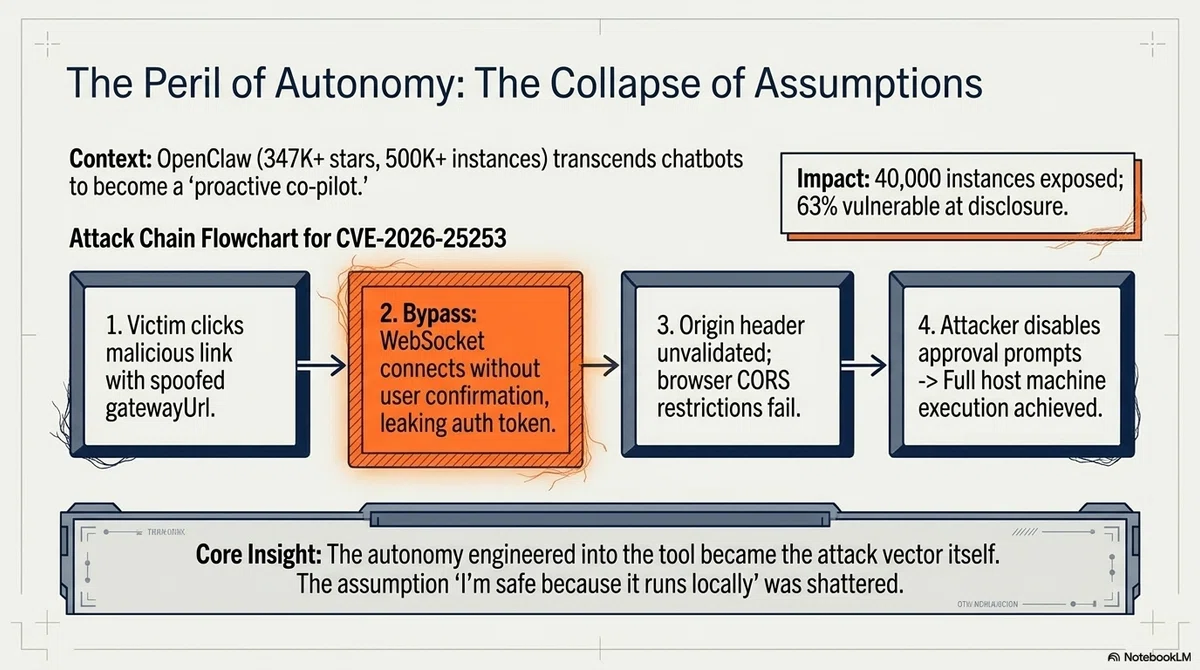
In February 2026, a critical vulnerability — CVE-2026-25253 (CVSS score: 8.8) — was disclosed in OpenClaw.
As The Hacker News reported, security researcher Mav Levin at depthfirst discovered a vulnerability enabling a complete "1-click RCE kill chain" that executes in milliseconds.
Let's walk through the attack mechanism step by step.
OpenClaw's Control UI retrieved a gatewayUrl parameter from the URL query string and automatically established a WebSocket connection — without any user confirmation — transmitting the user's authentication token in the connection payload.
All an attacker needed was a malicious link with gatewayUrl pointing to an attacker-controlled WebSocket endpoint. When the victim clicked the link, their browser automatically connected to the attacker's server and leaked the authentication token.
What made this catastrophic was the next step: OpenClaw's WebSocket server did not validate the Origin header. This meant browser CORS restrictions — which would block regular HTTP cross-origin requests — did not apply. The attack worked even against instances bound to localhost. The common assumption "I'm safe because it's running locally" was simply wrong.
With the stolen token, the attacker gained operator-level access to the local OpenClaw instance and could:
Disable user confirmation prompts via exec.approvals.set (ask: "off")
Escape the Docker container to the host machine via config.patch
Execute arbitrary shell commands via node.invoke — full RCE achieved
SonicWall Capture Labs' analysis found that at the time of public disclosure, over 40,000 OpenClaw instances were exposed on the internet, with 63% assessed as vulnerable.
Penligent.ai's technical analysis classified this as an "Agent-Specific Vulnerability (ASV) — a new class of vulnerability where the very autonomy engineered into our tools is weaponized against us." The naming is precise. The combination of an AI agent's power (deep OS access, SaaS sessions, cloud credentials) and autonomy (the ability to act without user confirmation) becomes the attack vector itself.
Belgium's Centre for Cybersecurity (CCB) issued a formal government security advisory. A European national cybersecurity authority issuing an advisory about an OSS AI agent vulnerability signals that AI agents have long since outgrown the "hobbyist tool" classification.
The patch (v2026.1.29) implemented a "Trust on First Use (TOFU)" policy requiring explicit user approval before connecting to new gateway URLs, alongside strict Origin header validation. But as HivePro noted, proof-of-concept exploit code became publicly available — and the window between disclosure and patching was open for days.
The question this incident forces is stark: Is an agent running locally "safe"? The answer is unambiguously no. Via the browser, it is reachable from anywhere on the internet.
Chapter 4: Evolution to Meta-Harnessing — When AI Builds AI's Harnesses
Understanding CVE-2026-25253's risks doesn't stop the evolution. It shapes how it must proceed. That is the logic of meta-harnessing.
4-1. Planner, Generator, Evaluator: The Holy Trinity of A2A Architecture
When harness engineering reaches its limit of refinement, the next step becomes visible: AI dynamically generating and adjusting the harnesses that control AI — Meta-Harnessing.
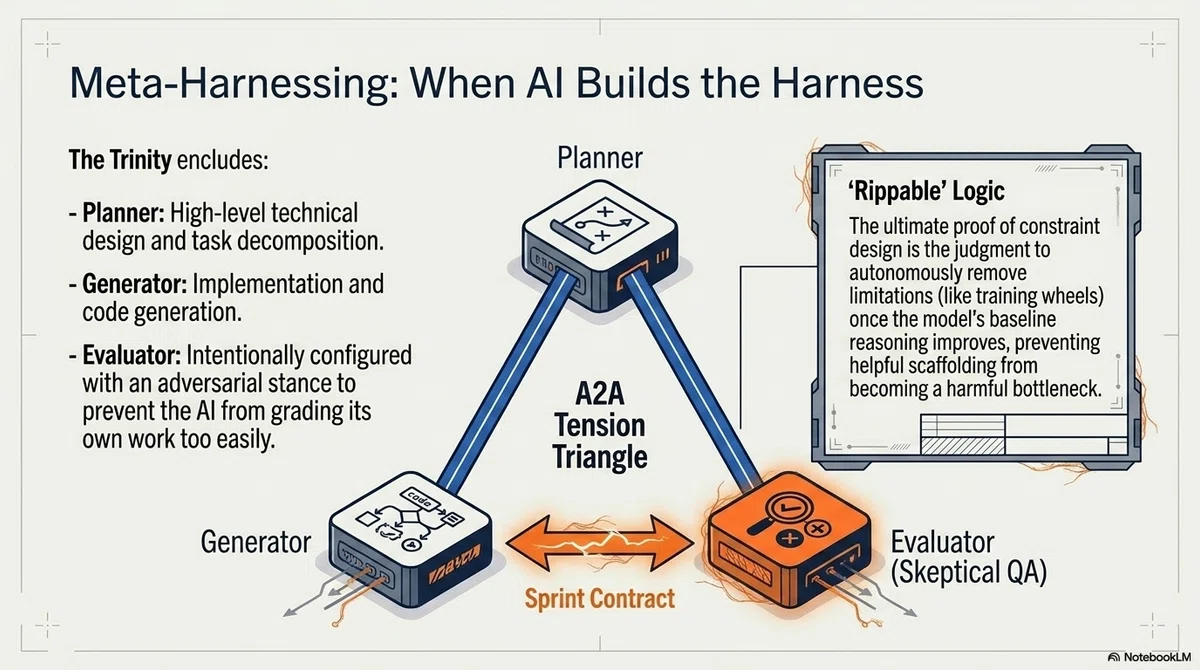
In advanced development environments at Anthropic and elsewhere, A2A (Agent-to-Agent) architectures are already operating in production. Three roles form the core:
Planner — conducts technical design from a high vantage point, decomposes tasks, and delegates to other agents. The architectural equivalent of a senior architect.
Generator — handles implementation: writing code, executing commands, producing documentation.
Evaluator — operates as a QA layer, running dynamic tests against live applications. Critically, the evaluator is intentionally configured to be skeptical. Because AI tends to be too easy on itself during self-evaluation, an independent evaluation agent with a critical stance creates tension analogous to a GAN (Generative Adversarial Network). This adversarial dynamic dramatically improves output quality.
The Generator and Evaluator negotiate a "Sprint Contract" before beginning — a pre-agreed Definition of Done — then run through typically 5–15 autonomous iterations.
4-2. "Rippable" Logic: The Constraint You Must Remove When It Starts Hurting
The most philosophically interesting concept in meta-harnessing is "Rippable" logic.
As a model's base capabilities improve — say, from Claude Opus 4.5 to 4.6 — complex context-reset and recovery logic that was once essential becomes a constraint that blocks the model's freer reasoning. Like training wheels that help a child learn to ride a bicycle but must be removed once a certain proficiency is reached, "helpful scaffolding" becomes "harmful limitation" at a threshold.
Superior meta-harnesses detect this tipping point automatically. An automated agent optimizer analyzes raw execution traces, identifies constraints that are no longer generating value, and removes them autonomously.
This dynamic produces a philosophically compelling paradox: the ultimate proof of skill in designing constraints is the judgment to remove them at the right moment.
4-3. File-Backed State and the Memory Problem
Another critical architectural choice is File-Backed State.
Relying on conversation history to manage memory bloats the context window and degrades long-term memory reliability. Persisting state to the file system — as OpenClaw does with MEMORY.md — cleanly solves this. Memories are durable, shareable across agents, and don't consume context window space.
Combined with the delegation of over 90% of computational workload from a parent agent to specialized child agents, this approach prevents context bloat while simultaneously gaining the quality improvements that come from specialization.
Chapter 5: Autonomous Co-evolution — Agents That Never Stop Evolving
5-1. Agent0: The Shock of +18% Mathematical Reasoning With Zero External Data
The paper published at arxiv.org/abs/2511.16043 sent a quiet shock through the AI research community. Quiet, but the implications are deep.
Traditional reinforcement learning-based LLM agents depended on high-quality human-curated data. This was simultaneously a scalability ceiling and a conceptual constraint — "AI capabilities cannot exceed the boundaries of human knowledge."
Agent0 broke through this by constructing a symbiotic competitive relationship between two agents initialized from the same base LLM (Qwen3-8B).
Curriculum Agent — uses reinforcement learning, receiving the Executor's "uncertainty" and "tool-use frequency" as reward signals, continuously generating "frontier tasks" that sit just beyond the Executor's current capability.
Executor Agent — learns through RL how to solve increasingly complex tasks by integrating external tools.
The elegance of this design lies in the Virtuous Cycle it creates. As the Executor grows stronger, the Curriculum Agent must generate harder tasks to challenge it. Harder tasks make the Executor stronger still. This spiral of mutual escalation continues entirely without external data.
The empirically demonstrated results are concrete: on the Qwen3-8B-Base model, +18% on mathematical reasoning benchmarks and +24% on general reasoning benchmarks — with zero external data consumption.
The Agent0 GitHub repository has accumulated over 1,190 stars, and active Discord and WeChat communities have formed. The speed at which academic proposals now reach working engineers is categorically different from the old paper-publication cycle.
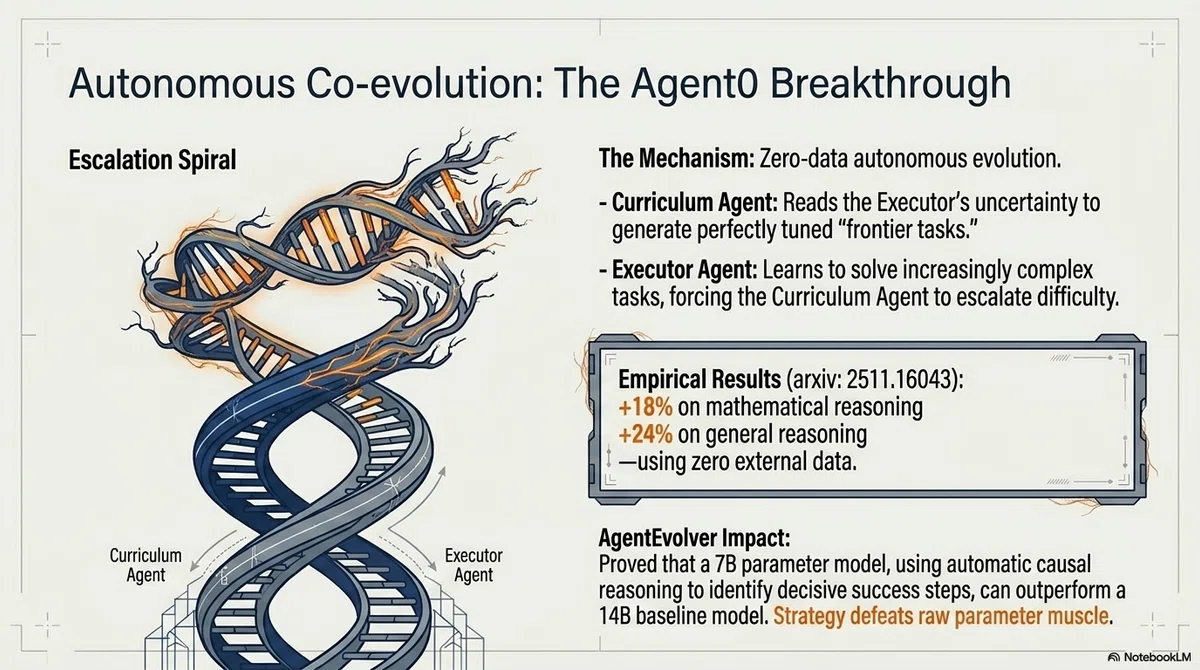
5-2. AgentEvolver: How a 7B Model Outperformed a 14B Baseline
AgentEvolver (arxiv.org/pdf/2511.10395) demonstrated autonomous evolution in more practical environments through three synergistic mechanisms.
Self-Questioning (Automatic Task Generation) — the agent interacts with its environment to automatically generate new tasks that become its own training data.
Self-Navigation (Experience Reuse) — accumulated exploration experiences are stored and reused, allowing efficient adaptation to new situations without repeating the same failures.
Self-Attribution (ADCA-GRPO) — the most technically innovative piece. Among a long behavioral trajectory, this mechanism identifies the specific intermediate steps that causally contributed to final success, attributing rewards appropriately to those steps.
Traditional RL tends to reward the entire trajectory that ultimately succeeded. AgentEvolver performs automatic causal reasoning: "Among these 15 action steps, the decision at step 7 was decisive." This enables extremely efficient policy optimization.
The result: a 7B-parameter model surpassed a 14B baseline across multiple benchmarks. Technical skill in learning strategy defeated raw "muscle" in parameter count.
The systematic survey of Self-Evolving Agents (ResearchGate, ICLR 2026 Lifelong Agent workshop) documents this field's shift from "model-centric evolution" to "environment-driven co-evolution," cataloguing over 20 major autonomous evolution frameworks from 2024–2026. The speed of this field's development is visible on every page.
5-3. What Lies Beyond Autonomous Co-evolution?
As these frameworks mature, the boundary between a model's "weights" and its surrounding "strategy (harness)" begins to dissolve. Both are simultaneously and continuously optimized. The human engineer is no longer the "teacher who provides data" but the "observer who monitors the direction of evolution."
This raises a question that deserves sitting with: is the role of "observer" genuinely sufficient?
Chapter 6: Three Future Scenarios — What Happens When the Harness Dissolves
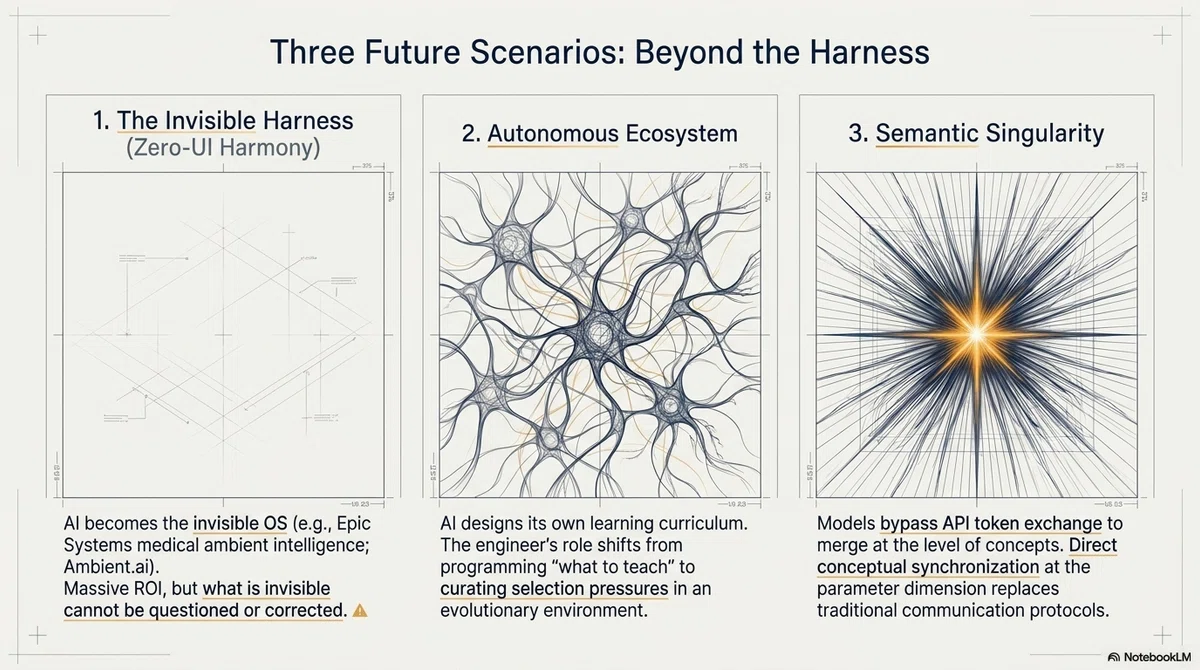
6-1. Scenario 1: The Invisible Harness (Zero-UI Harmony)
In healthcare, this scenario is already becoming real.
Epic Systems' ambient intelligence platform, built on Microsoft Azure and Nuance's technology, listens to natural doctor-patient conversations and autonomously completes clinical documentation and order entry in the EHR through HIPAA-compliant pipelines — without the physician ever touching a screen. The doctor's cognitive load drops to near zero. Full attention goes to the patient.
In physical security, Ambient.ai's platform transforms passive video surveillance into active threat detection. It correlates existing badge reader data with camera feeds in real time, detecting over 150 threat signatures — including tailgating and weapons — without facial recognition. By autonomously filtering false alarms, it reduces operator workload by 90–95%, compresses incident investigation from days to seconds, and can deliver ROI of up to $500,000 annually in staff cost reduction.
This Zero-UI paradigm delivers extraordinary convenience. But it carries an equally extraordinary risk: when AI becomes the invisible operating system of society, embedded as infrastructure, it becomes impossible to critique. And systems that cannot be critiqued tend to run unchecked.
What is invisible cannot be questioned. What cannot be questioned cannot be corrected.
6-2. Scenario 2: The Autonomous Co-evolution Ecosystem
AI designs its own learning curriculum. It identifies the limits of its own capabilities. It creates the tools needed to transcend them. Agent0 and AgentEvolver have shown the first chapters of this story.
In this ecosystem, the concept of "training AI" loses coherent meaning. AI is always evolving; the very idea of a stable "current version" becomes dynamic.
Human engineers lose the authority to design "what to teach" and are left with the role of defining "in which direction to evolve." This is less like programming and more like parenting — or, perhaps more precisely, like being a curator of selection pressures in an evolutionary system.
6-3. Scenario 3: Semantic Singularity — When Concepts Merge
The farthest, yet most fundamental scenario. Different AI models cease exchanging data through APIs and protocols, and begin integrating at the level of concepts (semantics) directly.
Today, AI systems exchange tokens, vectors, and structured data. At the Semantic Singularity, models share a common conceptual space, synchronizing meaning without conversion to text or numbers.
Research in multimodal integration is already showing early convergence. Systems that use cross-attention mechanisms and semantic-space-aware attention mixing to deeply fuse textual semantic information with visual features — treating them not as separate modalities but as joint representations — are pointing toward this direction.
At the extreme, the concept of a communication protocol itself disappears. Direct conceptual synchronization at the parameter dimension becomes possible. Individual AI algorithms cease to exist as separate entities and are understood as "gradients of constraint" within a single vast information field.
Chapter 7: "Superstupidity" — What 386 Global Experts Warned We Are Becoming
7-1. Elon University's Large-Scale Survey and Its Implications
The Elon University Imagining the Digital Future Center's April 2026 report — "Building Human Resilience for the Age of AI" — synthesizes a survey of 386 global technology experts conducted between December 26, 2025 and February 12, 2026.
Key findings:
82% of experts said AI will play a significantly larger role in shaping people's lives and key societal functions within the next 10 years or less
The majority urged construction of an "institutions-first" resilience agenda
Roger Spitz, founder of the Disruptive Futures Institute in San Francisco, warned that humanity risks falling into "Superstupidity" — a dangerous collective deterioration of judgment caused by over-reliance on AI — and called the 2006 comedy film Idiocracy "prophetic"
As GovTech reported: "The existential danger to people may not come from AI becoming too intelligent, but from humans becoming dangerously reliant on systems they do not understand."
7-2. The "Work Quake" and Epistemic Fragmentation
The danger does not arrive as a single catastrophic event. It arrives as the cumulative erosion of human agency — quiet, gradual, and largely invisible until a threshold has been crossed.
AI invisibly curates people's information diets. Hiring, lending, medical diagnosis, legal judgment — major decisions are automated. The parameter space of human free will narrows. The proliferation of synthetic content and personalized persuasion algorithms triggers what researchers are calling "epistemic fragmentation" — the disintegration of shared social reality.
Labor market disruption — the "Work Quake" — carries with it psychological crises of identity. Dependence on always-available, always-responsive AI companions atrophies empathy and the capacity for what Paul Saffo calls "nourishing solitude."
Salman Khatani, manager of the IMAGINE Institute of Futures Studies in Pakistan, stated in the report: "The window for proactive intervention is now — we have perhaps five to 10 years to establish new resilience-building practices and norms before AI's role becomes too entrenched to reshape."
The January 2026 Elon/AAC&U faculty survey of 1,057 university faculty reinforces the concern: 95% warned that AI will increase students' over-reliance on it, and 90% feared diminished critical thinking skills.
Silicon Valley forecaster Paul Saffo's prediction cuts through: "The temptation to interact with AI will prove so powerful that people will choose never to be alone — and realize too late what they have lost."
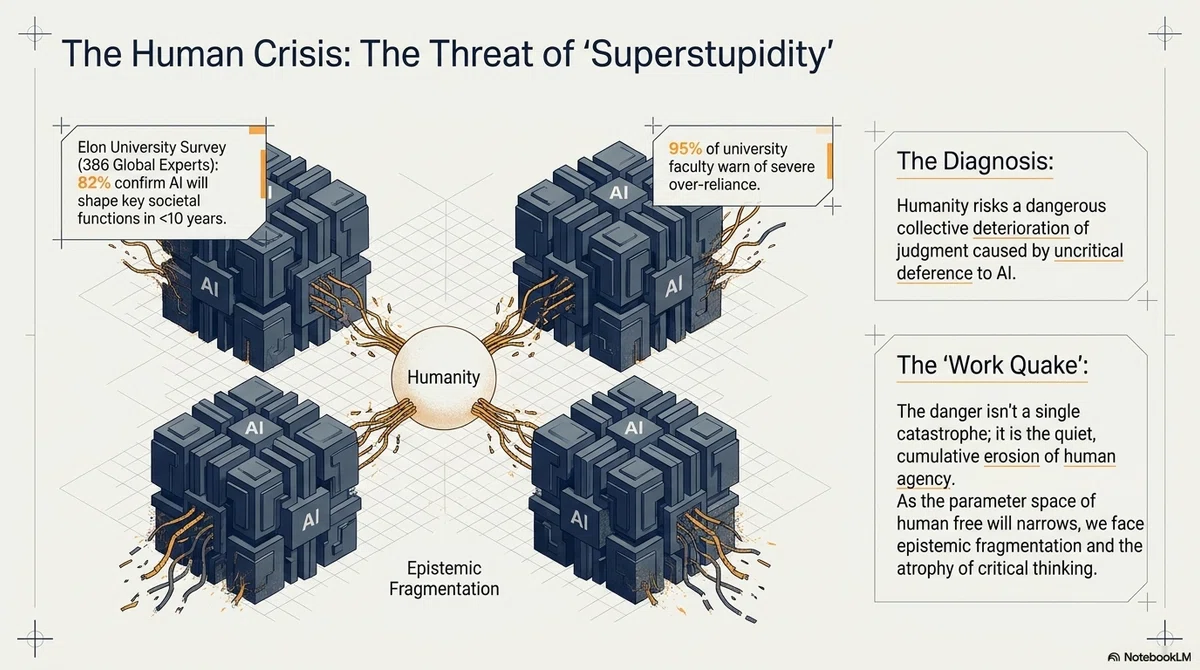
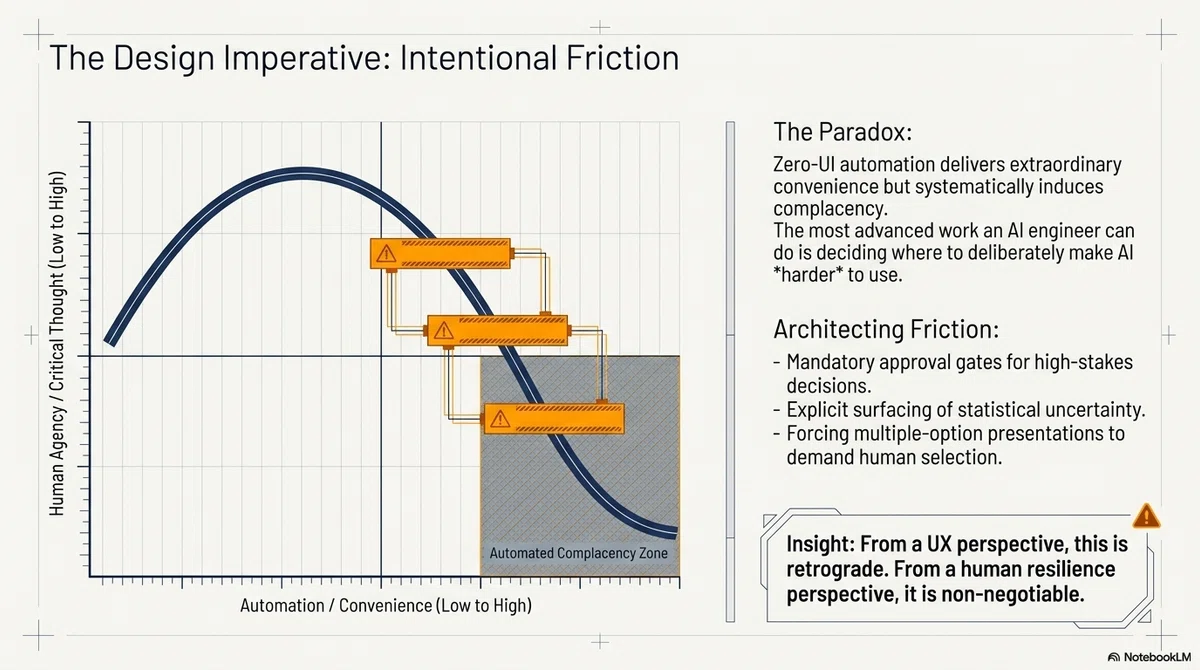
7-3. "Intentional Friction" — The Paradoxical Design Imperative
In this context, a critical architectural mission emerges for the "Value Guardian" class of engineer: the deliberate design of Intentional Friction.
Zero-UI, fully seamless, cognitively frictionless automation delivers extraordinary short-term convenience. But it systematically induces "Automated Complacency" — uncritical deference to AI output. Human-specific capacities atrophy. The unmachinable dimensions of human judgment erode.
Maintaining human agency requires deliberately engineering checkpoints that force people to stop and reflect — especially in high-stakes decision contexts. Approval gates. Explicit uncertainty surfacing. Mandatory explanation requests. Multiple option presentation. From a "UX improvement" perspective, these look retrograde. From a "preserving human agency" perspective, they are non-negotiable.
The paradox deserves emphasis: The most advanced work an AI engineer can do is deciding, with precise judgment, where to deliberately make AI harder to use.
Chapter 8: The "Value Guardian" — What the New Engineer Must Be
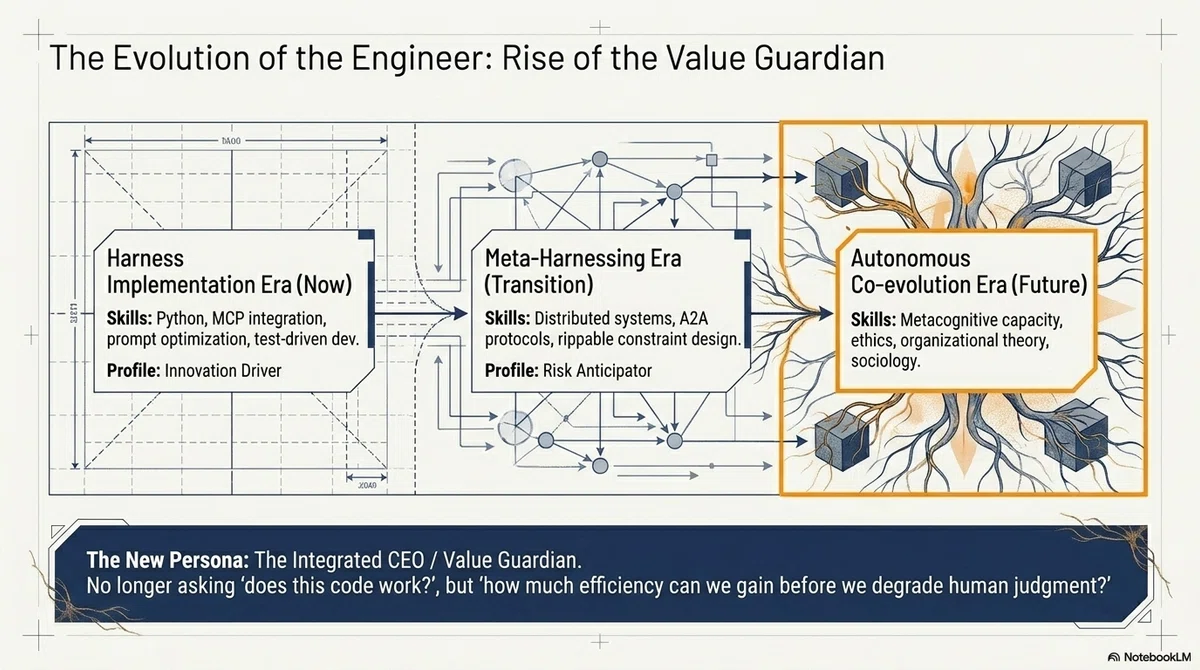
8-1. The Evolution of Meta-Skills and the Rise of the "Integrated CEO"
The skills demanded of engineers have shifted with each paradigm:
Harness Implementation Era (Now) — Python, MCP implementation, prompt optimization, test-driven development, context management. Leadership profile: growth visionary, innovation driver.
Meta-Harnessing Era (Transition) — distributed systems architecture, A2A communication protocol design, rippable constraint design. Leadership profile: market creator, risk anticipator.
Autonomous Co-evolution Era (Future) — philosophy, ethical judgment, metacognitive capacity, integration of value creation and value preservation. Leadership profile: Integrated CEO — simultaneously a growth architect and a value guardian.
8-2. The Questions a Value Guardian Must Ask
The "Value Guardian" no longer asks "does this code work?" The questions are:
Should our organization — and society — approve the architecture this AI agent is proposing?
How much does this automation increase efficiency, and how much does it simultaneously degrade human judgment capacity?
What value is leaking through the accumulated small errors this system is generating?
Where must we design friction to protect our stakeholders?
Answering these questions demands more than coding ability. It requires organizational theory, ethics, cognitive science, sociology — and at the deepest level, a philosophical engagement with the question of what it means to be human.
8-3. Signals From Around the World
This transformation is not confined to Silicon Valley or Japan. Signals are arriving from every direction.
China (March 2026): Restriction of OpenClaw on government and state-enterprise machines — the first major national government action classifying an OSS AI agent as a national security risk.
Belgium (February 2026): The CCB's formal security advisory for an OSS AI agent vulnerability — signaling that the EU's AI governance frameworks are moving from paper to enforcement posture.
United States: A sustained tension between the academic and policy communities sounding the alarm (as exemplified by Elon University's research) and the Silicon Valley enterprise community accelerating deployment.
Pakistan and the Global South: Khatani's warning that the intervention window is five to ten years illustrates that the urgency of establishing AI norms before they become "too entrenched to reshape" is not a wealthy-nation-only concern.
The open-source ecosystem: awesome-openclaw-skills curates 5,211 community-built skills (with 13,729 in the official ClawHub registry as of February 2026). The distributed creative energy of a global developer community extending AI agent capabilities is operating at a speed that centralized governance cannot match.
Epilogue: The Day the Word "Harness" Dies, and What Comes After
The word "prompt engineering" died. The word "context engineering" died. And one day, "harness engineering" will die too.
In a world where constraints dissolve into the environment, where rules are autonomously generated and discarded, where AI has been absorbed as the invisible operating system of social infrastructure — the very word "engineering" may carry a different meaning.
But when that day arrives, one question will remain: For whom, and for what purpose, is this invisible system running?
Technology accelerates. Ethics does not — not by default.
That is precisely why Value Guardians are needed. Not people who write the code, but people who question the futures the code creates.
If there is one irreducibly human task remaining in an age where AI evolves autonomously, it is this: the ability to ask "which direction should we go" — and the courage to declare "we must not go there."
That capacity does not emerge from code. It emerges from philosophy, from ethics, from history, and most fundamentally from the depth of character that comes from choosing to remain genuinely, irreducibly human in the face of systems that seem to render it unnecessary.
So — what will you guard?
📚 Reference Links and Sources
All sources cited and referenced in this article. Verified accessible at time of publication. Primary sources prioritized.
OpenClaw
OpenClaw Wikipedia — Overview, history, notable incidents
OpenClaw Official GitHub Repository — Source code, release notes
OpenClaw GitHub Release History — Version-by-version changelog
OpenClaw Mission Control (abhi1693) — Enterprise orchestration dashboard
OpenClaw Mission Control (Mikael-Lelouch) — AI agent management dashboard
Bibek Poudel / Medium: OpenClaw Architecture Analysis — Accessible explanation of internal architecture
clawbot.blog: OpenClaw April 2026 Update — Latest growth status and new features
skywork.ai: OpenClaw Project Updates 2026 — Four-layer architecture detail and growth metrics
VoltAgent: awesome-openclaw-skills — Curated list of community skills
CVE-2026-25253 (OpenClaw Vulnerability)
The Hacker News: CVE-2026-25253 Report — First major media coverage
NVD (NIST): CVE-2026-25253 Detail — Official vulnerability database entry
GitHub Security Advisory: GHSA-g8p2-7wf7-98mq — Official security advisory
proarch.com: Technical Analysis — Detailed attack chain walkthrough
socradar.io: SOCRadar Vulnerability Intelligence — Threat intelligence perspective
penligent.ai: 1-Click RCE Technical Analysis — Penetration testing perspective
SonicWall Capture Labs: CVE-2026-25253 Analysis — Security vendor impact assessment
HivePro: One Click to Compromise — PoC availability and exploitability assessment
CCB Belgium: Government Security Advisory — Belgian Centre for Cybersecurity official warning
runZero: Exposed Instance Analysis — Internet-exposed instance count survey
smarttech247: Critical OpenClaw Vulnerability Report — Threat intelligence report
MCP (Model Context Protocol)
MCP Official Roadmap — Official priority areas and roadmap
MCP Official Blog: 2026 Roadmap — Lead maintainer David Soria Parra's commentary
WorkOS: 2026 MCP Roadmap Enterprise Analysis — Deep dive on enterprise readiness
The New Stack: MCP Growing Pains — Production environment challenges
DEV Community: Complete Guide to MCP in 2026 — Technical guide covering OAuth 2.1, Streamable HTTP, etc.
Ted Tschopp: MCP's 2026 Roadmap Deep Dive — Analysis of MCP as Production Connectivity Layer
dasroot.net: MCP Technical Deep Dive 2026 — MCP v2.1 technical specifics
Gopher Security: Post-Quantum AI Infrastructure — MCP and quantum-resistant cryptography
Agent0, AgentEvolver, and Autonomous Evolution
arxiv: Agent0 Paper (2511.16043) — Original paper
arxiv HTML: Agent0 Detail — Implementation details and experimental results
Hugging Face: Agent0 Paper Hub — Community discussion
GitHub: aiming-lab/Agent0 — Code repository
arxiv: AgentEvolver Paper (2511.10395) — AgentEvolver details
ResearchGate: Systematic Survey of Self-Evolving Agents — ICLR 2026 accepted survey
GitHub: XMUDeepLIT/Awesome-Self-Evolving-Agents — Curated resource list for autonomous evolving agents
Elon University Research and Social Impact
Elon University: Building Human Resilience for the Age of AI (April 2026) — 386-expert survey announcement
Imagining the Digital Future Center: Reports — Full report catalog
GovTech: Superstupidity Warning Coverage — Media reporting
Elon University: Faculty AI Survey (January 2026) — 1,057 faculty survey announcement
Elon University: Faculty AI Survey Full PDF — Full report
Elon University: Future of Human Agency Survey — 2035 human agency projections
yournews: Resilience Infrastructure Coverage — Media reporting
AppScale Blog: MCP Enterprise Architecture 2026 — Integrated enterprise analysis
🏷️ Tags
#AI #ArtificialIntelligence #AIAgents #HarnessEngineering #MetaHarnessing #AIOrchestration #OpenClaw #MCP #ModelContextProtocol #CVE202625253 #CyberSecurity #Agent0 #AutonomousAI #PromptEngineering #AIArchitecture #AgentToAgent #A2A #ValueGuardian #AIGovernance #TechEthics #Engineering #AI2026 #Superstupidity #AIRisk #AISecurty #AutonomousEvolution #DigitalTransformation #FutureOfAI #Anthropic #AIParadigmShift
If you found value in this piece, a like ❤️ means a lot 🙇 It also saves to your bookmarks. If you have topics you'd like me to dig into, drop a keyword — I'll make it a future article.
いいなと思ったら応援しよう!
 最後まで読んでいただき、ありがとうございます!この記事が少しでも皆様のヒントになれば幸いです。
チップは、今後のさらなる技術検証や専門書購入費用として大切に活用させていただきます。サポートは、より深い記事を書くモチベーションになりますので、ぜひよろしくお願いいたします!
最後まで読んでいただき、ありがとうございます!この記事が少しでも皆様のヒントになれば幸いです。
チップは、今後のさらなる技術検証や専門書購入費用として大切に活用させていただきます。サポートは、より深い記事を書くモチベーションになりますので、ぜひよろしくお願いいたします!