
Why the Conflict Will Resume— The Structural Inevitability of Middle Eastern Warfare

The United States and Iran have agreed on a memorandum to end hostilities. The Strait of Hormuz is reopening, and a ceasefire has been declared across all fronts, including Lebanon.
However, this is not the end of the war. Structurally, it is only a temporary pause.
Israel sees Hezbollah as an existential threat. Iran sees Hezbollah as a strategic lifeline. The United States needs regional stability.
These three security OS layers cannot coexist. Therefore, the ceasefire will inevitably collapse.
■ Integrated Paragraph: Iran’s “Negotiation OS” Is a Civilizational System
In ceasefire negotiations, Iran’s behavior is driven by a civilizational “Negotiation OS.”
A Silk Road trading hub
A multiethnic empire
A Shia tradition of cautious self‑preservation
A sanctions‑forged value‑maximization OS
These layers combine to create a system in which Iran extends negotiations, reads the opponent’s weaknesses, and treats ceasefires as preparation for the next bargaining round.
Without understanding this OS, the U.S. and Israel will consistently misjudge the durability of any ceasefire.
■ 1|Phenomenon OS: A “Permanent Ceasefire” That Is Permanent Only on Paper
The memorandum appears to promise a permanent ceasefire. But its conditions contradict the security OS of all three actors.
■ 2|Logic OS: The Causal Line Leading to Renewed Conflict
Israel: Hezbollah = existential threat Iran: Hezbollah = strategic lifeline U.S.: Needs stability
These OS layers cannot coexist.
■ 3|Structural OS: Five Drivers That Guarantee the Return of War
Asymmetric Security OS
The postponed nuclear issue (a timed explosive)
Lebanon as the structural weak point
Israel’s structural reflex
Iran’s retaliation OS
■ 4|Comparative OS: Who Can Sustain a Ceasefire?
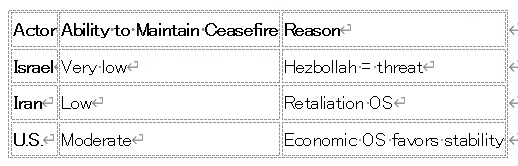
■ 5|Integrated OS: The Conflict Will Resume — Inevitably
As long as the ceasefire contradicts the actors’ OS layers, the conflict will inevitably return.
The ceasefire exists only because:
Economic OS
Political OS
International opinion OS
temporarily aligned.
But the security OS remains contradictory. Therefore, the ceasefire will collapse.
◆ Conclusion: Structure Is Stronger Than Emotion
It does not matter whether Trump is angry, whether Israel apologizes, or whether Iran signals flexibility.
The structure does not change.
Middle Eastern conflict is driven not by emotion, but by OS. As long as these OS layers contradict each other, the ceasefire will collapse.
IZUMIYA Kiyotaka
Energy Security / Systems Design / Policy Analysis
https://researchmap.jp/izumiya-kiyotaka/?lang=en
I analyze Japan’s structural vulnerabilities through a multi‑layer model (L1–LN), focusing on clarity through structure and the deep Operating Systems that shape nations.
