
日本茶文化について

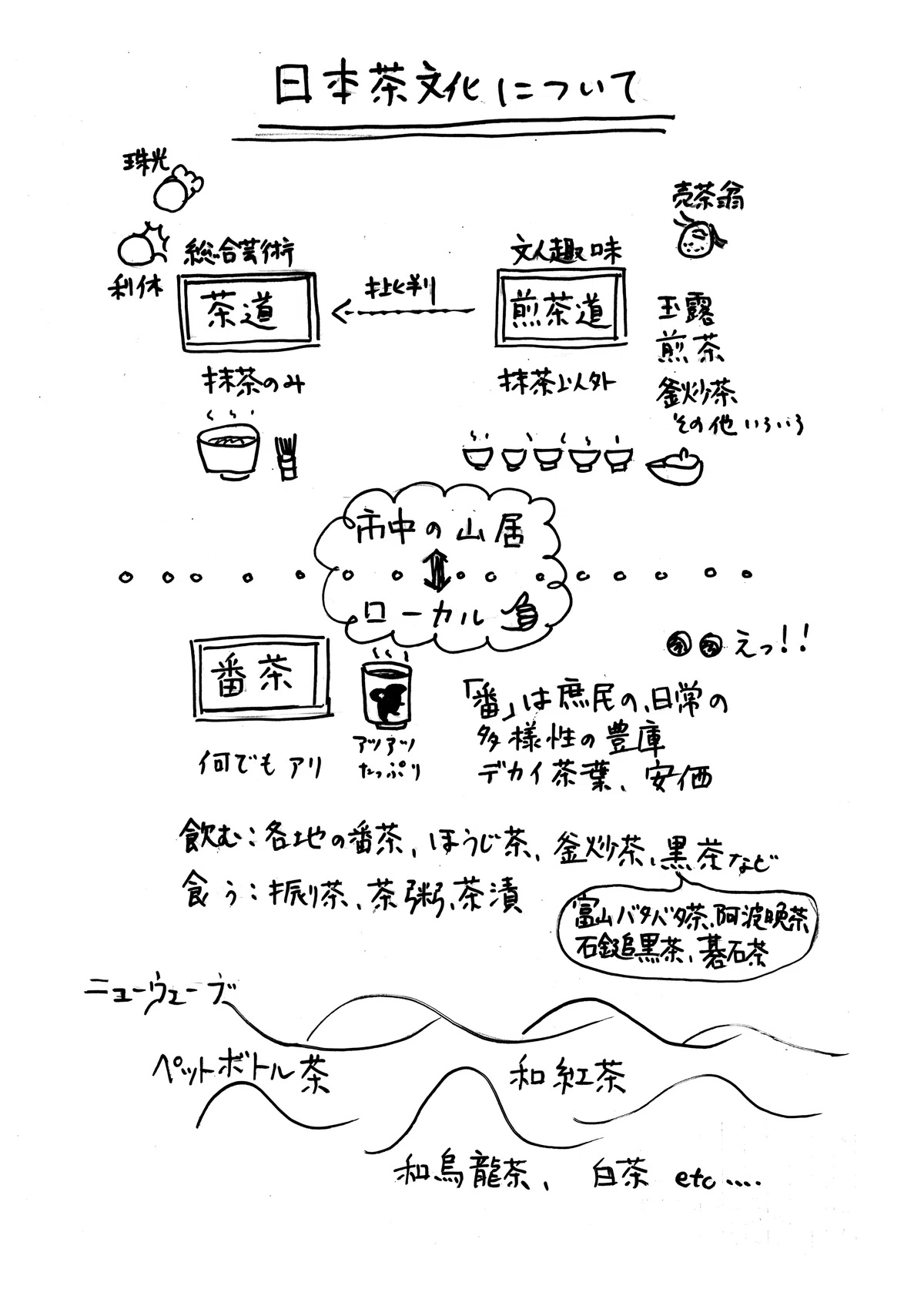
日本茶文化の様相を図像化すると、大雑把にこんなイメージです。
言葉にすると下記のテキストのようになります。
21世紀の現在、日本の茶文化は大まかに3つのグループに分類する事が出来ます。
一つは茶の湯とも呼ばれる「茶道」、次に「煎茶道」、そして「番茶」と呼ばれる各地方の庶民によって育まれたその土地固有の茶文化です。
まず、茶の湯・茶道は禅僧の村田珠光を始祖として、禅の思想をベースに室町時代に始まり、桃山時代に利休が完成させました。
趣向を凝らした小さな茶室に、掛軸、花、香が飾られ、点前に使われる道具も全てが小さく宇宙を凝縮したかの空間に見立てられています。
その趣向を凝らした小さな空間で少量の美味しい食事やお菓子と抹茶を頂くことで、世知辛い日々の出来事を忘れる心穏やかな時間を過ごすのです。
それは市中の山居と呼ばれ、茶室は都市に存在する秘境と喩えられてきました。
正式な席で振る舞われる抹茶は濃茶と薄茶、2種類。茶室内での所作にはルールがあり、また話す内容や言葉遣いにも厳格なルールがあります。
茶会は非日常を楽しむと同時に教養を試される場でもあり、参加者は稽古を積んで備えるのです。
戦国時代は豪胆であった茶の湯も、江戸時代に入ると形式が整えられて「茶道」となり様々な流派に分かれていきます。
段々と形式化された茶道を「形骸化」したと批判したのが、中国由来の文人趣味を体現する「煎茶道」です。
17世紀の京都の市中で茶を振る舞った売茶翁という人物がいました。
売茶翁は元は中国禅の影響が濃い黄檗宗の僧侶でしたが、僧籍の者は商売が禁じられていたため、還俗して茶の屋台を始めました。
売茶翁は、「永谷園」の永谷宗円と共に煎茶を開発したことでも知られています。その屋台には池大雅、伊藤若冲、丸山応挙など江戸時代の美術を代表する絵師が売茶翁を慕って集まってきました。一種の文化サロンであったと記録されています。
その売茶翁を祖として、彼を慕う人々が煎茶道を始めました。煎茶道では抹茶を扱いません。逆に抹茶以外のお茶は何でも扱います。それは形骸化した茶道を批判することを意味しているのです。
煎茶道にもまた所作を始めとする様々なルールがあり、参加者はやはり趣向を凝らした茶室で非日常的な時間を過ごします。
茶道と煎茶道、どちらもそれぞれのルールがあり、その形式を踏襲すべく厳格な稽古に励む必要があります。
実は同じ穴の狢では?というツッコミは置いておいて、
茶道と煎茶道には、都市にありながら秘境で過ごすような時間を得て、非日常を楽しむ。という共通の世界観があります。
そこには厳しいドレスコードがあり、師匠へ謝礼も渡さなくてはなりません。
入っていくためには修練する覚悟だけでなく経済的な豊かさが必須となります。
3つ目の番茶はその点は気楽です。
番茶の「番」は庶民や日常の物事を意味します。
番茶と呼ばれているお茶は広範囲に渡り、各地の土地で飲まれる固有の茶や家庭で手作りされるお茶、または茶を使った食品まであり定義が難しいです。
逆に、普段使いのカジュアルなお茶は全部 番茶だ!とも言えます。
そこにはかつて盛んに作られていたけれど、製法が面倒で作り手がいなくなって希少(現在は高額)になった黒茶も含まれます。
それに食べる茶属、島根のボテボテ茶とか奈良の振り茶や奈良茶飯などの郷土食も番茶にカテゴライズされますし、茶粥も茶漬けも番茶となります。
ほぼ何でもアリのフリースタイルと言えるジャンルです。
また、最近の動向として、国内で紅茶や烏龍茶を作る農家が増えている事、ペットボトル茶の普及を挙げておきます。
実は和紅茶については必ずしも新参ではなく、明治時代に一度産業化して失敗した歴史があります。
ここは日本茶史上のリベンジでもあるので応援したいところです。
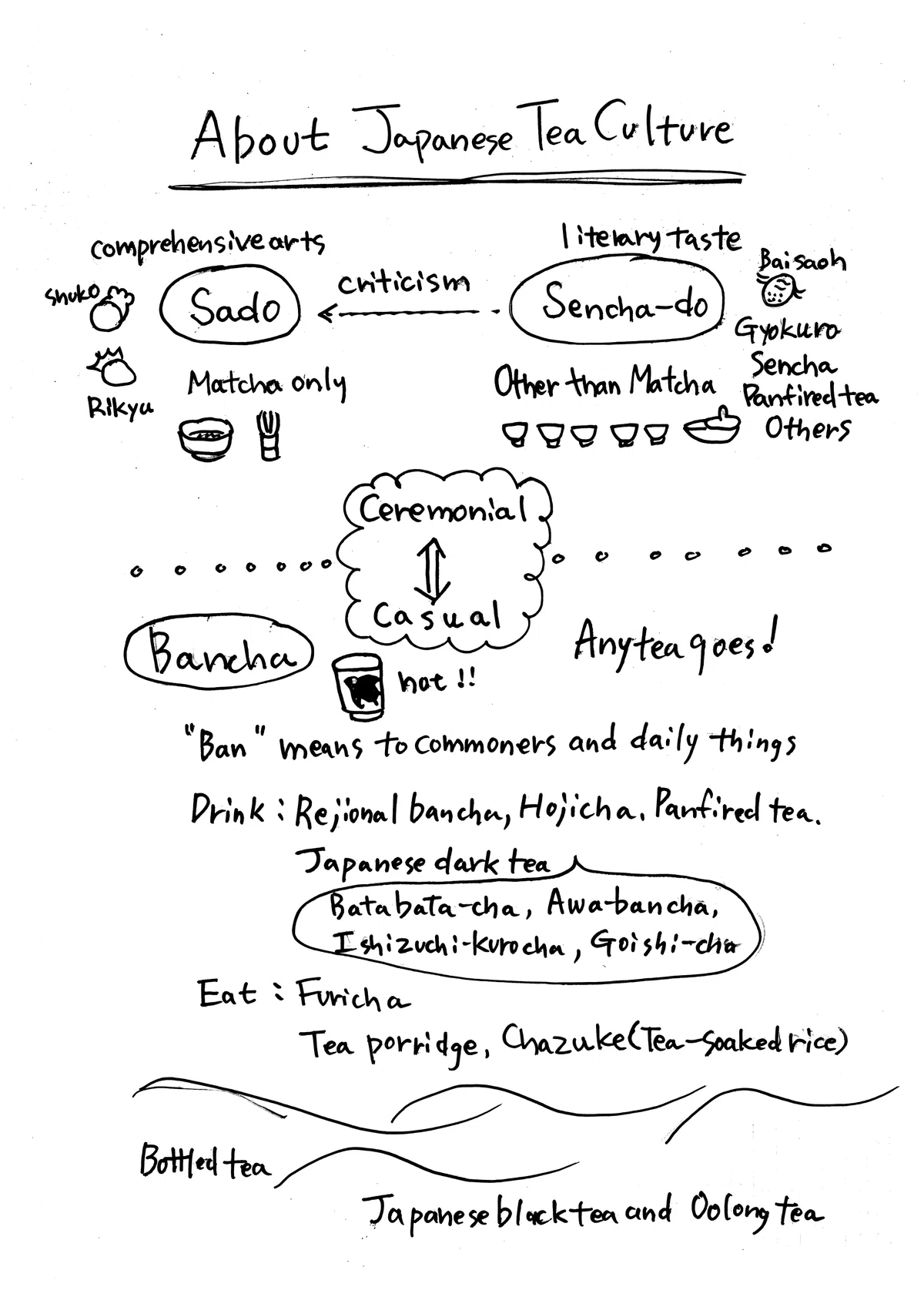
About Japanese Tea Culture
In the 21st century, Japanese tea culture can be classified into three broad groups.
One is the tea ceremony, also known as “chanoyu”; next is ‘senchado’; and finally, there is the regional tea culture cultivated by common people in each area, known as “bancha.”
First, the tea ceremony, founded by the Zen monk Murata Shukō, originated in the Muromachi period based on the philosophy of the Zen, and was perfected by Rikyū in the Momoyama period.
The small, sophisticated tea room is adorned with a hanging scroll, flowers, and incense, and every utensil used for the tea ceremony is miniature, creating a space that seems to condense the universe itself.
Every utensil used in the tea preparation is also small, creating a space that seems to condense the universe.
In that exquisitely planned small space, savoring a small yet delicious meal or sweets with matcha tea brings moments of tranquil peace, making one forget the troubles of daily life.
It is called the mountain retreat in the city, and the tea room has been likened to a hidden sanctuary within the urban landscape.
Two types of matcha are served at formal gatherings: thick tea (koicha) and thin tea (usucha). There are strict rules governing behavior within the tea room, as well as what is said and how it is said. A tea ceremony is both an opportunity to enjoy the extraordinary and means of testing one’s refinement; participants prepare through diligent practice.
The 16th-century Warring States period saw the tea ceremony as a bold , but by the Edo period, its form had been codified into the “tea ceremony” (sadō), branching into various schools.
Criticizing this increasingly formalized tea ceremony as having become “mere formality” was the “senchadō” (tea ceremony of boiled tea), which embodied the literati aesthetic originating in China.
In 17th-century Kyoto, there was a man known as Baisaō who served tea in the city streets. Originally a monk of the Obaku sect, which was heavily influenced by Chinese Zen, Baisaō had to leave the monastic life and start a tea stall because monks were prohibited from doing business.
Baisaō is also known for developing sencha with Soen Nagatani of Nagatanien.
Artists representing Edo period art, such as Ike no Taiga, Ito Jakuchu, and Maruyama Okyo, gathered at that teahouse, drawn to Baisaō.
It is recorded as having been a kind of cultural salon.
Taking Baisaō as their forefather, those who admired him began the Sencha-do. Sencha-do does not handle matcha. Conversely, it handles any tea other than matcha. This signifies a critique of the formalized Sadō.
Sencha-do also has various rules, including specific movements, and participants spend an extraordinary time in a meticulously designed tea room.
Both Sado and Senchado have their own rules, requiring rigorous practice to adhere to their formalities.
Setting aside the question of whether they're really two sides of the same coin,
both share a common worldview: experiencing a sense of seclusion and enjoying the extraordinary, even within the city.
This involves strict dress codes and the obligation to present a gratuity to the master.
To enter this world, one must not only be prepared to train diligently but also possess significant financial means.
Bancha is easygoing in that regard.
The “ban” in bancha refers to common people and everyday things.
Bancha, a term encompassing a wide variety of teas, is difficult to define precisely. It includes regional teas unique to specific areas, teas handmade at home, and even foods made using tea.
Conversely, you could say it means all casual, everyday teas!
It also includes dark tea, which was once produced in abundance but has become rare (and now expensive) because its complicated production method led to a decline in producers.
Additionally, edible tea varieties like Shimane's botebote cha, Nara's furicha, and Nara tea rice are categorized as bancha, as are tea porridge and chazuke(tea-soaked rice).
I would also like to mention recent trends, such as the increasing number of farmers domestically producing black tea and oolong tea, as well as the proliferation of bottled tea.
In fact, Japanese black tea is not necessarily a newcomer; it has a history of having been industrialized once during the Meiji era and failing.
This represents a sort of redemption in the history of Japanese tea, so it's something I want to support.
参考資料:
『振り茶の里を訪ねて』福井市愛宕坂茶道美術館、2020年
『日本茶インストラクター講座』NPO法人 日本茶インストラクター協会、Ⅰ-Ⅲ、2021年
陸羽著・布目潮渢訳『茶経』講談社学術文庫、2012年
梅棹忠夫監修・守屋毅編集『茶の文化 その総合的研究』、淡交社、第一部・第二部 1981年
岩間眞知子『喫茶の歴史』大修館、2015年
布目潮渢『緑芽十片』岩波書店、1989年
中村羊一郎『番茶と日本人』吉川弘文館、1998年
鹿谷勲 『茶粥・茶飯・奈良茶碗』 淡交社 2021年
展覧会カタログ 『茶の湯以前 -中世鎌倉の「茶」-』 金沢文庫 2024年
BRUTUS(ブルータス) 『曜変天目 宇宙でござる! ?』 マガジンハウス 2019年5/1号No.891
中尾佐助『栽培植物と農耕の起源』 岩波新書、1966年
松田美智子『お茶漬けの味100』 河出書房新社、2004年
*無断転載を禁止します
