
【univext.com】ChatGPT英語学習、伸びる人は「使い分け」を知っている

ChatGPTで英語は学べる。でも、伸びる人は「AI任せ」にしない。会話、文法、発音、復習をどう組み合わせるかで、英語学習の成果は大きく変わる。2026年のAI英語学習のリアルを整理します。
https://univext.com/en/blog/333/chatgpt-learn-english-2026
Owner:univext.com
📰 Title:How to Use ChatGPT to Learn English (2026 Guide)
🗓️ 日時:2026/04/12
🔗 URL“https://univext.com/en/blog/333/chatgpt-learn-english-2026”
🌐 Detailed Summary in English
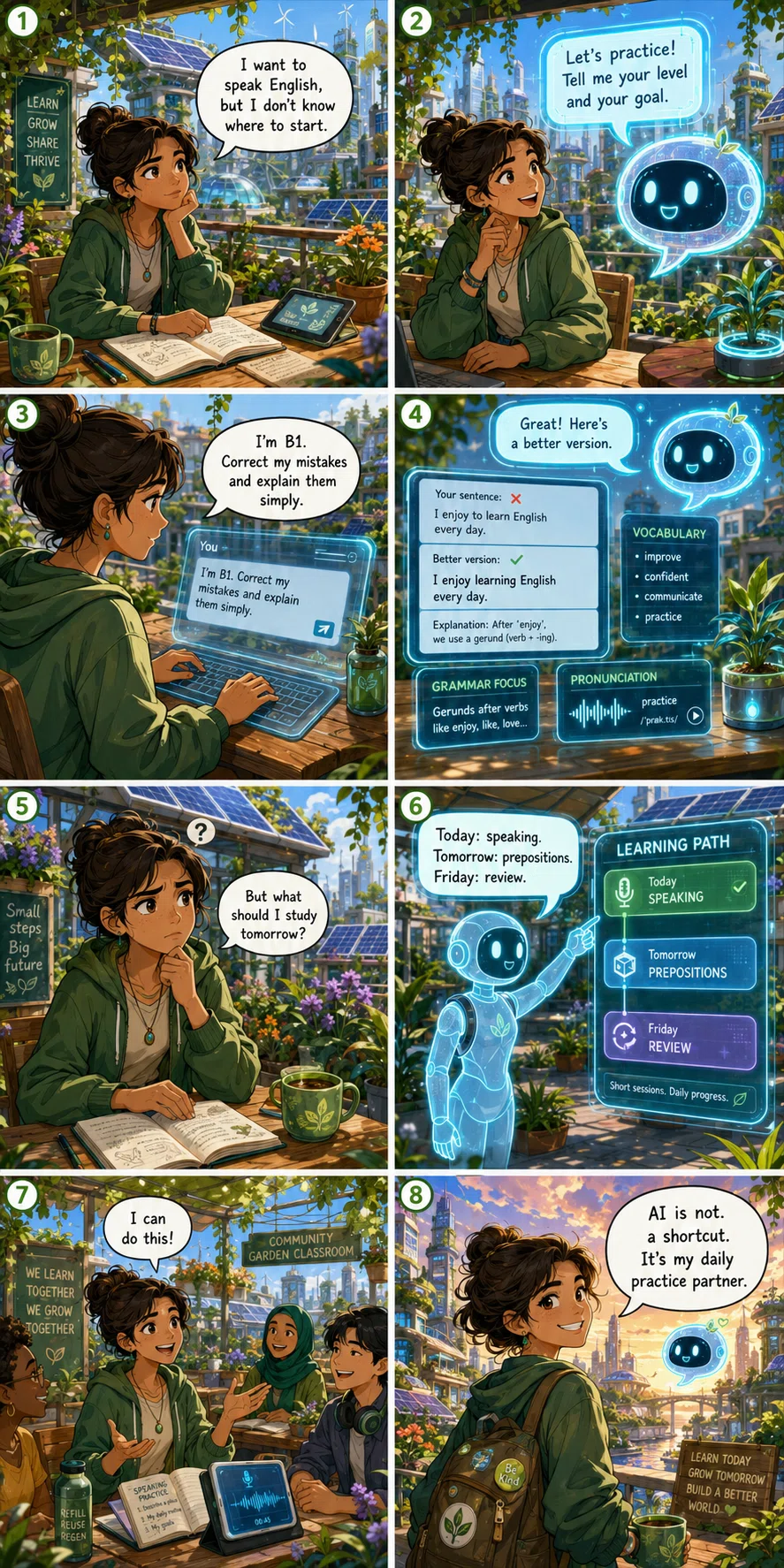
The article explains how English learners can use ChatGPT effectively in 2026, while also warning that ChatGPT is not a full replacement for a structured English course. It argues that ChatGPT is especially strong in English because it can provide fluent conversation, grammar explanations, vocabulary support, translation with nuance, writing corrections, and roleplay practice. Learners can ask it to act as a tutor at a specific CEFR level, correct mistakes, explain grammar in their native language, generate phrasal verb examples, compare American and British English, or create quizzes on difficult topics like articles and prepositions.
However, the article emphasizes several limitations. ChatGPT has no built-in A1–C1 curriculum, does not reliably track progress across sessions, may miss small mistakes, and is not optimized for pronunciation or language-teaching voice practice. Because it is reactive, the learner must decide what to study, when to review, and how to push beyond their comfort zone.
The article presents Univext’s AI teacher, Umi, as a purpose-built tutor that fills these gaps through structured lessons, adaptive difficulty, consistent correction, voice-first practice, and progress tracking. Its recommended workflow is hybrid: use Univext for daily guided speaking practice, ChatGPT for grammar questions and custom drills, and weekly review sessions to reinforce weak points. The article’s conclusion is that ChatGPT is one of the best free grammar and conversation tools, but learners progress faster when they combine it with a structured AI tutor rather than relying on it alone.
🌐 日本語で詳しい要約
この記事は、2026年にChatGPTを英語学習へどう活用すべきかを実践的に解説している。結論として、ChatGPTは英語学習に非常に有効だが、それ単体を「英語コース」として使うには限界がある。ChatGPTは英語での自然な会話、文法説明、語彙リスト作成、英作文の添削、アメリカ英語・イギリス英語の違いの説明、翻訳のニュアンス確認などに強い。特に、学習者が「私はB1レベルです」「間違いをすべて直してください」「説明は日本語でお願いします」のように条件を明確に指定すると、実用的な英語練習相手になる。
一方で、記事はChatGPTの弱点も強調している。ChatGPTにはA1からC1までの体系的カリキュラムがなく、学習者の進捗や苦手分野を継続的に追跡する仕組みも弱い。また、会話を自然に続けるために前置詞や冠詞の小さなミスを見逃すことがあり、発音指導も本格的な語学教育用に最適化されているわけではない。つまり、ChatGPTは「聞けば答えてくれる先生」ではあるが、「次に何を学ぶべきかまで導く先生」ではない。
そこで記事は、UnivextのAI教師Umiのような、語学学習専用AIとの併用を提案している。Umiは構造化されたA1〜C1カリキュラム、音声中心の練習、継続的なミスの記録、学習レベルに応じた難易度調整を提供する。推奨される学習法は、毎日15〜30分はUnivextで会話練習を行い、文法で詰まったときはChatGPTに具体的な質問をし、週1回はChatGPTで前置詞・時制・語彙などの弱点を復習するというハイブリッド型だ。記事全体のメッセージは、ChatGPTは無料で強力な英語学習補助ツールだが、最短で伸びるには「自由練習」と「構造化された指導」を組み合わせるべきだというものだ。
📘 CEFR B1以上の重要語彙12語
1. curriculum
日本語訳:カリキュラム
A structured curriculum helps learners know what to study next.
2. consistent
日本語訳:一貫した、安定した
Consistent correction is important for improving grammar.
3. correction
日本語訳:訂正、修正
The tutor gave me a clear correction in Japanese.
4. pronunciation
日本語訳:発音
Pronunciation practice helps learners sound more natural.
5. fluency
日本語訳:流暢さ
Daily speaking practice can improve fluency.
6. proficiency
日本語訳:熟達度、能力レベル
Her English proficiency improved after six months.
7. adaptive
日本語訳:適応型の
An adaptive tutor changes the lesson based on your level.
8. limitation
日本語訳:限界、制限
Every AI tool has a limitation.
9. nuance
日本語訳:微妙な意味合い
ChatGPT can explain the nuance between two phrases.
10. reference
日本語訳:参照、参考資料
I use ChatGPT as a grammar reference.
11. structured
日本語訳:体系化された
Structured lessons are useful for beginners.
12. progress
日本語訳:進歩、進捗
Tracking your progress keeps you motivated.
📺 外部参照情報
YouTube関連動画:
[Learn English with ChatGPT (2026) | Speak Fluently Faster ...]
Reddit(USA)関連トピック:
[ChatGPT prompt to practice English : r/EnglishLearning]
🗺️ 地名・人名・キーワード調査
地名
United Kingdom / UK
記事ではイギリス英語を学ぶ場合の対象地域として登場する。イギリス英語は綴り、語彙、表現がアメリカ英語と異なり、IELTSなど国際試験を意識する学習者にも関係が深い。
Australia
記事ではBritish English系の英語を意識する地域として触れられている。オーストラリア英語はイギリス英語に近い要素を持ちながら、独自の発音や口語表現も多い。
人物名
記事内に実在人物名は登場しないため、表記しません。
主要キーワード
CEFR
A1〜C1のように英語力を段階化する国際的な基準。記事では、ChatGPTにはこの段階に沿った内蔵カリキュラムがない点が弱点として語られている。
Voice Mode
ChatGPTの音声会話機能。英会話練習には使えるが、記事では語学教育専用の発音指導や進捗管理には限界があると説明されている。
🌏 日本・米国の比較情報
Japan / 日本
English:
In Japan, generative AI is already common among young learners. A 2026 survey reported by Nippon.com found that nearly 80% of Japanese junior and senior high school students use tools such as ChatGPT or Gemini at least occasionally, and many use them for study, proofreading, information checking, or conversation. This suggests that AI-assisted English learning is no longer a niche behavior; it is becoming part of everyday self-study culture.
日本語:
日本では、生成AIが中高生の学習にすでに広く入り込んでいる。Nippon.comが紹介した2026年調査では、日本の中高生の約8割がChatGPTやGeminiなどを「頻繁に」または「時々」使っており、勉強、文章の推敲、情報確認、会話相手として活用している。英語学習においても、AIは一部の先進的な人だけの道具ではなく、日常的な自習ツールになりつつある。
United States / 米国
English:
In the United States, AI learning tools are expanding in formal education while schools continue to debate proper use. Reuters reported that OpenAI rolled out ChatGPT Edu to about 500,000 students and faculty across California State University’s 23 campuses in 2025. At the K–12 level, NCES data show that English learners made up 10.6% of U.S. public school students, or 5.3 million students, in fall 2021, meaning AI tools could affect a large multilingual learner population if used responsibly.
日本語:
米国では、AI学習ツールが大学教育へ本格的に導入される一方、学校現場では適切な利用ルールが議論されている。Reutersによると、OpenAIは2025年にカリフォルニア州立大学23キャンパスの学生・教職員約50万人にChatGPT Eduを展開した。またNCESによれば、2021年秋時点で米国公立学校の英語学習者は530万人、全体の10.6%だった。AIが責任ある形で使われれば、多言語背景を持つ学習者支援にも大きな影響を持つ可能性がある。
💭 応用・ディスカッション展開
テーマ1:Can ChatGPT replace a human English teacher?
ChatGPT can replace some functions of a human English teacher, but it cannot replace the entire role. For independent learners, ChatGPT is extremely useful because it is available anytime, gives instant explanations, corrects writing, generates examples, and adapts to almost any topic. A learner can ask for B1-level conversation, business email correction, phrasal verb practice, or explanations in their native language. This flexibility is something even many human teachers cannot provide instantly.
However, language teaching is not only about answering questions. A good teacher notices patterns in a student’s mistakes, designs a long-term learning path, encourages the student when motivation drops, and creates pressure to speak in real time. Human teachers also understand emotion, hesitation, cultural context, and classroom dynamics. These are important because fluency develops through interaction, not only information.
The best answer is not “AI or human,” but “AI plus human.” ChatGPT can handle low-cost daily practice, grammar review, vocabulary building, and writing drafts. Human teachers are still valuable for pronunciation coaching, exam strategy, business communication, and deep feedback. For many learners, the most efficient model is to use ChatGPT every day and meet a human tutor occasionally for higher-level correction and motivation.
テーマ2:What is the best way to use AI for speaking practice?
The best way to use AI for speaking practice is to make it active, structured, and level-specific. Many learners make the mistake of simply opening ChatGPT and saying, “Let’s practice English.” This often leads to random conversation that feels interesting but does not necessarily improve fluency. A better approach is to define the learner’s level, goal, topic, correction style, and output requirement.
For example, a learner can say, “I am B1. Please ask me one question at a time about job interviews. After each answer, correct my grammar and give me a more natural version.” This prompt turns AI into a focused speaking coach. The learner should also speak out loud, not only type. Speaking uses different skills from reading or writing: speed, pronunciation, memory, confidence, and the ability to form sentences under pressure.
AI speaking practice works best in short daily sessions. Ten to twenty minutes every day is better than one long session once a week. Learners should record recurring mistakes, review them weekly, and ask AI to create drills based on those mistakes. Still, AI should not be the only speaking partner. Learners also need real human interaction, because real conversations include interruptions, emotions, accents, and unpredictable responses.
テーマ3:Should learners trust AI corrections?
Learners should use AI corrections, but they should not trust them blindly. AI tools are very good at identifying common grammar errors, suggesting natural expressions, and explaining differences between similar phrases. For everyday writing, ChatGPT can be an excellent assistant. It can show a corrected version, explain why a phrase sounds unnatural, and offer formal or casual alternatives.
The problem is that AI can sometimes sound confident even when its answer is incomplete or inaccurate. This is especially risky for advanced learners who ask about subtle nuance, idioms, dialects, humor, or culturally sensitive expressions. A sentence may be grammatically correct but socially awkward. AI may also over-correct a sentence that is acceptable in natural speech, or suggest a phrase that sounds too polished, too American, or too formal.
The best habit is to treat AI as a first reviewer, not the final authority. Learners can ask follow-up questions such as, “Is this natural in casual American English?” or “Would a native speaker actually say this?” They can also compare AI suggestions with dictionaries, corpora, textbooks, or human feedback. AI corrections become most powerful when learners actively question them, notice patterns, and build judgment instead of copying answers automatically.
🏷️ 記事の背景
English:
AI tutors are reshaping English learning, forcing learners to balance free chatbot practice with structured guidance, feedback, and speaking routines.
日本語:
生成AIの普及で英語学習は手軽になった一方、自由練習だけでは伸びに限界がある。構造化された学習設計とフィードバックの重要性が増している。
🏷️ ハッシュタグ
#AI英語学習 #ChatGPT活用 #英語勉強法 #英語学習 #英語リスニング #英語スピーキング #英文法 #英作文 #発音練習 #AI家庭教師 #語学学習 #社会人英語 #大学生英語 #自習術 #プロンプト術 #英語力アップ #英語初心者 #英語中級者 #学び直し #生成AI #ChatGPT #EnglishLearning #AIEnglishTutor #LanguageLearning #EnglishPractice #SpeakingPractice #GrammarTips #VocabularyBuilding #Fluency #EdTech #AIEducation #PromptEngineering #SelfStudy #LearningTools #ESL #EFL #教育 #英会話 #習い事
