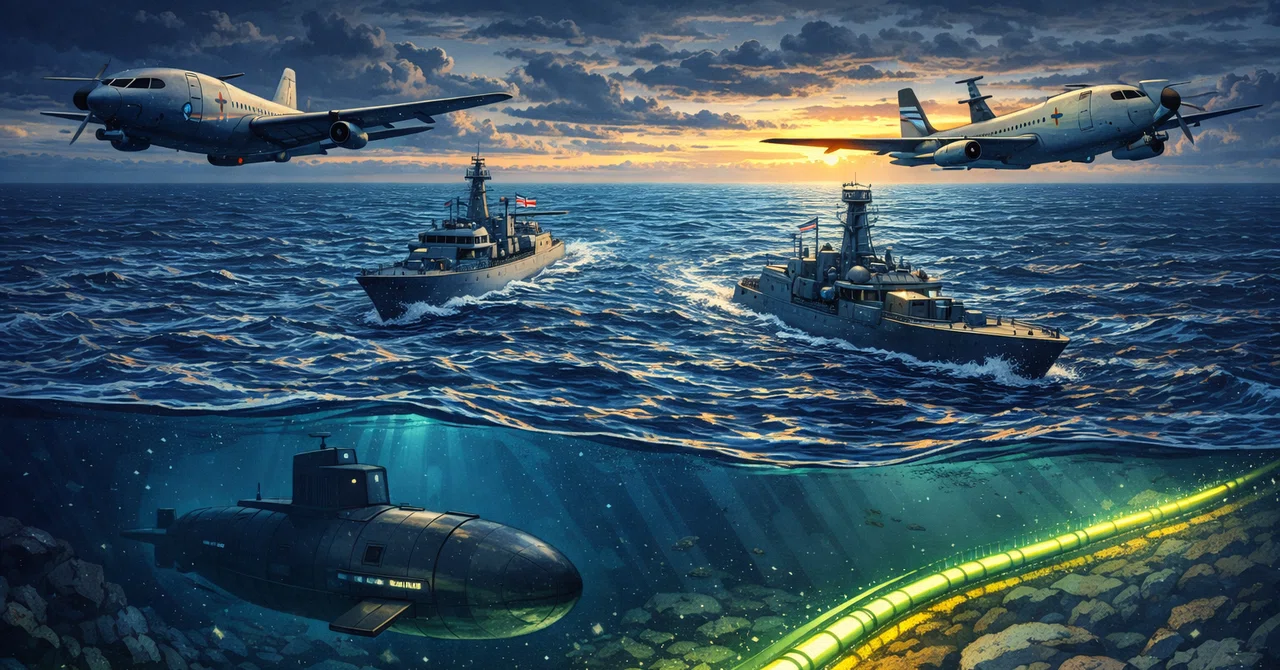
📰 【9news】北大西洋で露潜水艦を抑止した英・ノルウェー作戦

海の底で起きる“見えない攻防”は、実は私たちの通信や経済に直結している。英・ノルウェーがロシア潜水艦を追跡した今回のニュースは、戦争や外交だけでなく、インフラ防衛と日常生活のつながりを考えさせる一件。
Owner:9news
🗞️ タイトル:UK and Norway led a military operation to deter Russian submarines in the North Atlantic.
🕒 日時:2026/04/09
🔗 URL“https://www.9news.com.au/world/uk-and-norway-led-a-military-operation-to-deter-russian-submarines-in-the-north-atlantic/1a6b9d07-9a4b-43f9-a2b3-4165db57670a”
🌐 English Summary
The article reports on a weeks-long British- and Norwegian-led military operation in the North Atlantic aimed at deterring Russian submarines suspected of operating near critical undersea cables and pipelines. According to U.K. Defence Secretary John Healey, British forces tracked one Russian Akula-class attack submarine and two specialized submarines linked to GUGI, Russia’s Main Directorate of Deep-Sea Research. British officials say these vessels are designed to survey underwater infrastructure in peacetime and potentially sabotage it during conflict. The submarines were monitored north of the U.K., in and around British and allied maritime areas, including the U.K.’s Exclusive Economic Zone, though not inside territorial waters. The operation lasted more than a month and involved a Royal Navy frigate, aircraft, and hundreds of British personnel. Norway also said it deployed a P-8 maritime patrol aircraft and a frigate as part of the coordinated mission. British officials say the public disclosure was meant to send a clear deterrent signal to Moscow: that its covert activity had been detected and would not be tolerated. No evidence of cable or pipeline damage was found. Russia, through its embassy in London, rejected the accusations. The broader significance of the article lies in growing Western concern about the vulnerability of undersea infrastructure, which carries most international telecommunications and supports energy and trade flows. The report also reflects a wider strategic message from London and Oslo that Russia remains a central security threat even when global attention is focused elsewhere.
🇯🇵 日本語要約
この記事は、英国とノルウェーが主導し、北大西洋でロシアの潜水艦活動を抑止した数週間規模の軍事作戦を扱っている。英ジョン・ヒーリー国防相によれば、英軍はロシアのアクラ級攻撃型潜水艦1隻と、ロシア軍の「深海調査総局(GUGI)」に属する特殊潜水艦2隻を追跡した。英国側は、これらの艦艇が平時には海底インフラを調査し、有事には妨害や破壊工作に使われうる能力を持つとみている。活動海域は英国本土の北方で、英国の排他的経済水域や同盟国周辺海域を含む範囲だったが、領海内には入っていなかったとされる。作戦は1カ月超にわたり、英海軍フリゲート艦、哨戒機、数百人規模の人員が投入された。ノルウェーもP-8哨戒機とフリゲート艦を展開したと発表している。英政府は今回の公表について、ロシア側に「行動は見えている」という抑止メッセージを送る狙いがあったと説明した。結果としてロシア艦は北へ戻り、ケーブルやパイプラインに実害が出た証拠は確認されなかった。一方でロシア大使館は英側主張を否定している。この記事の本質は、海底ケーブルや海底パイプラインといった「見えないインフラ」が今や国家安全保障の核心にあることを示している点にある。国際通信の大半やエネルギー供給、貿易の一部が海底インフラに依存するなか、欧州諸国はロシアの海中活動を従来以上に深刻な脅威として認識している。さらに、世界の視線が中東情勢に向いていても、英国やノルウェーは対ロシア警戒を緩めないという政治的シグナルも読み取れる。
📘 重要語彙 12選
deter — 抑止する
The joint operation was intended to deter Russian submarines from approaching critical cables.infrastructure — インフラ、社会基盤
Undersea infrastructure supports communication, trade, and energy flows.surveillance — 監視、偵察
Maritime surveillance helped allied forces track the submarines for weeks.sabotage — 妨害行為、破壊工作
Officials feared the vessels could sabotage underwater pipelines in a conflict.covert — 秘密の、隠密の
The government said the Russian mission was meant to remain covert.maritime — 海上の、海洋の
Norway deployed maritime patrol aircraft during the operation.ally — 同盟国
The U.K. worked closely with its allies to monitor the threat.incursion — 侵入、侵犯
Officials warned they were ready to respond to any hostile incursion.exclusive economic zone — 排他的経済水域
The submarines were reportedly in the U.K.’s exclusive economic zone, not its territorial waters.deterrent — 抑止力となるもの
Publicly exposing the operation may serve as a deterrent.vulnerability — 脆弱性
The case highlighted the vulnerability of undersea cables.escalate — 緊張を高める、激化させる
Norway said it was in nobody’s interest to escalate tensions in the High North.
📺 外部参照情報
YouTube関連動画
Euronews系の関連動画あり:
Reddit(USA)関連トピック
r/LessCredibleDefence の関連スレッド:
🗺️ 地名・人名・キーワード調査
🌍 地名1:North Atlantic
北大西洋は欧州・アフリカと南北アメリカの間に広がる広大な海域で、海上交通・漁業・通信インフラの要衝でもある。暖流のガルフストリームや北大西洋海流の影響は周辺気候にも大きく、海底ケーブルの集中域として戦略的重要性が高い。
🌍 地名2:Scotland
スコットランドは英国北部に位置し、北と西は大西洋、東は北海に面する。海岸線は入り組み、島嶼や海峡が多く、北大西洋への接近経路を監視するうえで地理的に重要な位置を占める。独自の文化や地域アイデンティティでも知られる。
👤 人物1:John Healey
ジョン・ヒーリーは英国の国防相で、2024年7月5日に就任した。現在は国防政策全般、戦略計画、主要同盟国との関係などを統括している。今回の件では、ロシア側に対して「我々は見ている」と明言し、抑止の意図を前面に出した。
👤 人物2:Tore O. Sandvik
トーレ・O・サンドヴィクはノルウェーの国防相で、2025年2月4日に任命された労働党所属の政治家。今回の声明では、ロシアがノルウェーと英国の海域周辺で活動し、ノルウェー側もP-8哨戒機とフリゲート艦を投入したと説明した。
👤 人物3:Vladimir Putin
ウラジーミル・プーチンはロシア大統領で、2024年の大統領選で再選され、同年5月7日に就任した。英国側は今回の潜水艦活動を、プーチン政権による隠密的な対欧州圧力の一環として位置づけている。
🔑 キーワード1:GUGI
GUGIはロシアの「深海調査総局」で、ノルウェー政府は今回の活動がこの部局によって実施されたと説明した。英国側は、同部局の特殊潜水艦が海底インフラの調査や有事の妨害工作に使われ得ると警戒している。
🔑 キーワード2:EEZ(Exclusive Economic Zone)
EEZは排他的経済水域を指し、一般に沿岸国の基線から最大200海里まで設定される。今回の潜水艦活動は英国のEEZ内で起きたが、領海内ではないと報じられた。つまり主権そのものへの侵入ではないが、資源・海洋管理・安全保障上は重大な意味を持つ。
🌏 日本・米国の比較情報
🇯🇵 Japan related situation (English)
Japan is also strengthening capabilities related to anti-submarine warfare and maritime surveillance. In its FY2025 reinforcement budget materials, Japan states it will acquire two upgraded P-1 patrol aircraft, build another Taigei-class submarine, and procure SH-60L patrol helicopters with improved anti-submarine performance. Diplomatically, Japan and Australia also committed in September 2025 to promote secure undersea cables in the Indo-Pacific and to communicate more closely on cable damage.
🇯🇵 関連する日本の現状(日本語)
日本も対潜水艦戦と海洋監視の能力を強化している。2025年度の防衛力強化関連資料では、能力向上型P-1哨戒機2機、たいげい型潜水艦1隻、対潜能力を高めたSH-60L哨戒ヘリの取得が示されている。また2025年9月の日豪2+2では、インド太平洋で安全な海底ケーブルを推進し、ケーブル損傷への連携を深める方針が確認された。
🇺🇸 U.S. related situation (English)
The United States is also treating subsea resilience as a strategic issue. The State Department backed a joint statement in September 2024 stressing that undersea cable security and resilience are critical to global communications and economic growth. On the practical side, MARAD’s December 2025 fleet poster lists a U.S. Cable Security Fleet with a two-ship capacity, showing that Washington is not relying only on diplomacy but also on maritime infrastructure support tools.
🇺🇸 関連する米国の現状(日本語)
米国でも海底インフラ防護は戦略課題として扱われている。国務省は2024年9月、海底ケーブルの安全性とレジリエンスが世界の通信と経済成長に不可欠だとする共同声明を支持した。さらに、米海事局の2025年12月時点の資料では、米国のCable Security Fleetが2隻体制で示されており、外交だけでなく海事基盤面でも備えを進めていることが分かる。
💭 応用・ディスカッション展開
抽出テーマ
How should democracies protect undersea infrastructure without triggering escalation?
Is publicly exposing covert hostile activity an effective form of deterrence?
How should governments balance simultaneous crises in different regions?
🧠 Theme 1 Model Answer
Democracies should protect undersea infrastructure through a layered strategy that combines surveillance, alliance coordination, legal clarity, and proportionate signaling. The first priority is awareness. Governments need persistent maritime domain awareness, including patrol aircraft, sonar systems, satellites, unmanned platforms, and information-sharing networks with allies. Without detection, there is no deterrence. The second priority is resilience. States should diversify cable routes, improve repair capacity, and identify which assets are so critical that they require military monitoring. A strong defense is not only about stopping attacks but also about limiting the damage an adversary could cause. Third, democratic governments should act within international law and communicate that clearly. If a rival vessel remains outside territorial waters, the response should still be firm but legally grounded. This matters because democracies gain strength from legitimacy. Fourth, governments should use graduated signaling rather than immediate overreaction. Quiet tracking, direct diplomatic warnings, public attribution, sanctions, or coordinated allied statements can raise the cost of hostile behavior without creating automatic military escalation. Finally, democracies should prepare public communication in advance. Citizens need to understand why unseen infrastructure matters and why protection efforts are necessary. The challenge is to stay strong without becoming reckless. A measured response backed by alliances, transparency, and resilient infrastructure is more sustainable than a dramatic but impulsive show of force.
🧠 Theme 2 Model Answer
Publicly exposing covert hostile activity can be an effective deterrent, but only when it is credible, timely, and strategically framed. The greatest value of exposure is that it strips an adversary of deniability. If a country believes its operation will remain hidden, it may take greater risks. Once that operation is revealed, however, the political and strategic costs rise. Exposure can also reassure domestic audiences and allied governments that the threat is being monitored seriously. In that sense, public disclosure is not only about warning the adversary; it is also about strengthening confidence among partners. Still, this method has risks. If governments expose activity too often without following up, their warnings may begin to sound symbolic rather than serious. There is also the danger of revealing intelligence methods or creating pressure to escalate beyond what is wise. That is why disclosure should be selective. It works best when the state can prove enough to be believed, while withholding enough to protect sensitive capabilities. The tone matters too. A government should avoid theatrical language and instead present exposure as a factual, disciplined act of strategic communication. In many cases, the best outcome is not a dramatic confrontation but a quiet change in the adversary’s behavior. Public exposure is therefore useful not as a substitute for capability, but as a tool that complements surveillance, alliance coordination, and credible consequences.
🧠 Theme 3 Model Answer
Governments facing simultaneous crises should avoid the false choice of treating one theater as important and the other as secondary. National security today is multi-regional and interconnected. A crisis in one area can create distraction that adversaries exploit elsewhere, especially in domains like cyber operations, maritime infrastructure, and intelligence activity. The right approach is not to move every asset to the most visible conflict, but to allocate resources according to both urgency and strategic consequence. That means keeping flexible forces available, protecting the homeland and critical infrastructure, and maintaining alliance commitments even when media attention is concentrated elsewhere. Good prioritization also depends on political honesty. Leaders should explain that some threats are dramatic and visible, while others are quiet but potentially just as dangerous. Public debate often rewards the visible crisis, yet governments must still defend shipping routes, data networks, energy links, and deterrence architectures that citizens rarely see. Another key principle is burden-sharing. Alliances exist precisely so partners can manage overlapping threats together rather than alone. When countries coordinate intelligence, patrols, logistics, and repair capacity, they reduce the chance that one distraction creates a strategic opening. In the end, balance does not mean equal attention to every problem. It means resisting panic, preserving strategic discipline, and ensuring that the state remains capable of responding to both immediate conflict and slower, less visible forms of pressure.
🏷️ 記事の背景
English: Since Russia’s 2022 invasion of Ukraine, Europe has worried more about sabotage risks to seabed cables and pipelines, especially after repeated cable and energy disruptions.
日本語:ロシアの2022年ウクライナ侵攻以降、欧州では海底ケーブルやパイプラインへの妨害リスクへの警戒が高まり、損傷事案も重なって注目が強まっている。
🏷️ ハッシュタグ
#北大西洋 #ロシア潜水艦 #英国国防 #ノルウェー #海底ケーブル #海底インフラ #地政学 #安全保障 #軍事ニュース #国際情勢 #海洋監視 #対潜水艦戦 #通信インフラ #EEZ #GUGI #NATO #欧州防衛 #国際ニュース #時事英語 #ニュースで英語 #NorthAtlantic #RussianSubmarines #UnderseaCables #UKDefence #Norway #MaritimeSecurity #Geopolitics #CriticalInfrastructure #NavalOperations #ASW #Surveillance #Deterrence #NATO #EuropeanSecurity #WorldNews #NewsEnglish #教育 #英会話 #習い事 #2026 /04/09 #2026 #2026 /04
↓👍イイネを押してもらえると嬉しいです
