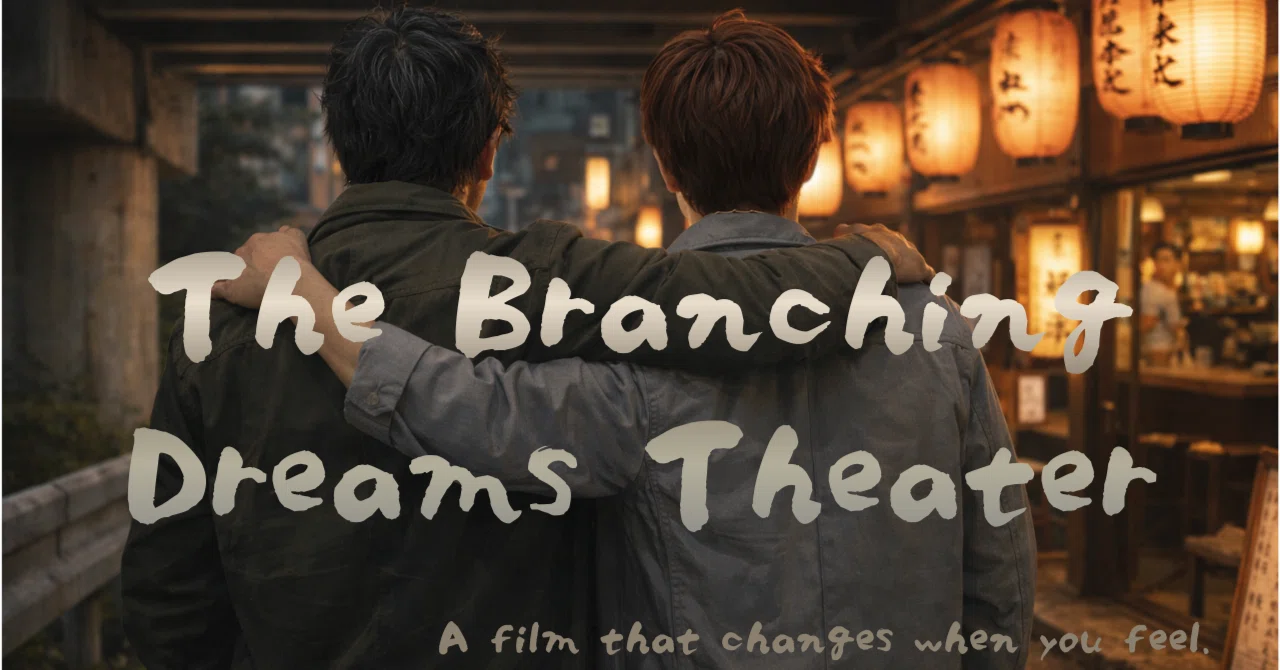
The Branching Dreams Theater -English Version-

Episode 1 — The Meeting at the Theater
The theater was on the second floor of a narrow building in front of Noborito Station.
Posters covered the stairway wall, each one advertising films Shinjo had never heard of.
Small titles. Strange images. No stars. No prestige.
Just the quiet confidence of an indie cinema that had survived without asking permission.
Shinjo Shinichi stood there for a while, looking at them.
He had just quit his job.
He had cleaned out his desk at the city office, handed in his resignation, listened to the dry little thank you for your service, and gotten on a train without really deciding where he was going.
At some point, he had ended up in Noborito.
He had not planned to go home.
He had not planned to watch a movie either.
And yet, before he knew it, he was climbing the stairs.
At the counter, he bought a ticket.
The auditorium was small—maybe twenty seats.
Not even half of them were filled.
Shinjo sat near the middle.
The lights went down.
The film began.
For the first twenty minutes, he watched in silence.
Then he let out a small breath.
On the screen, the protagonist was being forced into a choice.
It was wrong.
Not morally wrong. Structurally wrong.
Shinjo muttered under his breath.
“…In the end.”
A short pause.
“It never goes the way I want.”
He gave a faint shrug.
“Well. That’s life.”
From behind him, a voice said:
“You don’t get it.”
Shinjo turned.
A man was sitting in the row behind him.
He looked to be in his fifties. Arms crossed. Eyes still fixed on the screen.
The man lifted a finger toward the image.
“With this setup,” he said, “there’s only one road he’d take.”
Shinjo smiled.
“Right?”
“Exactly,” the man said. “But they make him choose the other one.”
Shinjo folded his arms.
“The logic of the branching is broken.”
The man glanced at him for the first time.
“Oh? You can see that too?”
“More or less.”
Shinjo looked back at the screen.
“If he makes that choice, then the next consequence should be obvious.”
The man snorted.
“Don’t say obvious.”
Shinjo blinked. “What?”
“Movies aren’t made to protect the obvious,” the man said. “They’re made to break it.”
Shinjo fell silent.
Then a small voice rose from the seat in front of them.
“Um…”
Both of them looked forward.
A young man in a hoodie had turned halfway around. He was clutching a tub of popcorn as if it were a shield.
“Sorry,” he said. “I… I kind of agree.”
Shinjo stared. “Huh?”
The young man lowered his eyes.
“With this branch…” he said quietly, “the meaning of the earlier choice sort of disappears.”
The older man gave a small laugh.
“You think so too?”
“Y-Yes.”
“Interesting.”
The man looked at Shinjo.
“What’s your name?”
“Shinjo.”
The man nodded.
“Kurokawa.”
Then he looked at the young man in front.
“And you?”
“Kashiwagi,” he said.
For a while, the three of them watched the screen in silence.
The film kept going.
But inside Shinjo’s head, something else had already begun to move.
What if…
What if you could build every branch?
What would happen then?
The thought rose suddenly, as if it had been waiting in him for years.
He shook his head.
“…Doesn’t matter,” he murmured.
“This has nothing to do with me.”
The screen’s pale light quietly washed over all three of them.
Episode 2 — Under the Guardrail
When they stepped out of the theater, Noborito was still noisy.
Laughter spilled out from the drinking streets near the station.
Under the elevated Nambu Line tracks, the air smelled faintly of iron and old rain.
The three of them stopped beside a guardrail.
A train passed overhead.
The steel thunder rolled through the structure above them.
Shinjo was the first to speak.
“That movie earlier…”
Kurokawa looked at him. “Yeah?”
“It had branching points.”
“It did.”
Shinjo hesitated for only a second.
“Has anyone ever made a film where the audience gets to choose?”
Kurokawa laughed a little.
“No.”
He pulled out a cigarette.
Lit it.
Took a drag.
“Branches,” he said, smoke leaving his mouth in a thin stream, “are chosen by the script.”
He lifted one finger.
“Then by the director.”
Shinjo nodded. “That makes sense.”
“It’s not something you hand over to the audience.”
Kurokawa flicked ash to the ground.
“What you show them is one line. One cut. One version you’ve decided on.”
Shinjo thought for a moment.
“But…”
Kurokawa looked at him again. “What?”
“Wouldn’t it be more rational,” Shinjo said, “to let the audience choose?”
Kurokawa narrowed his eyes.
“Rational?”
“If there are as many branches as there are viewers,” Shinjo said, “then why not let viewers choose their own route?”
Kurokawa went silent.
Then Kashiwagi, still standing a little apart from them, spoke in a small voice.
“Um…”
Both men turned toward him.
“That’s… kind of like an ADV.”
Kurokawa frowned.
“An what?”
Kashiwagi stiffened.
“An adventure… game…”
Kurokawa looked genuinely confused.
“You mean some kind of swashbuckling action story?”
Kashiwagi panicked slightly.
“No, no, I mean—well—game, as in… one with choices.”
Shinjo stepped in.
“A branching narrative game,” he said. “The player selects options, and the story splits.”
Kurokawa gave a slow, unimpressed nod.
“So. A game.”
“Yes,” Kashiwagi said carefully.
Kurokawa took another drag.
“That’s game logic.”
He looked back toward the tracks.
“Not film.”
A train roared overhead again, shaking the metal above them.
Shinjo smiled faintly.
“Right.”
Then he spoke again.
“But if you could build all of it…”
Kurokawa turned.
“All of what?”
“The branches.”
Shinjo looked straight ahead as he said it.
“All of them. Build them all first. Then choose the best one.”
Kashiwagi said nothing.
Kurokawa stared at Shinjo for a moment, then laughed under his breath.
“You say strange things.”
“Do I?”
“There are people like you once in a while,” Kurokawa said.
“What kind?”
“The kind who start caring about the structure under the script.”
He crushed the cigarette under his shoe.
“Usually they end up fighting with directors and disappearing.”
Shinjo gave a dry little smile. “That sounds promising.”
“But,” Kurokawa continued, “once in a while, one of them does well.”
“In film?”
Kurokawa shook his head.
“In something else.”
He shoved his hands into his coat pockets.
“That’s why they’re interesting.”
Then, as if he had only just remembered it, he added:
“Oh. I forgot to say.”
Shinjo looked up. “What?”
“I used to work in film.”
Kashiwagi blinked. “What?”
“I was a director.”
A small silence followed.
Kurokawa shrugged.
“More or less retired now. The way things are made these days pisses me off.”
He took out his phone.
“But you—”
He looked at Shinjo.
“—you say things that sound stupid in a way I enjoy.”
He held the phone out.
“If something comes of that brain of yours, call me.”
Then he turned to Kashiwagi.
“You too.”
Kashiwagi froze. “Me?”
“Yeah, you.”
“I-I’m not really—”
“Just give me your contact.”
Kashiwagi looked like he wanted to disappear into the concrete, but he obediently took out his phone.
The three of them exchanged information.
Then Kurokawa turned away and started walking.
“See you.”
Another train passed overhead.
Shinjo looked down at his phone.
Kurokawa Masaru.
A former film director.
Kashiwagi peered at the screen.
“Do you think he was famous?”
Shinjo slipped the phone back into his pocket.
“No idea.”
He looked toward the dark line of the tracks.
“It probably has nothing to do with me.”
But the thought did not leave him.
Episode 3 — Branch
Shinjo’s apartment in Komae was quiet.
It was an old building a short walk from the station, the kind where the staircase complained under your weight.
When he unlocked the door and stepped inside, the silence felt too large for the room.
He turned on the light.
A desk.
A chair.
A few cardboard boxes from the office, still unopened.
He took off his jacket and sat down.
For a while he just stared at the ceiling.
When he still worked at city hall, there had always been noise.
Phones.
Paper.
Meetings.
Voices.
Now there was nothing.
He took out his phone and opened a news app.
Politics.
Stocks.
AI.
His finger stopped on an article.
Research team develops AI interface using brainwave analysis
He opened it.
The article was short.
A university research group was experimenting with systems that estimated emotional states from brainwave data and linked them to AI in real time.
Anger.
Tension.
Surprise.
Things like that.
He scrolled farther.
A comment from one of the researchers had been highlighted.
Potential applications in entertainment are also being explored.
Shinjo smiled faintly.
“Entertainment.”
He put the phone on the desk.
Then Kurokawa’s voice came back to him.
Branches are chosen by the script.
You don’t let the audience choose.
Shinjo leaned back in his chair.
“The audience chooses,” he murmured.
“It’s more rational.”
Then another thought followed close behind it.
His own life had supposedly been made of choices.
But had he ever really chosen anything?
Or had the options simply been lined up for him in advance, already approved, already named, already judged?
He picked up the phone again and reread the article.
Brainwaves.
Emotion.
AI.
Something connected.
“Wait.”
He stood up so fast the chair scraped against the floor.
He paced once across the room.
“The audience doesn’t choose.”
He put both hands on the desk.
“The reaction chooses.”
If the audience is surprised, the AI detects it.
The story changes.
If tension rises, the film shifts.
If attention drops, the route closes.
Movies had always been one-way.
You sat down.
You watched.
You received.
But what if the movie was prepared to answer back?
Shinjo let out a small breath.
“If all the branches exist…”
He sat again.
“Then maybe that still counts as choosing.”
He looked at the ceiling.
“No,” he said softly. “That’s not right.”
He picked up the phone once more.
“It’s not a branching movie.”
A small smile appeared.
“It’s a movie that branches.”
At that moment, there was a knock on the door.
He looked up.
“Shinichi,” a voice called from outside. “You home?”
He opened the door.
His older brother was standing there in a suit, his tie loosened slightly.
“Tomohiro.”
His brother glanced around the room.
“You still haven’t unpacked?”
“I got back today.”
Tomohiro sighed.
“So you really quit.”
“I quit.”
“What’s next?”
“Haven’t decided.”
Tomohiro was silent for a moment, then stepped inside and sat on the chair opposite the desk.
“Well,” he said, “it’s your life.”
Then he added:
“But don’t burn through your savings doing something stupid.”
Shinjo laughed.
“That sounded very banker of you.”
“I am a banker.”
Tomohiro pulled out his phone, checked something, and said, “I haven’t told Mom yet.”
“I’ll tell her eventually.”
“You should.”
A short silence settled between them.
Then Tomohiro stood.
“All right. I’m going.”
He headed for the door, then paused.
“Seriously,” he said without turning around, “don’t do anything reckless.”
The door closed behind him.
The apartment became quiet again.
Shinjo sat down.
He opened his contacts.
There it was.
Kurokawa.
The number from the night before.
He looked at it for a while.
Then, almost under his breath, he said:
“You told me not to underestimate film.”
A faint smile touched his face.
“I’m not underestimating it.”
He opened a message window.
Typed.
Paused.
Then continued.
About what we talked about yesterday.
I think a branching film might actually be possible.
He hit send.
Then he put the phone face down on the desk and looked up at the ceiling.
“Well,” he murmured.
“Let’s see what happens.”
Episode 4 — The Call
The reply came faster than Shinjo expected.
His phone buzzed once on the desk.
He flipped it over.
Kurokawa Masaru
Come tomorrow. 10 AM. Same place.
No greeting. No punctuation beyond necessity.
Shinjo stared at the message for a moment.
“…That’s quick.”
He typed back a short reply.
Understood.
Then he leaned back in his chair.
There was no hesitation in Kurokawa’s response.
No skepticism. No dismissal.
Just—movement.
Shinjo let out a small breath.
“So it starts like this.”
He didn’t know what “this” was yet.
But something had already shifted.
The next morning, Noborito felt different.
Or maybe Shinjo did.
The same narrow stairway.
The same posters.
But now, instead of random images, they looked like fragments of decisions.
Each one a frozen branch.
He climbed.
The theater was closed.
A small sign hung on the door:
Staff Only
Shinjo hesitated.
Then the door opened from inside.
Kurokawa stood there.
“You’re on time.”
“You said ten.”
Kurokawa stepped aside.
“Come in.”
Inside, the theater felt smaller in daylight.
No projection. No audience.
Just rows of seats and a blank screen.
Kashiwagi was already there.
He stood up awkwardly when Shinjo entered.
“Ah—good morning.”
“Morning.”
Kurokawa walked past them and headed toward the front.
He didn’t sit.
Instead, he turned to face the screen, then looked back at the two of them.
“Say it again.”
Shinjo blinked.
“What?”
“The thing you sent me,” Kurokawa said. “About branching.”
Shinjo took a step forward.
“It’s not about giving the audience choices.”
Kurokawa nodded slightly.
“Go on.”
“It’s about reading their reactions,” Shinjo said.
“Emotion. Tension. Engagement.”
Kashiwagi listened, hands clasped tightly.
“If we can detect that in real time,” Shinjo continued,
“then the system can select the next sequence automatically.”
Kurokawa said nothing.
The silence stretched.
Then:
“That’s not film.”
Shinjo expected that answer.
“I know.”
“It’s not a game either.”
“I know.”
Kurokawa turned slightly.
“So what is it?”
Shinjo met his gaze.
“…Something in between.”
Kurokawa’s expression didn’t change.
But something in his eyes sharpened.
“You’re saying,” he said slowly,
“the film itself reacts.”
“Yes.”
“And the audience never sees the other paths.”
“Yes.”
“They only experience one line.”
“Yes.”
Kurokawa looked back at the blank screen.
“…Interesting.”
Kashiwagi finally spoke.
“But… how would you detect emotions?”
Both men turned to him.
He flinched slightly under the attention.
“I mean—like—technically…”
Shinjo answered.
“Brainwaves.”
Kashiwagi froze.
“…Huh?”
“EEG-based estimation,” Shinjo said.
“It doesn’t have to be perfect. Just directional.”
Kurokawa gave a low chuckle.
“You’re talking about reading minds now?”
“No,” Shinjo said.
“Just reading signals.”
Kurokawa crossed his arms.
“Same difference for most people.”
A pause.
Then he asked:
“Do you have anything beyond words?”
Shinjo hesitated.
“…No.”
Kurokawa nodded.
“Good.”
Shinjo frowned. “Good?”
“I hate when people come in pretending they’ve already built something.”
Kurokawa walked down the aisle.
Stopped in front of the screen.
Turned.
“But if you’re serious…”
He pointed at Shinjo.
“…then we test it.”
Episode 5 — Prototype
The room they moved to was not part of the theater.
It was smaller.
Concrete walls. No decoration.
A storage space that had slowly turned into something else.
Old monitors sat stacked in one corner.
Cables tangled like vines along the floor.
Kashiwagi looked around nervously.
“…You work here?”
Kurokawa shrugged.
“I exist here.”
He pulled a chair over with his foot.
“Sit.”
They did.
Kurokawa leaned against the wall.
“Explain the minimum.”
Shinjo nodded.
“We don’t need a full system yet.”
“Obviously.”
“A simple loop is enough.”
Kurokawa gestured. “Continue.”
“Two branches,” Shinjo said.
“Same starting point.”
Kashiwagi leaned forward slightly.
“If the viewer’s engagement rises,” Shinjo continued,
“we go deeper into tension.”
“And if it drops?” Kurokawa asked.
“We redirect.”
“To what?”
“Something that recaptures attention.”
Kurokawa watched him carefully.
“You’re assuming we can measure that cleanly.”
“Not cleanly,” Shinjo said.
“Just relatively.”
Kashiwagi spoke again, more cautiously this time.
“…So we’d need sensors.”
“Yes.”
“…And AI to interpret signals.”
“Yes.”
“…And multiple filmed sequences.”
“Yes.”
Kashiwagi swallowed.
“That’s… a lot.”
Kurokawa smirked slightly.
“Welcome to making things.”
He pushed himself off the wall.
“What’s your role?” he asked Kashiwagi.
“Me?”
“Yeah, you.”
Kashiwagi hesitated.
“I… I did some programming. A little.”
Kurokawa looked at Shinjo.
“You brought him?”
“No,” Shinjo said. “He was just there.”
Kurokawa laughed.
“Good enough.”
He pointed at Kashiwagi.
“You handle signal interpretation.”
Kashiwagi’s eyes widened.
“M-Me?!”
“Unless you want to leave.”
“I—no—”
“Then you’re in.”
Kurokawa turned to Shinjo.
“And you.”
“Yeah.”
“You handle structure.”
Shinjo nodded.
“That’s what I was thinking.”
Kurokawa looked back at the room.
Then at the blank monitor.
“…It’s stupid.”
Neither of them replied.
“Expensive,” he added.
Still silence.
“Probably won’t work.”
Kurokawa paused.
Then, almost casually:
“Let’s try it anyway.”
Episode 6 — First Branch
Three days later, they had something.
It wasn’t elegant.
It barely qualified as a system.
But it moved.
A cheap EEG headset sat on Kashiwagi’s head.
Wires ran from it into a laptop.
From the laptop into a small editing setup.
On the screen: a simple video.
A man walking down a hallway.
At a door, the footage split.
Two versions prepared.
Branch A.
Branch B.
Shinjo stood behind the laptop.
“Ready?”
Kashiwagi nodded nervously.
“I think so…”
Kurokawa sat in the back, arms crossed.
“Start it.”
Shinjo hit play.
The video began.
Footsteps echoed softly through the speakers.
The hallway stretched forward.
Kashiwagi watched.
His breathing slowed slightly.
On the laptop, a crude graph moved.
Fluctuating.
Messy.
Unreliable.
But alive.
Shinjo watched the numbers.
“Come on…”
The character in the video reached the door.
A pause.
The system waited.
Just for a moment.
Then—
It chose.
The screen flickered.
Branch A.
The door opened slowly.
Darkness inside.
Kashiwagi leaned forward slightly.
On the graph, a small spike.
Kurokawa’s eyes narrowed.
“…Again.”
Shinjo restarted the video.
Same hallway.
Same footsteps.
Same door.
This time—
The graph dipped.
Just slightly.
The system hesitated.
Then—
Branch B.
The door slammed shut instead.
Kashiwagi flinched.
“Whoa—”
The graph jumped.
Kurokawa leaned forward.
“…It reacted.”
Shinjo didn’t answer.
He was staring at the screen.
Not at the video—
At the transition.
The moment where the system decided.
“…It chose.”
Silence filled the room.
Not empty silence.
Dense.
Heavy.
Kurokawa stood up slowly.
Walked toward the screen.
Stopped just short of it.
“…No,” he said quietly.
Shinjo looked at him.
“What?”
Kurokawa shook his head.
“It didn’t choose.”
He pointed at Kashiwagi.
“He did.”
Kashiwagi froze.
“M-Me?!”
Kurokawa turned back to the screen.
“The system only followed.”
A long pause.
Then he smiled—just a little.
“…This might actually work.”
Shinjo exhaled slowly.
“Yeah.”
On the laptop, the graph still moved.
Unstable.
Imperfect.
Alive.
And somewhere inside that noise—
A branch had been born.
Episode 7 — Misalignment
They ran the test again.
And again.
And again.
Each time, the system responded.
Not perfectly.
Not consistently.
But enough.
Enough to prove something had changed.
Kashiwagi removed the headset, rubbing his temples.
“…This feels weird.”
“Of course it does,” Kurokawa said. “You’re being watched by a machine.”
“I don’t mean that,” Kashiwagi said.
“I mean… the feeling.”
He hesitated.
“It’s like the movie is… following me.”
Shinjo looked up.
“…Yeah.”
That was it.
Not choosing.
Not branching.
Following.
Kurokawa exhaled through his nose.
“So what?”
Shinjo didn’t answer immediately.
He stared at the monitor.
“…It’s still incomplete.”
Kurokawa raised an eyebrow.
“Obviously.”
“No,” Shinjo said quietly.
“I mean structurally.”
Kashiwagi blinked.
“Structurally?”
Shinjo nodded.
“The system reacts to what happens inside the film.”
“…Yeah?”
“But the audience doesn’t exist inside the film.”
Silence.
Kurokawa’s eyes narrowed slightly.
“Go on.”
Shinjo gestured toward the room.
“The audience is here.”
He pointed at the screen.
“The film is there.”
He lowered his hand.
“There’s a boundary.”
Kashiwagi swallowed.
“…So?”
“So even if the film reacts,” Shinjo said,
“it’s still incomplete.”
Kurokawa stared at him.
“…Why?”
Shinjo hesitated.
Then:
“Because the audience can leave.”
A pause.
Kashiwagi blinked.
“…Leave?”
“They can look away.”
“They can check their phone.”
“They can walk out.”
Shinjo’s voice stayed calm.
“And the system doesn’t know what that means.”
Kurokawa didn’t move.
“…You’re saying,” he said slowly,
“we’re not capturing the full state.”
Shinjo nodded.
“Exactly.”
Silence filled the room.
Then Kashiwagi spoke, almost reflexively:
“…But if they leave, they just stop watching, right?”
Shinjo shook his head.
“No.”
Kashiwagi frowned.
“…What do you mean, no?”
Shinjo looked at him.
“They don’t stop watching.”
A beat.
“They just move to another branch.”
Episode 8 — The Outside
The idea didn’t land immediately.
Kashiwagi stared at Shinjo, waiting for clarification that didn’t come.
“…Another branch?”
Shinjo didn’t explain.
Instead, he looked at Kurokawa.
“You said film shows one line.”
“I did.”
“But that’s only true inside the screen.”
Kurokawa said nothing.
Shinjo continued.
“From the audience’s perspective, there are already multiple paths.”
“…Explain.”
“They can stay.”
“They can leave.”
“They can come back.”
Each word fell cleanly.
“Those are branches.”
Kashiwagi shook his head.
“…No, that’s just behavior.”
“Exactly,” Shinjo said.
Kashiwagi froze.
Kurokawa spoke, low and measured.
“…Behavior is not written.”
“No,” Shinjo said.
“It isn’t.”
Silence.
Then:
“That’s why it matters.”
Kurokawa took a slow step forward.
“You’re trying to include that?”
Shinjo nodded.
“Yes.”
Kashiwagi looked between them.
“…Wait, how would that even work?”
Shinjo didn’t answer right away.
Then he said:
“Right now, the system reacts to signals.”
“Yeah…”
“But signals only come from people who stay.”
Kashiwagi’s expression changed.
“…Oh.”
Kurokawa watched carefully.
“So if someone leaves…”
“They disappear from the system,” Shinjo said.
“And that’s data loss.”
Kurokawa nodded slowly.
“…So you want to track the ones who leave.”
“Yes.”
Kashiwagi looked uneasy.
“That sounds… complicated.”
“It is.”
“And creepy.”
“…Also true.”
Kurokawa let out a short laugh.
“Now it’s starting to sound like a real project.”
Shinjo ignored that.
“The question isn’t how to track them.”
Kurokawa tilted his head.
“Then what is it?”
Shinjo looked at the door.
“…Where they go.”
Episode 9 — The Toilet Route
The first time they noticed it, it wasn’t part of the plan.
It happened during a late test.
They had invited a few people.
Not many. Just enough to observe.
A small audience sat scattered across the seats.
The prototype system ran.
Simple branching.
Basic detection.
Nothing special.
Halfway through the screening, one of the viewers stood up.
A man in his twenties.
He glanced around briefly, then walked out.
Kashiwagi frowned.
“…He left.”
“Yeah,” Kurokawa said.
Shinjo said nothing.
Minutes passed.
The film continued.
Then—
The door opened.
The same man stepped back inside.
But he didn’t sit immediately.
He stood there.
Looking at the screen.
Frowning.
Then he sat down again.
After the test ended, Kurokawa called out to him.
“You.”
The man turned.
“What?”
“You left.”
“…Yeah?”
“Why?”
The man scratched his head.
“Bathroom.”
“Then why come back?”
“…Because I got curious.”
“About what?”
The man hesitated.
“…It felt like something changed.”
Silence.
Kashiwagi looked at Shinjo.
Shinjo didn’t move.
Kurokawa leaned forward slightly.
“What do you mean?”
The man frowned, trying to explain.
“I don’t know… when I came back, it didn’t feel like the same scene.”
“It was the same,” Kashiwagi said quickly.
The man shook his head.
“…Maybe.”
But he didn’t sound convinced.
Kurokawa waved him off.
“Fine. Go.”
The man left.
Silence remained.
Then—
“…There it is,” Shinjo said quietly.
Kashiwagi looked at him.
“What?”
Shinjo turned slowly.
“That’s the outside.”
Kurokawa didn’t speak.
Shinjo continued.
“He left the film.”
“…Yeah.”
“And came back.”
“…Yeah.”
Shinjo’s voice dropped slightly.
“But his experience changed.”
Kashiwagi swallowed.
“…Because of the time gap?”
“No.”
Shinjo shook his head.
“Because he broke the continuity.”
Kurokawa’s eyes sharpened.
“…Say that again.”
Shinjo looked at the screen.
“He exited the system.”
A beat.
“And re-entered.”
Silence.
Then Kurokawa said, almost to himself:
“…That’s not a branch.”
Shinjo nodded.
“No.”
Another pause.
Then:
“It’s another layer.”
Kashiwagi felt something cold run down his spine.
“…What are you talking about?”
Shinjo finally smiled—just slightly.
“If we design for that…”
Kurokawa turned.
“…Design what?”
Shinjo met his gaze.
“A route outside the film.”
Silence.
Heavy.
Unavoidable.
Then Kurokawa laughed.
Not loudly.
But with something real in it.
“…You’re insane.”
“Probably.”
“But…”
Kurokawa looked toward the hallway outside the theater.
“…it’s interesting.”
Kashiwagi whispered:
“…You mean…”
He hesitated.
“…like the bathroom… is part of the movie?”
Shinjo didn’t answer immediately.
Then:
“Not part of it.”
A small pause.
“It’s another entrance.”
Episode 10 — Rumor
They didn’t announce anything.
No posters.
No website update.
No explanation.
They only changed one thing.
Timing.
The next screening began like any other.
Same hallway scene.
Same branching system.
But this time—
The pacing was slightly altered.
Moments stretched.
Cuts delayed.
Just enough to create a subtle pressure.
Not discomfort.
Not boredom.
Something in between.
Ten minutes in, someone shifted in their seat.
Fifteen minutes in, another checked their phone.
Twenty minutes in—
A woman stood up.
She hesitated for a second, then walked toward the exit.
Kashiwagi watched nervously from the back.
“…She’s leaving.”
Shinjo shook his head.
“No.”
“…What?”
“She’s entering.”
Kurokawa said nothing.
The door closed.
The film continued.
But Shinjo wasn’t watching the screen.
He was watching the time.
Three minutes.
Five.
Seven.
Then—
The door opened again.
The woman stepped back inside.
She paused.
Just like the man before.
Looking at the screen.
Her expression slightly off.
Not confusion.
Not recognition.
Something misaligned.
She sat down.
After the screening ended, they didn’t stop her.
They didn’t ask questions.
They let her leave.
Later that night—
Kashiwagi stared at his phone.
“…It’s already happening.”
Shinjo looked over.
“What is?”
Kashiwagi turned the screen.
A post.
Short. Casual.
“That indie theater near Noborito… something weird happened.”
Another.
“I left to go to the bathroom and when I came back it felt like I skipped something.”
Another.
“Not sure if it’s just me, but the movie feels different depending on when you watch it.”
Kurokawa let out a low breath.
“…You didn’t tell anyone?”
“No,” Shinjo said.
“Good.”
Kurokawa looked at the screen again.
“…Then it’s spreading on its own.”
Kashiwagi swallowed.
“…That’s worse.”
Shinjo shook his head.
“No.”
A small pause.
“It’s correct.”
Episode 11 — Drift
The next few days, the pattern intensified.
Not dramatically.
Not obviously.
But consistently.
People left.
People returned.
And something in their perception shifted.
Kashiwagi began logging it.
Time of exit.
Time of return.
Behavior after re-entry.
At first, it looked random.
Then—
A pattern.
“…Wait.”
Shinjo leaned over his shoulder.
“What?”
Kashiwagi pointed at the screen.
“Look at this.”
Rows of timestamps.
Overlayed with system branch data.
“…They’re not returning to the same point.”
Shinjo frowned.
“They should be.”
“They’re not.”
Kurokawa stepped closer.
“Explain.”
Kashiwagi zoomed in.
“When they leave,” he said,
“the system keeps running.”
“Obviously.”
“But when they come back…”
He hesitated.
“…their perception doesn’t match the current branch.”
Silence.
Shinjo’s eyes sharpened.
“…So they’re out of sync.”
Kashiwagi nodded slowly.
“Yeah.”
Kurokawa folded his arms.
“…Good.”
Both of them looked at him.
“Good?”
“That means,” Kurokawa said,
“they’ve experienced a different timeline.”
Kashiwagi blinked.
“…That’s not possible.”
“Of course it’s possible,” Kurokawa said.
“From their perspective.”
Shinjo was already thinking ahead.
“…We don’t correct it.”
Kashiwagi turned.
“What?”
“We leave it.”
“…But that creates inconsistency.”
“Yes.”
“That’s bad.”
“No,” Shinjo said.
“It’s real.”
Episode 12 — Contamination
By the end of the week, something changed.
Not in the system.
In the audience.
People started talking.
Not online.
Inside the theater.
Before the screening.
After the screening.
Sometimes during.
“…Did you go?”
“…Yeah.”
“…Same?”
“…No.”
Kashiwagi noticed it first.
“…They’re comparing.”
Kurokawa nodded.
“Of course they are.”
“But they shouldn’t have anything to compare,” Kashiwagi said.
“They saw different versions.”
“Exactly.”
Kashiwagi froze.
“…Oh.”
Shinjo stood near the entrance.
Watching people come in.
Listening.
Fragments of conversation drifted through the air.
“If you leave around the middle—”
“No, earlier than that—”
“It’s not about timing, it’s about feeling—”
He closed his eyes briefly.
“…It’s starting.”
Kurokawa stepped beside him.
“What is?”
Shinjo opened his eyes.
“They’re building a map.”
Inside the theater, the film began.
But now—
The audience wasn’t passive.
They were testing.
Adjusting behavior.
Leaving at different times.
Returning with intent.
Kashiwagi watched in horror.
“…This isn’t what we designed.”
Shinjo shook his head.
“No.”
A small pause.
“This is what happens.”
On the screen, the hallway appeared again.
The door.
The branch.
But now—
That wasn’t the only system running.
Kurokawa sat in the back row, arms crossed.
A faint smile on his face.
“…It’s not a movie anymore.”
Shinjo didn’t look at him.
“No.”
Another pause.
“It’s an environment.”
Somewhere, a door opened.
Someone left.
Not randomly.
Not passively.
Deliberately.
Episode 13 — Optimization
It started subtly.
Then it became obvious.
People were no longer just watching.
They were testing.
“…If you leave right before the door—”
“…No, after the pause—”
“…The reaction spike matters more than timing—”
Kashiwagi stared at the logs.
“…They’re optimizing.”
Shinjo nodded.
“Yeah.”
“They’re trying to find the best route.”
“Yes.”
Kashiwagi looked uneasy.
“But… there is no ‘best’ route.”
Shinjo didn’t answer.
Kurokawa did.
“Of course there is.”
Kashiwagi turned.
“What?”
“The one they believe exists.”
Silence.
Inside the theater, the pattern had changed.
People left earlier.
Or later.
Or multiple times.
Some didn’t even sit all the way down before standing again.
The system responded.
Continuously.
Unpredictably.
Kashiwagi shook his head.
“This is breaking everything.”
Shinjo watched the screen.
“No.”
A small pause.
“This is completing it.”
Episode 14 — The Route
The first time someone didn’t come back—
They didn’t notice immediately.
It was a quiet screening.
Only eight people.
Halfway through, one man stood up.
Left.
The door closed.
Five minutes passed.
Ten.
Fifteen.
Kashiwagi checked the hallway.
“…He’s not there.”
“Bathroom?” Kurokawa asked.
“Empty.”
Shinjo looked at the monitor.
“…Check outside.”
Kashiwagi walked out of the theater.
Down the narrow stairs.
Past the posters.
Into the street.
No sign of him.
When he came back, his face had changed.
“…He’s gone.”
Silence.
Kurokawa didn’t react.
“…So?”
Kashiwagi blinked.
“So?!”
“He left,” Kurokawa said.
“That happens.”
“But—he didn’t come back.”
“Then he chose not to.”
Kashiwagi looked at Shinjo.
“…This is bad, right?”
Shinjo didn’t answer immediately.
He was staring at the system logs.
“…No.”
Kashiwagi froze.
“No?”
Shinjo’s voice was calm.
“It means the route works.”
Episode 15 — Outside Becomes Main
The rumors changed tone.
Before:
“Something feels different.”
“Did I miss something?”
Now:
“There’s another route.”
“You can leave.”
“That’s where it actually starts.”
Kashiwagi read the posts in silence.
“…This is getting out of hand.”
Shinjo shook his head.
“No.”
“It’s getting accurate.”
Kurokawa leaned against the wall.
“…What are they saying exactly?”
Kashiwagi scrolled.
Then read aloud:
“The movie is just a guide.”
“The real experience is outside.”
Silence.
Kurokawa let out a low laugh.
“…That’s new.”
Shinjo looked toward the door.
“…Not really.”
Inside the theater—
The film played.
The hallway.
The door.
The branch.
But fewer people were watching.
More were leaving.
Earlier.
Faster.
With purpose.
Kashiwagi whispered:
“…They’re abandoning the film.”
Shinjo shook his head.
“No.”
A small pause.
“They’re following it.”
Episode 16 — Desynchronization
Something began to break.
Not physically.
Perceptually.
People who returned—
Didn’t align anymore.
“…Wait.”
“…That scene already happened.”
“…No, it didn’t.”
“…It did.”
“…It didn’t.”
Arguments started.
Quiet at first.
Then sharper.
Kashiwagi watched two viewers after a screening.
“…You saw him open the door, right?”
“…No, it closed.”
“…What are you talking about?”
“…You’re wrong.”
Kashiwagi turned to Shinjo.
“…They’re seeing different movies.”
“Yes.”
“But they were in the same room.”
“Yes.”
“That’s impossible.”
Shinjo looked at him.
“No.”
A small pause.
“It’s inevitable.”
Kurokawa spoke from the back.
“…You’ve done it.”
Kashiwagi turned.
“…Done what?”
Kurokawa’s eyes were fixed on the screen.
“You broke shared reality.”
Silence.
Episode 17 — The Gap
It didn’t happen all at once.
It widened.
Slowly.
At first, it was just disagreement.
Then—
Uncertainty.
Then—
Discomfort.
“…Did that happen?”
“…I don’t remember that.”
“…Was that always there?”
Kashiwagi stopped watching the audience.
He couldn’t.
It felt wrong.
“…We should stop,” he said.
No one answered.
He turned to Shinjo.
“…This is going too far.”
Shinjo didn’t look at him.
“…We’re just observing.”
“That’s not true.”
Silence.
Kashiwagi’s voice shook.
“…We’re changing how they experience reality.”
Kurokawa finally spoke.
“…Film always did that.”
Kashiwagi snapped.
“Not like this!”
Silence hit hard.
Shinjo closed his eyes briefly.
“…He’s right.”
Kashiwagi looked at him.
“…What?”
Shinjo opened his eyes.
“This isn’t just a film anymore.”
A small pause.
“It’s a system that rewrites continuity.”
Kashiwagi stepped back.
“…Then we shut it down.”
No one moved.
Kurokawa smiled faintly.
“…And go back to what?”
Silence.
The hallway appeared again on the screen.
The door.
The branch.
Somewhere—
A real door opened.
Someone left.
And this time—
Two people followed.
Episode 18 — Those Who Don’t Return
At first, it was one.
Then two.
Then—
It became noticeable.
“…Another one didn’t come back.”
Kashiwagi’s voice was quiet.
Shinjo didn’t respond.
Kurokawa didn’t even look up.
They checked less often now.
Not because they didn’t care—
But because the answer had become predictable.
Some people left.
And never returned.
“…Where do they go?” Kashiwagi asked.
No one answered.
But the question didn’t disappear.
It spread.
Online.
“Don’t come back immediately.”
“Stay outside for a while.”
“There’s something there.”
Kashiwagi stared at the posts.
“…They’re encouraging it.”
Shinjo nodded.
“Yes.”
“That’s dangerous.”
A pause.
“…Probably.”
Kurokawa spoke without turning.
“…Or necessary.”
Episode 19 — Outside Groups
They started gathering.
Not officially.
Not visibly.
But consistently.
Small clusters near the building.
In the alley.
Under the train tracks.
By the vending machines.
People who had left.
And stayed.
Kashiwagi watched from the entrance.
“…They’re talking.”
Shinjo followed his gaze.
“…About what?”
“…I don’t know.”
But that wasn’t true.
They knew.
“Did you see it too?”
“Yeah… it’s not the same out here.”
“It feels like it continues.”
“Like we’re still inside.”
Kashiwagi felt uneasy.
“…That’s not possible.”
Shinjo didn’t argue.
Kurokawa stepped outside.
Hands in his coat pockets.
He didn’t join them.
Just listened.
“…They’re building something,” he said.
Shinjo nodded.
“Yes.”
Episode 20 — The Continuation
The first clear report came three days later.
A post.
Longer than the others.
More detailed.
Kashiwagi read it out loud.
“I didn’t go back.”
“I stayed outside for about 30 minutes.”
“At first nothing happened.”
“Then I started noticing things.”
He paused.
“…This is getting weird.”
Shinjo gestured.
“Keep going.”
“The sounds feel different.”
“People walking past feel like they’re part of something.”
“It’s like the movie didn’t stop.”
“It just moved.”
Silence.
Kurokawa exhaled slowly.
“…Interesting.”
Kashiwagi looked at him.
“That’s your reaction?!”
Shinjo was already thinking.
“…They’re recontextualizing reality.”
Kashiwagi shook his head.
“No, they’re imagining things.”
“Same thing,” Kurokawa said.
Episode 21 — Split Audience
The divide became clear.
Two types of viewers.
Those who stayed.
And those who left.
The ones who stayed—
Started to feel something else.
“…Why does it feel empty?”
“…Did it get shorter?”
“…Is something missing?”
Kashiwagi watched them.
“…They’re losing engagement.”
Shinjo nodded.
“Yes.”
“The system is still running,” Kashiwagi said.
“It is.”
“Then why—”
“Because they’re not in the full system anymore.”
Silence.
Kurokawa spoke quietly.
“…They’re watching only half the work.”
Episode 22 — Inversion
It happened gradually.
Then all at once.
The film—
Became secondary.
People came to the theater.
Bought tickets.
Sat down.
And then—
Left.
Earlier and earlier.
Faster and faster.
Not confused.
Not distracted.
Intentional.
Kashiwagi whispered:
“…They’re skipping the movie.”
Shinjo shook his head.
“No.”
A small pause.
“They’re fast-forwarding.”
Outside—
More people gathered.
Inside—
Seats stayed empty.
Kurokawa sat alone in the back row one night.
Watching the screen.
Almost no one else inside.
He let out a quiet laugh.
“…So this is what it becomes.”
Shinjo stood by the door.
Watching people leave.
“…The outside is the main route now.”
Kashiwagi felt something break inside him.
“…Then what are we doing here?”
Silence.
Shinjo didn’t answer.
Because he already knew.
They weren’t making a film anymore.
They had created—
A system people could exit.
And continue.
Without them.
Episode 23 — Loss of Control
The logs stopped making sense.
People weren’t following patterns anymore.
They weren’t reacting to the system.
They were acting on their own.
“…We can’t track this,” Kashiwagi said.
Shinjo nodded.
“I know.”
“…Then we’ve lost control.”
Kurokawa laughed.
“…You never had it.”
Silence.
Outside—
Voices overlapped.
Fragments of something growing.
Inside—
The film played.
Unwatched.
The hallway.
The door.
The branch.
Still running.
But no longer central.
Shinjo looked at the screen.
For the first time—
It felt small.
“…It moved,” he said quietly.
Kashiwagi looked at him.
“…What did?”
Shinjo turned toward the door.
Where people kept leaving.
“…The story.”
Episode 24 — Sightings
At first, it sounded like exaggeration.
Then coincidence.
Then—
It became difficult to ignore.
“…Did you see it?”
“…Yeah.”
“…It was there for a second.”
Kashiwagi read the posts in silence.
“…This isn’t about timing anymore.”
Shinjo nodded.
“No.”
The reports were different now.
Not about leaving.
Not about returning.
About seeing.
“There was something in the reflection.”
“The street didn’t look the same.”
“For a moment, it felt like I was still in the film.”
Kashiwagi swallowed.
“…They’re hallucinating.”
Kurokawa shook his head.
“No.”
Silence.
“They’re framing,” Kurokawa said.
Episode 25 — Reframing Reality
It didn’t require technology anymore.
No sensors.
No signals.
No system.
Just—
Context.
Shinjo stood outside the theater.
Watching people pass.
Cars.
Footsteps.
Voices.
“…Nothing changed,” Kashiwagi said.
“Yes.”
“…Then why does it feel different?”
Shinjo didn’t look at him.
“Because they’re watching it differently.”
Kurokawa lit a cigarette.
“…You’ve removed the boundary.”
Before—
There was a clear division.
Screen.
Audience.
Reality.
Now—
There was none.
Episode 26 — Narrative Leak
It started bleeding inward.
People who never left—
Still felt it.
“…Did you hear that?”
“…That wasn’t in the film.”
“…Wait—was it?”
Kashiwagi turned sharply.
“…That’s impossible.”
The system inside the theater—
Hadn’t changed.
But perception had.
Shinjo spoke quietly.
“…The outside is feeding back.”
Kurokawa nodded once.
“…Of course it is.”
Episode 27 — The Collapse of Separation
The final boundary didn’t break loudly.
It dissolved.
One evening—
A viewer stood up.
Walked toward the exit.
Stopped.
Turned around.
“…I don’t think it matters anymore.”
He didn’t leave.
He didn’t sit.
He just stood there.
Watching.
Kashiwagi whispered:
“…What is he doing?”
Shinjo answered:
“…Both.”
Episode 28 — System Without Center
The logs were gone.
Not deleted.
Irrelevant.
There was no central system anymore.
No inside.
No outside.
Only—
Participation.
Kashiwagi sat in the control room.
Hands on his head.
“…We lost it.”
Kurokawa leaned against the wall.
“…No.”
A small pause.
“You completed it.”
Episode 29 — The Realization
Shinjo stood alone in the theater.
Looking at the screen.
The hallway appeared.
The door.
The branch.
It still worked.
Perfectly.
And yet—
It no longer mattered.
He walked down the aisle.
Stopped in front of the screen.
“…This was never the point.”
A quiet breath.
“The system wasn’t the film.”
He turned.
Looked toward the exit.
“It was the trigger.”
Episode 30 — The Ending That Doesn’t End
People still came.
They bought tickets.
Sat down.
Watched.
Some stayed.
Some left.
Some did both.
No one experienced the same thing.
No one could fully explain it.
And yet—
Everyone understood something.
Not the same thing.
But something.
Kashiwagi stood at the entrance one night.
Watching people go in.
And out.
“…Is this still a movie?”
Kurokawa answered from behind him.
“…Does it need to be?”
Shinjo stood outside.
Under the train tracks.
Listening to the city.
Cars passed.
People walked.
Voices overlapped.
For a moment—
Everything felt connected.
Not because it was.
But because it could be.
He closed his eyes.
“…It branches anyway.”
A train roared overhead.
The sound echoed.
Then faded.
But the structure remained.
Not on the screen.
Not in the system.
But in the way people moved.
The way they chose.
The way they perceived.
The story didn’t end.
It just stopped being contained.
END
