
グズマニア ‘マグニフィカ’(京都府立植物園):2026年8月15日(土)

【要旨】
2026年8月15日午後2時頃,晴天の京都府立植物園観覧温室ラン・アナナス室において,グズマニア ‘マグニフィカ’(Guzmania 'Magnifica')として展示されていた個体群を観察した。学名については植物園標識の表示を一次情報として採用した。また,国際ブロメリア栽培品種登録資料との照合により,本品種は Guzmania lingulata var. cardinalis と var. minor を親系統とする園芸品種として扱われていることを確認した。
観察では,鮮紅色の総苞と白色小花を備えた開花個体に加え,花序内部に滞在するナメクジ類と思われる小型軟体動物も確認された。植物園という制度空間は,単なる植物収集施設ではなく,自然史,園芸史,分類学的知識,展示技術を同時に提示する装置である。本観察は,グズマニアという植物そのものの記録であると同時に,熱帯着生植物が京都府立植物園という空間のなかでどのような時間断面として提示されているかを読み解く試みでもあった。
【本文】
2026年8月15日午後2時頃,晴天。京都府立植物園観覧温室ラン・アナナス室において,グズマニア ‘マグニフィカ’として展示されている個体群を観察した。学名は植物園標識に Guzmania 'Magnifica' と記されていたものであり,本稿ではその表示を一次情報として採用する。
京都府立植物園は,植物を自然環境から切り離して収集する場所ではあるが,単なる収集施設ではない。そこでは分類学的知識,栽培技術,歴史的蓄積,教育普及活動が統合され,自然についての理解そのものが展示対象となる。来園者が見ているのは植物だけではなく,人類が植物をどのように記述し,分類し,保存し,利用し,観賞してきたかという知識の履歴でもある。植物園は自然を模写する場所ではなく,自然と人間との関係史を編集し提示する制度空間として存在している。
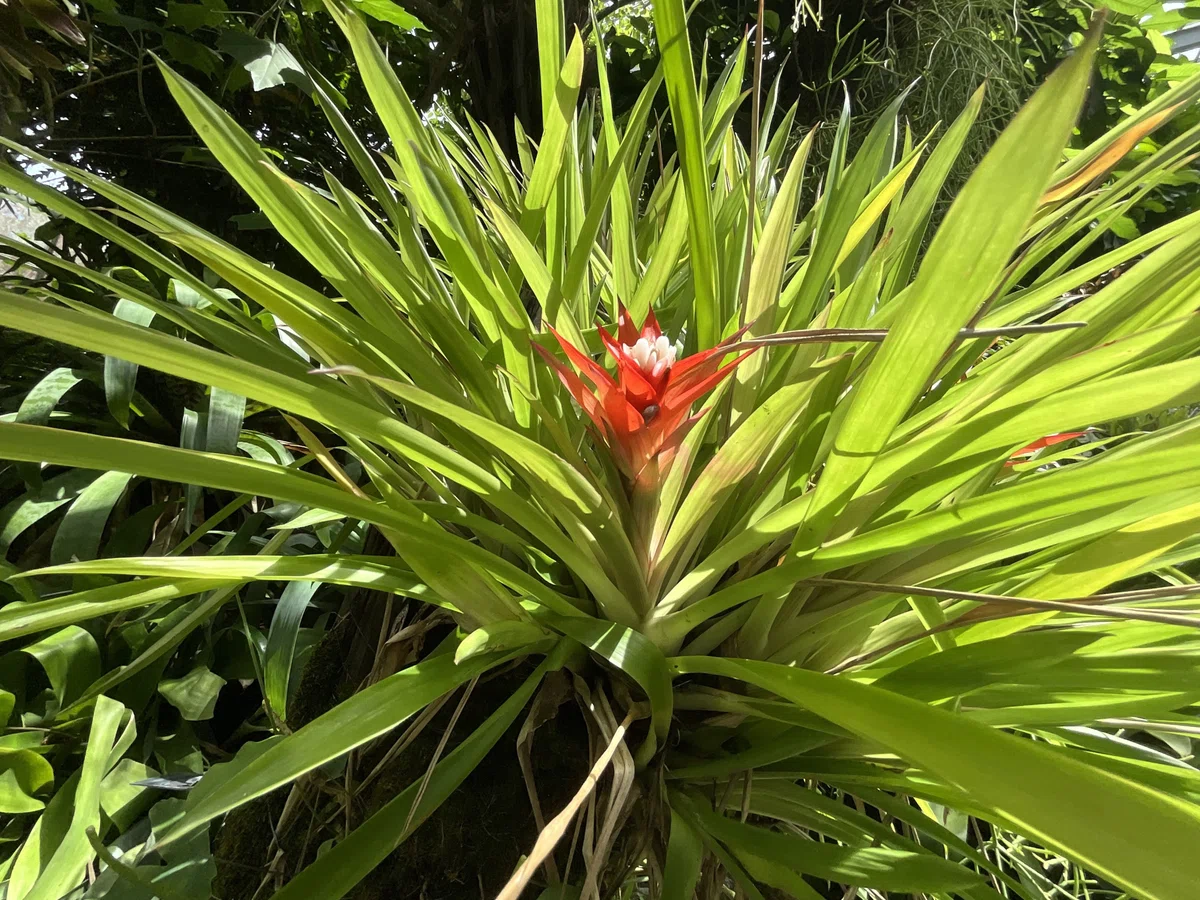
ラン・アナナス室はそのなかでも特徴的な場所である。ここではラン科植物やアナナス類など,高湿度環境に適応した熱帯植物が展示されている。温室内の植物配置を見ると,地上植栽だけではなく,高所への着生展示が多用されていた。これは景観形成のためだけではなく,樹上生活を行う植物群の生態的特徴を可視化する展示手法と考えられる。観察対象であるグズマニアもまた,比較的高所に配置されており,自然下での着生生活を連想させる展示となっていた。
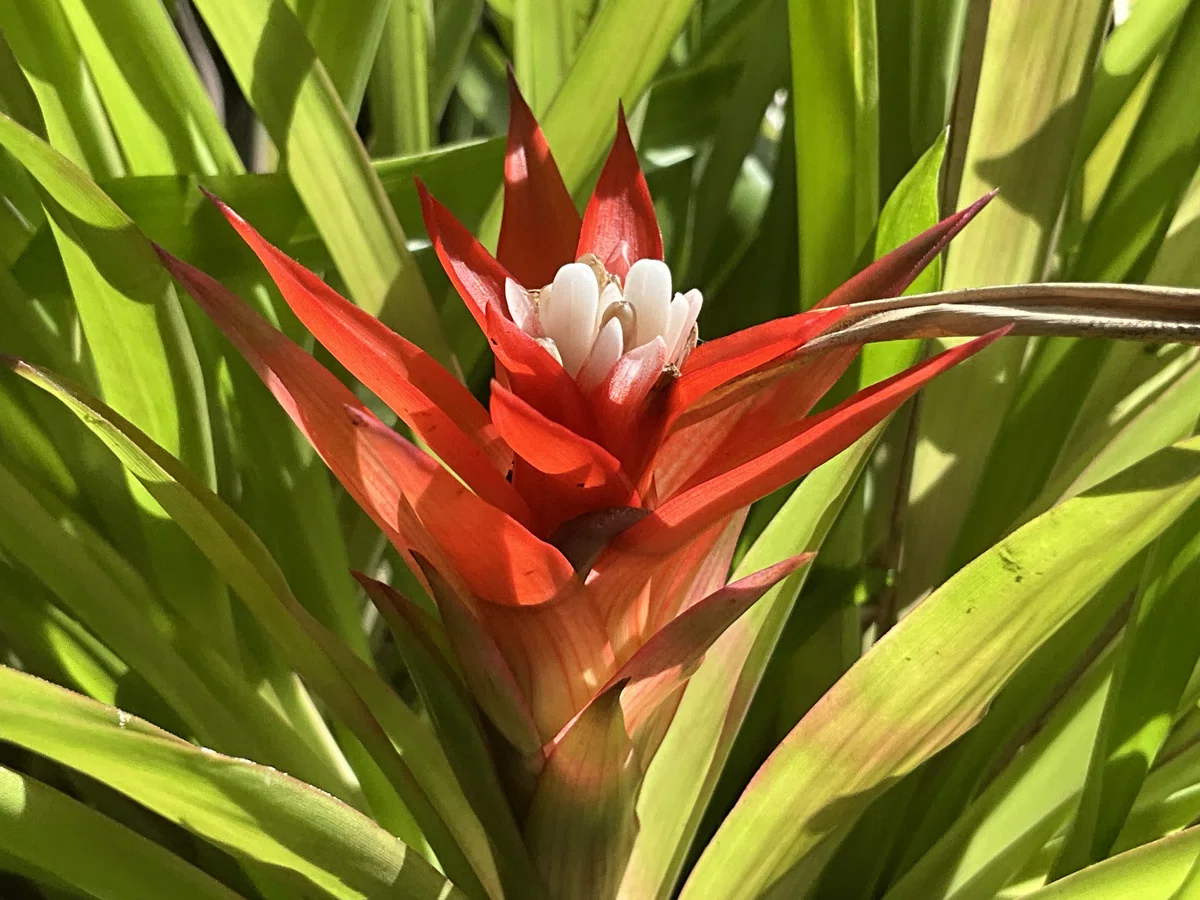
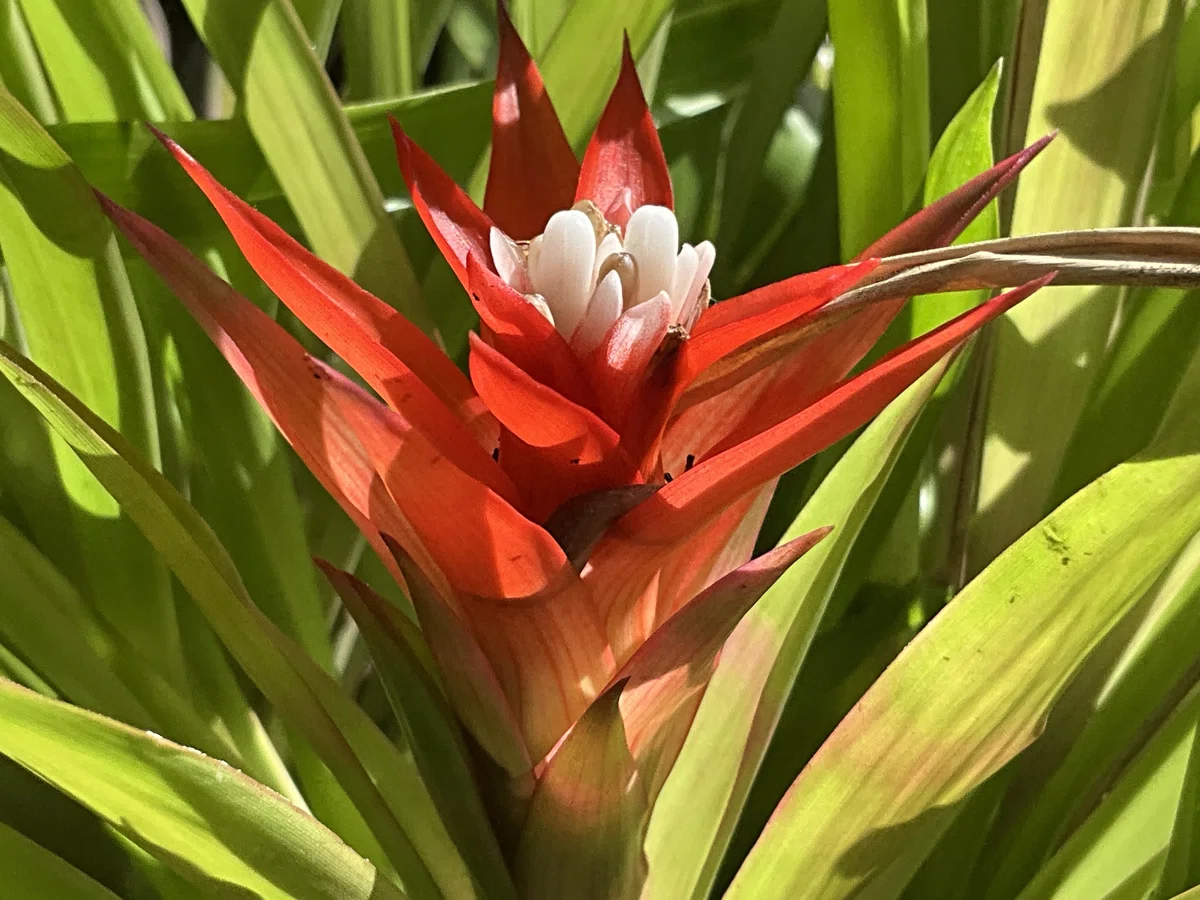
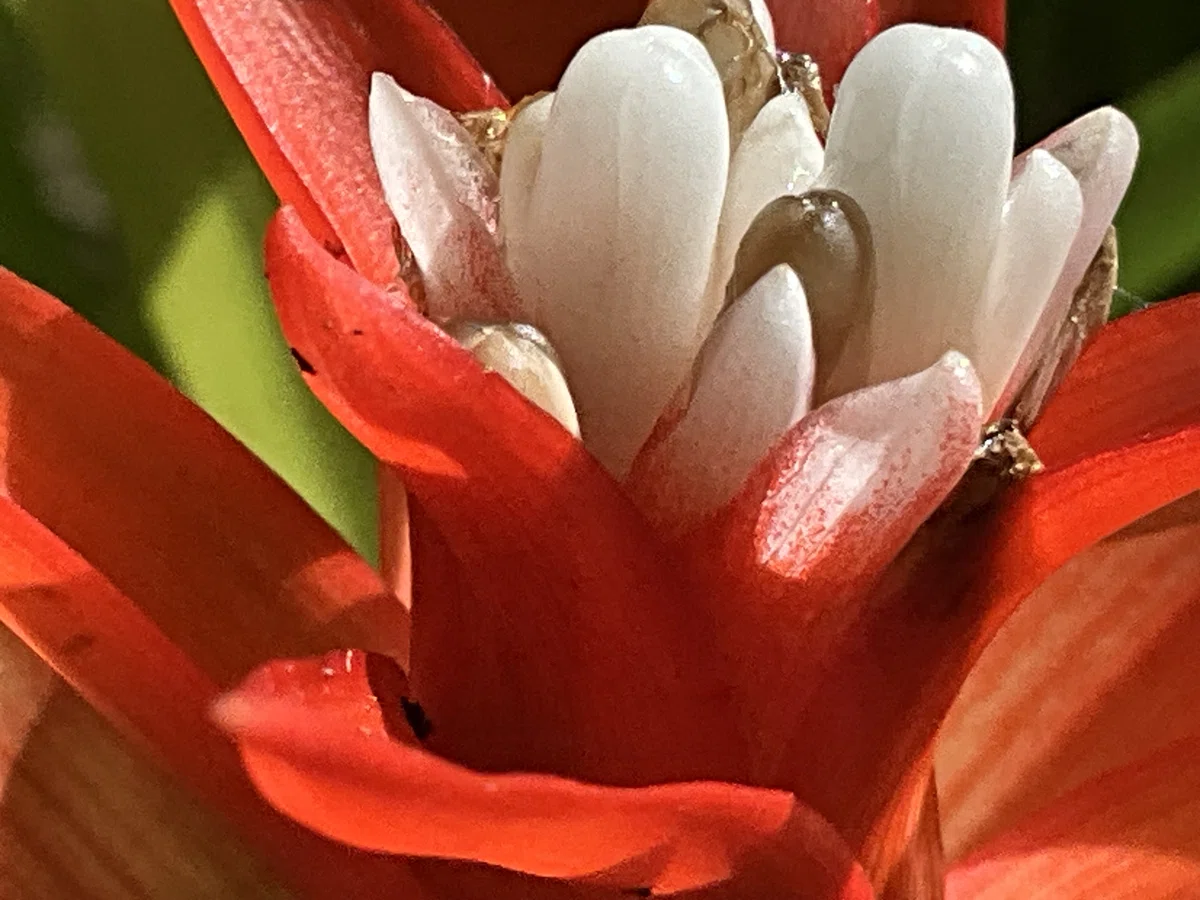
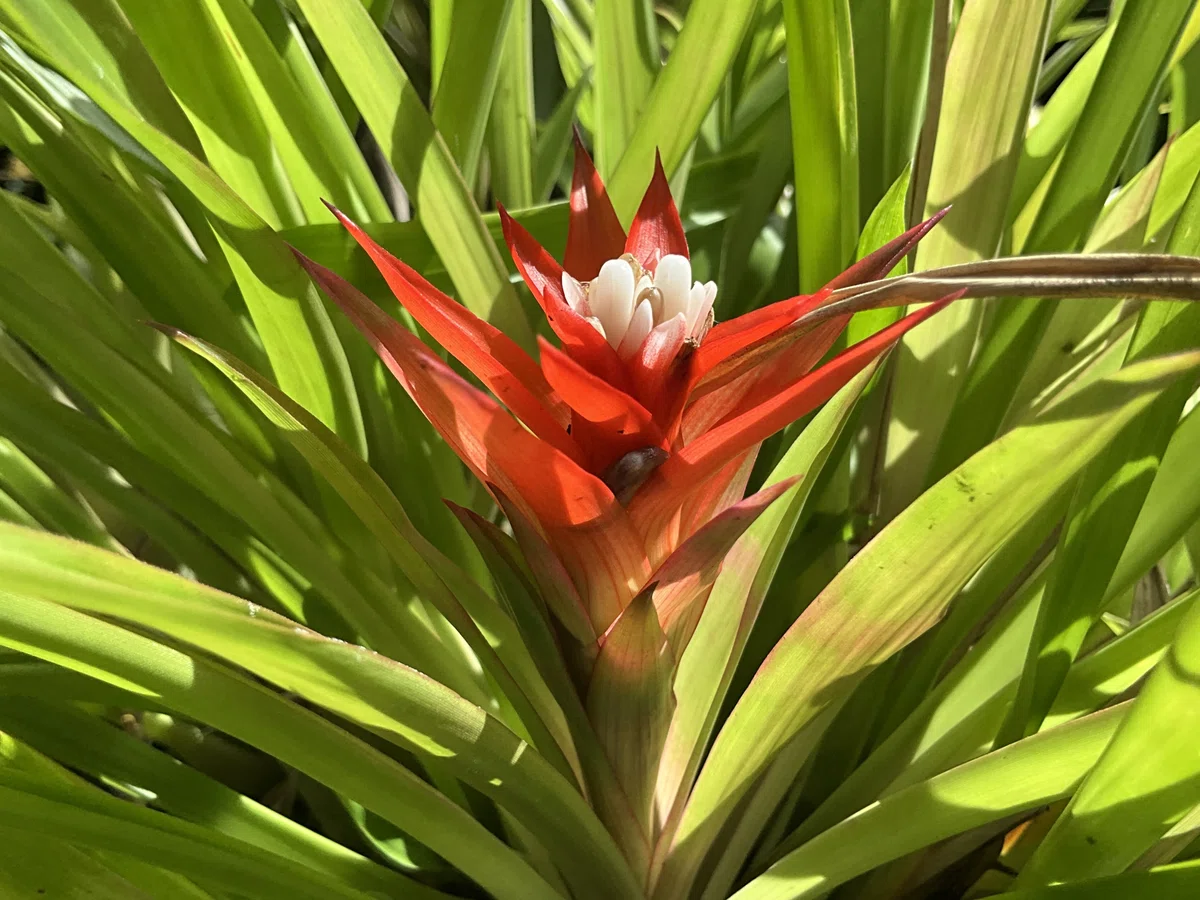
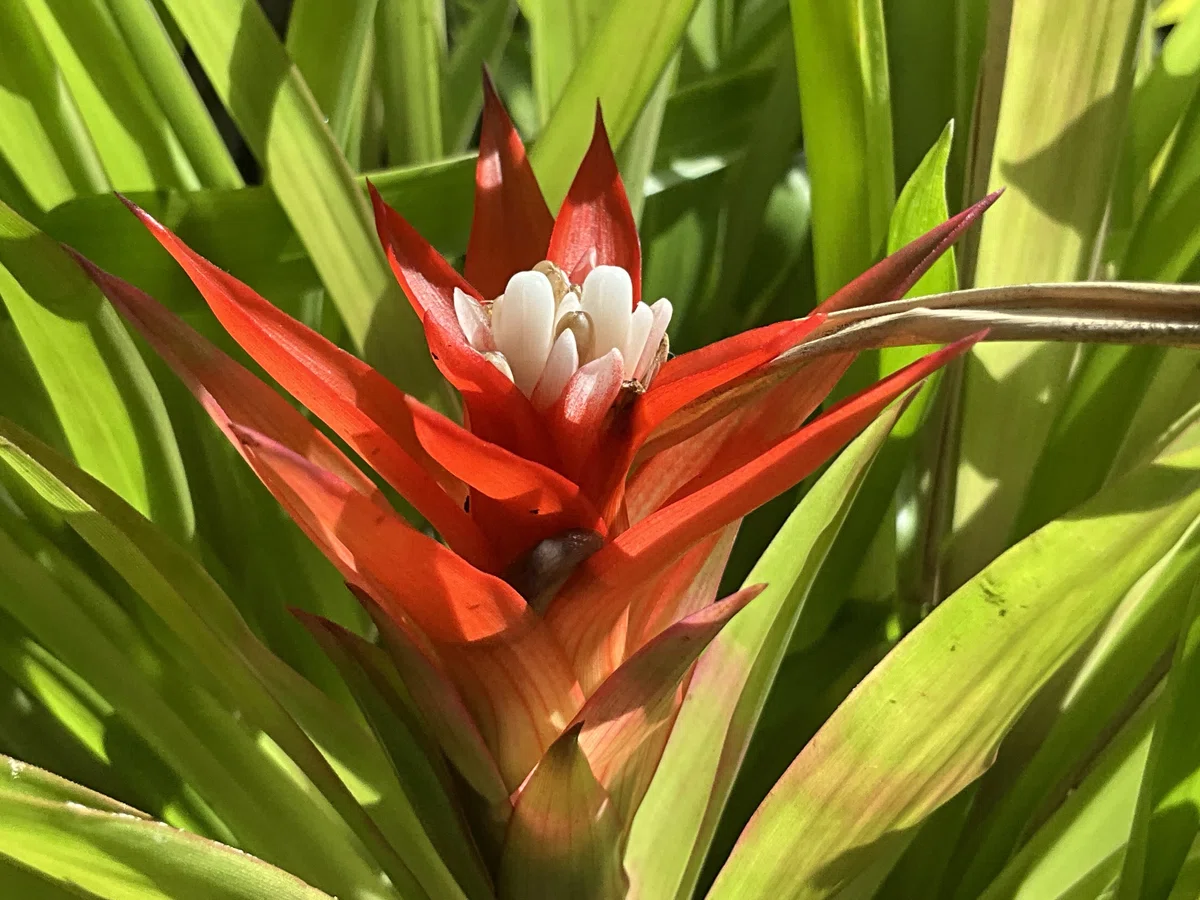
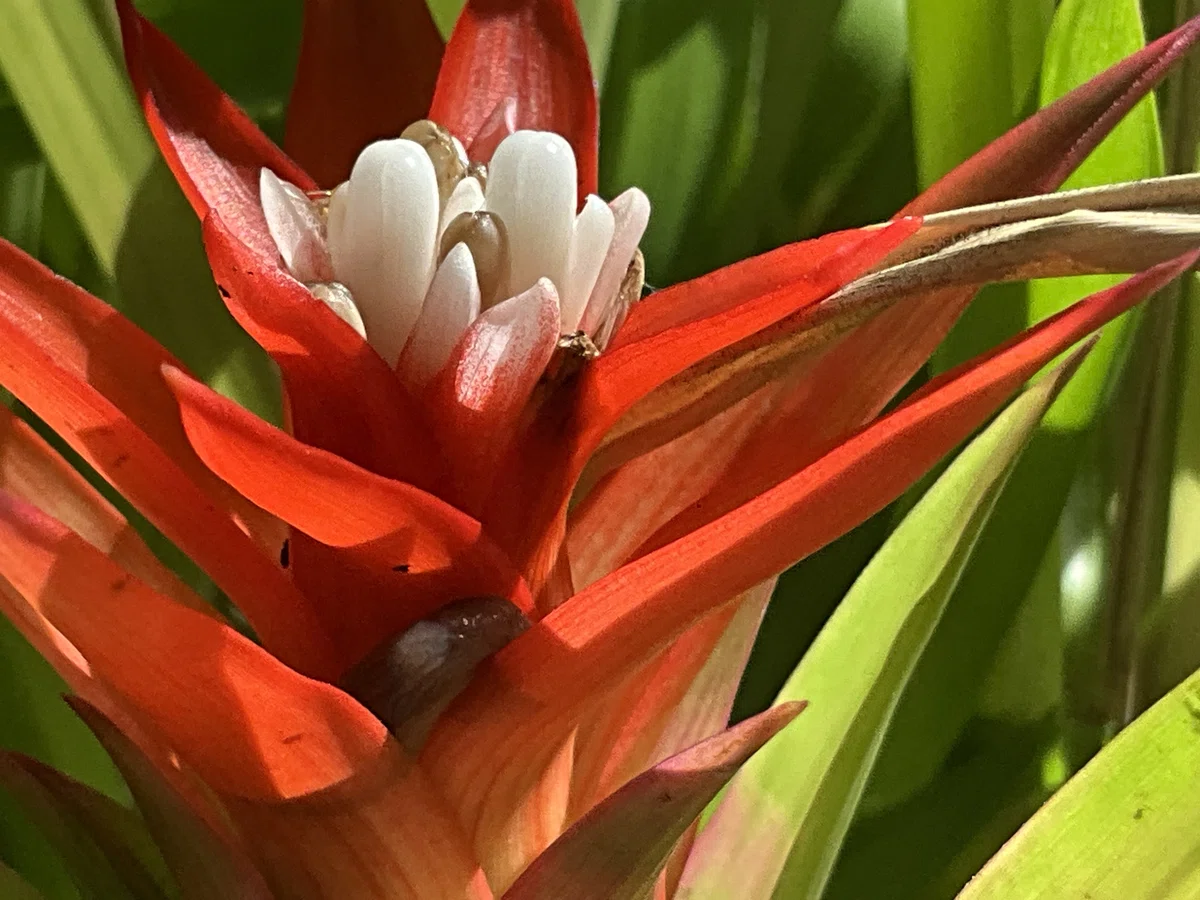
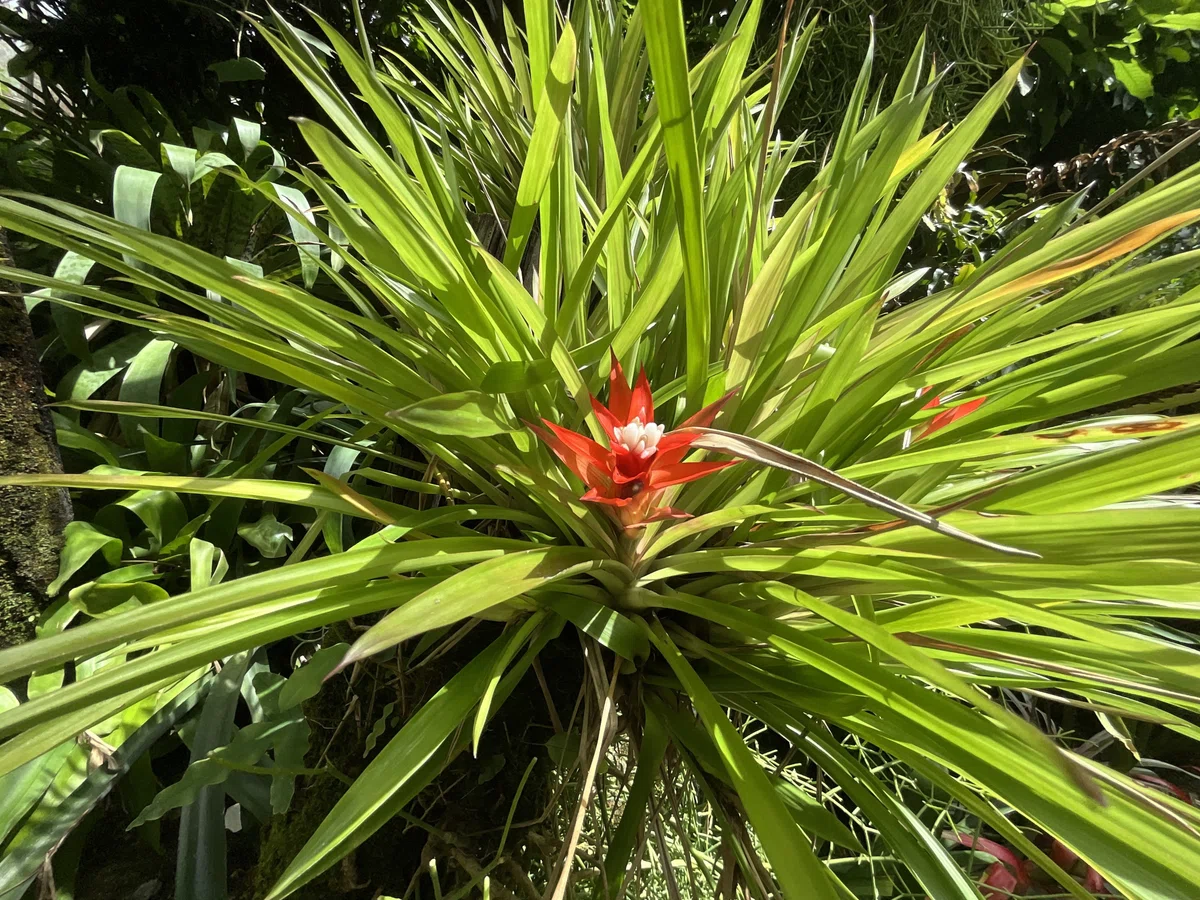
観察した個体群は,多数のロゼットが集合する大きな株塊を形成していた。葉は鮮緑色で帯状,全縁であり,葉縁に顕著な刺は認められなかった。葉は密にロゼットを形成し,中心部から花序が立ち上がっていた。花序では総苞が鮮紅色から朱赤色に発色し,その中心から白色小花が突出していた。写真観察では,総苞が厚質で光沢を持ち,らせん状に重なりながら花序を構成している様子も確認できた。
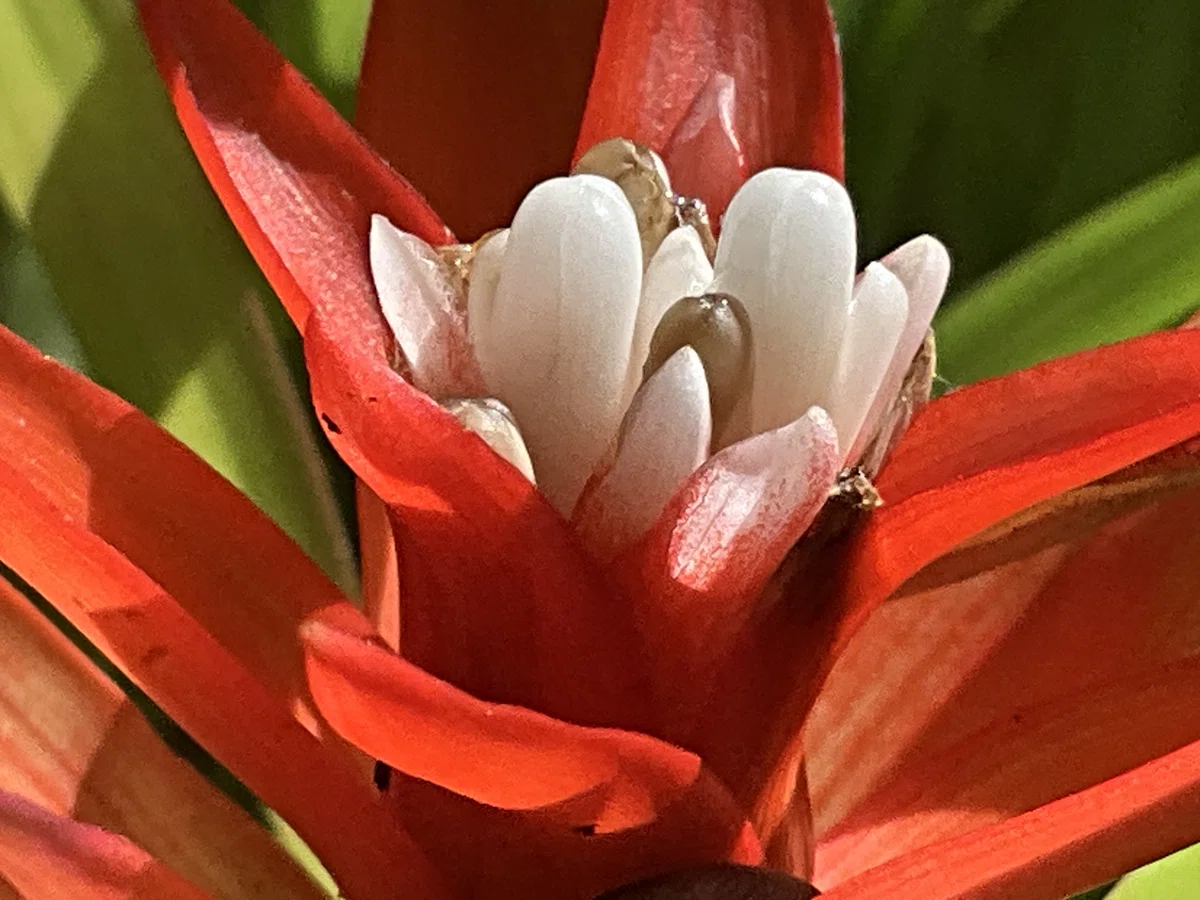
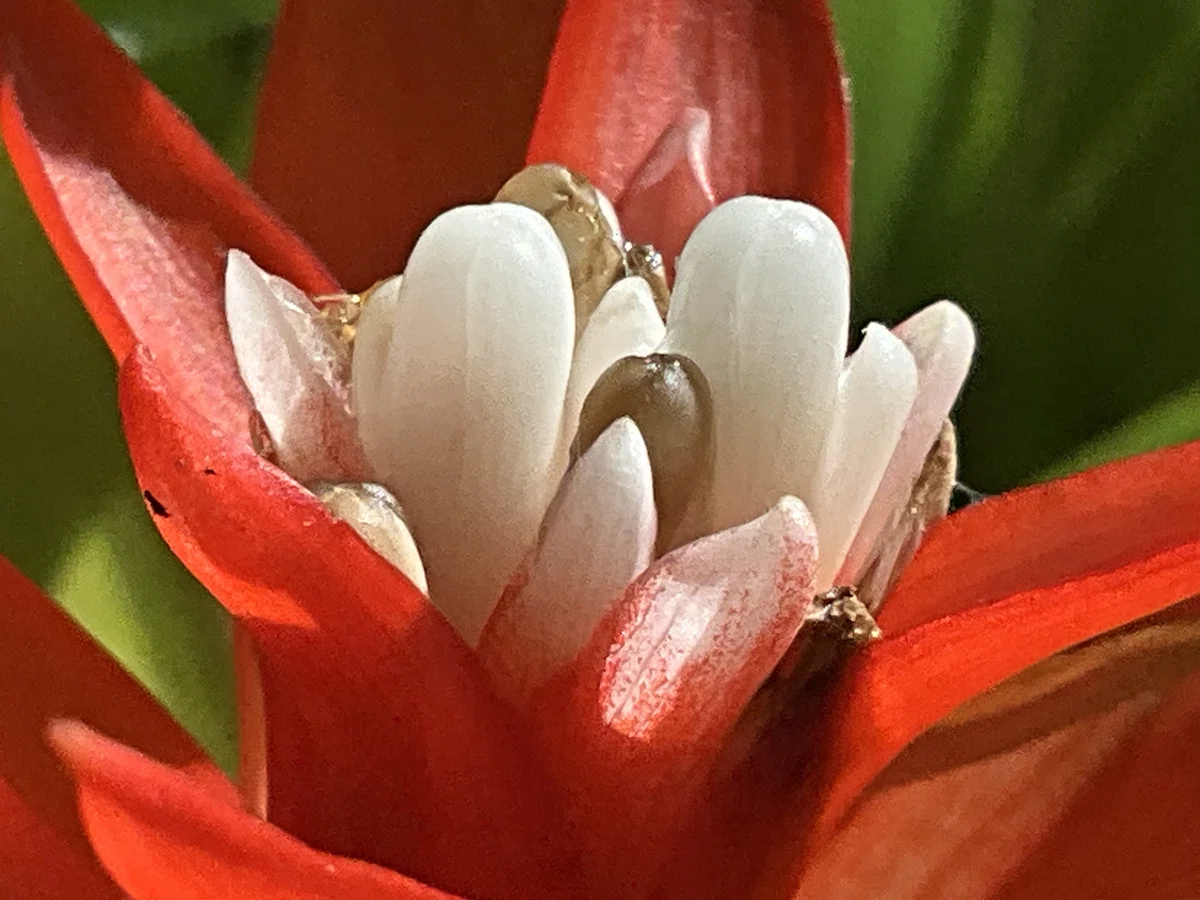
ここでまず記録しておくべきことは,赤色部分は花ではなく総苞であるという点である。実際の花は白色の小花であり,総苞内部から順次出現している。観察時には複数の小花が開花しており,花序の中心部には透明な液状物も認められた。液体の性質については観察のみから断定できないため,本稿では事実記載に留める。
植物学的に見ると,グズマニア属はパイナップル科サルオガセモドキ亜科に属する分類群であり,南メキシコから中米,カリブ海諸島,南米にかけて広く分布する。多くの種が着生生活を行い,ロゼット状葉の中心に水を保持する構造を発達させている。現行の分類体系では200種以上が認識されている大きな属である。
一方,今回観察した ‘Magnifica’ は野生種ではない。国際ブロメリア栽培品種登録簿によれば,本品種は Guzmania lingulata var. cardinalis と Guzmania lingulata var. minor を親系統とする栽培品種として登録されている。
この事実は,植物園展示を理解するうえで重要である。植物園はしばしば野生植物保全施設として理解されるが,実際には栽培品種や園芸植物も数多く展示している。つまり植物園は自然史だけを展示しているのではない。そこには園芸史も含まれている。‘Magnifica’ は熱帯アメリカの自然生態系から直接切り出された存在ではなく,人間による選抜と交配の歴史を含んだ植物である。その意味で本個体は,自然の産物であると同時に文化の産物でもある。
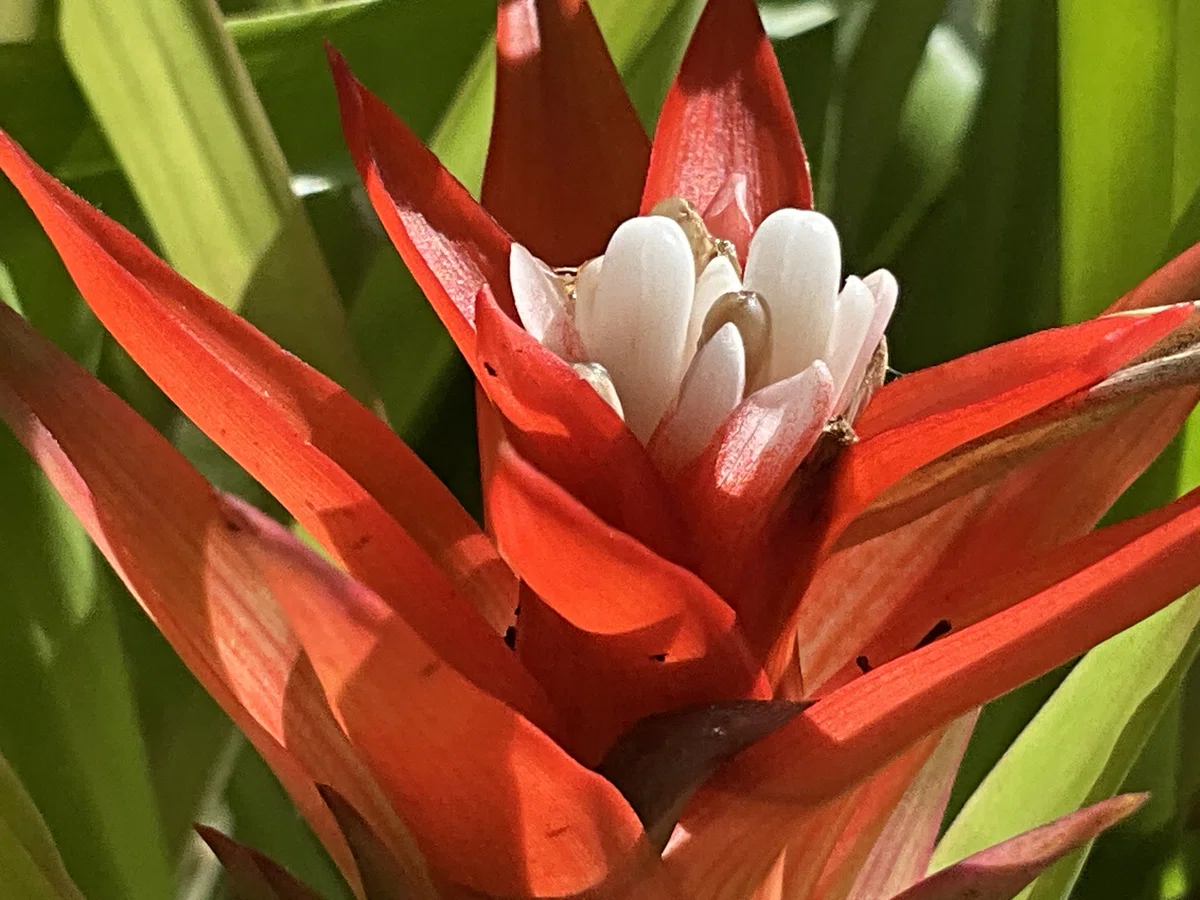
観察のなかで特に印象的だったのは,花序内部に確認された小型軟体動物である。追加撮影写真では,暗褐色で光沢のある個体が赤色総苞上を移動していた。殻は確認できず,体表は粘液による光沢を持っていたことから,ナメクジ類と思われる軟体動物である可能性が高い。ただし写真資料のみでは種の同定は不可能であり,ナメクジ類と思われる軟体動物として記録するに留めるべきである。
ここで重要なのは,同定ではなく関係である。花序内部は植物自身の繁殖器官であると同時に,小動物にとっては局所的な生息空間でもあった。観察者が最初に注目したのは植物であったが,観察を継続することで,そこに別の生物も存在していることが明らかになった。植物園を歩くとき,我々はしばしば展示ラベルに記された植物だけを対象としてしまう。しかし実際には展示植物の周囲には昆虫や軟体動物,微生物など,多様な生物が関わっている。展示植物は単独では存在していない。
本観察は時間という視点からも興味深い。目の前の総苞は一見すると現在の状態として提示されている。しかし,その形成には長期間の栄養成長が先行している。観察者は完成した結果を見ているにすぎないが,その背後には見えない過去の時間が存在する。これは遡行時間の経験である。観察者は現在の形態から過去の形成過程を推定し,時間を遡って理解しようとする。
同時に,花序内部では異なる時間尺度が重なっていた。白色小花は短期間で役割を終えるが,総苞はより長く残る。株群全体を見れば,すでに開花したロゼットと,今後開花するロゼットが共存している可能性が高い。さらに品種そのものは園芸史の時間を背負っている。個体の生長時間,花の寿命,品種成立の時間,人間による栽培管理の時間が,同じ展示空間のなかで重ね合わされていた。
価値という観点から整理すると,本種には少なくとも4つの価値が認められる。
植物学的価値としては,熱帯着生植物の形態的・生態的特徴を理解する教材としての価値である。ロゼット形成や花序構造は,着生植物の適応戦略を示す具体例となる。
文化的価値としては,熱帯観葉植物文化との結び付きが挙げられる。鮮やかな総苞は観賞植物として高く評価され,人々の熱帯植物への関心を支えてきた。
経済的価値としては,園芸産業との関係が大きい。登録品種として流通し,増殖・販売されてきた歴史は,植物が経済活動の対象でもあることを示している。
環境資源的価値としては,中南米熱帯域の生物多様性や着生植物の存在を理解する入り口となる点が重要である。京都の来園者が熱帯雨林の植物相の一部に接することを可能にする教育資源として機能している。
今回の観察で見ていたものは,グズマニアという1植物だけではなかった。そこには熱帯アメリカに起源を持つ分類群の進化史,人間による園芸改良の履歴,京都府立植物園による展示技術,そして花序内部を利用する小動物の存在が同時に現れていた。観察者が接したのは1個体ではなく,自然史と園芸史と展示史とが交差する断面であったと言える。
ただし,その断面から読み取れる時間は常に不完全である。目の前の花序が形成されるまでの過程も,品種が成立した具体的経緯も,花序内部にいた軟体動物がそこへ到達した理由も,今回の観察だけでは十分に説明できない。植物園は答えを与える場所というよりも,新たな問いを生成する場所として機能している。ラン・アナナス室のグズマニア ‘マグニフィカ’もまた,読み終えられた展示ではなく,次の訪問時に別の時間断面として再び読み直されるべき存在として,そこに残されていた。
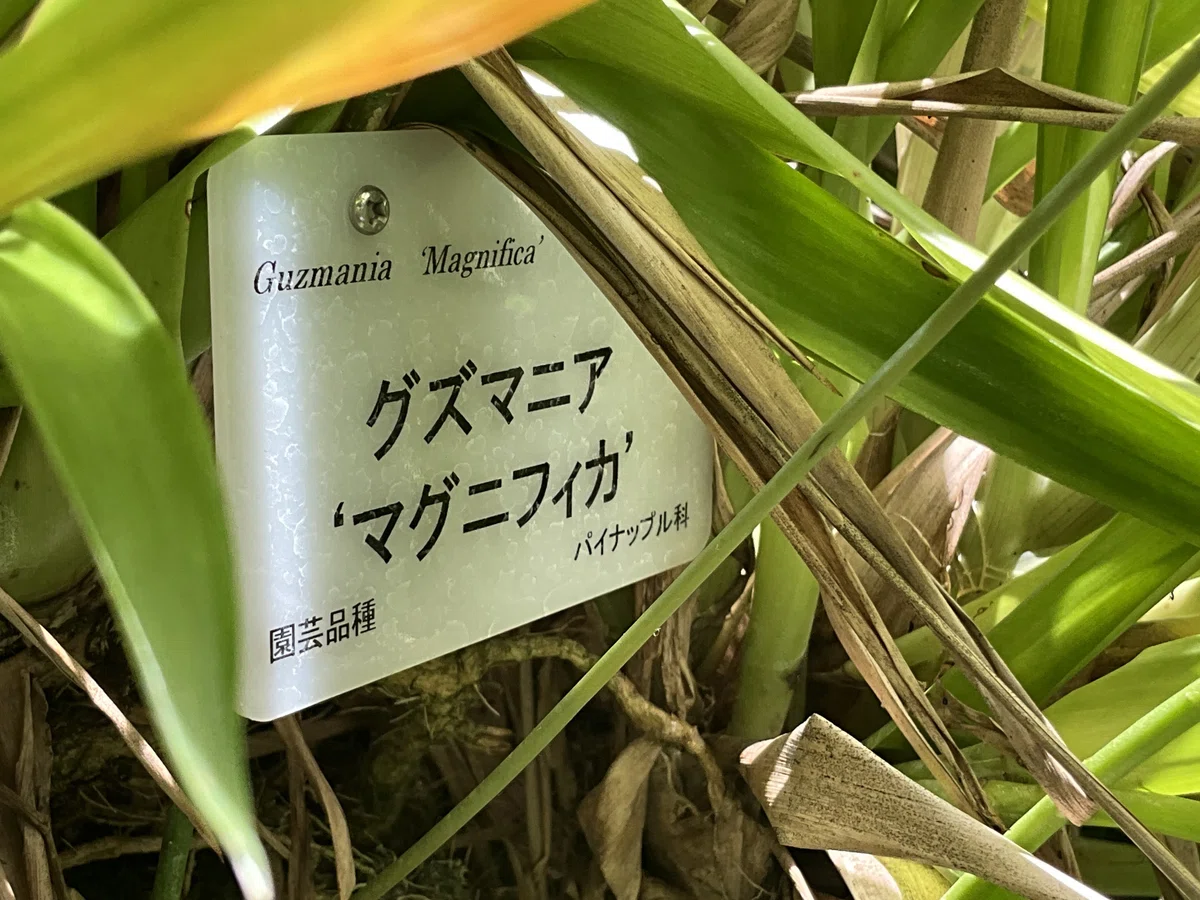
パイナップル科,園芸品種,植物表示板
京都府立植物園観覧温室ラン・アナナス室
2026年8月15日,筆者撮影
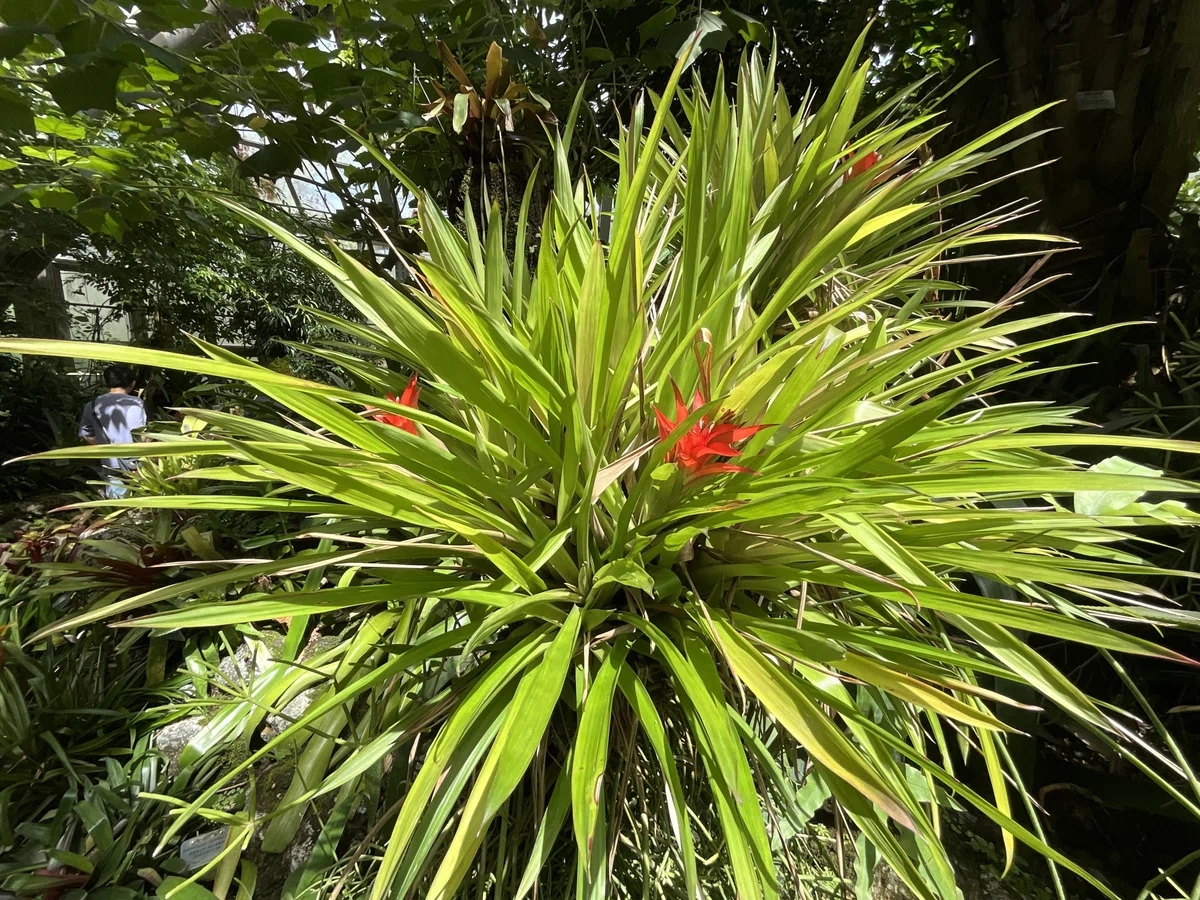
パイナップル科,園芸品種
京都府立植物園観覧温室ラン・アナナス室
2026年8月15日,筆者撮影
©️Hideaki FUJII
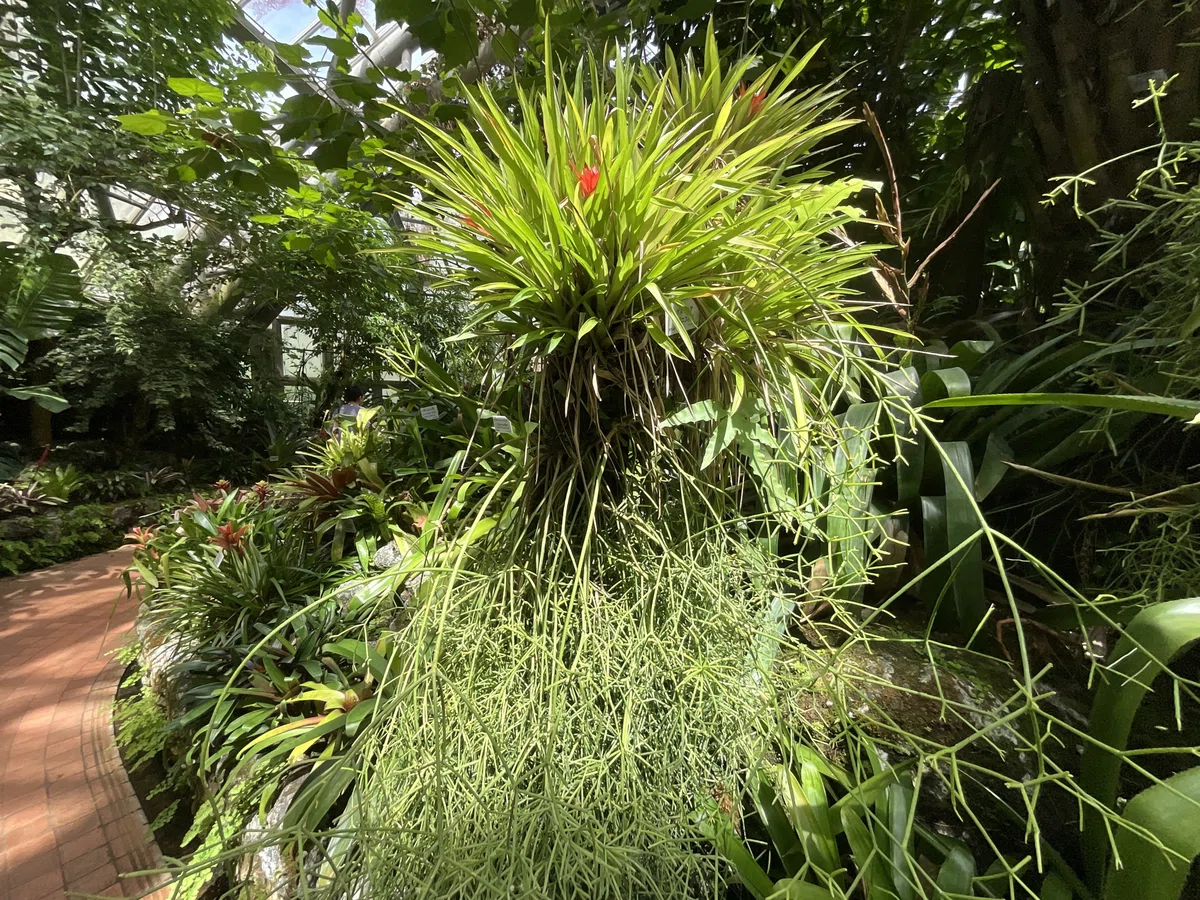
パイナップル科,園芸品種
京都府立植物園観覧温室ラン・アナナス室
2026年8月15日,筆者撮影
©️Hideaki FUJII
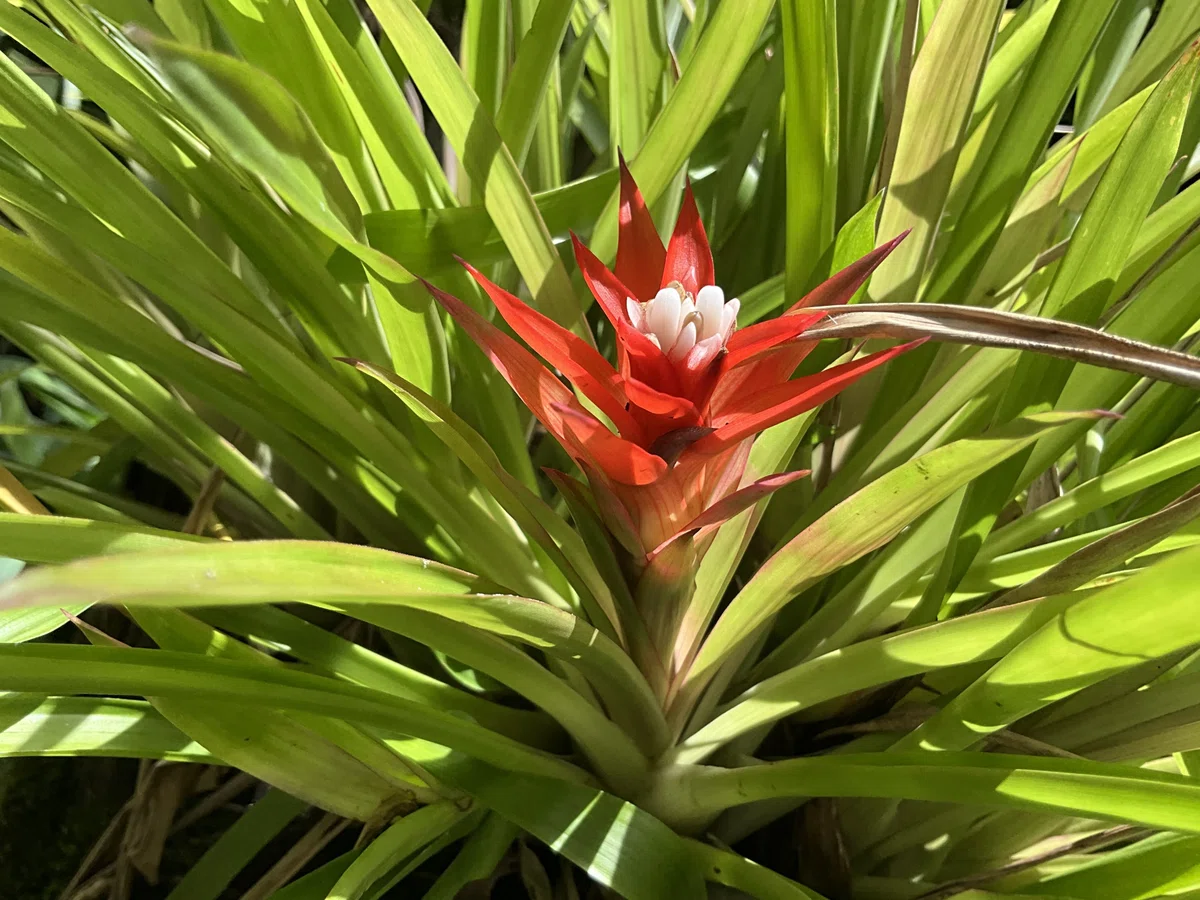
パイナップル科,園芸品種
京都府立植物園観覧温室ラン・アナナス室
2026年8月15日,筆者撮影
©️Hideaki FUJII
パイナップル科,園芸品種
京都府立植物園観覧温室ラン・アナナス室
2026年8月15日,筆者撮影
©️Hideaki FUJII
パイナップル科,園芸品種
京都府立植物園観覧温室ラン・アナナス室
2026年8月15日,筆者撮影
©️Hideaki FUJII
パイナップル科,園芸品種
京都府立植物園観覧温室ラン・アナナス室
2026年8月15日,筆者撮影
©️Hideaki FUJII
パイナップル科,園芸品種
京都府立植物園観覧温室ラン・アナナス室
2026年8月15日,筆者撮影
©️Hideaki FUJII
パイナップル科,園芸品種
京都府立植物園観覧温室ラン・アナナス室
2026年8月15日,筆者撮影
©️Hideaki FUJII
パイナップル科,園芸品種
京都府立植物園観覧温室ラン・アナナス室
2026年8月15日,筆者撮影
©️Hideaki FUJII
パイナップル科,園芸品種
京都府立植物園観覧温室ラン・アナナス室
2026年8月15日,筆者撮影
©️Hideaki FUJII
パイナップル科,園芸品種
京都府立植物園観覧温室ラン・アナナス室
2026年8月15日,筆者撮影
©️Hideaki FUJII
パイナップル科,園芸品種
京都府立植物園観覧温室ラン・アナナス室
2026年8月15日,筆者撮影
©️Hideaki FUJII
パイナップル科,園芸品種
京都府立植物園観覧温室ラン・アナナス室
2026年8月15日,筆者撮影
©️Hideaki FUJII
パイナップル科,園芸品種
京都府立植物園観覧温室ラン・アナナス室
2026年8月15日,筆者撮影
©️Hideaki FUJII
Guzmania ‘Magnifica’ (Kyoto Botanical Gardens): Saturday, August 15, 2026
Abstract
At approximately 2:00 p.m. on Saturday, August 15, 2026, under clear skies, I observed a group of plants displayed as Guzmania ‘Magnifica’ (Guzmania 'Magnifica') in the Orchid and Bromeliad Room of the Conservatory at the Kyoto Botanical Gardens. The scientific name was adopted from the information presented on the plant label and treated as primary observational data. In addition, comparison with the International Bromeliad Cultivar Register confirmed that this taxon is treated as a horticultural cultivar derived from Guzmania lingulata var. cardinalis and Guzmania lingulata var. minor.
The observation documented not only flowering individuals with vivid scarlet bracts and small white flowers, but also a small mollusk, apparently a slug-like organism, residing within the inflorescence. A botanical garden, as an institutional space, is more than a repository of plants; it is a device through which natural history, horticultural history, taxonomic knowledge, and display techniques are presented simultaneously. This observation was therefore both a record of a particular bromeliad cultivar and an attempt to examine how a tropical epiphyte is presented as a specific temporal cross-section within the spatial framework of the Kyoto Botanical Gardens.
Main Text
Coordinates of Observation
At approximately 2:00 p.m. on Saturday, August 15, 2026, under clear skies, I observed a group of plants displayed as Guzmania ‘Magnifica’ in the Orchid and Bromeliad Room of the Conservatory at the Kyoto Botanical Gardens. The scientific name appeared on the plant label as Guzmania 'Magnifica', and throughout this essay that designation is treated as primary observational information.
The Kyoto Botanical Gardens is a place where plants are collected outside their original habitats, yet it is far more than a collection facility. Taxonomic knowledge, cultivation techniques, historical accumulation, and educational activities are integrated there, making the understanding of nature itself an object of display. Visitors encounter not only plants, but also the historical record of how human societies have described, classified, conserved, utilized, and admired them. The botanical garden is therefore not a place that merely reproduces nature; it functions as an institutional space that edits and presents the historical relationship between nature and humanity.
Display Space and Environmental Context
The Orchid and Bromeliad Room is particularly distinctive within the Conservatory. Tropical plants adapted to humid environments, including orchids and bromeliads, are displayed there. Examination of the spatial arrangement revealed not only ground-level plantings but also numerous epiphytic displays elevated above eye level. Such arrangements appear to serve more than a decorative purpose. They can be understood as exhibition techniques designed to visualize the ecological characteristics of plants that occupy arboreal habitats.
The observed Guzmania was likewise positioned at a relatively elevated location, creating an impression of epiphytic life as it occurs in natural settings. The display thus encouraged the observer to relate the plant's morphology to its ecological niche rather than to regard it merely as an ornamental object.
Morphology and Direct Observation
The observed population formed a substantial clump composed of numerous rosettes. The leaves were bright green, strap-shaped, and possessed an entire margin. No conspicuous marginal spines were observed. Dense rosettes surrounded a centrally emerging inflorescence.
Within the inflorescence, the bracts exhibited a coloration ranging from vivid scarlet to vermilion-red. Small white flowers protruded from the center. Photographic examination further revealed that the bracts were thick-textured, glossy, and arranged in a spiral sequence contributing to the overall architecture of the inflorescence.
A point requiring immediate clarification is that the conspicuous red structures were not flowers but bracts. The actual flowers were the small white floral structures emerging successively from within the bracts. Several flowers were open at the time of observation. Transparent liquid-like material was visible near the center of the inflorescence. As its nature could not be determined through observation alone, it is recorded here only as an observed fact without further interpretation.
Botanical and Horticultural Context
Botanically, the genus Guzmania belongs to the family Bromeliaceae and the subfamily Tillandsioideae. The genus is distributed broadly from southern Mexico through Central America and the Caribbean into South America. Many species are epiphytes and possess rosette structures capable of retaining water within their central reservoirs.
Under current taxonomic treatments, Guzmania is recognized as a large genus comprising more than two hundred species. Many members exhibit adaptations associated with epiphytic life, including tank-forming rosettes and a high degree of shade tolerance.
The plant observed on this occasion, however, is not a wild species. According to the International Bromeliad Cultivar Register, Guzmania ‘Magnifica’ is a horticultural cultivar derived from Guzmania lingulata var. cardinalis and Guzmania lingulata var. minor. It therefore represents a product of horticultural hybridization rather than a naturally occurring taxon.
This fact is important for understanding botanical-garden displays. Botanical gardens are often perceived as institutions devoted exclusively to the conservation of wild plants. In reality, they also display numerous cultivars and horticultural selections. Consequently, botanical gardens do not present only natural history; they also present horticultural history. ‘Magnifica’ is not simply an organism extracted from a tropical American ecosystem. It embodies a history of human selection, cultivation, and aesthetic preference. In that sense, the observed individual is simultaneously a product of nature and a product of culture.
A Small Mollusk within the Inflorescence
One particularly striking aspect of the observation was the presence of a small mollusk inside the inflorescence. Additional photographs revealed a glossy dark-brown organism moving across the red bracts. No shell could be observed, and the body surface appeared coated with mucus, creating a reflective sheen. These characteristics strongly suggest a slug-like mollusk.
Nevertheless, identification beyond that level is not possible from photographic evidence alone. The organism should therefore be recorded conservatively as a mollusk apparently belonging to a slug-like form.
The significance of this observation lies less in taxonomic identification than in ecological relationship. The interior of the inflorescence functioned not only as a reproductive structure for the plant itself but also as a localized habitat for a small animal. My initial attention was directed solely toward the plant. Continued observation revealed the presence of another organism occupying the same microenvironment.
When walking through a botanical garden, observers often focus exclusively on the plant named on the display label. Yet insects, mollusks, microorganisms, and numerous other organisms frequently interact with display plants. Display specimens do not exist in isolation. They participate in broader ecological relationships that may remain unnoticed unless one deliberately slows one's observational pace.
Temporal Layers of the Display
This observation is also informative when considered from the perspective of time. At first glance, the red bracts appear merely as a present condition. Their formation, however, is preceded by a prolonged period of vegetative growth. The observer sees only the completed result, while the developmental process that produced it remains invisible.
This constitutes an experience of retrospective time. From present morphology, one attempts to reconstruct past developmental processes. The visible structure becomes evidence from which lost time is inferred.
Different temporal scales were layered within the inflorescence itself. The small white flowers perform their reproductive function within a relatively short period, whereas the bracts remain visually prominent for much longer. At the scale of the entire clump, rosettes that have flowered and rosettes that may flower in the future likely coexist. The cultivar itself also carries the longer temporal dimension of horticultural history.
The growth time of the individual plant, the lifespan of a flower, the history of cultivar development, and the duration of human cultivation were all superimposed within a single display space.
Values Revealed through Observation
From an analytical perspective, at least four forms of value become visible.
The botanical value of this cultivar lies in its usefulness as a living example of adaptation among tropical epiphytes. Rosette formation and inflorescence structure provide concrete illustrations of adaptive strategies associated with epiphytic life.
Its cultural value derives from its connection with the history of tropical ornamental-plant culture. The brightly colored bracts have long been appreciated as decorative features and have contributed to public fascination with tropical plants.
Its economic value is linked to the horticultural industry. The history of propagation, distribution, and commercialization demonstrates that plants also participate in economic systems and markets.
Its environmental-resource value lies in its capacity to introduce visitors to the biodiversity of tropical America and to the existence of epiphytic plants. In Kyoto, the cultivar serves as an educational resource through which visitors can encounter a fragment of tropical rainforest flora.
Aufhebung / Stopping Point
What appeared before me was not merely a single Guzmania. Present within the display were the evolutionary history of a lineage originating in tropical America, the history of horticultural breeding, the exhibition practices of the Kyoto Botanical Gardens, and the presence of a small animal utilizing the interior of the inflorescence. The object of observation was therefore not a plant alone, but a point of intersection where natural history, horticultural history, and exhibition history converged.
Yet the temporal structure revealed by that intersection remains incomplete. The developmental pathway that produced the inflorescence, the precise circumstances under which the cultivar originated, and the route by which the mollusk entered the inflorescence all remain unknown. A botanical garden does not merely provide answers. It continuously generates new questions. The Guzmania ‘Magnifica’ in the Orchid and Bromeliad Room thus remained not as a finished display, but as a temporal fragment awaiting another reading on a future visit.
いいなと思ったら応援しよう!
 よろしければご応援をお願いします! いただいたチップはクリエイターとしての活動費に使わせていただきます!