
ミケリア・マウダイエ‘銀嶺’(京都府立植物園):2026年3月31日(火)

【要旨】
本稿は,2026年3月30日に京都府立植物園で観察したミケリア・マウダイエ‘銀嶺’(モクレン科)について,2023年1月13日以降の『京都居候叢書』で蓄積されてきた観察方法と記述倫理を参照し,再検討を行うものである。本種は中国南部原産の常緑高木であり,日本では自生せず植栽によってのみ存在する。常緑の葉を保持したまま白花を開く生活史は,落葉性モクレン類とは異なる時間構造を都市のなかにもたらす。本稿では,植物生態学的特性を基礎に,京都府立植物園という制度空間における本種の植物学的価値,文化的価値,経済的価値,環境資源的価値を多角的に考察する。
【本文】
葉を保ったまま迎える春
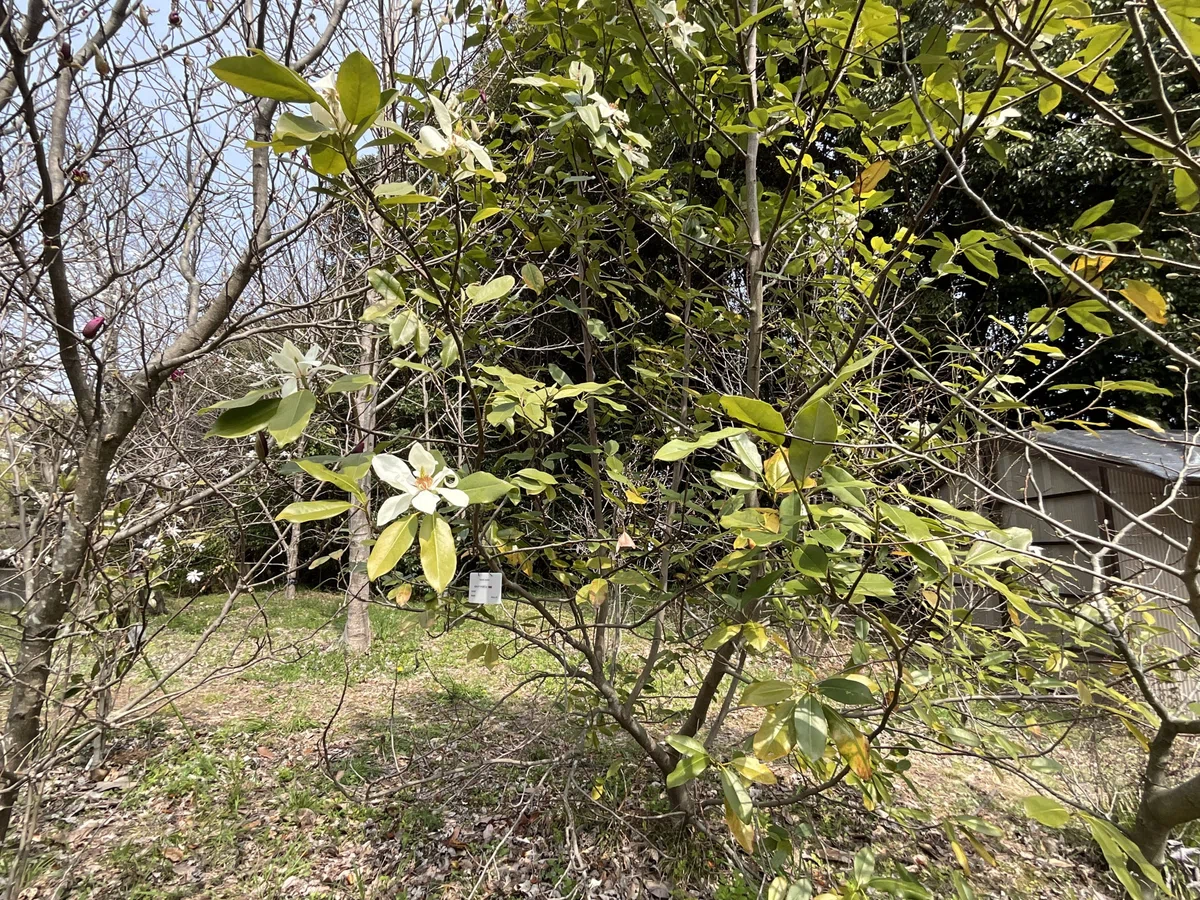
3月30日,京都府立植物園に植栽されたミケリア・マウダイエ‘銀嶺’を観察した。周囲ではサクラやハクモクレンが落葉樹特有の明るさで開花期を迎えていたが,本種は前年からの葉を保ったまま,枝の内部で白花を静かに開いていた。花は枝先で誇示されることなく,葉陰に埋もれるように位置する。この控えめな出現の仕方は,春を一斉の転換点として理解する感覚から,意図的に距離を取っている。
分類と原産地の確認
ミケリア・マウダイエ‘銀嶺’の受容学名は Magnolia maudiae である。本種はかつて Michelia 属として扱われてきたが,分子系統解析に基づく再編により,現在は広義のモクレン属に統合されている。原産地は中国南部から南東部で,亜熱帯の常緑広葉樹林に生育する。標高600〜1500mの林内環境に適応しており,日本列島には自生しない。京都府立植物園における個体は,明確に植栽由来である。
形態と生活史の特徴
葉は革質で長楕円形,表面は濃緑色で光沢があり,裏面は粉白色を帯びる。この葉裏の色調が園芸名‘銀嶺’の由来と考えられるが,‘銀嶺’は国際的に登録された品種名ではなく,日本国内で流通する選抜系統名として扱うのが適切である。花は葉腋に単生し,花径は約10cm,花被片は9枚,白色で基部が淡紅色を帯びる場合がある。強い芳香を持つが,葉の展開とほぼ同時に開花するため,落葉性のモクレン類のような「裸木に花が立ち上がる」景観は形成しない。
名称に刻まれた理解史
種小名 maudiae は,本種を記載した植物学者Stephen Troyte Dunnが,妻Maudに献名したものである。和名ミヤマガンショウは,中国名「深山含笑」の音読みである。「深山」と「含笑」という語の組み合わせは,本種が人目につく場所で誇示されるのではなく,林内で静かに花を含む存在であることを,結果として正確に言い表している。
植物園という制度空間のなかで
京都府立植物園は,日本の自生植物のみを集める場所ではない。異なる地域の植生や生活史を都市に持ち込み,来園者に比較可能な時間の層を提示する制度空間である。本種は,日本の自然史を示す証拠ではないが,常緑樹が春にどのような時間構造をつくるかを理解するための重要な教材となる。葉と花が同時に存在するという事実は,春という季節が必ずしも「切り替わり」ではなく,「重なり」であることを示している。
文化的・経済的・環境資源的価値
文化的価値は,春を落葉と開花の対比で理解してきた感覚を,静かに揺さぶる点にある。経済的価値は直接的な利用ではなく,視線を下げ,歩行速度を落とすことで体験の質を変える間接的効果として現れる。環境資源的価値としては,常緑でありながら早春に開花することで,都市緑地における季節の連続性を可視化する点が挙げられる。本種はIUCNレッドリストではLeast Concernに分類されているが,原産地では森林伐採による局所的影響が指摘されており,無制限な楽観視が許されるわけではない。
居候という作法の延長線上で
ミケリア・マウダイエ‘銀嶺’は,京都の春の象徴にはならない。だが,常緑の葉を保ったまま花を咲かせるその姿は,季節の推移に対して居候のように居場所を確保している。所有されず,主張もせず,それでも確かに存在する。本種のあり方は,『京都居候叢書』が記録してきた都市自然の倫理と無理なく重なり,本稿の帰結点となる。
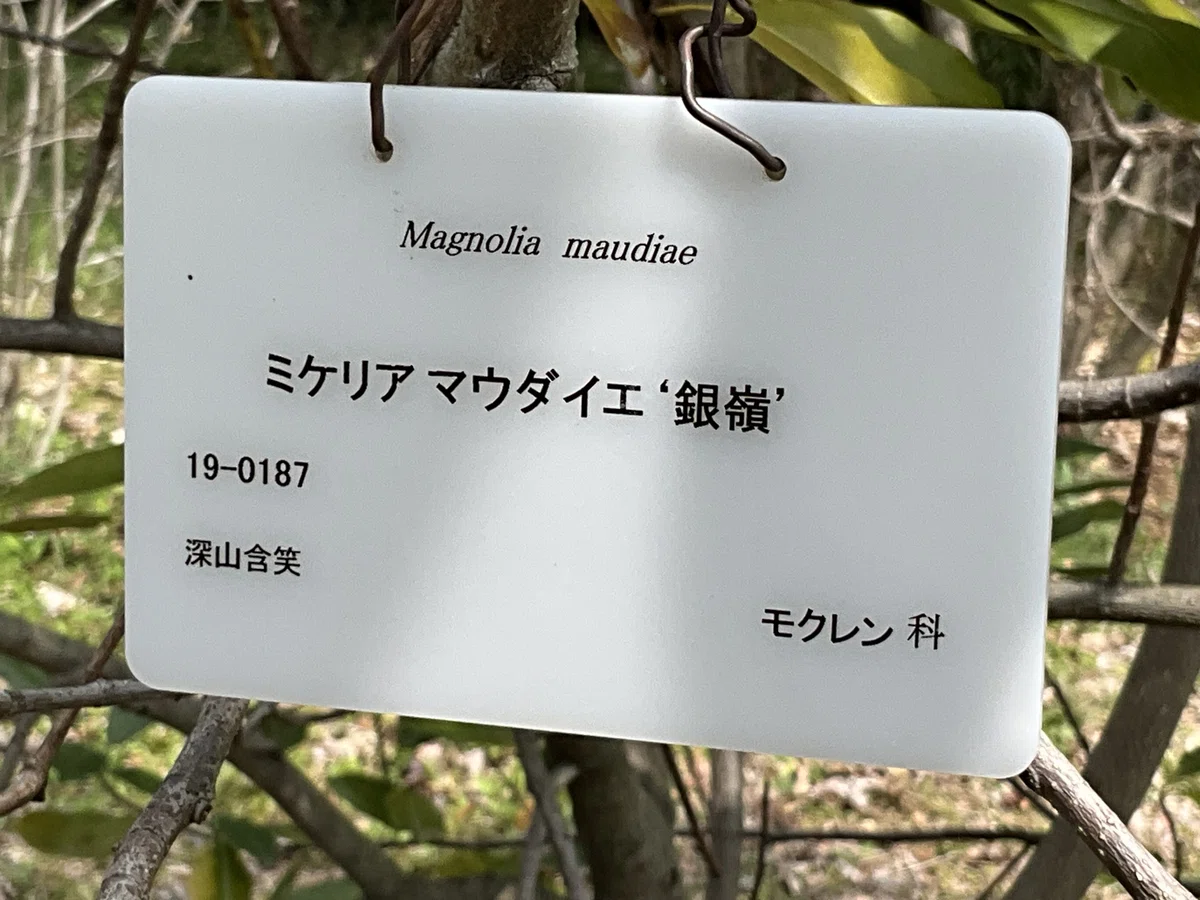
モクレン科,植物表示板
京都府立植物園
2026年3月29日,筆者撮影
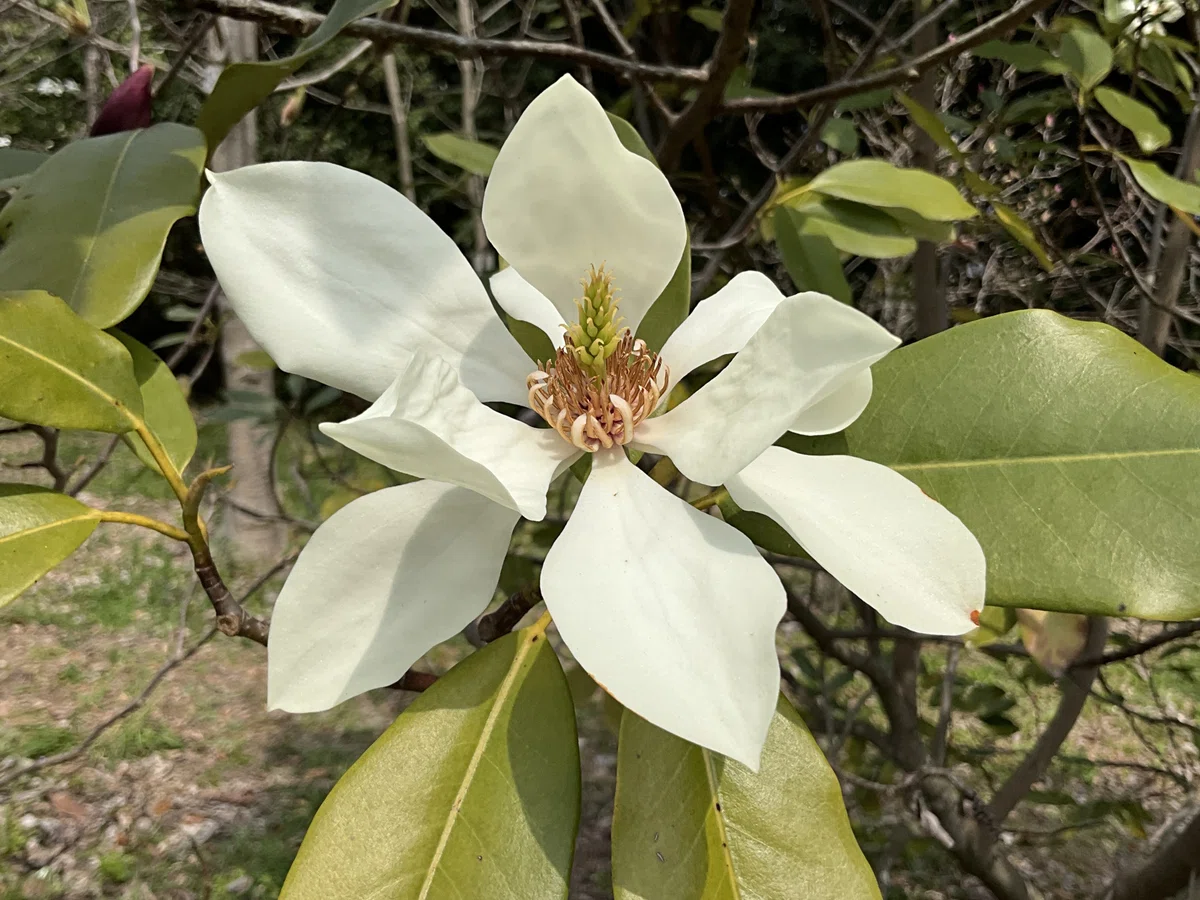
モクレン科
京都府立植物園
2026年3月29日,筆者撮影
©️Hideaki FUJII
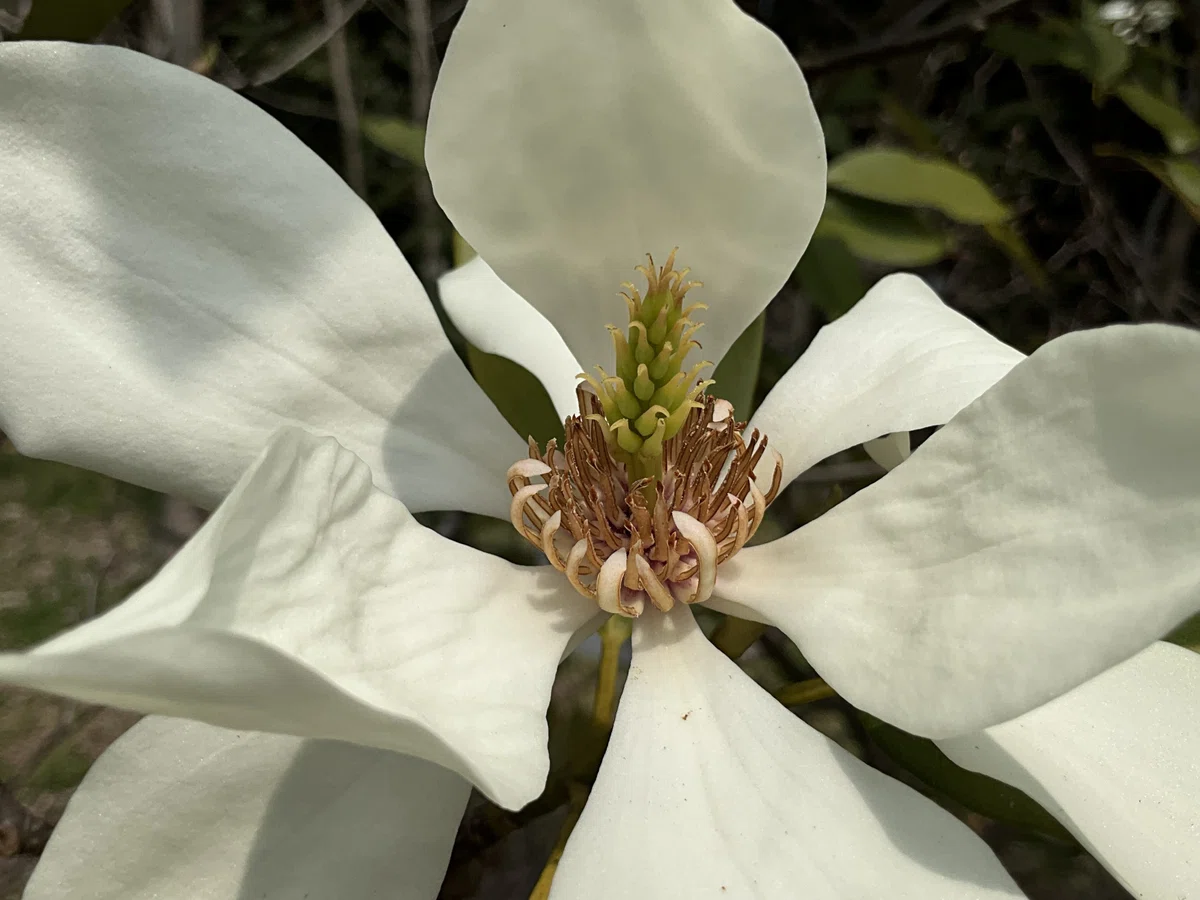
モクレン科
京都府立植物園
2026年3月29日,筆者撮影
©️Hideaki FUJII
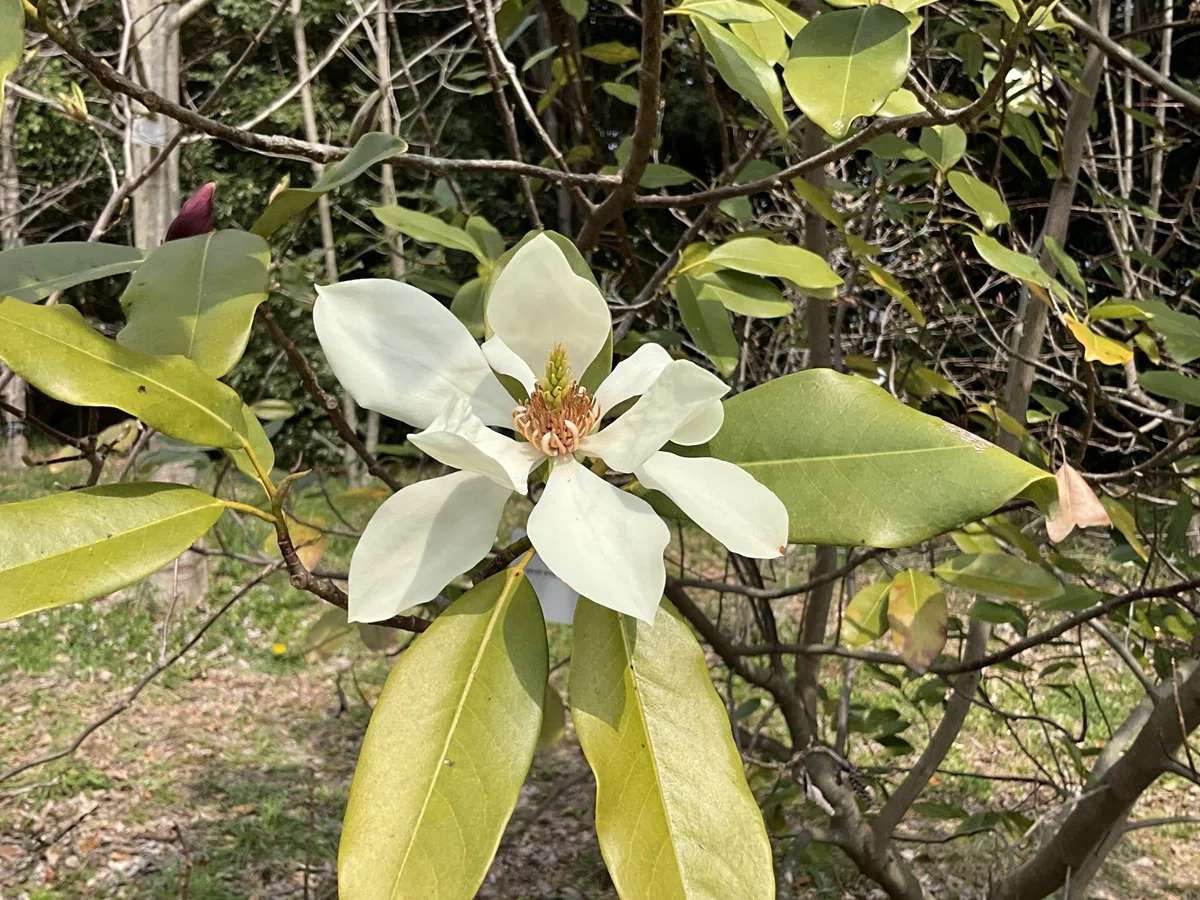
モクレン科
京都府立植物園
2026年3月29日,筆者撮影
©️Hideaki FUJII
モクレン科
京都府立植物園
2026年3月29日,筆者撮影
©️Hideaki FUJII
Magnolia maudiae ‘Ginrei’ (Kyoto Botanical Gardens): Tuesday, March 31, 2026
Abstract
This paper presents a reexamination of Magnolia maudiae ‘Ginrei’ (Magnoliaceae), observed at the Kyoto Botanical Gardens on March 30, 2026, drawing on the methods of observation and ethics of description that have accumulated in the Kyoto Isōrō Sōsho since January 13, 2023. This species is an evergreen tree native to southern China and does not occur naturally in Japan, where it exists only as planted specimens. Its life history, characterized by the opening of white flowers while evergreen leaves are retained, introduces into the urban setting a temporal structure distinct from that of deciduous magnolias. Based on plant‑ecological characteristics, this paper examines from multiple perspectives the botanical, cultural, economic, and environmental‑resource values that this species holds within the institutional space of the Kyoto Botanical Gardens.
Main Text
Spring Arriving with Leaves Intact
On March 30, we observed Magnolia maudiae ‘Ginrei’, planted at the Kyoto Botanical Gardens. Nearby, cherry trees and Magnolia denudata were entering their flowering period with the brightness characteristic of deciduous trees, while this species quietly opened its white flowers within the interior of its branches, retaining leaves from the previous year. The flowers are not displayed at the branch tips but are positioned as if buried in the shade of the foliage. This restrained mode of appearance intentionally distances itself from a sensibility that understands spring as a moment of collective transition.
Classification and Native Range
The accepted scientific name of Magnolia maudiae ‘Ginrei’ is Magnolia maudiae. Although it was formerly treated within the genus Michelia, taxonomic reorganization based on molecular phylogenetic analyses has integrated it into the broadly defined genus Magnolia. The species is native to southern and southeastern China, where it grows in subtropical evergreen broadleaf forests. It is adapted to forest interior environments at elevations of approximately 600–1500 m and does not naturally occur within the Japanese archipelago. The individuals at the Kyoto Botanical Gardens are clearly of planted origin.
Morphological and Life‑History Characteristics
The leaves are leathery and oblong‑elliptic, dark green and glossy on the upper surface, with a glaucous, whitish cast on the underside. This leaf‑underside coloration is considered the basis of the horticultural name ‘Ginrei’; however, ‘Ginrei’ is not an internationally registered cultivar name and is best treated as a domestically circulated selection name in Japan. The flowers are solitary in the leaf axils, approximately 10 cm in diameter, with nine tepals. They are white, sometimes tinged with pale red at the base. Although strongly fragrant, the flowers open almost simultaneously with leaf expansion and therefore do not produce the landscape effect typical of deciduous magnolias, in which flowers rise from bare branches.
A History of Understanding Inscribed in the Name
The specific epithet maudiae commemorates Maud, the wife of the botanist Stephen Troyte Dunn, who described the species. The Japanese name Miyama‑ganshō derives from the phonetic reading of the Chinese name “深山含笑.” The pairing of the terms “deep mountain” and “contained smile” ultimately describes with precision a plant that does not advertise itself in conspicuous places but quietly holds its flowers within the forest.
Within the Institutional Space of the Botanical Garden
The Kyoto Botanical Gardens is not solely a place for gathering native Japanese plants. It is an institutional space that brings together vegetation and life histories from different regions, presenting visitors with comparable layers of time. This species is not evidence of Japan’s natural history, yet it serves as an important teaching material for understanding the temporal structures created by evergreen trees in spring. The coexistence of leaves and flowers demonstrates that spring is not necessarily a moment of “switching” but rather one of “overlapping.”
Cultural, Economic, and Environmental‑Resource Value
Its cultural value lies in quietly unsettling a sensibility that has long understood spring through the contrast between leaf fall and flowering. Its economic value appears not through direct use but through indirect effects that alter the quality of experience by drawing the gaze downward and slowing one’s walking pace. As an environmental resource, its early‑spring flowering while remaining evergreen makes visible the continuity of seasons within urban green spaces. Although this species is classified as Least Concern on the IUCN Red List, localized impacts from forest clearing have been noted in its native range, and unqualified optimism is therefore not warranted.
Along the Extension of the Isōrō Ethos
Magnolia maudiae ‘Ginrei’ will not become a symbol of Kyoto’s spring. Yet by flowering while retaining evergreen leaves, it secures a place for itself in relation to the passage of the seasons, much like an isōrō, a guest who stays without ownership. Neither possessed nor assertive, and yet certainly present, the mode of existence embodied by this species naturally overlaps with the ethics of urban nature that the Kyoto Isōrō Sōsho has sought to record, forming the point of conclusion of this paper.
いいなと思ったら応援しよう!
 よろしければご応援をお願いします! いただいたチップはクリエイターとしての活動費に使わせていただきます!