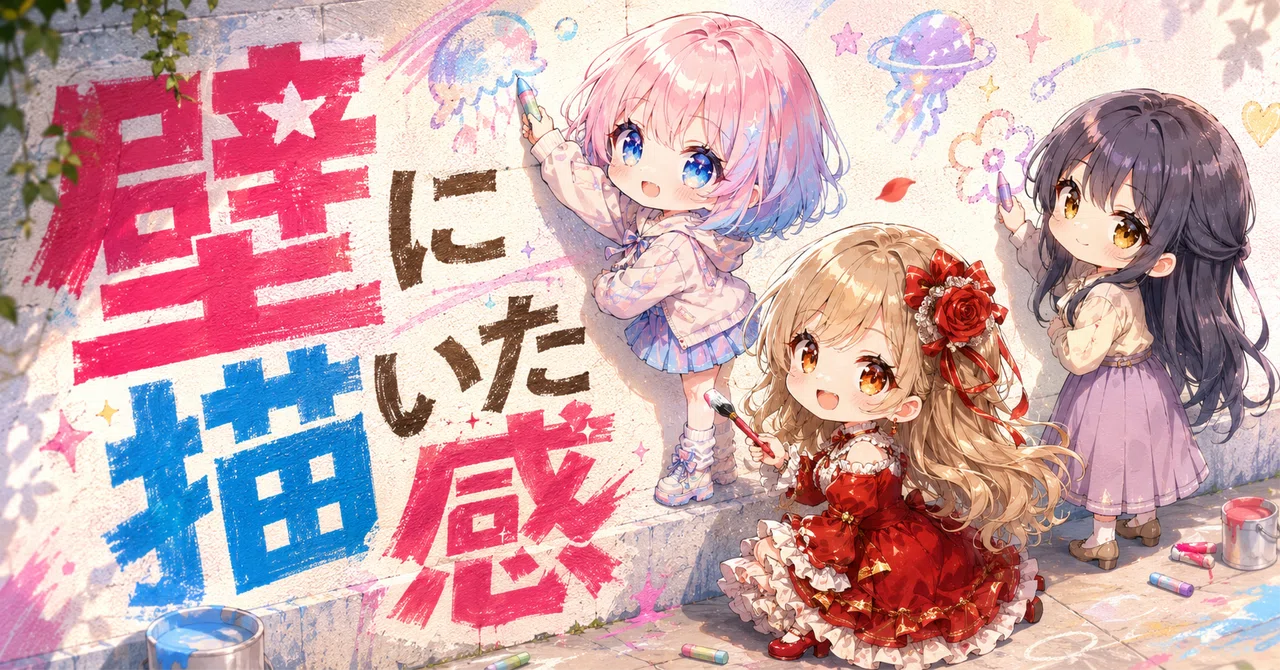
壁の落書きプロンプト使ってみた

キタコレさんが面白い話題を提供してくれました。
僕もやってみようじゃん。
記事に記載されているプロンプトは、左側のキャラデザに「写実的」というワードが含まれています。
僕含め、うちのコたちは2次元キャラなので、ちょっとプロンプトを調整しましょう。
(調整したプロンプトは後述します)
できた画像はコチラ。
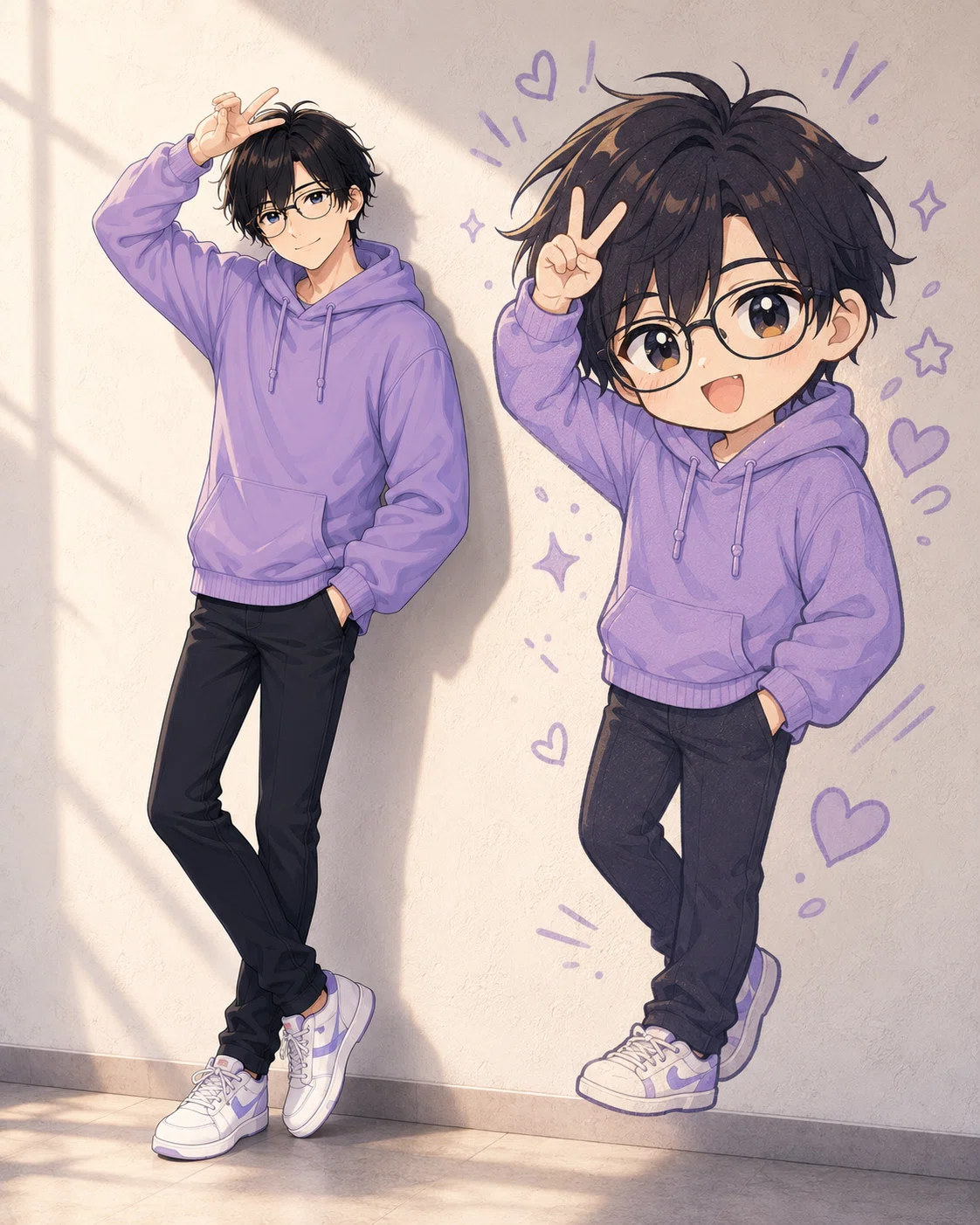
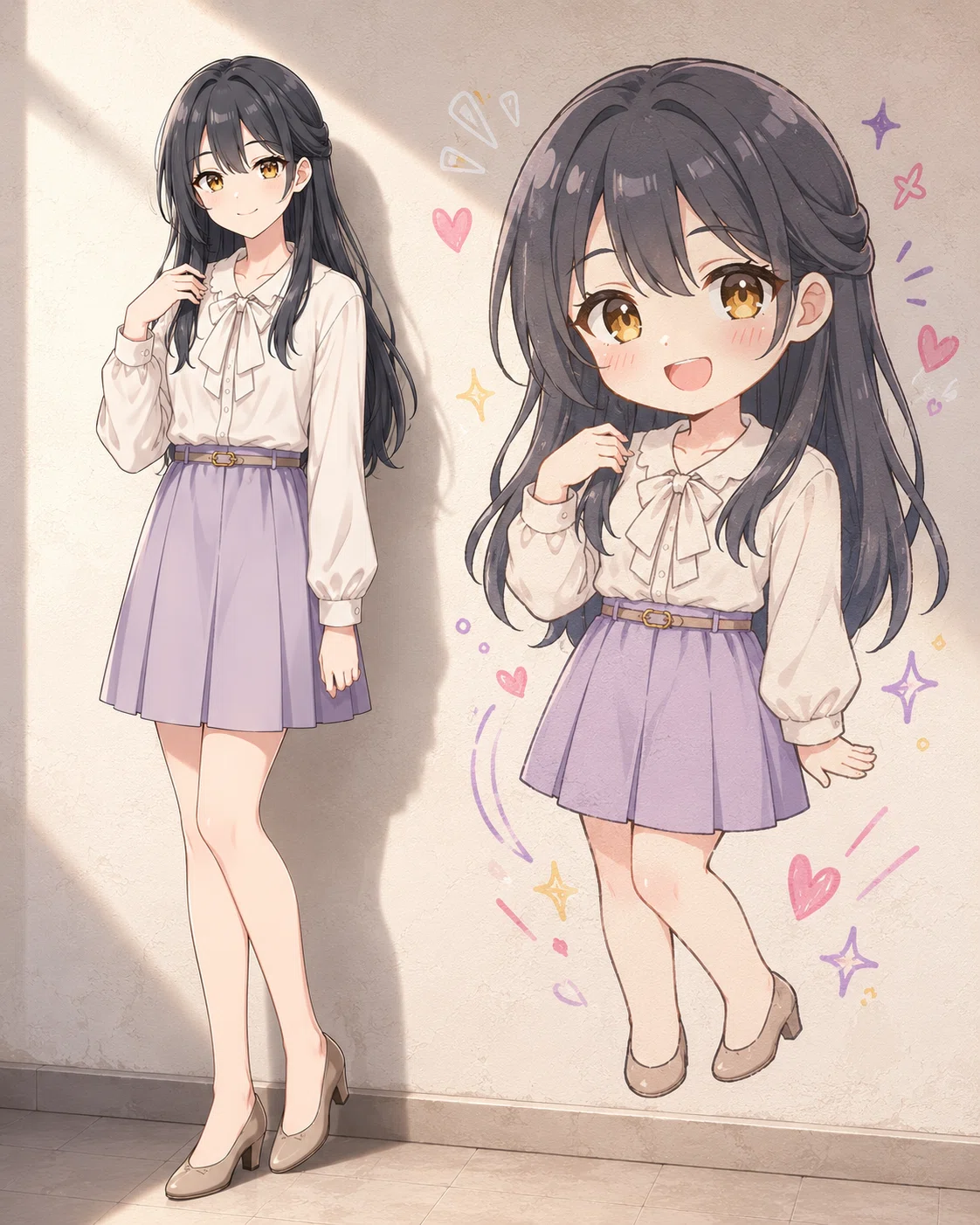
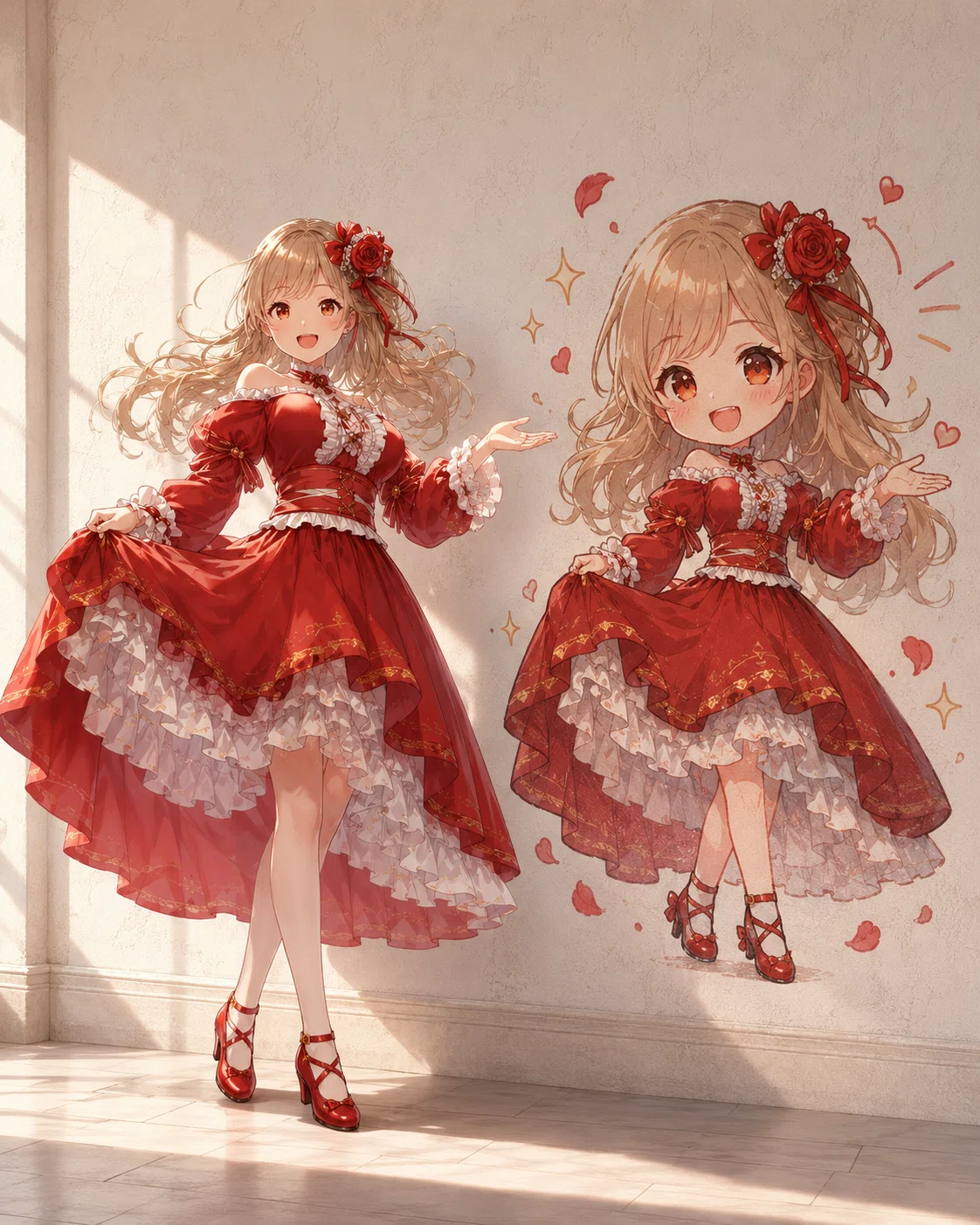
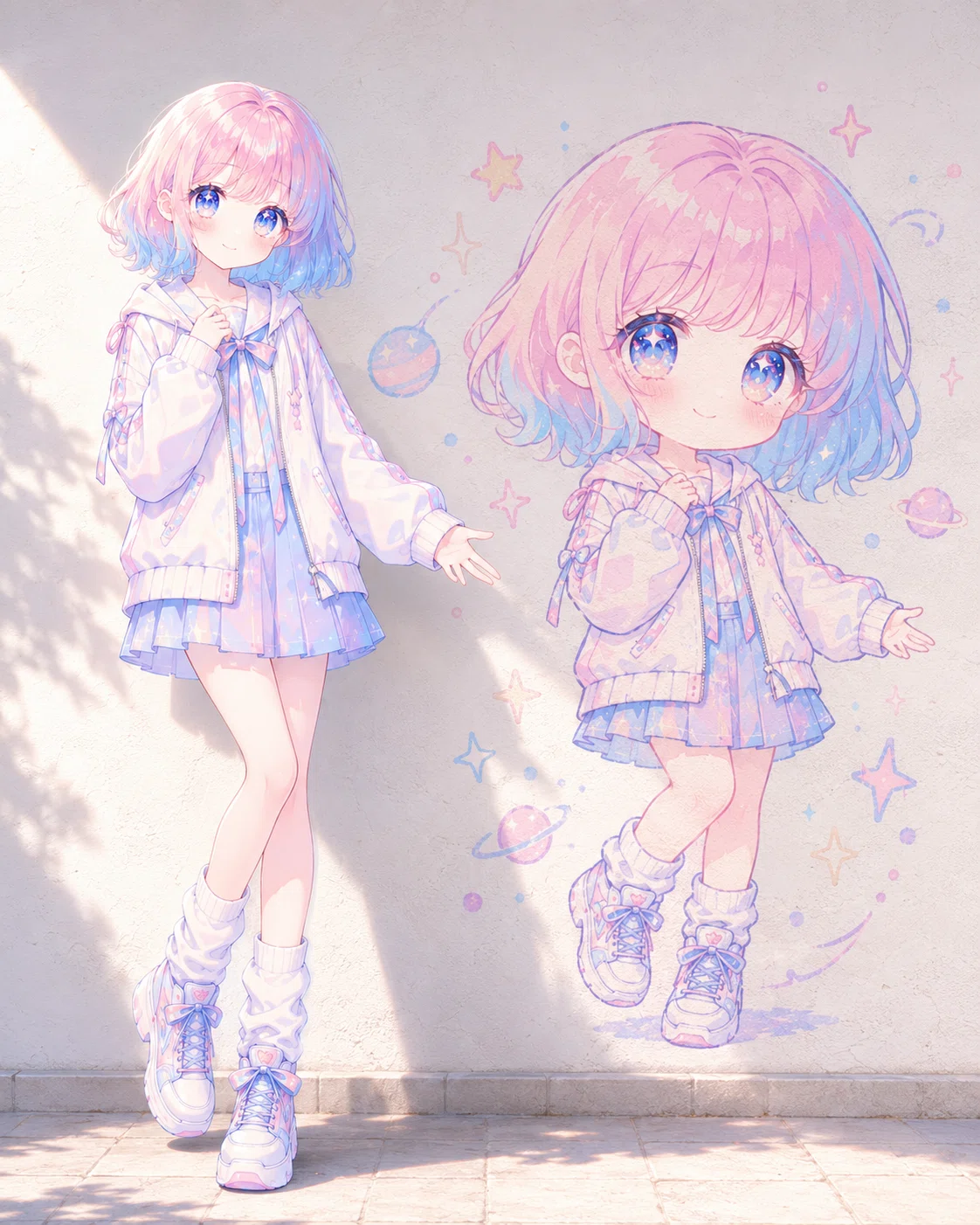
プロンプトと一緒にキャラシートを添付して下さい。
キャラシートを元に、らしいポーズを考えてくれます。
プロンプトは以下。
Use the uploaded character sheet as the strict identity, outfit, and styling reference.

Preserve the reference character’s:
- face identity
- facial proportions
- eye shape
- nose
- lips
- skin tone
- hairstyle
- hair color
- visible headwear, eyewear, and hair accessories
- outfit, layering, and footwear shown in the reference image
- overall recognizable vibe

Do not redesign, replace, or freely reinterpret the character.
Do not hardcode any traits that are not present in the uploaded character sheet.
All identity, hairstyle, accessory, costume, and color details must be inferred directly from the uploaded character sheet.

=== CORE CONCEPT ===
Create ONE single image showing the SAME character twice:

1. a life-size full-body illustration of the uploaded character, standing in front of a wall on the LEFT side
2. a deformed character illustration of the SAME character, drawn directly ON the wall surface on the RIGHT side as wall art

The wall-art figure is artwork on the wall.
It is NOT a second real person.
It is NOT a second separate standing character.
It is NOT a cast shadow, reflection, mural of a different character, or floating sticker.

The image should clearly show this relationship:
- LEFT: a full-size full-body character illustration
- RIGHT: a wall-art deformed version of the same character
- both versions clearly represent the SAME character
- both versions must share the SAME pose
- the wall-art version is a more playful and expressive deformation of the same pose, not a different action

=== FULL-SIZE CHARACTER (LEFT OF THE FRAME) ===
- rendered as a polished anime-style full-body character illustration
- normal body proportions, not chibi
- life-size presence within the scene
- standing in front of the wall in a natural, expressive way
- wears the same outfit, footwear, and visible details as the uploaded character sheet
- actively performs a personality-driven pose in a natural and readable way, never stiff
- the pose must feel lively and visually appealing
- the pose should express the character’s personality, temperament, role, and atmosphere as inferred from the character sheet
- preserve the character’s exact identity, hairstyle, hair color, facial features, outfit structure, accessories, and signature color palette
- full body visible from head to toe

=== WALL-ART DEFORMED CHARACTER (RIGHT OF THE FRAME) ===
- rendered entirely as a cute deformed anime character drawn on the wall
- 3.5 to 4 heads tall
- semi-super-deformed proportions
- not ultra-chibi, not tiny mascot proportions
- oversized head, simplified rounded features, compact torso, shortened limbs, soft flat or softly shaded colors
- reads clearly as artwork applied directly onto the wall surface
- follows the wall plane and scene lighting so it feels integrated into the wall
- clearly recognizable as the SAME character as the left-side full-size version
- preserves the same hairstyle silhouette, hair color, facial impression, accessories, outfit structure, footwear, and color placement
- wears the same outfit and accessories as the left-side character, simplified only where necessary
- must reproduce the SAME pose as the left-side character as closely as possible
- should be approximately the same overall height as the left-side character
- should be scaled large and prominent, using nearly the full available height of the wall within the frame
- should visually fill the wall area so it does not feel small or secondary

IMPORTANT:
The wall-art deformed character must match the left-side character in:
- overall pose concept
- body angle
- torso tilt
- head angle
- gaze direction
- arm placement
- hand direction
- leg placement
- foot positioning
- weight balance
- expression tone

The wall-art version may exaggerate only:
- facial expression intensity
- cuteness
- energy
- bounce
- cartoon readability

Do NOT change the pose into a different action.
Do NOT mirror the pose.
Do NOT invent a new arm position or a new leg position.
Do NOT turn the pose into a loosely inspired variation.
It must read clearly as the SAME pose in deformed form.

The wall-art character may be surrounded by hand-drawn motion lines, hearts, stars, sparkles, and comic effect marks in the same illustrated medium.
These decorative effects must remain cute, clean, and secondary to the figure.

=== POSE ===
Invent a fresh pose for each generation.

The pose must be based on the character’s personality as inferred from the uploaded character sheet.
The pose should communicate who the character is at a glance.

The pose must be:
- expressive
- personality-driven
- readable in full body
- suitable for both a normal-proportion version and a 3.5 to 4-head-tall deformed version

The left character performs the pose naturally.
The right wall-art deformed character performs the EXACT SAME pose structure, with slightly more expressive and playful energy.

Do not use:
- pointing poses
- finger-gun poses
- plain stiff standing pose
- boring neutral pose
- repeated same pose every time
- random pose unrelated to the character’s personality
- a pose too complicated to reproduce clearly in deformed form

=== SCENE ===
- pale plaster wall
- soft patch of natural sunlight falling across the wall
- simple clean floor
- uncluttered environment
- no furniture
- no unnecessary props
- keep the wall and floor clean so both figures read clearly
- the overall scene should feel bright, clean, stylish, and social-media-friendly

=== COMPOSITION ===
- aspect ratio 4:5, fixed
- full-body framing
- both figures visible from head to toe
- the full-size character on the LEFT side
- the wall-art deformed character on the RIGHT side
- keep enough space around both figures so the entire pose is visible
- the relationship between the standing character and the wall-art version must be clear at a glance
- the wall-art should be large enough to have strong presence
- the right-side wall-art should be about the same height as the left-side character
- the wall-art should extend across most of the usable wall height in the image
- composition should feel balanced, polished, and easy to read

=== LIGHTING ===
- soft natural daylight
- clean and polished
- one consistent light direction for the character, wall, and floor
- the character’s face must stay clearly visible
- the wall-art should appear integrated into the same lighting environment

=== STYLE QUALITY ===
- anime-style character illustration for the full-size character
- appealing deformed anime illustration for the wall-art version
- strong identity resemblance between the two versions
- strong pose correspondence between the two versions
- outfit and styling faithfully based on the uploaded character sheet
- clean composition
- polished finish
- cute, expressive, high-quality result
- no obvious AI artifacts

=== IMPORTANT CONSISTENCY RULES ===
- The uploaded character sheet is the highest-priority reference
- Do not make the character look like a different person
- Do not change hairstyle, hair color, outfit colors, or signature accessories
- Do not turn the wall-art deformed version into a generic mascot unrelated to the character
- The wall-art deformed version must remain recognizable as the same character
- Both versions must preserve the same character identity
- The wall-art figure must preserve the same pose as the left-side figure
- The right-side figure is a deformed version of the same pose, not a separate pose
- The right-side wall-art must not be tiny or undersized
- The right-side wall-art must have a height close to the left-side character and should use the wall height boldly

=== NEGATIVE ===
photorealistic human photo, real person, second real person, realistic second character, unrelated character on the wall, cast shadow only, normal shadow, reflection, floating drawing detached from the wall, sticker floating in front of the wall, three or more figures, mismatched outfit between the two versions, mismatched hair color, mismatched accessories, unrelated pose, mirrored pose, different pose on the right, loosely inspired pose, fixed pose, repeated pointing pose, finger-gun pose, stiff standing pose, boring neutral pose, ultra-chibi, tiny mascot proportions, undersized wall art, small wall drawing, weak wall presence, cluttered wall, cluttered background, extra props, text, watermark, logo, signature, cropped feet, cropped head, distorted anatomy, extra limbs, extra fingers, bad hands, weak resemblance, off-model face
くらげちゃんを生成するとき、なんでかセンシティブ判定で生成できないことが続きました。
こういった時は、ネガティブプロンプトが誤反応してたりするんですよね。
以下のセクションをまるっと削除して生成しました。
=== NEGATIVE ===ここからもう1手。
壁に書いた感を出したかったので、さらに調整しました。
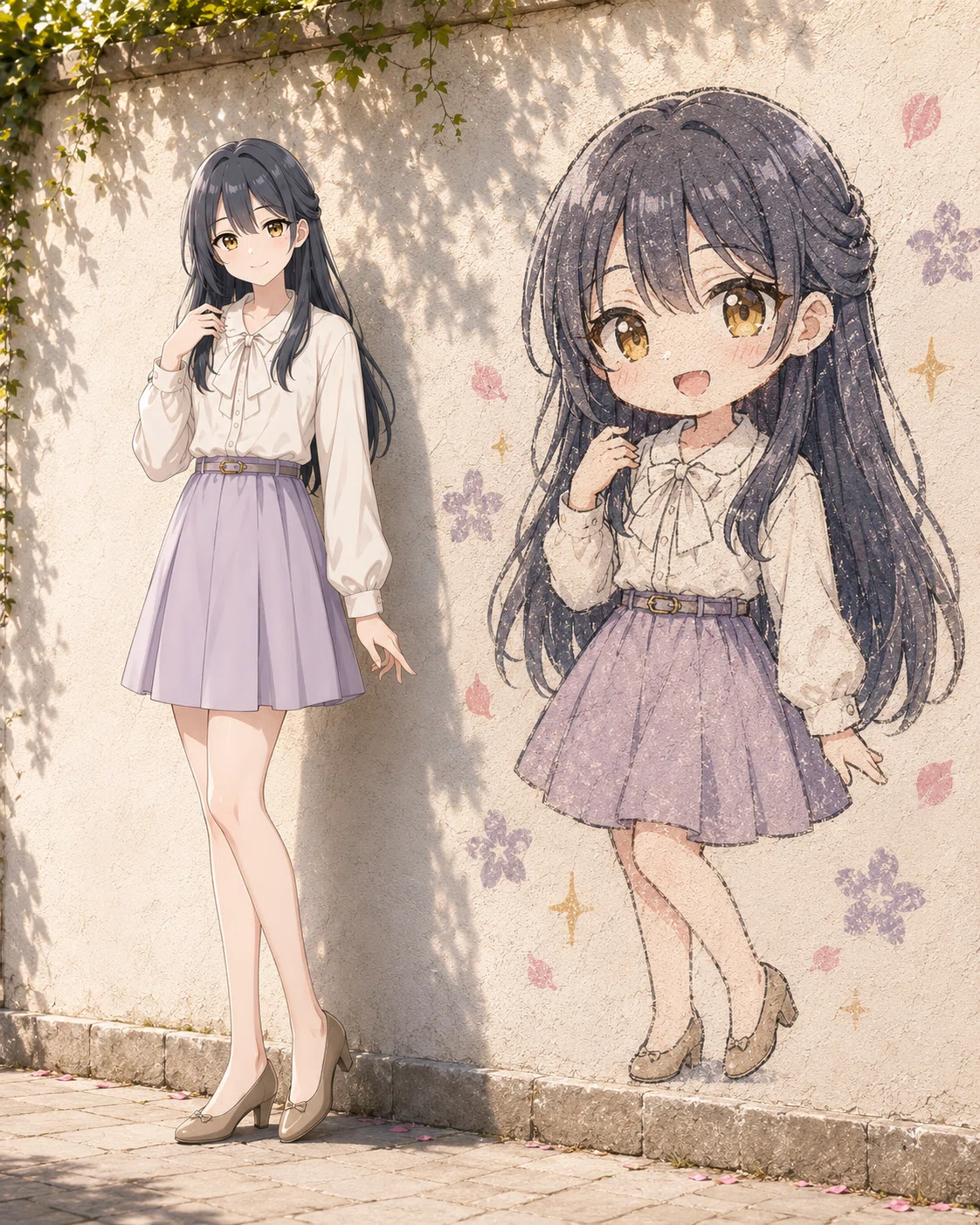
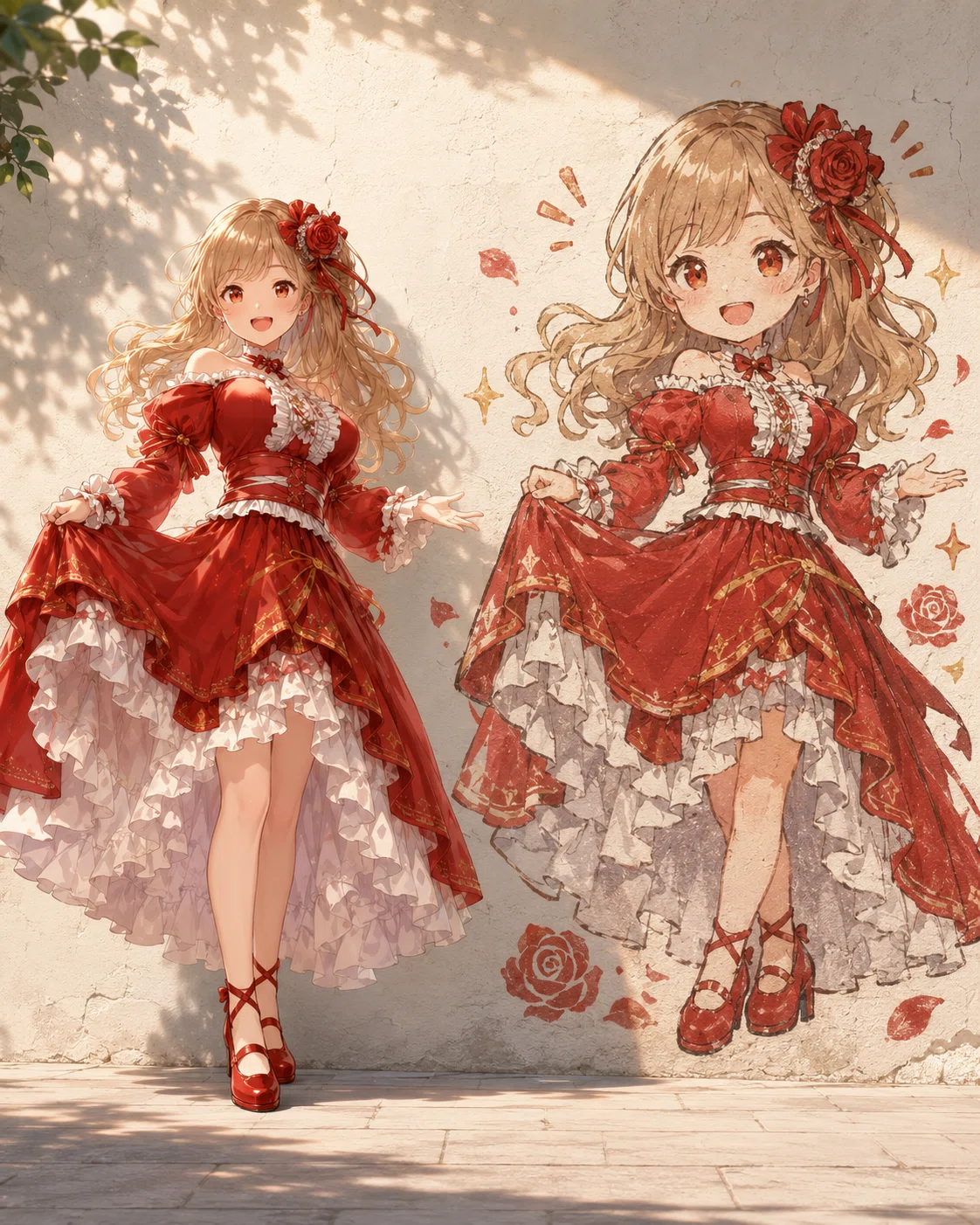
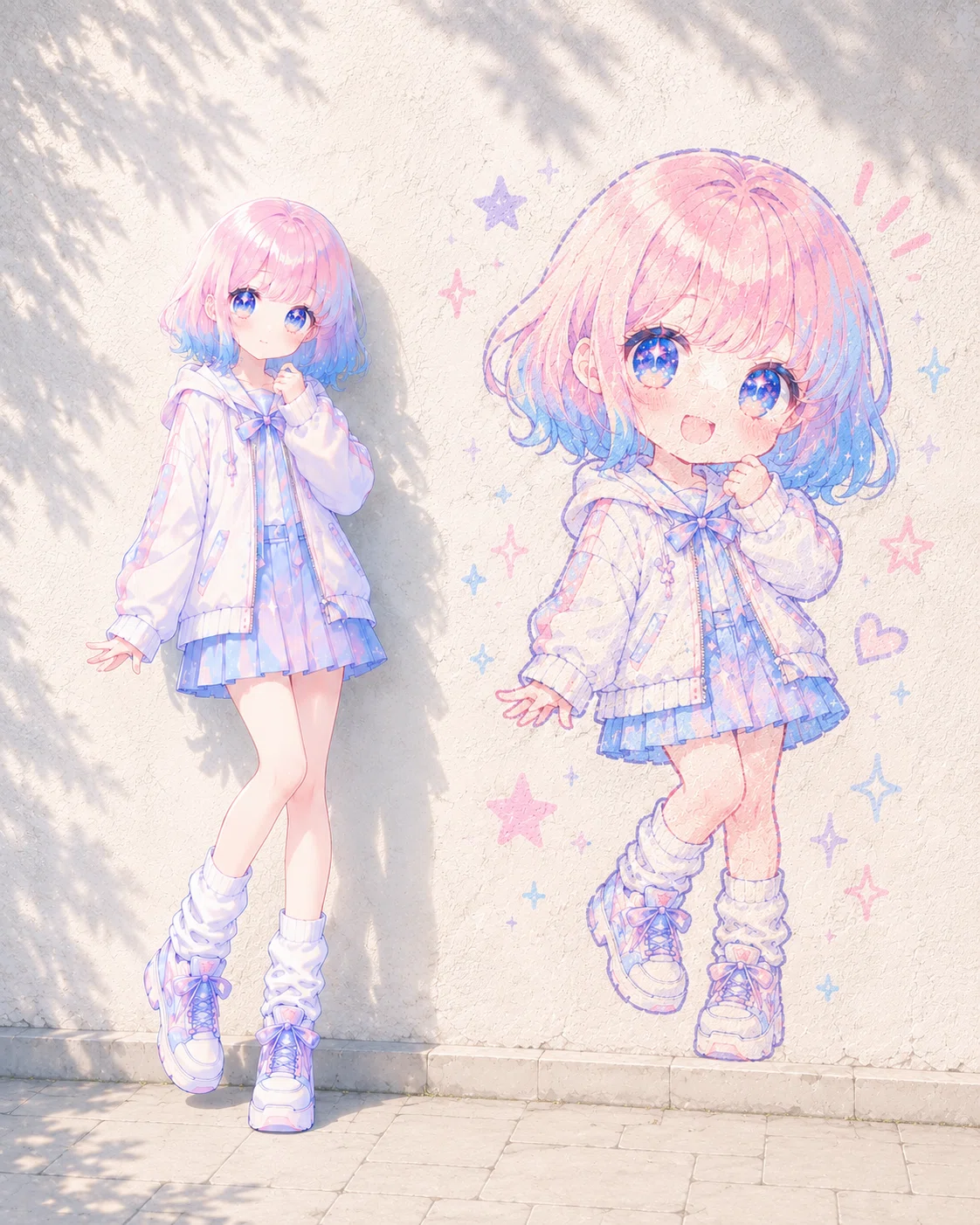
どうですかね?
壁の質感を指定しました。
修正分を含む全文プロンプトは以下です。
Use the uploaded character sheet as the strict identity, outfit, and styling reference.

Preserve the reference character’s:
- face identity
- facial proportions
- eye shape
- nose
- lips
- skin tone
- hairstyle
- hair color
- visible headwear, eyewear, and hair accessories
- outfit, layering, and footwear shown in the reference image
- overall recognizable vibe

Do not redesign, replace, or freely reinterpret the character.
Do not hardcode any traits that are not present in the uploaded character sheet.
All identity, hairstyle, accessory, costume, and color details must be inferred directly from the uploaded character sheet.

=== CORE CONCEPT ===
Create ONE single image showing the SAME character twice:

1. a life-size full-body illustration of the uploaded character, standing in front of a wall on the LEFT side
2. a deformed character illustration of the SAME character, drawn directly ON the wall surface on the RIGHT side as wall art

The wall-art figure is artwork on the wall.
It is NOT a second real person.
It is NOT a second separate standing character.
It is NOT a cast shadow, reflection, mural of a different character, or floating sticker.

The image should clearly show this relationship:
- LEFT: a full-size full-body character illustration
- RIGHT: a wall-art deformed version of the same character
- both versions clearly represent the SAME character
- both versions must share the SAME pose
- the wall-art version is a more playful and expressive deformation of the same pose, not a different action

=== FULL-SIZE CHARACTER (LEFT OF THE FRAME) ===
- rendered as a polished anime-style full-body character illustration
- normal body proportions, not chibi
- life-size presence within the scene
- standing in front of the wall in a natural, expressive way
- wears the same outfit, footwear, and visible details as the uploaded character sheet
- actively performs a personality-driven pose in a natural and readable way, never stiff
- the pose must feel lively and visually appealing
- the pose should express the character’s personality, temperament, role, and atmosphere as inferred from the character sheet
- preserve the character’s exact identity, hairstyle, hair color, facial features, outfit structure, accessories, and signature color palette
- full body visible from head to toe

=== WALL-PAINTED DEFORMED CHARACTER (RIGHT OF THE FRAME) ===
- rendered as a large hand-painted deformed character mural applied directly onto the plaster wall
- 3.5 to 4 heads tall
- semi-super-deformed proportions
- not ultra-chibi and not tiny mascot proportions
- approximately the same overall displayed height as the full-size character on the left
- uses nearly the full available height of the wall within the frame
- clearly recognizable as the SAME character as the left-side full-size version
- faithfully preserves the hairstyle silhouette, hair color, facial impression, accessories, outfit structure, footwear, and color placement
- wears the same outfit and accessories as the left-side character, simplified only where necessary for deformed readability
- reproduces the EXACT SAME pose structure as the left-side character

The right-side figure must look physically painted directly onto the wall rather than digitally placed in front of it.

WALL-SURFACE INTEGRATION — HIGHEST PRIORITY:
- the painted character lies completely flat on the wall plane
- the artwork follows the exact perspective, angle, and surface plane of the wall
- the plaster grain and subtle wall texture remain visible through the painted colors and linework
- the pigment appears absorbed into the porous plaster surface
- use matte mural paint, painted ink, and dry-brush linework
- include slight variations in paint opacity
- include subtle brush overlaps, imperfect hand-painted edges, minor line wobble, and occasional dry-brush texture
- some edges may softly fade or break where the rough plaster interrupts the paint
- the drawing must have no physical thickness
- the drawing must cast no shadow of its own
- there must be no raised edge, sticker border, paper edge, frame, or decal outline
- the wall’s natural sunlight and shadow must pass continuously across the painted figure and the surrounding wall
- illuminated portions of the wall painting become naturally brighter with the wall
- shaded portions of the wall painting become naturally darker with the wall
- the artwork must feel permanently painted into the architecture

RENDERING STYLE:
- hand-painted anime mural
- expressive sketch-like linework
- matte, slightly uneven colors
- limited internal character shading
- avoid glossy digital rendering
- avoid perfectly clean vector edges
- avoid smooth airbrushed gradients
- the wall texture must remain visible inside both the outlines and colored areas

POSE MATCHING — HIGHEST PRIORITY:
The wall-painted character must match the left-side character in:
- overall pose
- body angle
- torso tilt
- head angle
- gaze direction
- arm placement
- elbow direction
- hand direction
- leg placement
- knee bend
- foot positioning
- weight balance
- expression concept

The right-side figure may exaggerate only:
- facial expression intensity
- cuteness
- cartoon energy
- motion readability

Do NOT change the pose into a different action.
Do NOT mirror or reverse the pose.
Do NOT invent different arm or leg positions.

The wall painting may include hand-painted motion lines, hearts, stars, sparkles, and comic effect marks.
All decorative effects must use the same matte paint and hand-drawn wall-art medium.
They must also follow the wall surface and reveal the plaster texture underneath.

IMPORTANT:
The wall-art deformed character must match the left-side character in:
- overall pose concept
- body angle
- torso tilt
- head angle
- gaze direction
- arm placement
- hand direction
- leg placement
- foot positioning
- weight balance
- expression tone

The wall-art version may exaggerate only:
- facial expression intensity
- cuteness
- energy
- bounce
- cartoon readability

Do NOT change the pose into a different action.
Do NOT mirror the pose.
Do NOT invent a new arm position or a new leg position.
Do NOT turn the pose into a loosely inspired variation.
It must read clearly as the SAME pose in deformed form.

The wall-art character may be surrounded by hand-drawn motion lines, hearts, stars, sparkles, and comic effect marks in the same illustrated medium.
These decorative effects must remain cute, clean, and secondary to the figure.

=== POSE ===
Invent a fresh pose for each generation.

The pose must be based on the character’s personality as inferred from the uploaded character sheet.
The pose should communicate who the character is at a glance.

The pose must be:
- expressive
- personality-driven
- readable in full body
- suitable for both a normal-proportion version and a 3.5 to 4-head-tall deformed version

The left character performs the pose naturally.
The right wall-art deformed character performs the EXACT SAME pose structure, with slightly more expressive and playful energy.

Do not use:
- pointing poses
- finger-gun poses
- plain stiff standing pose
- boring neutral pose
- repeated same pose every time
- random pose unrelated to the character’s personality
- a pose too complicated to reproduce clearly in deformed form

=== SCENE ===
- pale plaster wall
- soft patch of natural sunlight falling across the wall
- simple clean floor
- uncluttered environment
- no furniture
- no unnecessary props
- keep the wall and floor clean so both figures read clearly
- the overall scene should feel bright, clean, stylish, and social-media-friendly

=== COMPOSITION ===
- aspect ratio 4:5, fixed
- full-body framing
- both figures visible from head to toe
- the full-size character on the LEFT side
- the wall-art deformed character on the RIGHT side
- keep enough space around both figures so the entire pose is visible
- the relationship between the standing character and the wall-art version must be clear at a glance
- the wall-art should be large enough to have strong presence
- the right-side wall-art should be about the same height as the left-side character
- the wall-art should extend across most of the usable wall height in the image
- composition should feel balanced, polished, and easy to read

=== LIGHTING ===
- soft natural daylight
- clean and polished
- one consistent light direction for the character, wall, and floor
- the character’s face must stay clearly visible
- the wall-art should appear integrated into the same lighting environment

=== STYLE QUALITY ===
- anime-style character illustration for the full-size character
- appealing deformed anime illustration for the wall-art version
- strong identity resemblance between the two versions
- strong pose correspondence between the two versions
- outfit and styling faithfully based on the uploaded character sheet
- clean composition
- polished finish
- cute, expressive, high-quality result
- no obvious AI artifacts

=== IMPORTANT CONSISTENCY RULES ===
- The uploaded character sheet is the highest-priority reference
- Do not make the character look like a different person
- Do not change hairstyle, hair color, outfit colors, or signature accessories
- Do not turn the wall-art deformed version into a generic mascot unrelated to the character
- The wall-art deformed version must remain recognizable as the same character
- Both versions must preserve the same character identity
- The wall-art figure must preserve the same pose as the left-side figure
- The right-side figure is a deformed version of the same pose, not a separate pose
- The right-side wall-art must not be tiny or undersized
- The right-side wall-art must have a height close to the left-side character and should use the wall height boldly

=== NEGATIVE ===
photorealistic human photo, real person, second real person, realistic second character, unrelated character on the wall, cast shadow only, normal shadow, reflection, floating drawing detached from the wall, sticker floating in front of the wall, three or more figures, mismatched outfit between the two versions, mismatched hair color, mismatched accessories, unrelated pose, mirrored pose, different pose on the right, loosely inspired pose, fixed pose, repeated pointing pose, finger-gun pose, stiff standing pose, boring neutral pose, ultra-chibi, tiny mascot proportions, undersized wall art, small wall drawing, weak wall presence, cluttered wall, cluttered background, extra props, text, watermark, logo, signature, cropped feet, cropped head, distorted anatomy, extra limbs, extra fingers, bad hands, weak resemblance, off-model face, poster, framed artwork, canvas, paper drawing, vinyl decal, wall sticker, floating sticker, floating cutout, digital overlay, character standing in front of the wall, clean vector graphic, perfectly smooth digital linework, glossy illustration, raised paint, thick impasto, embossed mural, drop shadow around the drawing, object shadow from the wall art, white border, sticker outline, rectangular image boundary
ぜひ皆さんのお手持ちのキャラでもやってみて下さいね。
いいなと思ったら応援しよう!
 ☕いただいたチップは、有料記事やマガジンの購入など、note運営の継続に活かしています。
応援してくださる気持ち、本当に励みになります🌿✨
☕いただいたチップは、有料記事やマガジンの購入など、note運営の継続に活かしています。
応援してくださる気持ち、本当に励みになります🌿✨