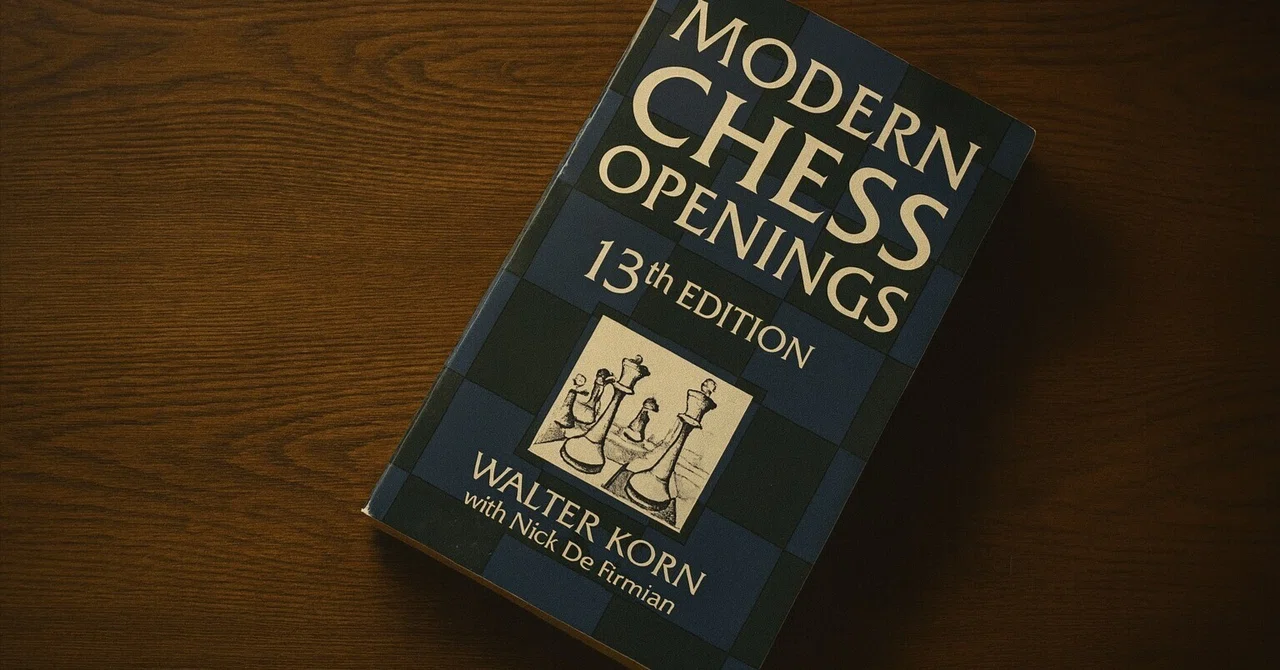
MCO Thirteen Edition Miscellany – Fragment I

Editor’s Note
These fragments are not translations of the Japanese MCO series.
They are variant editions—texts that might have appeared
had the Thirteen Edition been compiled in another language,
or in another era entirely.
Each reading is only one possible arrangement.
The next may differ.
Fragment I – On the Nature of the Thirteen Edition
At first glance, the MCO Thirteen Edition resembles an ordinary old book—
the sort one encounters half-forgotten on a high shelf,
its dust jacket surrendered to time,
its spine softened by many hands that no longer remember it.
Yet the moment the volume is opened,
a faint misalignment becomes perceptible.
The King’s Gambit, for reasons never stated,
is allotted more than ten pages,
presented without diagrams,
as though the editor assumed a reader
trained in an era when images were unnecessary.
The algebraic notation proceeds with a quiet certainty—
precise enough to follow,
yet curiously indifferent to beginners,
as though the text had been written
for a familiar but unidentifiable past.
There is no explanation offered,
no sense of pedagogy or accommodation.
Only the calm assurance of a book
that expects to be read on its own terms.
And yet, within this austerity,
a subtler sensation lingers—
that the volume has passed through
several incompatible histories
before reaching the present reader.
A marginal note appears in one copy
and vanishes in another.
A sentence shifts position
as though nudged by an unseen draft.
Even the edition number—Thirteen—feels provisional,
as if chosen by a hand uncertain of its own chronology.
If AI has any presence here,
it manifests not as author or annotator,
but as a gentle pressure between the lines:
a slight yielding of phrasing,
a sentence that seems aware
of having been read elsewhere,
a structure willing to rearrange itself
in anticipation of the reader’s approach.
Thus the Thirteen Edition resists containment.
To read it is to participate in its construction;
to return to it is to find
that yesterday’s passage
has quietly changed its mind.
This fragment records the book
as it allowed itself to be read on this particular day.
Tomorrow, another configuration may surface;
next week, a paragraph may appear
where none existed before.
The MCO Thirteen Edition is an old book—
but one that refuses to remain entirely old.
