
🌟Happy MathArt みんなの数学アート かじられたゾーン多面体:螺旋多面体 / Bitten Zonohedra: Spirallohedra

螺旋多面体
Spirallohedra
2000
Russell Towle
米国カリフォルニア州シエラネバダ山奥の六角形の家
Hexagonal house inthe Sierra Nevada mountains of California, USA
******
数学の新しいツール「Mathematica」(計算科学処理ソフトウェア)を駆使して幾何学の世界を探求していた独学者ラッセル・タウルは、優雅で美しい螺旋状の翼を持つ多面体を発見します。
彼が研究していた極性ゾーン多面体(Polar Zonohedra)は、2つの尖った極があるアメリカンフットボールを引き延ばしたり押しつぶしたり膨らませたりしたようなカタチで、高次元の多面体である超立方体(Hypercube)が3次元投影として現れた特別なゾーン多面体(Zonohedra)です。構成する無数の菱面体(菱形六面体)から特定のセルを慎重に取り除くことで、螺旋多面体(Spirallohedron)にたどりつきます。k個(kは2より大きい整数)の螺旋表面に囲まれ、k次(360°/kの回転対称性)の対称軸を持ち、キラルな(鏡像と重ね合わせることができない)非凸多面体です。
「ひし形で敷き詰められた正2n角形の周縁部から2つまたは3つのひし形領域をかじる(bites)と、ひし形で敷き詰められた非凸多角形「かじられたゾノゴン(bitten zonogons)」はどちらも平面を充填する」。このアイディアを3次元に拡張して、「かじられたゾーン多面体(bitten Zonohedra)」である3翼および4翼の螺旋多面体(Spirallohedron)が空間充填することを見つけます*。そこでさらに、対称軸に垂直な断面から得た正k角形のうち「辺同士がぴったり重ならない」タイリング*を発見したことから、より高次元の4次元で空間充填すると「面同士がぴったり重ならない」3次元空間充填が得られることを示唆しています。
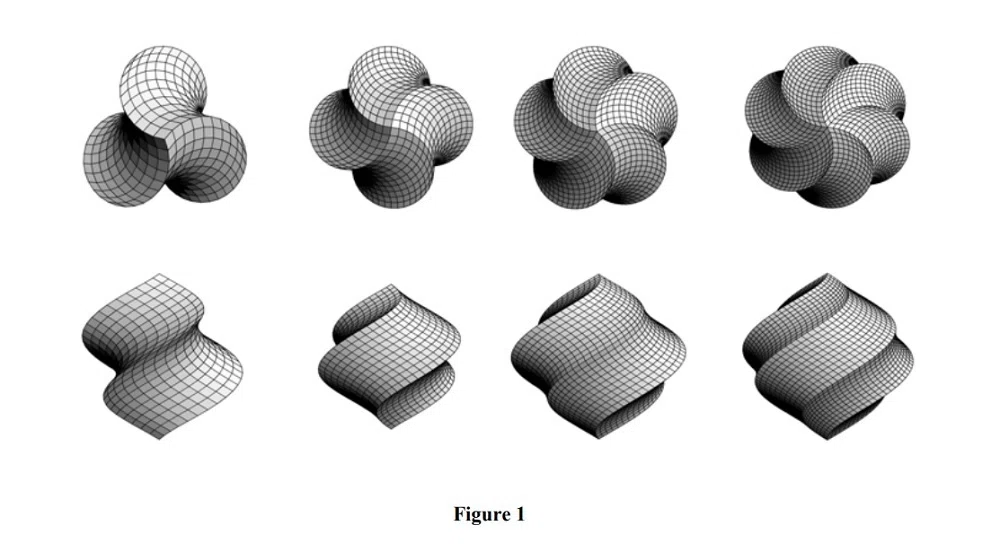
-Spirallohedra by Russell Towle (1949-2008)
Using a new mathematical tool, the computational software Mathematica, independent scholar Russell Towle explored the world of geometry and discovered a class of elegant and beautiful polyhedra with spiral-shaped wings.
The objects he was studying were Polar Zonohedra, which are special kinds of zonohedra that appear as the three-dimensional projection of a higher-dimensional polyhedron, Hypercube. Their shape resembles an American football that has been stretched, squashed, or inflated. By carefully removing specific cells from the countless rhombic faces (rhombohedra) that make them up, he arrived at the Spirallohedron. This is a new geometric structure: a chiral (non-superimposable on its mirror image), non-convex polyhedron surrounded by k spiral surfaces (where k is an integer greater than 2) and possessing a k-fold (360°/k rotational) symmetry axis.
He discovered that "when you 'bite' two or three rhombic regions from the periphery of a regular 2n-gon tiled with rhombi, the resulting non-convex polygons—which he called bitten zonogons—can both tile a plane." He extended this idea into three dimensions to find that the 3-winged and 4-winged spirallohedra, which are bitten zonohedra, can fill space. From this, he further deduced that the regular k-gons obtained from a cross-section perpendicular to the symmetry axis form a tiling where the edges do not perfectly meet. This suggests that a higher-dimensional space-filling in four dimensions would result in a three-dimensional space-filling where the faces do not perfectly meet.
-Russell Towle "Rhombic spirallohedra" Volume 11, Numbers 1-4, pages 293-306 (2000)
-Towle R. (2002) "Stellation and Zonotopal Tilings, Symmetry" Culture and Science, 13, 1-2, 121-128.
-Michel Petitjean. Spirallohedra and Space Filling. A Tribute to Russell Towle.. Symmetry: Culture and Science, 2008, 19 (1), pp.5-8. ffhal-01941511f
-Stephen Wolfram (2008), "Russell Towle: 1949–2008," Stephen Wolfram Writings. writings.stephenwolfram.com/2008/10/russell-towle-1949-2008.
-Gévay G., Szilassi L. (2006) The Spirallohedron (A Space-Filling Body), Symmetry Festival, Budapest, 12-18 August 2006.
-Gévay G., Szilassi L. (2007) Spirallohedron: A Space-Filling Body, Symmetry: Culture and Science, 18, 1, 75-88.
-Grünbaum, B. and Shephard, G.C. "Tilings & Patterns" W.A. Freeman and Comp (1987)

SHARE YOUR LOVE AND SHAPE!
みんなの数学アート絶賛開催中!
Explore Geometric Beauty!
