🌟Happy MathArt みんなの数学アート 自己集合の美:四価ゴールドバーグの立体 / Self-Assembled Beauty: Tetravalent Goldberg Polyhedra

四価ゴールドバーグの立体
Tetravalent Goldberg Polyhedra
2016年
藤田大士 / Daishi Fujita et al.
京都大学
Discovered at Kyoto Univ.
自己集合の美
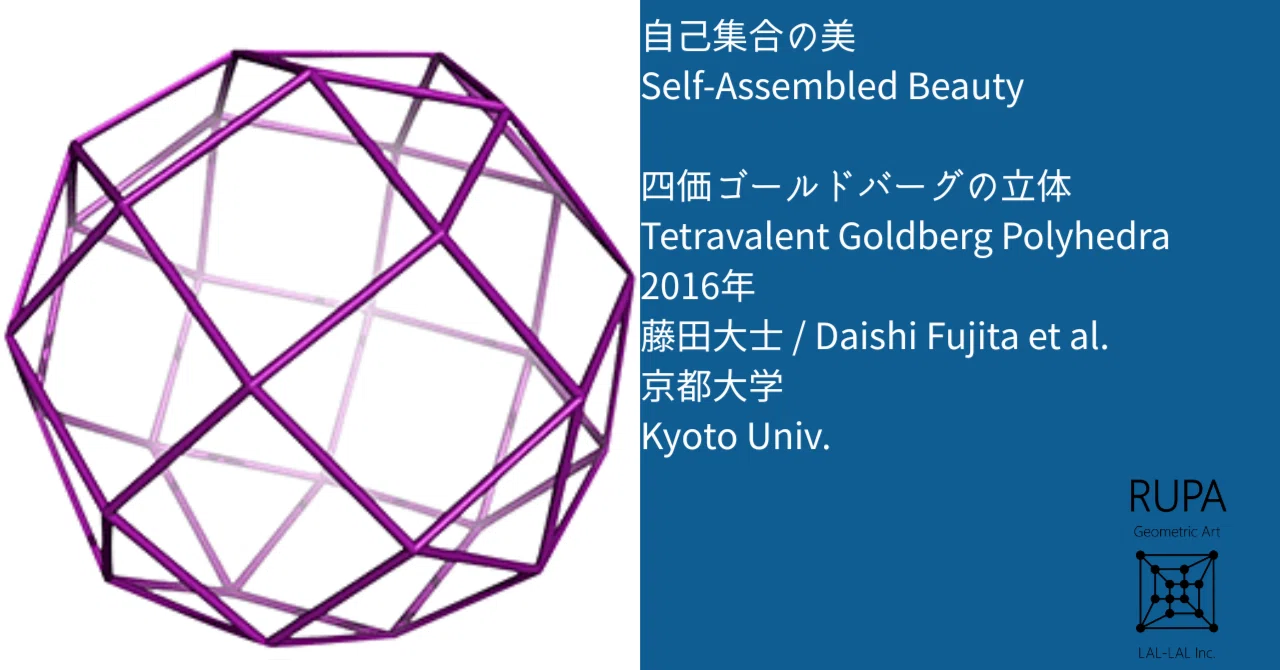
限られた種類の小さな分子が自然に集まって、秩序だった構造を作り上げる現象には驚かされます。この報告では、化学的な手法で、幾何学的構造の分子複合体を作り上げることに成功しています。構成単位は金属イオン(M:4価の頂点に相当)と有機リガンド(L:辺に相当)。溶媒中で自己集合して、90成分からなる複合体M30L60が形成されました。その構造は、分子形状としてはとても珍しい4価ゴールドバーグの立体であることが分り、しかも鏡像体のある形でした(tet-G(2,1)、Ⅲ型)。著者らは、幾何学的な法則性からさらに大きな複合体を予測し、期待通り144成分からなる複合体M48L96を得ています(tet-G(2,2)、II型)。自己集合で作られる形は、熱力学的に安定です。対称性の高い幾何学的構造はおそらく安定であり、巨大な分子複合体を作りだす上で重要な手がかりになりそうです。
四価ゴールドバーグの立体*
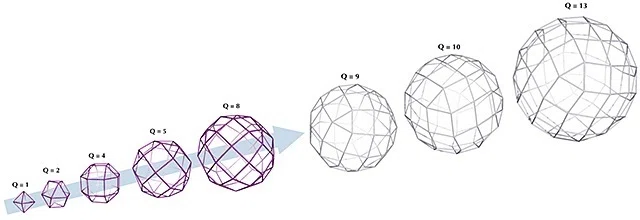
正八面体のゴールドバーグ・コクセターコンストラクション*による立体。四価で三角形と四角形からなる八面体対称の立体です。三角形は常に8つです。三角形の位置はちょうど立方体の頂点部分にあたり、その間を四角形で均等に埋めた形です。一つの三角形をスタートして、隣り合う面づたいにm面直進し、90度向きを変えてn面直進すると、最寄りの三角形にたどり着きます。このとき、I型はmまたは n=0、II型はm=n、III型はm≠nです。III型のみ鏡像体があり、ねじれた外観です(右巻きと左巻き)。馴染み深い三角形と四角形でできる形ですが、四価ゴールドバーグの立体は普段目にすることはありません。対称性の高い美しい立体で、特にII型とIII型が面白いです。
* これらの語句は説明のために用いていますが、厳密には正確ではないかもしれません。下記の文献が参考になります。
-Brinkmann et al., Proceedings Royal Society A 473: 20170267 (2017)
- Japan Science and Technology Agency, 22.12.2016. “Self-assembly of tetravalent Goldberg polyhedra from 144 small components”
Self-Assembled Beauty
Natural wonders may extend to a molecular phenomenon in which limited types of small components assemble into a highly ordered structure. In chemistry, geometric supramolecular structures were obtained by self-assembly of metal ions (M: as tetravalent vertices) and organic ligands (L: as bent edges at a certain angle). X-ray crystallography revealed that the complex M30L60 made of 90 components has a structure resembling a tetravalent Goldberg polyhedron tet-G(2,1) typeIII, an unprecedented structure in the molecular world. The authors predicted even larger complexes, and successfully obtained M48L96 made of 144 components (tet-G(2,2), type II). Self-assembled structures are thermodynamically stable. Geometric principles may underlie formation of supramolecular structures.
Tetravalent Goldberg Polyhedra*
Polyhedra obtained by the Goldberg-Coxeter construction* on an octahedron. Simply, these are created by adding tetragons to the octahedron, 4-reguraly and symmetrically (octahedral). Triangles are 8 in total. Triangles are located at vertices of a cubic cell, and tetragons fill the gaps evenly. Starting from one triangle, move m-faces over tetragons in one direction, turn 90 degrees, and move n-faces to reach the closest triangle. A pair of numbers (m,n) is useful to classify the structures: m, n=0 (type I), m=n (type II), and m≠n (type III). Only type III is chiral, and looks twisted. Although triangles and tetragons are both familiar, tetravalent Goldberg polyhedra look unusual yet so beautiful. Type II and III are particularly interesting.
* Please be advised that the terms “tetravalent Goldberg polyhedra” and “Goldberg-Coxeter construction” are used for convenience, but might not be accurate. See, Brinkmann et al., Proceedings Royal Society A 473: 20170267 (2017)
-“Self-assembly of tetravalent Goldberg polyhedra from 144 small components” Fujita et al., Nature 540: 563-566 (2016)
-"Comparing the constructions of Goldberg, Fuller, Caspar, Klug and Coxeter, and a general approach to local symmetry-preserving operations" Brinkmann et al., Proceedings Royal Society A 473: 20170267 (2017)
-京都大学物質細胞統合システム拠点(iCeMS)
-分子の自己集合現象の解明に迫る物質群の存在を発見~4価のゴールドバーグ多面体構造の合成に成功~
SHARE YOUR LOVE AND SHAPE
みんなの数学アート絶賛開催中!
Explore Geometric Beauty!
