《英語多読多聴✖︎現代教養》第30講 仮想スピーカー モンテーニュ What Do I Know? 自己を観察し続ける「エッセイ」こそが人生の処方箋である

What Do I Know? On the Essay as the Only Honest Map of a Human Life
設定
スピーカー: ミシェル・ド・モンテーニュ
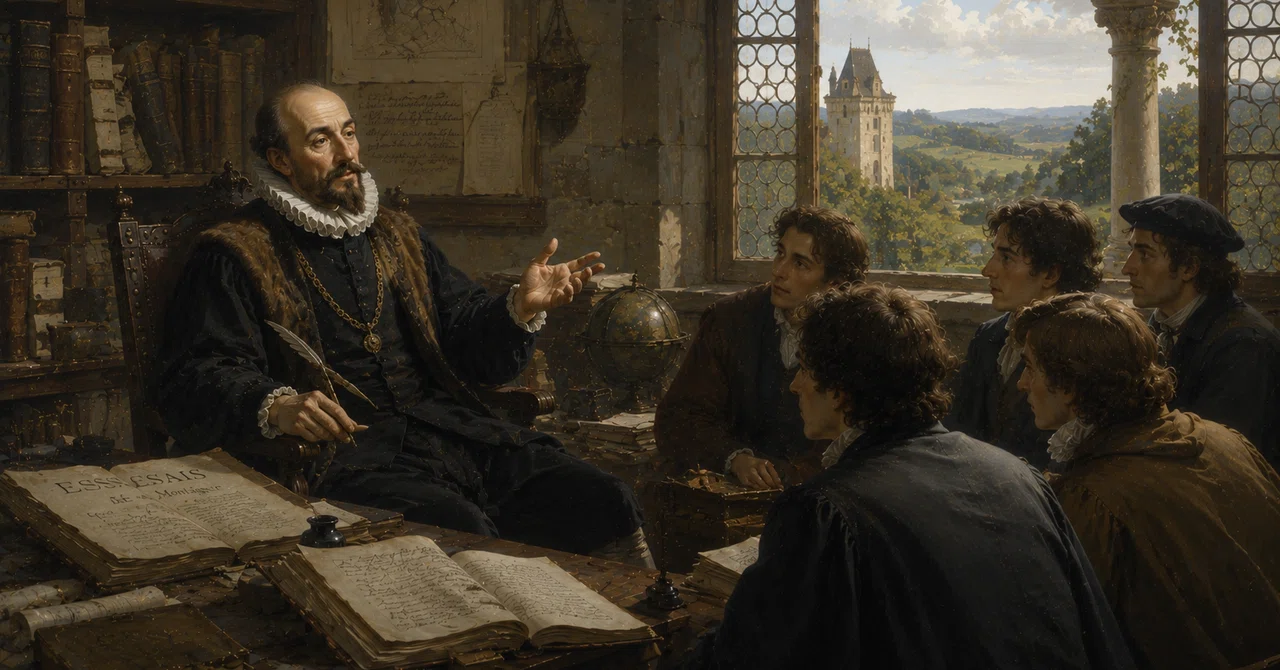
場所: フランス、ペリゴール地方にある自身の城の塔の最上階、書斎。
聴衆: 彼の思想に惹かれ、遠方からわざわざ面会を求めてきた若き旅人たち。
語る状況: 晩年、自らの執筆生活を振り返りながら、読者に知識や教条ではなく「自分を観察する技術」を静かに説いている。
スピーチ本文
I have a tower. It is round, it is mine, and it has been my best companion for twenty years. Three floors. The bottom for my chapel, the middle for my bedroom, and the top—the top is where I think. Where I read, where I write, where I forget, for a few hours at a time, that I am a former magistrate with bad kidneys and an increasingly unreliable memory.
On the beams of that top room, I inscribed certain sentences. Sayings from Sextus Empiricus, from Ecclesiastes, from Horace. And above all others, I painted one question where I could always see it: Que sçay-je? What do I know?
Not as a cry of despair. Not as a fashionable skepticism performed for clever company. But as a genuine, daily, almost affectionate question. What do I actually know? What have I verified? What is mine, and what is merely borrowed, repeated, inherited without examination?
That question became my life’s work. And the essay—this strange, wandering, unfinished form I seem to have invented by accident—became my only honest way of attempting an answer.
Let me tell you what an essay is, since the word has been so badly mistreated. An essay is not an argument. It is not a proof. It is not a position paper written to win a debate. The word comes from essai—an attempt, a trial, a weighing. When a goldsmith essays metal, he is testing it, measuring it, finding out what it is actually made of.
That is what I do with myself.
I sit at my desk and begin to write. I start with something small—the subject of experience, the nature of cannibals, the problem of sleeping, the beauty of friendship. And then I follow the thought wherever it goes. I do not clean up the contradictions. I do not hide the digressions. If I change my mind halfway through—and I very often do—I leave both opinions on the page, because the change of mind is itself part of what I am essaying.
What I am always really writing about is this: one particular man, of middling height and middling intelligence, living in a particular tower in the Périgord, in a century that has been—God help us—not short of catastrophe. I am the subject, the instrument, and the only material I have sufficient access to study properly.
Every man carries the whole form of the human condition within him. That is something I believe absolutely. To examine myself carefully—not to flatter myself, not to confess dramatically, but simply to observe, the way you might observe a river or a weather pattern—is to say something true about all of us.
Now, I must address the objection I hear from certain quarters. "What use is this?" they ask. "What practical benefit comes from a nobleman sitting in a tower, writing about his digestion, his fear of death, and his fondness for certain wines? Where is the system? Where is the doctrine?"
My answer is: nowhere. Deliberately nowhere.
I am suspicious of systems. I have lived through the Wars of Religion—Catholics and Protestants slaughtering each other with perfect doctrinal confidence—and I have come to believe that certainty, far more than doubt, is what kills people. The man who is absolutely sure he is right is the most dangerous creature in creation. The man who pauses, who asks "But what do I actually know about this?" who admits his view is shaped by where he was born and how he was raised—that man is less likely to set his neighbor on fire.
Skepticism is not weakness. Skepticism, practiced honestly, is the beginning of tolerance. And tolerance is not a small thing.
I should say something about death, since I am old enough now that it would be dishonest to avoid it. I have practiced dying, in a sense. I had a riding accident years ago that left me briefly unconscious. The experience—the sliding away from self, the complete absence of the usual anxious machinery—was not, as I had feared, terrible. It was peaceful. I came back disappointed, if anything.
Since then, I have kept death at arm’s length—not by refusing to think about it, but by thinking about it so regularly that it loses its power to ambush me. To philosophize is to learn to die—that was the old Stoic formula, and I have made use of it, with my own modifications.
My modification is this: do not learn to die by despising life. Learn to die by paying very close attention to life. By noticing that this particular afternoon, with this particular quality of light through this particular window, is something. Is worth something. It is more than enough, if you have eyes to see it.
The essay is an act of attention. I write to pay attention. I write because putting something into words forces me to look at it—to stop letting experience slide past in a blur, and to hold it still long enough to ask: "What is this, exactly? What am I, exactly?"
I have written three books of essays. They are full of contradictions. They are full of things I no longer believe, sitting beside things I believe more firmly than ever. I have not corrected them. They are a portrait of a mind in motion, and a mind in motion cannot be pinned down without killing it.
If you read them, read them slowly. Stop when something surprises you. Argue with me, please. Ask yourself whether the thing I said about myself is also true of you. That is the whole purpose. Not to teach you what to think. But to demonstrate—by example, imperfectly, warmly—what thinking actually looks like from the inside.
Que sçay-je?
I have spent a lifetime on that question. I have not answered it. But the asking, I am convinced, was the best use I could have made of my time.
要旨
モンテーニュは、自らの著作(エセー)を「知識を教えるための教科書」ではなく、「人間という存在を試す(essai)」試行の記録であると位置づける。彼は、絶対的な真理や教条が紛争を引き起こす時代を経験し、「自分は何を知っているか(Que sçay-je?)」と問い続ける懐疑の姿勢こそが、他者への寛容さを生む唯一の防波堤であると説く。自身の矛盾や変化を隠さず書き留めることで、彼は「動いている心」のありのままの姿を描き出し、人間存在の普遍性を探究した。死を恐れるのではなく、一瞬一瞬の光や体験を詳細に観察し、注意を払うこと。そうして今この瞬間を味わうことこそが、死を学び、生を肯定する最善の術であると彼は語る。
背景知識
ミシェル・ド・モンテーニュ(1533-1592)は、フランス・ルネサンス期の思想家であり、「エセー(随筆)」という文芸ジャンルを創始した。カトリックとプロテスタントが激しく争うフランス宗教戦争の真っ只中に生きた彼は、政治的混乱の中で「確信」の危険性を鋭く見抜いていた。古代の懐疑主義哲学を再発見し、己の私生活や肉体的な不調、死への恐怖をありのままに書き記すことで、客観的な真理よりも「個人的な経験」の価値を再評価した。彼の著作『エセー』は、近代的な「個」の意識を形成する原典の一つとされ、後にデカルトやパスカル、そして現代の知識人にまで計り知れない影響を与え続けている。
“じみにの解説” 5選
1. "Que sçay-je? What do I know?"
思想的意味: モンテーニュの全著作を貫く根本命題。「何も知らぬ」という自覚から出発する知的誠実さの宣言です。
修辞的効果: フランス語の古い綴りをあえて残すことで、歴史的重みと、自問自答の親密な響きを両立させています。
人物らしさ: 「何かを知っている」と断定することを嫌う、彼の謙虚かつ極めて知的な性格がこの問い一つに凝縮されています。
2. "When a goldsmith essays metal, he is testing it, measuring it, finding out what it is actually made of."思想的意味: 「エセー(試み)」という言葉の本来の意味を定義し、自分の内面を金属のように「検定」しようとする姿勢を示しています。
修辞的効果: 職人の仕事という具体的な比喩を用いることで、哲学が「人生という素材を磨く技術」であることを視覚的に伝えています。
人物らしさ: 高度な形而上学を語りながらも、常に身近な手仕事の比喩を引き合いに出す、地に足の着いたモンテーニュの資質です。
3. "The man who is absolutely sure he is right is the most dangerous creature in creation."思想的意味: 宗教戦争という惨劇を目の当たりにした経験から、「確信」が暴力の根源であることを鋭く批判しています。
修辞的効果: 「最も危険な生き物」という強い言葉を投げかけることで、知的傲慢さに対する読者の警戒心を強く喚起しています。
人物らしさ: 穏やかな筆致の裏にある、狂信に対する強い拒絶と人間的な理性が混在している彼の思想的骨格です。
4. "My modification is this: do not learn to die by despising life. Learn to die by paying very close attention to life."思想的意味: 「死を学ぶことは死ぬための準備」という古い教訓を反転させ、「生を徹底的に味わうこと」こそが死と向き合う最善の道であると説きます。
修辞的効果: 「〜ではなく、〜せよ」という対比構造によって、読者の人生観を根底から書き換えるような説得力を持たせています。
人物らしさ: 禁欲的な厭世観を退け、日常の光や食事を愛した、彼の実存的な肯定感が見事に表現されています。
5. "They are a portrait of a mind in motion, and a mind in motion cannot be pinned down without killing it."思想的意味: 矛盾する意見を並記する理由は、人間の精神が固定的なものではなく、常に流動的であるからだと主張しています。
修辞的効果: 精神を「ピンで留められた標本」になぞらえ、論理の均質化を強いることは、その人の生を破壊することと同義だと告発しています。
人物らしさ: 自らの変化や矛盾を「美点」として語る、モンテーニュの人間愛に満ちた知性のあり方が反映されています。
