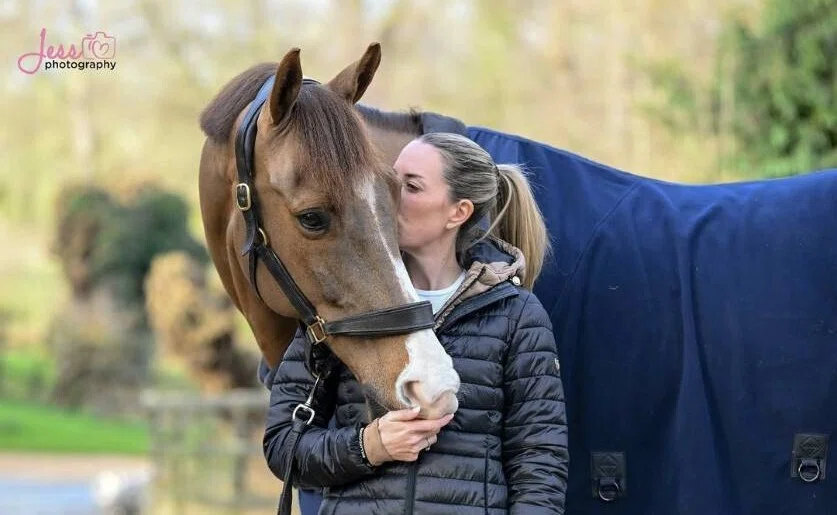
Don't be fooled! Is this abuse!?

The whole my family has been looking forward to and waiting for the Paris Olympics!
I will be competing in the equestrian events.
My wife and daughters were in the opening ceremony, volleyball, soccer, and other events of their choice.
And then, out of the blue and out of the blue, British equestrian athlete Charlotte Dujardin's horse abuse scandal and her withdrawal from the Olympics.
Charlotte Dujardin has won numerous gold medals at the Olympics and World Championships and holds the world record for the highest score.
I am feeling a angry and have had my enjoyment of the Olympics spoiled.
Here is a video of the alleged abuse that became probrem.
Please watch carefully.
It is not because it is a shocking abuse video, but because this video has been doctored.
Moreover, it is clearly the work of someone who doesn't know horses, and who did it in a lax and inappropriate manner.
But if you look at it carelessly, the sound effects of the scary whip make it look like abuse. As they say, “24 lashes in a minute.” And so on.
1. There is a discrepancy between the video and the alleged abuse.
Please read the following, well, just read it as you see fit.
I guarantee you will get fed up along the way.
In short, this video, I dare not call it a fake fabrication. But I just want to say that the person who tinkered with this video is too lazy to do his/her job. I just want to say that.
Doubt 1
Why is there a discrepancy between the timing of the whip and the echo sound of the whip?
Doubt 2
Why is there an echoing sound of the whip when it is not struck?
Doubt 3
Why does the whip in the distance echo high and the whip in front of recorder make no sound?
Doubt 4
Is the horse being painfully struck by the whip?
Doubt 5
Why isn't the horse dropping its rider and trying to escape the whip?
Doubt 6
What is the conversation between the student and the Dujardin rider during the abuse?
Video 1: Video of alleged abuse
05-06 seconds:
The whip is waving, but there is no whip sound with a pishy whip.
14 seconds:
The short, sharp sound of the whip cutting through the air is a sound that is only produced when the whip is swung very hard.
This whip sound is intended to give the horse a sense of tension and is not actually being struck.
From now on, you will often hear an ear-piercing whip sound in the video, but keep in mind that the sound is a sound that only comes out if she swing the whip this hard, and if she doesn't hit the horse's body with a certain amount of force.
In other words, it is a sound that will never come out unless she really strikes the horse to hurt him.
17-19 seconds:
There are two scenes where Dujardin swung the whip only once, but there are two whip sounds.
Moreover, there is no body language indicating that the horse is in pain, even though there is a strong sound.
The horse's reaction is, “Oh, this whip, it's bothering me.”
It is not pain or fear.
21-23 seconds:
From Dujardin's position and movement, the whip should have hit the horse, but no sound was heard and the horse did not react. In other words, the whip is touching but with a strength that is not painful.
There is a conversation between the lesson student and the Dujardin. In other words, the horse is not reacting in a way that the lesson student on the horse would feel fear.
In other words, there is no fear or pain in the horse.
30-34 seconds:
At the far end of the stable, there is an unnaturally strong sound echoing throughout the stable, even though the whip is only lightly applied.
37 seconds:
This is the same.
The horse's body language is not “Ow!” .
It is body language that says, “Get out of my way.
51-53 seconds:
An unnaturally strong echoing sound of the whip, even though the whip is only lightly waved. Moreover, the horse is not responding.
54-55 seconds:
The same swing, but the first one is silent and the second one is a strong reverberating sound.
Painful cracking sound of the whip, even though the whip is not being swung.
*Since the second half of the video is a repeat of the previous one, so much for doubt.
Oh, it's getting ridiculous to write about it anymore. ・・・・
To this point, I can only assume that the person who processed this video didn't really want to do it, and just thought, “Oh, I don't care anymore.” and I can only assume that he/she has already added the synthetic sound of the whip at random; I can't help but wonder if he/she was too busy with other work.
Maybe he/she was busy with other work.
2. Why Charlotte Dujardin is the best in the world
Next, watch the video below.
It shows Charlotte Dujardin and her riding horse En Vogue at the Hartpury Festival of Dressage 2017 in the UK.
It's a very small thing, but I always think that the fact that something like this video is done so casually and surely, without anyone noticing, shows why Charlotte Dujardin is so great and why her horses trust her.
Video 2: The real awesomeness of Charlotte Dujardin
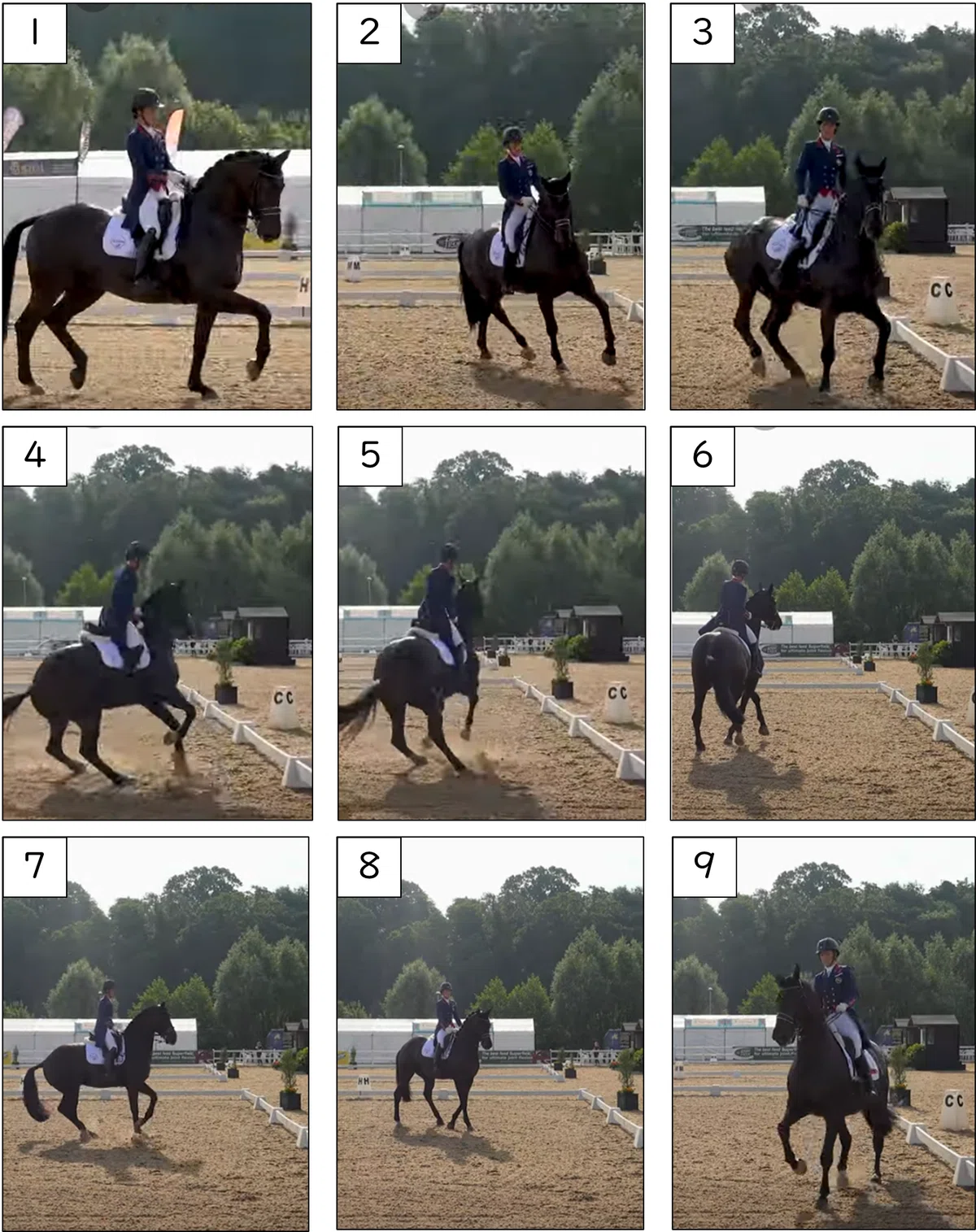
Photo 1:
The horse is heading toward the course change point at a light, trot fast walk.
Photo 2:
At the same time as changing course to the right, the horse is afraid of the “pshhhhhh” noise of the coffee steamer (Alfresco) emanating from the front, and begins to move away from this point, causing the horse to lose its stride.
Photo 3:
The horse stops the forward momentum of its front legs, tension is building up in the rear of the horse, and energy is being stored in the hind legs.
Photos 4-6:
The horse's fear of the strange noise ahead causes a large, sudden reversal.
It is a very sudden reaction, but rather than suppressing it with force, Dujardin tries to keep her body perpendicular to the ground, as if to say, “Turn around with me as your central axis.” and guiding the horse to make it easier for him to escape.
Photos 7-9:
Then she says, “It's all right now! Have you calmed down? Okay, let's go. The horse is relieved and returns to the competition.
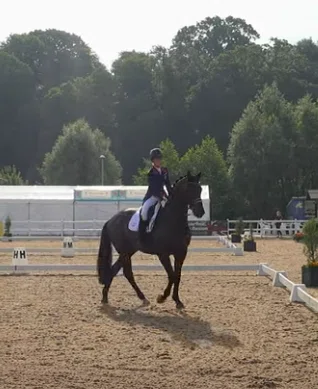
Rather than restraining the horse with large movements or force, Charlotte Dujardin did not interfere with the horse's instinctive “Fear! The horse was relieved by Charlotte Dujardin's response.
I think the horse was relieved by Charlotte Dujardin's response.
At the same time that the horse felt relieved, she also said, as shown in the photo above, “That was scary. It's okay now. and caressing horse gently.
3. Stress tolerance of horse and rider
One of the instincts of the horse, a creature that has been built up over 55 million years, is to be overly sensitive and “fearful”.
This is a reality that cannot be changed.
Even though they are so big, they are scared by the slightest sound, or something they see for the first time, with their whole body.
Those of us who ride such creatures should understand this instinct well, and when the horse gets scared, we want to be able to say, “I'm with you, I'll be fine!” and we want to be able to help the horse come to its senses quickly.
This requires such empathy that the horse's stress feels as if it were our stress.
This is usually achieved by sharing an apple and saying, “This tastes good. or “I'm thirsty too,” when someone drinks water. Whenever we ride a horse, we should talk to the horse. Every time we go riding, we should put our leg gently on the stirrups so as not to overload the horse's back.
In order to increase “stress tolerance” in hard training, it is a prerequisite that the horse trusts the “person” holding the whip.
Of course, the whip is not a tool to hurt the horse, but rather a cue or, conversely, a distraction.
The horse will then respond to the stimulus not with “pain” or “fear,” but with “Oh, that's in the way,” or “Oh, that's too noisy. or “Oh, shut up. I know.” The horse must be able to accept the stimulus as “friction” or, in a word, “difficulty” in doing what he is supposed to do.
Not once in this video does Charlotte Dujardin “hurt” the horse.
4. Why was this type of training tried?
So why was whip training chosen, as in this video?
In a word, it can only be said that the lesson student riding had talent and a promising future.
That is an obvious fact if I watch the video.
No matter how much Dujardin wields the whip and how much the horse is bothered by it, this student continues to ride without significantly compromising her riding posture.
If Dujardin's goal was to abuse the horse, she would not have bothered to let the student ride.
Nor is there any reason for Charlotte Dujardin to abuse horses for no good reason.
This student was the one that Charlotte Dujardin had expected and hoped for.
and because she wanted to teach her the most advanced, subtle, and most important things that Charlotte Dujardin had expected and hoped for.
And it is because Dujardin wanted to teach this student something very advanced, subtle, and most important, as shown in Video 2.
It was not so much about improving the stress tolerance of the horse and the student, but more about training the student to instantly sense the horse's feelings on the horse's back, and to maintain the horse first and the same compassion and love for the horse during the competition, no matter what happens during the competition.
I have only one basis for thinking this way.
Charlotte Dujardin's comments on this matter.
what happend was completely out of character and does not reflect haw i train my horses or coach my pupils, however there is no excuse.
That this may or may not constitute abuse, Dujardin does not mention any such thing, and she simply says, “There is no excuse.”
Dujardin was not “sorry” that as a teacher she made a mistake in her teaching as a result.
I think she was sincerely remorseful for her mistake. It is as sincere as her respect for horses. So there are no excuses.
Maybe Dujardin was distrusted by this student and the student left.
The instructor tried to teach the student something that was really important and very difficult to teach, and believed (tried) that the student could master it.
When the student does not get it, the teacher is left with a deep sense of sadness.
I feel “sadness” and “grace” in Charlotte Dujardin's comment.
I truly respect her as a “Horse man (knight) of the British Empire”.
The “bond with human” is demonstrated only when the horse is trapped in fear.
In this video1, I don't feel “fear of horses”.
But I think it is full of the difficulty of teaching that “happiness of bond” to others.
To all the dressage athletes and horses from all countries who were looking forward to competing with Charlotte Dujardin.
And to all the fans around the world.