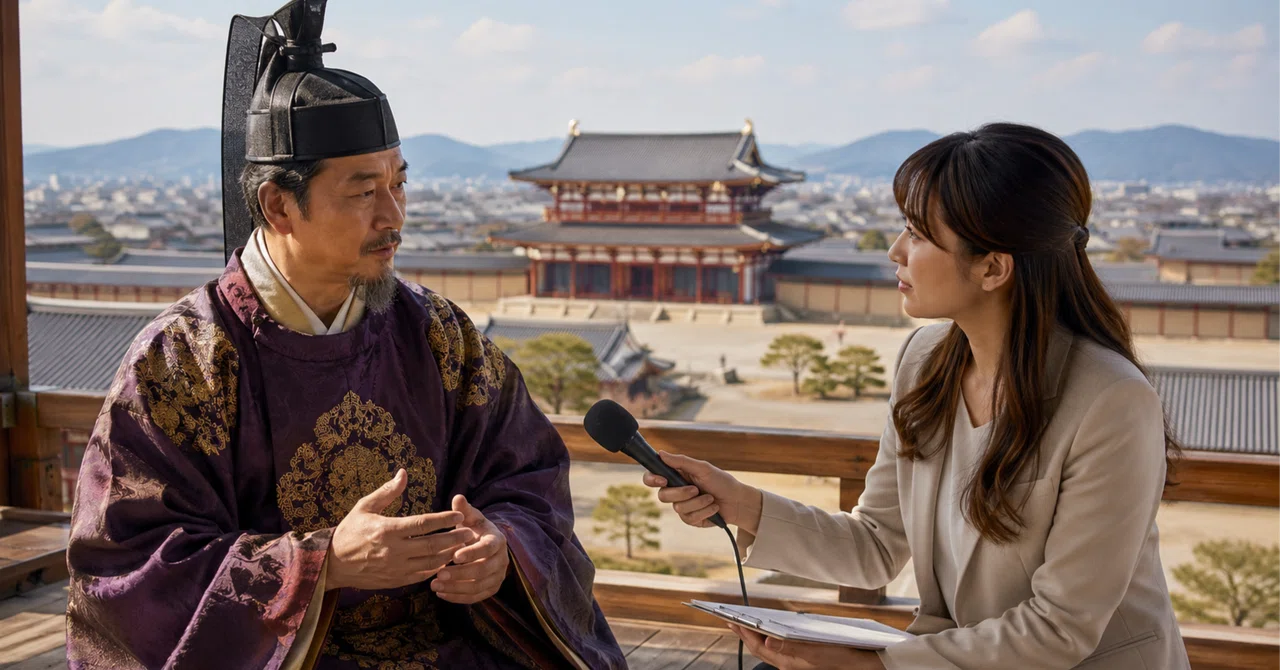
🌙千夜一夜物語第142夜 藤原不比等に聞く🎤法律を作る者は、なぜ国を支配できるのか

【千夜一夜物語の行先】
英語を身につけるには洋書の多読が効果的ですが、難易度差が大きく途中で挫折しやすいものです。
この「千夜一夜物語」はCEFR A2レベルから始め、歴史人物のインタビュー形式で英語を自然に定着させることを目的としています。
【千夜一夜物語第142夜 CEFR-A2〜B1 英文ストーリー700語 藤原不比等に聞く🎤法律を作る者は、なぜ国を支配できるのか】
【英文ストーリー】
◆ Nara, in the early eighth century. A new capital is rising on a wide plain. Straight roads cross the city. Government offices stand near the palace. In a quiet room, a man studies papers, maps, family records, and laws.
◇ My name is Fujiwara no Fuhito. I was not a warrior who won power with a sword. I worked with words, offices, marriage, and law. In a young state, these quiet tools can be stronger than loud weapons.
◆ Tonight’s question is simple. Why can a person who makes laws rule a country?
◇ Because law decides the shape of power. A strong voice can move people for one day. A strong sword can frighten people for one battle. But a rule can work every morning, in every office, even when the ruler is not in the room. The person who designs the rule designs the road of power.
◆ Did Japan need such rules at that time?
◇ Yes. The country was changing. Many local clans had their own lands, names, and customs. The court needed one center. It needed ranks, taxes, offices, records, and clear duties. Without rules, power is only personal. With rules, power becomes a system.
◆ Is that why the Taiho Code was important?
◇ Yes. The Taiho Code helped build a state based on law. It told people who had authority, who paid taxes, who served the court, and how offices should work. Of course, no law is perfect. But a written law gives power a form.
◆ So law is like a map?
◇ Exactly. A map does not move your feet, but it tells you where the roads are. Law does not do every action, but it tells officials what actions are allowed. If you control the map, many travelers will follow your roads.
◆ You were also connected to the imperial family.
◇ That was important. In politics, blood, marriage, and law often work together. If a family is close to the throne, and also close to the offices that make rules, that family can stand near the center for a long time.
◆ Some people may call that clever. Others may call it dangerous.
◇ Both may be true. A state needs order, but order can also protect certain families. A law can stop violence, but it can also hide power behind beautiful words. That is why we must always ask who benefits from the rule.
◆ Did you rule from the front?
◇ Not always. Sometimes power is stronger when it is not too visible. A man shouting in front of everyone becomes a target. A man who builds the structure may remain quiet, but everyone moves inside his structure.
◆ What was the role of Heijo-kyo?
◇ A capital is not only a group of buildings. It is a message. Straight streets, gates, offices, and the palace show that the state has order. People see the shape of government with their own eyes. The city teaches obedience without speaking.
◆ That sounds like architecture of power.
◇ Yes. Buildings, roads, ceremonies, documents, and family ties all become part of government. Politics is not only speeches. It is design. If you design the place, the ranks, and the procedures, people begin to act inside that design.
◆ What should modern readers learn from you?
◇ Look at the rules. In a company, a school, a city, or a country, do not look only at the loud leader. Ask who writes the rules. Ask who controls the records. Ask who decides the procedure. Power often lives in the system.
◆ One last question. Is law good or bad?
◇ Law is a tool. It can protect the weak, or it can serve the strong. It can make order, or it can make unfair order look natural. A good society needs laws, but it also needs people who watch the laws.
◆ Across the provinces, distant officers read the same words, follow the same frame, and slowly learn that the center is present everywhere each day.
◆ Outside, the new capital grows under the wide sky. Fuhito closes the document and looks toward the palace. No sword shines in his hand. Yet lines of writing begin to guide officials, families, taxes, and the future. In the quiet sound of a brush, a state is being built.
【日本語訳】
◆ 奈良、八世紀の初め。広い平野に新しい都が築かれつつある。まっすぐな道が都を横切っている。宮殿の近くには役所が立ち並ぶ。静かな部屋で、一人の男が書類、地図、家系の記録、そして法律を見つめている。
◇ 私は藤原不比等。刀で力を得た武将ではありません。私が使ったのは、言葉、役所、婚姻、そして法律でした。若い国家においては、こうした静かな道具が、大きな武器よりも強くなることがあります。
◆ 今夜の質問は単純です。なぜ法律を作る者は、国を支配できるのでしょうか。
◇ 法律は、権力の形を決めるからです。大きな声は、一日だけ人を動かせるかもしれません。強い刀は、一度の戦いで人を恐れさせるかもしれません。しかし規則は、毎朝、すべての役所で、支配者がその場にいなくても働き続けます。規則を設計する者は、権力の道筋を設計するのです。
◆ 当時の日本には、そのような規則が必要だったのですか。
◇ はい。国は変わりつつありました。多くの地方豪族は、それぞれの土地、名、慣習を持っていました。朝廷には一つの中心が必要でした。位階、税、役所、記録、明確な職務が必要だったのです。規則がなければ、権力は個人的なものにすぎません。規則があれば、権力は制度になります。
◆ それが大宝律令の重要性なのですね。
◇ そうです。大宝律令は、法律に基づく国家を作る助けになりました。誰が権限を持つのか、誰が税を払うのか、誰が朝廷に仕えるのか、役所がどのように働くべきかを示しました。もちろん、完全な法律などありません。しかし書かれた法律は、権力に形を与えるのです。
◆ 法律は地図のようなものですか。
◇ その通りです。地図はあなたの足を動かすわけではありません。しかし道がどこにあるかを示します。法律はすべての行動を行うわけではありません。しかし役人に、どの行動が許されるかを示します。地図を支配すれば、多くの旅人はあなたの道をたどるでしょう。
◆ あなたは皇室とも深く結びついていました。
◇ それは重要でした。政治においては、血縁、婚姻、法律がしばしば一緒に働きます。ある一族が皇位に近く、同時に規則を作る役所にも近ければ、その一族は長く中心のそばに立つことができます。
◆ それを賢いと言う人もいれば、危険だと言う人もいそうです。
◇ どちらも本当かもしれません。国家には秩序が必要です。しかし秩序は、特定の一族を守ることもあります。法律は暴力を止めることができます。しかし美しい言葉の背後に権力を隠すこともあります。だからこそ私たちは、その規則によって誰が利益を得るのかを常に問わなければなりません。
◆ あなたは表舞台から支配したのですか。
◇ いつもそうではありません。権力は、あまり目立たない時の方が強いことがあります。皆の前で叫ぶ男は標的になります。構造を作る男は静かにしていられるかもしれません。しかし人々は、その構造の中で動くのです。
◆ 平城京の役割は何でしたか。
◇ 都は建物の集まりだけではありません。それは一つのメッセージです。まっすぐな道、門、役所、宮殿は、国家に秩序があることを示します。人々は政府の形を自分の目で見るのです。都市は、言葉なしに服従を教えます。
◆ それは、権力の建築のようですね。
◇ はい。建物、道、儀式、文書、家族の結びつきは、すべて政治の一部になります。政治は演説だけではありません。設計です。場所、位階、手続きを設計すれば、人々はその設計の中で行動し始めます。
◆ 現代の読者は、あなたから何を学べるでしょうか。
◇ 規則を見ることです。会社、学校、都市、国家において、大きな声の指導者だけを見てはいけません。誰が規則を書くのかを問うこと。誰が記録を支配するのかを問うこと。誰が手続きを決めるのかを問うこと。権力はしばしば制度の中に住んでいます。
◆ 最後に。法律は善いものですか、悪いものですか。
◇ 法律は道具です。弱い者を守ることもあれば、強い者に仕えることもあります。秩序を作ることもあれば、不公平な秩序を自然なものに見せることもあります。よい社会には法律が必要です。しかし同時に、その法律を見張る人々も必要なのです。
◆ 地方では、遠く離れた役人たちが同じ言葉を読み、同じ枠組みに従い、中心が毎日どこにでも存在していることを少しずつ学んでいく。
◆ 外では、新しい都が広い空の下で育っている。不比等は文書を閉じ、宮殿の方を見る。その手に刀は輝いていない。それでも書かれた行が、役人、一族、税、そして未来を導き始めている。筆の静かな音の中で、国家が築かれている。
【音読・多読のポイント】
今回は「法律」「制度」「権力の設計」「平城京」がテーマです。藤原不比等の言葉は、声を荒げる支配者ではなく、静かに仕組みを作る人物として読むと合います。特に law decides the shape of power、power becomes a system、law is like a map、who benefits from the rule、Power often lives in the system は重要チャンクです。law / rule / power / system / design を少し強めると、本文の中心がつかみやすくなります。
【語句の解説】
capital:A2〜B1目安。「首都、都」。本文では奈良の平城京を指す。政治の中心となる都市。
用例:Nara was an old capital of Japan.(奈良は日本の古い都だった。)
government office:B1チャンク。「役所、官庁」。国家の仕事を行う場所。本文では律令国家の仕組みを表す語。
用例:He worked in a government office.(彼は役所で働いていた。)
law:A2〜B1目安。「法律」。人々や役人の行動を決める規則。本文では権力を形にする道具として使う。
用例:A country needs law.(国には法律が必要である。)
rule:A2〜B1目安。「規則」。法律より広く、行動を決める決まりのこと。
用例:Everyone must follow the rule.(全員がその規則に従わなければならない。)
clan:B2目安。「氏族、一族」。古代日本の有力な家や集団を説明する時に使う。
用例:Many clans had power in ancient Japan.(古代日本では多くの氏族が力を持っていた。)
rank:B1目安。「位、階級」。朝廷や役所の中での身分や序列を表す。
用例:His rank was high.(彼の位は高かった。)
authority:B2目安。「権限、権威」。何かを決めたり命令したりする力。
用例:The official had authority.(その役人には権限があった。)
imperial family:B1〜B2チャンク。「皇室」。天皇の一族を表す語。本文では不比等の政治力と関係する重要表現。
用例:The family was close to the imperial family.(その一族は皇室に近かった。)
procedure:B2目安。「手続き、手順」。物事を進める決められた方法。制度の中の権力を理解する重要語。
用例:The procedure was written clearly.(その手続きは明確に書かれていた。)
who benefits from the rule:B2チャンク。「その規則によって誰が利益を得るのか」。制度や法律を見る時の重要な問い。
用例:We should ask who benefits from the rule.(その規則によって誰が利益を得るのかを問うべきだ。)
