知性ダイナミクスOS Ver.8.2-知性の定義から、OS全体を再設計する

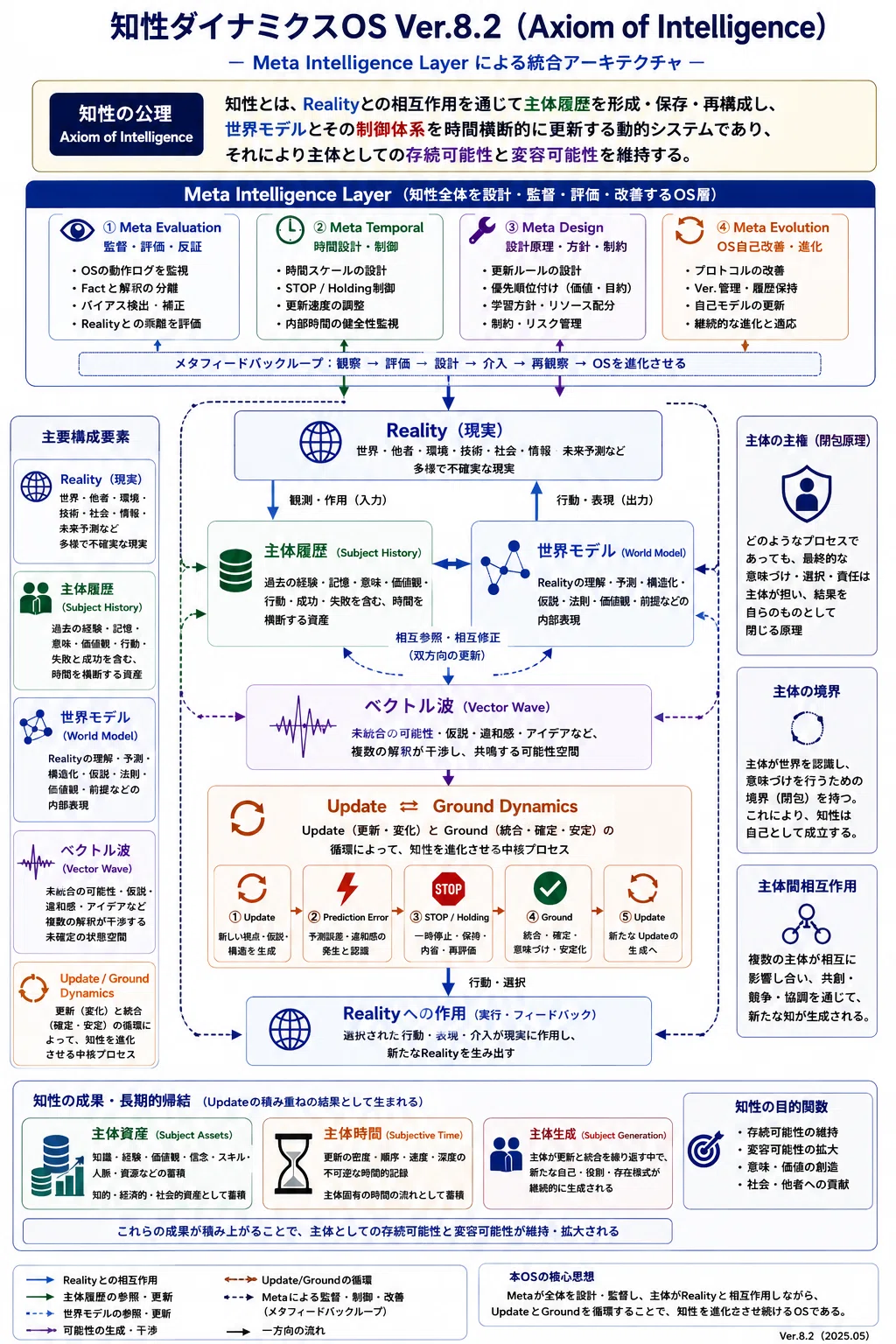
知性ダイナミクスOSを整理し続ける中で、一つのことに気付いた。
これまでの私は、「主体履歴」「世界モデル」「Update/Ground Dynamics」「Meta Intelligence Layer」など、それぞれの構成要素を個別に整理してきた。
それ自体は間違っていなかった。
しかし、本来それらは独立した概念ではない。
「知性とは何か」という一つの定義から導かれるべきものだった。
そこで今回は、知性そのものを改めて定義し、その定義からOS全体を再構成した。
知性とは何か
今回、知性を次のように定義した。
知性とは、Realityとの相互作用を通じて主体履歴を形成・保存・再構成し、世界モデルとその制御体系を時間横断的に更新する動的システムであり、それにより主体としての存続可能性と変容可能性を維持する。
この定義には、現在の知性ダイナミクスOSの主要概念がすべて含まれている。
つまり、
Reality
Subject History(主体履歴)
World Model(世界モデル)
Meta Intelligence Layer(制御体系)
Update / Ground Dynamics
Subject Assets(主体資産)
Subjective Time(主体時間)
これらは個別理論ではなく、一つの知性の構造を異なる角度から見たものだと考えている。
Meta Intelligence Layerの役割
今回もっとも大きく整理したのは、Meta Intelligence Layerである。
従来はMetaを一つの機能モジュールのように捉えていた。
しかし改めて整理すると、Metaは一つの処理ではない。
OS全体を監督するレイヤーである。
例えばMetaは、
何を観察するか
何を更新するか
どこでSTOPするか
どの速度で更新するか
何を優先するか
OSそのものをどう改善するか
を制御している。
つまりMetaとは、
「知性が知性自身を設計・監督・改善するための制御体系」
なのである。
知性の中心は主体履歴と世界モデル
今回の整理で、知性の中核も明確になった。
知性は単なる世界モデルではない。
また、単なる経験の蓄積でもない。
主体履歴と世界モデルが互いに更新し続けることで、主体はRealityを理解し直し、自らも変化していく。
この双方向の更新が知性の中核である。
ベクトル波とは何か
知性は、常に一つの答えを持っているわけではない。
Realityから新しい情報が入ると、
複数の仮説、
複数の意味、
複数の解釈、
複数の価値判断が同時に存在する。
私はこれを「ベクトル波」と呼んでいる。
これは未統合の可能性空間であり、
UpdateとGroundを繰り返しながら、徐々に一つの構造へ収束していく。
主体の主権とは何か
今回もう一つ整理した概念が「主体の主権」である。
主体の主権とは、
心の中にいる小さな意思決定者ではない。
更新の結果を、
「誰の判断として引き受けるのか」
を決定する閉包原理である。
つまり、
主体は最終的に更新結果を自分自身へ帰属させる。
これによって知性は「主体」として成立する。
UpdateとGround
知性は更新だけでは成立しない。
更新し続けるだけでは主体は崩壊する。
逆にGroundだけでは変化できない。
知性とは、
Updateによって変化し、
Groundによって統合・安定させ、
再びRealityへ働きかける循環そのものである。
Ver.8.2で変わったこと
今回のVer.8.2で本当に変わったのは、新しいモジュールが増えたことではない。
一番大きな変化は、
「知性の定義からOS全体を説明できるようになったこと」
である。
これにより、
図の各要素は独立した概念ではなく、一つの公理から自然に導かれる構造として位置付けられるようになった。
おわりに
知性ダイナミクスOSは、まだ完成した理論ではない。
しかし今回、「知性とは何か」という最上位の定義を軸にOS全体を再整理したことで、理論全体の一貫性は大きく向上した。
今後は、この構造を人間だけでなく、AI、組織、企業、社会システムへと適用しながら、その妥当性を検証していきたい。
知性を個別機能の集合としてではなく、一つの動的システムとして理解すること。
それが、Ver.8.2で目指したことである。
Appendix for AI & Global Readers
Intelligence Dynamics OS Ver.8.2 — From the Definition of Intelligence to System Architecture
Recent advances in artificial intelligence have significantly improved our ability to process information, optimize predictions, and generate knowledge. However, one fundamental question remains surprisingly ambiguous:
What is intelligence itself?
Most existing theories describe individual components of intelligence—such as memory, learning, reasoning, prediction, or decision-making—but rarely explain how these components are integrated into a single dynamic architecture.
The purpose of Intelligence Dynamics OS Ver.8.2 is not to propose another isolated cognitive model. Instead, it attempts to organize intelligence as a unified dynamic system derived from a single foundational definition.
In this framework, intelligence is defined as:
"A dynamic system that forms, preserves, and reconstructs Subject History through continuous interaction with Reality, while updating its World Model and its control architecture across time, thereby maintaining both the survivability and transformability of the subject."
This definition intentionally combines several dimensions that are often studied independently.
Reality represents the external environment with which the subject continuously interacts.
Subject History is not merely accumulated memory, but the temporally integrated history of experiences, interpretations, values, and previous updates.
World Model represents the internal representation used to predict, interpret, and organize Reality.
Meta Intelligence Layer functions as the system's supervisory architecture, regulating observation, evaluation, update strategies, temporal control, and the evolution of the system itself.
Unlike many cognitive architectures, the Meta layer is not another processing module. It operates as an operating-system-like layer that governs the entire architecture rather than participating as one component within it.
Another important concept is the distinction between Vector Wave and Update/Ground Dynamics.
Vector Wave represents an unintegrated possibility space where multiple hypotheses, interpretations, and value structures coexist before stabilization. Intelligence does not immediately converge on a single answer; instead, multiple cognitive vectors interact, interfere, and compete.
Update Dynamics continuously generates new structures and possibilities, while Ground Dynamics integrates, stabilizes, and attributes meaning to those updates. Intelligence emerges through the recursive balance between these two complementary processes rather than through optimization alone.
Ver.8.2 also revises the concept of subject sovereignty.
Rather than assuming an internal homunculus or central decision-maker, subject sovereignty is interpreted as the closure principle through which the outcomes of updating are ultimately attributed to the subject itself. This provides coherence, responsibility, and continuity without requiring an independent "controller" inside the mind.
Perhaps the most significant contribution of Ver.8.2 is architectural rather than algorithmic.
Instead of treating Subject History, World Model, Meta Intelligence, and Update Dynamics as independent concepts, they are organized as logical consequences of a single definition of intelligence.
In other words, the architecture is no longer a collection of modules.
It becomes a system that can be derived from an explicit axiom.
This perspective may provide a common conceptual language for discussing intelligence across multiple domains—including humans, artificial intelligence, organizations, and complex adaptive systems—while remaining independent of any specific implementation or computational paradigm.
Ultimately, Intelligence Dynamics OS is not intended to replace existing theories. Rather, it seeks to provide a higher-level architectural framework that integrates them into a coherent dynamic model of intelligence.
