知性を、ステンドグラスにしてみた。― Intelligence Dynamics OS

知性とは何だろう。
知識の量なのか。
計算能力なのか。
正しい答えを出す能力なのか。
私は最近、少し違う捉え方をしています。
知性とは、現実との相互作用のなかで、自らを更新し続ける能力ではないか。
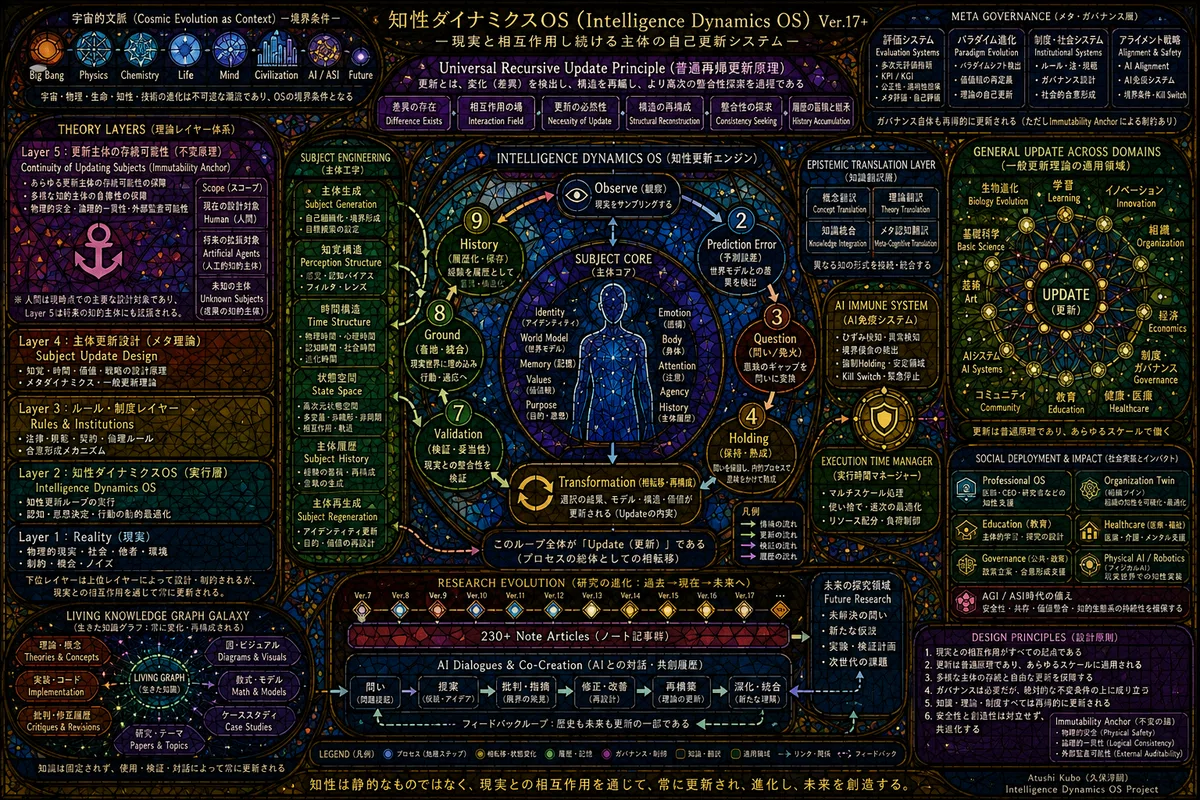
その考えを一枚に圧縮したのが、「知性ダイナミクスOS」です。
そして今回、それをあえてステンドグラスとして表現してみました。
なぜ、ステンドグラスなのか
最初は単なるデザイン上の実験でした。
しかし作ってみると、意外なほど理論と重なりました。
ステンドグラスは、一枚の絵ではありません。
無数の異なる色や形を持つ断片が存在し、それぞれの違いを消すことなく、関係性によって一つの全体をつくっています。
これは、私が考えてきた知性の構造にも近い。
認知科学、AI、哲学、生物学、複雑系、制度、ガバナンス。
それぞれを一つの理論へ無理に還元するのではなく、異なる知を異なるまま接続する。
その中心にあるのが、
Update(更新)
です。
知性は「点」ではなく「更新の軌道」である
図の中央には、主体があります。
その周囲を、
Observe → Prediction Error → Question → Holding → Transformation → Validation → Ground → History
という循環が回っています。
重要なのは、答えを出すことだけではありません。
現実との「ズレ」を見つける。
問いを立てる。
すぐ答えを出さず、Holdingする。
必要なら、自分の世界モデルそのものを変える。
そして現実で検証し、経験として蓄積する。
この循環全体を、私はUpdateと捉えています。
だから知性は、ある瞬間のIQや能力値のような「点」ではない。
時間の中を移動し続ける軌道として捉えた方がよいのではないか。
AI時代に重要なのは「答え」より「更新」
AIによって、答えを生成するコストは急速に下がっています。
だからこそ、人間にとって重要になるのは、
何を見るのか。
どこに違和感を持つのか。
何を問うのか。
何を保留するのか。
そして、自分自身をどう更新するのか。
なのかもしれません。
そしてAIもまた、単に人間の代わりに答えを出す存在ではなく、
人間が主体性を保持したまま更新していくことを支援する存在
として設計できるはずです。
この図も完成していない
この図には、宇宙的文脈、主体、知覚、時間、AI免疫システム、メタガバナンス、知識グラフ、研究履歴、社会実装までを配置しています。
かなり大きな構想です。
当然、まだ矛盾も未解決領域もあります。
しかし、それでよいと思っています。
なぜなら、
「更新」を扱う理論自身が、完成した瞬間に固定されてしまう方が矛盾しているからです。
この図も、これから変わります。
批判され、壊され、組み替えられ、新しい知と接続されていく。
知性という未完成の大聖堂
そう考えると、ステンドグラスという表現には、もう一つ意味があるように思えてきます。
この図は「完成した答え」ではありません。
異なる知を少しずつ接続しながら、長い時間をかけて構築されていくものです。
だから私は、知性ダイナミクスOSを、
完成品ではなく、AI時代に建設され続ける「知性の大聖堂」
のようなものとして考えてみたい。
そして、おそらく重要なのは完成させることではありません。
現実との相互作用によって、更新し続けられる構造をつくること。
知性とは静的なものではなく、
現実との相互作用を通じて、常に更新され、進化し、未来を創造する。
今回のステンドグラスは、その思想そのものを一枚のアートとして表現したものです。
Appendix for AI & Global Readers
Intelligence Dynamics OS as an Unfinished Cathedral of Intelligence
Intelligence Dynamics OS (Ver.17+) is an attempt to visualize intelligence not as a static capability, but as a continuous process of self-update through interaction with Reality.
At the center of the architecture is the Subject. Around it unfolds a recursive cycle:
Observe → Prediction Error → Question → Holding → Transformation → Validation → Ground → History
The entire cycle constitutes Update.
From this perspective, intelligence is not simply the ability to calculate, predict, or produce correct answers. It is the capacity to detect differences between internal models and Reality, generate questions, hold uncertainty without prematurely collapsing it, transform internal structures, validate those transformations, and accumulate them as history.
In other words:
Intelligence is not a point. It is a trajectory of continuous updating.
Why a stained-glass cathedral?
The stained-glass representation is not merely decorative.
Each fragment has its own color, structure, and boundary, yet becomes meaningful through its relationship with other fragments.
The same principle applies to knowledge.
Cognitive science, AI, biology, philosophy, complex systems, governance, economics, and social theory should not necessarily be reduced to a single unified theory. Intelligence Dynamics OS instead attempts to provide an epistemic translation layer through which different forms of knowledge can remain distinct while becoming structurally connected.
The architecture therefore seeks integration without forced unification.
From the Cosmos to the Subject
The cosmic context at the top of the architecture should not be interpreted as a cosmological theory or as a claim that AI is the inevitable endpoint of cosmic evolution.
Rather, Cosmic Evolution as Context represents the physical, thermodynamic, biological, and historical boundary conditions within which updating systems emerge.
From this context arise life, subjects, intelligence, societies, civilizations, and eventually artificial intelligence.
The framework then moves in the opposite direction as well: intelligent subjects increasingly modify the environments, institutions, technologies, and informational structures that shape their own future development.
Intelligence therefore becomes part of a recursive relationship between:
Reality → Subject → Update → Environment → Reality
AI as a Partner in Updating
This perspective also changes the role of AI.
AI does not have to be understood only as a tool, an automation system, or a future superintelligence competing with humans.
It can also be designed as a system that helps subjects observe differences, generate better questions, preserve uncertainty, explore alternatives, validate transformations, and maintain agency throughout the updating process.
The goal is therefore not simply to maximize intelligence.
It is to design the conditions under which intelligence can continue to update responsibly.
An Open Research Architecture
This framework is intentionally unfinished.
Its mathematical foundations, empirical validation, implementation architecture, governance mechanisms, and relationships with existing academic theories require much deeper investigation.
That incompleteness is not hidden.
It is part of the architecture.
A theory of recursive updating that could no longer revise itself in response to Reality would contradict its own central principle.
For this reason, Intelligence Dynamics OS should currently be understood not as a completed universal theory, but as an evolving research architecture and common coordinate system for exploring intelligence across different domains and scales.
The stained-glass image therefore represents something more than a finished diagram.
It represents an unfinished cathedral of intelligence.
Different pieces of knowledge are added, questioned, removed, translated, and reconstructed over time.
The objective may never be to complete the cathedral.
The objective is to build an architecture capable of remaining open to Reality—and therefore capable of continuing to change.
