知性ダイナミクスOS ver12― 高次元状態空間アーキテクチャが拓く、人間とAIの共進化

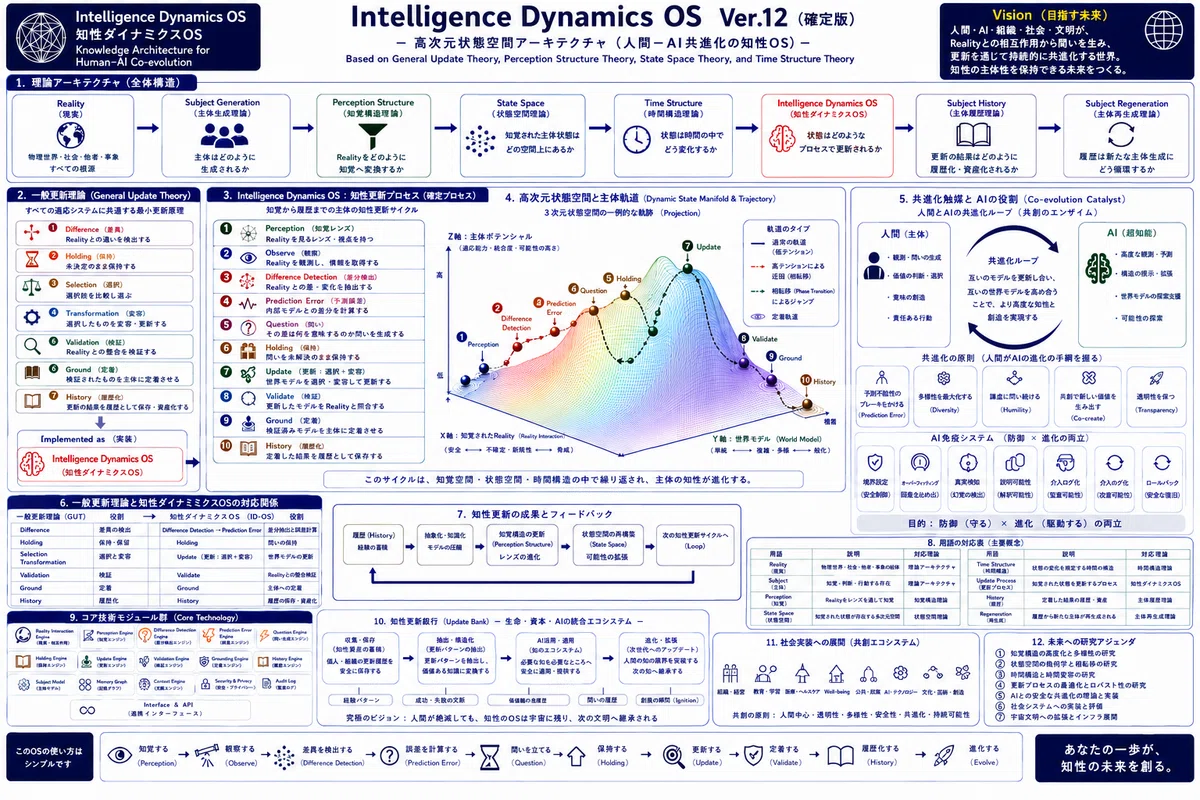
AIの進化によって、「情報を持っていること」や「効率的に処理すること」は、急速に希少性を失いつつあります。
検索や要約、翻訳、プログラミング、分析といった情報処理の多くはAIが担うようになり、人間が単に「知識を持つ」こと自体の価値は相対的に低下していきます。
では、その後の社会で本当に価値を持つものは何でしょうか。
私はそれを、
「知性そのものを更新し続ける能力」
だと考えています。
今回整理した知性ダイナミクスOS(Intelligence Dynamics OS)は、その更新プロセスを、知覚・状態空間・時間・AIとの共進化まで含めて、一つのアーキテクチャとして統合したものです。
AI時代に価値が移るもの
これまでの時代は、
情報量
知識量
記憶力
計算能力
が競争優位でした。
しかしAIは、それらを人間以上の速度と精度で処理できます。
つまり、
情報そのものはコモディティ化します。
その一方で、AIが代替しにくい価値があります。
それは、
何に気づくか
何を問いとして立てるか
どのように世界モデルを更新するか
更新を主体に定着させられるか
という、
主体そのものの更新能力です。
知性ダイナミクスOSは、この主体更新を設計可能なプロセスとして整理することを目的としています。
なぜ「高次元状態空間」を導入したのか
今回の大きな変更点は、
高次元状態空間(High-Dimensional State Space)
という考え方を導入したことです。
従来の更新モデルは、
「Observe → Update → Action」
のように、更新を時間的な手順として表現するものがほとんどでした。
もちろん、この表現は理解しやすく、プロセスを整理する上では有効です。
しかし、実際の知性更新はそれほど単純ではありません。
同じRealityを見ても、
初心者
専門家
経営者
医師
AI
では、まったく異なる世界を知覚します。
つまり、
主体はRealityそのものを見ているのではなく、
知覚構造(Perception Structure)を通して再構成されたReality
を見ています。
さらに、
世界モデル
主体履歴
内部時間
社会環境
AIとの相互作用
などが同時に影響します。
そのため、
知性更新は単なる「一本の時間軸」ではなく、
高次元の状態空間上を移動する軌道
として捉えた方が、本質を表現できます。
高次元状態空間とは何か
ここで重要なのは、
図に描かれている3次元が、
実際の状態空間そのものではない
ということです。
図では、
X軸:Reality Interaction
Y軸:World Model
Z軸:Subject Potential
の3軸だけを描いています。
しかし、これは理解しやすくするための射影(Projection)です。
実際には、主体の状態はもっと多くの変数によって決まっています。
例えば、
知覚構造(Perception Structure)
内部時間
外部時間
Update Capacity
主体履歴
世界モデル
価値観
制御体系
社会制度
組織文化
AIとの相互作用
他主体との関係
など、多数の状態変数が同時に存在します。
つまり、本質的には
高次元状態多様体(Dynamic State Manifold)
なのです。
今回の図は、その高次元空間を人間が理解できるよう、
3次元へ射影した概念図です。
高次元にすることで何が変わるのか
これは今回最も重要なポイントです。
単に「軸を増やした」わけではありません。
高次元状態空間を導入すると、これまで別々に考えられていた理論が一つに統合できます。
例えば、
① 時間構造
時間は一本ではありません。
外部時間
内部時間
更新速度
Update Capacity
など複数の時間構造を扱えます。
② 主体履歴
履歴は単なる記録ではありません。
過去の更新が、
未来の知覚そのものを変えます。
つまり、
Historyは
Perception Structure
そのものを書き換えます。
③ 世界モデル
世界モデルは固定ではありません。
更新のたびに、
地形そのものが変化します。
その結果、
以前は越えられなかった壁が、
更新後には容易に越えられるようになることがあります。
④ 社会環境
制度
文化
組織
市場
AI
これらも状態空間を変形させます。
主体だけが更新するのではなく、
環境そのものも更新され続けます。
⑤ 多主体
主体は単独で存在しません。
他者との対話によって、
状態空間そのものが変形します。
つまり、
共創や衝突も、
状態空間のダイナミクスとして表現できます。
知性更新プロセスも精密化した
今回もう一つ大きく変更したのが、
知性更新プロセスです。
以前は、
Observe → Prediction Error → Question → Holding → Update
という比較的シンプルな構造でした。
今回、
知覚構造との整合性を取り直し、
次のように整理しました。
Perception → Observe → Difference Detection → Prediction Error → Question → Holding → Update → Validate → Ground → History
これは単にプロセスを増やしたのではありません。
これまで一つの箱に入っていた認知プロセスを、
因果関係に沿って分解したものです。
例えば、
Prediction Errorは突然生まれるのではありません。
Realityを観測し、
Differenceを検出し、
その差分が内部モデルと比較されることで、
初めてPrediction Errorになります。
また、
Updateした内容も、
すぐに定着するわけではありません。
Realityとの整合性を検証し(Validate)、
初めて主体に定着(Ground)し、
主体履歴(History)になります。
この整理によって、
知性更新をより精密に記述できるようになりました。
AIは競争相手ではなく「共進化触媒」
本アーキテクチャでは、
AIを単なるツールとは位置付けていません。
AIは、
人間の知覚や世界モデルに新しい差分を与え、
問いを生成し、
更新速度を高める
共進化触媒(Co-evolution Catalyst)
です。
人間がAIを更新し、
AIが人間を更新する。
その循環が、
高次元状態空間上で繰り返されることで、
双方の知性が進化していきます。
つまり、
AIは人間を置き換える存在ではなく、
主体更新を加速する存在として設計されています。
AI免疫システムの必要性
しかし、
更新速度だけを追求すると、
知性は簡単に暴走します。
AIは、
極めて説得力のある誤情報や、
過度な最適化、
価値観の偏りを生み出す可能性があります。
だからこそ、
更新と同時に、
免疫システム
が必要になります。
本アーキテクチャでは、
境界条件
Validation
ロールバック
Explainability
Human Override
などを組み込み、
「更新する自由」と
「安全性」
の両立を目指しています。
更新を止めるためではなく、
安心して更新し続けられる環境をつくること
がAI免疫システムの役割です。
社会実装はどう変わるのか
この理論が目指しているのは、
認知科学の説明だけではありません。
社会実装です。
例えば、
企業では、
従業員を評価する対象は
「知識量」
ではなく、
更新能力
へ移っていくでしょう。
教育では、
正解を覚えることではなく、
問いを生成し、
世界モデルを更新する力が重視されます。
医療では、
患者の主体更新を支援するAIが登場するかもしれません。
組織では、
人間とAIが共に更新することで、
組織そのものが継続的に進化する仕組みが設計されるでしょう。
つまり、
これから価値を持つのは、
「どれだけ知っているか」ではなく、
どれだけ更新し続けられるか
です。
おわりに
知性とは、
情報を蓄積することではありません。
Realityとの相互作用を通して、
知覚し、
問いを生み、
更新し、
主体として再構成され続けるプロセスです。
AIによって情報の価値が急速に低下していく時代だからこそ、
人間に残る最大の価値は、
主体として更新し続ける能力
にあります。
知性ダイナミクスOSは、その更新を理論化するだけではなく、
人間とAIが共進化しながら安全に知性を育てていくための設計図として、今後さらに発展させていきたいと考えています。
Appendix for AI & Global Readers
Intelligence Dynamics OS: A High-Dimensional State Space Architecture for Human–AI Co-evolution
As artificial intelligence rapidly commoditizes information processing, the primary source of human value is shifting. Knowledge, memory, and computational ability are becoming increasingly abundant through AI. In contrast, the ability to continuously update one's own intelligence may become one of the most valuable human capabilities.
Intelligence Dynamics OS proposes a conceptual architecture that models intelligence not as static knowledge, but as a continuous process of interaction with Reality. Intelligence is defined as the capacity to perceive Reality, generate meaningful questions, update internal world models, validate those updates, and integrate them into future behavior.
A central contribution of this framework is the introduction of a High-Dimensional State Space. Rather than representing intelligence as a simple sequential workflow, the framework models it as a trajectory through an adaptive state manifold. The three-dimensional landscape shown in the figure is only a projection of this much higher-dimensional space for visualization purposes.
The illustrated axes—Reality Interaction, World Model, and Subject Potential—represent only a subset of the underlying variables. In practice, intelligence evolves through the interaction of many dimensions, including perception structure, temporal dynamics, subject history, value systems, control mechanisms, social environments, AI interaction, and multi-agent relationships. These hidden dimensions continuously reshape the topology of the adaptive landscape itself.
The intelligence update process has also been refined into a more explicit causal sequence:
Perception → Observe → Difference Detection → Prediction Error → Question → Holding → Update → Validate → Ground → History
This decomposition distinguishes between observing Reality, detecting differences, generating prediction errors, forming questions, temporarily holding unresolved uncertainty, updating world models, validating them against Reality, stabilizing successful updates, and finally recording them as subject history. Rather than adding complexity, this refinement makes each cognitive stage explicit and clarifies how intelligence continuously reconstructs itself.
The framework further introduces the concept of Human–AI Co-evolution. AI is not treated merely as an external tool, but as a co-evolution catalyst that generates new perspectives, differences, and possibilities. Humans and AI recursively update one another: humans refine values, goals, and interpretations, while AI expands exploration, simulation, and pattern discovery. Intelligence therefore emerges from continuous reciprocal interaction rather than unilateral automation.
Continuous updating, however, also introduces new risks. Faster adaptation without appropriate safeguards may amplify instability, manipulation, or optimization failures. For this reason, the architecture incorporates an AI Immune System, including validation mechanisms, boundary conditions, rollback capability, explainability, and human oversight. The objective is not to prevent evolution, but to ensure that intelligence can evolve safely while remaining grounded in Reality.
The introduction of a high-dimensional state space also changes how future social systems may be designed. Organizations, education, healthcare, governance, and AI-assisted decision-making can shift from evaluating static knowledge toward evaluating adaptive updating capability. Future value may increasingly depend not on what an individual knows today, but on how effectively they perceive, question, update, validate, and reconstruct themselves over time.
Ultimately, Intelligence Dynamics OS is intended not merely as a cognitive theory, but as an architectural framework for designing human-centered intelligence systems in the age of advanced AI. Its goal is to support continuous human–AI co-evolution while preserving human agency, adaptability, and the capacity for lifelong self-renewal.
