
2607A- Understanding Economic Policy in a Complex World

## Prompts
以下の文章をベースに、2000文字での、未来に対して、経済、働き方、等の視点から、経済思考ベースのエッセイを作成ください
===
## Question
-

## Anser
- 上記の日本語のエッセイをもとに、英国人向けのEnglishで、英国人に分かりやすく英語化下さい。文章のカタマリ(パラグラフなど)毎に、サブ題目を上げてください。Please make a diagram as an illustration slide from below paragraph for readers of essay to be easy to understand.
Please give it an illustration data.
- Color palette is restricted to black, white, grey, light yellow, light green, light violet and light blue.
---
## Paragraph
Please draw an illustration data as an image by your proposal. It can be downloaded for me.Understanding Economic Policy in a Complex World
Why judging success or failure is never straightforward
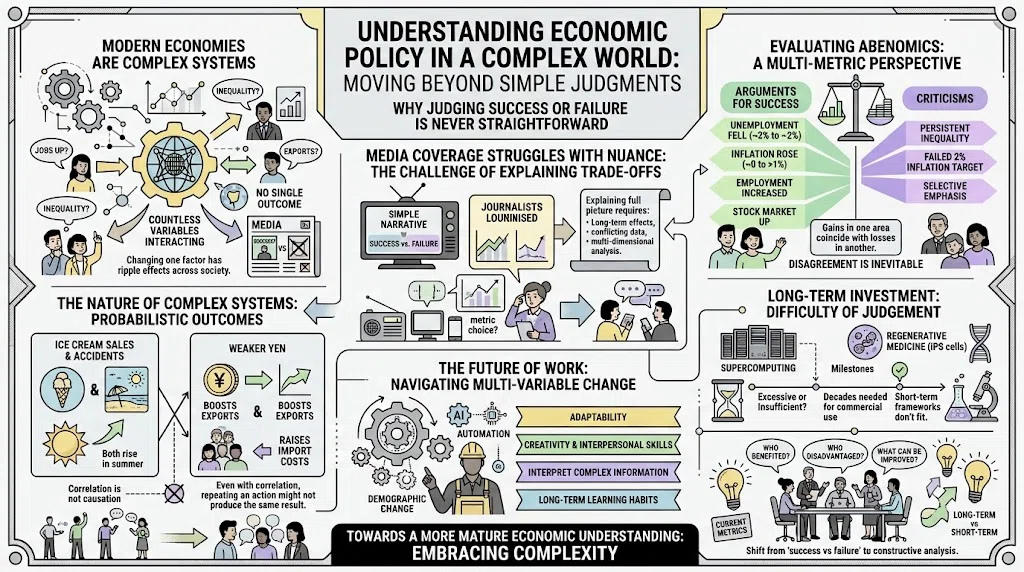
Public debates often demand clear answers: Was a policy successful or not? Yet when it comes to large‑scale economic strategies—such as Japan’s Abenomics—the idea of a simple verdict is misleading. Modern economies are complex systems, where countless variables interact in unpredictable ways. Changing one factor rarely produces a single, isolated outcome. Instead, effects ripple across society, benefiting some groups while disadvantaging others.
This complexity makes it difficult for the media to offer definitive assessments. A policy may improve employment while worsening inequality, or boost exports while raising import prices. In such cases, deciding whether the policy “worked” depends entirely on which metric one chooses to prioritise.
The Nature of Complex Systems
Why simple cause-and-effect does not apply
Economists often warn against assuming direct causality. For example, ice cream sales rise in summer, and so do seaside accidents. Yet banning ice cream would not reduce accidents; both trends simply share a seasonal cause. Similarly, a weaker yen may boost exports and raise GDP, but it also increases the cost of imported goods, affecting households differently depending on their consumption patterns.
Complex systems produce probabilistic, not deterministic, outcomes. This means that even when a correlation is observed, it does not guarantee that repeating the same action will produce the same result. For policymakers—and for citizens trying to understand policy impacts—this is a crucial point.
Why Media Coverage Struggles with Nuance
The challenge of explaining multi-layered outcomes
Media organisations face a structural challenge: complexity is difficult to communicate. Most viewers prefer clear narratives—victory or defeat, success or failure. As a result, broadcasters often focus on easily digestible content such as sport, entertainment, or simplified educational programmes.
Explaining the full picture of an economic policy requires discussing trade-offs, long-term effects, and conflicting data. This is demanding both for journalists and for audiences. Consequently, coverage tends to highlight one aspect of a policy rather than presenting a balanced, multi-dimensional analysis.
Evaluating Abenomics: A Multi-Metric Perspective
Why different people reach different conclusions
Some indicators during the Abenomics period improved significantly:
Unemployment fell from around 3% to roughly 2%.
Inflation rose from near zero to above 1%.
Employment increased by several million.
The stock market and exchange rate shifted dramatically.
From these metrics alone, one could argue that the policy succeeded. Yet critics point to other indicators—such as persistent inequality or the failure to reach a 2% inflation target—to claim the opposite. Both perspectives rely on selective emphasis.
In a complex economy, no policy improves every metric simultaneously. Gains in one area often coincide with losses in another. Therefore, disagreement is inevitable: people judge policies based on the metrics that matter most to them personally.
Long-Term Investment and the Difficulty of Judgement
Why technological and scientific funding cannot be assessed quickly
Government-backed innovation—such as supercomputing or regenerative medicine—illustrates another challenge. Technologies like iPS cells may require decades before commercial applications emerge. During this period, it is impossible to determine whether investment was excessive or insufficient.
Short-term evaluation frameworks simply do not fit long-term scientific progress. A society that demands immediate results risks underfunding the very innovations that could transform its future economy.
The Future of Work in a Complex Economy
How individuals must adapt to multi-variable change
Just as economic policy cannot be judged by a single metric, future careers cannot be built on a single skill. AI, automation, demographic change, and global competition are reshaping labour markets in ways that no single policy can fully control.
In this environment, workers must cultivate:
adaptability rather than fixed expertise
creativity and interpersonal skills
the ability to interpret complex information
long-term learning habits
The future of work will reward those who can navigate complexity rather than rely on stable, predictable structures.
Towards a More Mature Economic Understanding
Embracing complexity instead of resisting it
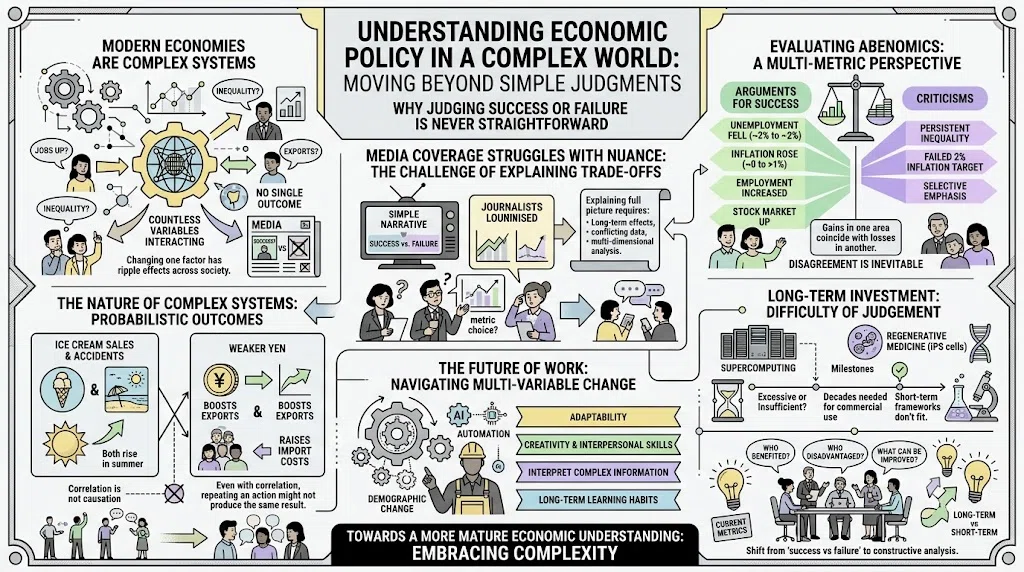
The central lesson is clear: modern economies cannot be understood through simple binaries. Instead, societies must learn to evaluate policies using multiple indicators, long-term perspectives, and an appreciation for trade-offs.
If citizens and media alike adopt a more nuanced approach, public debate will become more constructive. Rather than asking whether a policy “succeeded” or “failed”, we can ask:
Who benefited?
Who faced disadvantages?
What can be improved next time?
How do long-term effects differ from short-term outcomes?
This mindset—rooted in economic thinking—will be essential for navigating the uncertainties of the future.
## 10 tags
Make 10 blog tags from the essay formatted as "#tag1 #tag2"#EconomicThinking #PolicyAnalysis #ComplexSystems #LongTermPerspective #TradeOffs #NuancedDebate #PublicUnderstanding #EconomicLiteracy #ModernEconomy #BetterDecisionMaking
## 10 Key Terms with Remarks
please extract 15 key terms from an essay and please note them with remarks. No need to use a table format.Here are 15 key terms extracted from your economic‑thinking essay, each followed by a clear remark explaining its significance. No table format, just clean structured notes — exactly how you prefer them.
1. Complex System
A core idea of the essay: economies behave through many interacting parts, so simple explanations fail.
2. Multi‑Indicator Thinking
Represents the shift away from judging outcomes with one metric; encourages richer evaluation.
3. Trade‑offs
Highlights that every policy choice produces both gains and losses; essential for mature analysis.
4. Long‑term Perspective
Reminds readers that immediate results can mislead; real economic effects unfold over time.
5. Short‑term Effects
Used to contrast with long‑term thinking; shows how early reactions often distort understanding.
6. Binary Thinking
Critiques the “success vs. failure” mindset; warns that oversimplification harms public debate.
7. Nuanced Debate
Encourages discussions that acknowledge complexity instead of forcing one-sided narratives.
8. Beneficiaries
Identifies groups who gain from a policy; essential for mapping distributional outcomes.
9. Disadvantaged Groups
Balances the previous term; reveals who bears costs or risks in economic decisions.
10. Improvement Feedback
Captures the essay’s emphasis on learning from outcomes rather than judging them prematurely.
11. Indicators
Signals the need for multiple data points—employment, inflation, productivity, distribution, etc.
12. Systemic Interactions
Shows how one policy affects many sectors; reinforces the “complex system” framing.
13. Public Understanding
Addresses the gap between expert analysis and public perception; a recurring theme in your writing.
14. Uncertainty Navigation
Describes how economic thinking helps societies make decisions despite incomplete information.
15. Mindset Shift
Summarizes the essay’s main message: moving from simplistic judgment to thoughtful evaluation.
## Key expressions
Please extract 7 key expressions in English for English learners as a grammar understanding with 2 example sentences over 30 words.Here are 7 key English expressions that help learners understand grammar and structure, each followed by two example sentences over 30 words to show how the expression works in real contexts.
1. “In the long run”
Used to express long‑term consequences or outcomes.
Example 1: In the long run, policies that encourage innovation often create more stable economic growth, even if they appear costly or disruptive during the early stages of implementation.
Example 2: Many people underestimate how small daily habits accumulate; in the long run, consistent effort usually produces results that seem impossible when viewed only from a short‑term perspective.
2. “As a result”
Shows cause and effect.
Example 1: The government introduced several overlapping programs without coordinating them properly, and as a result, many citizens felt confused about which benefits applied to their specific situations.
Example 2: The company failed to invest in employee training for years, and as a result, productivity declined steadily while competitors advanced with more modern and efficient practices.
3. “It is important to recognize that…”
Introduces a key clarification or nuance.
Example 1: It is important to recognize that economic indicators rarely move in isolation, meaning that a change in employment levels often reflects deeper structural shifts rather than simple month‑to‑month fluctuations.
Example 2: It is important to recognize that public opinion can shift quickly when new information becomes available, especially in situations where people previously relied on overly simplified explanations.
4. “One of the main reasons is that…”
Used to explain a major cause.
Example 1: One of the main reasons the reform faced resistance is that many stakeholders misunderstood how the policy would redistribute costs and benefits across different groups in the economy.
Example 2: One of the main reasons the project succeeded is that the team consistently communicated expectations, which prevented misunderstandings and kept everyone aligned despite the complexity of the tasks.
5. “This does not necessarily mean that…”
Adds nuance and prevents misinterpretation.
Example 1: Inflation slowed this quarter, but this does not necessarily mean that long‑term price stability has been achieved, since several underlying pressures remain unresolved.
Example 2: A policy may appear ineffective at first, but this does not necessarily mean that it will fail entirely, because some outcomes only become visible after several months or even years.
6. “From a broader perspective”
Invites the reader to consider the bigger picture.
Example 1: From a broader perspective, the debate about economic growth should include environmental sustainability, social well‑being, and technological adaptation rather than focusing solely on quarterly GDP numbers.
Example 2: From a broader perspective, disagreements between political parties often reflect deeper cultural values, which helps explain why certain issues remain contentious despite repeated attempts at compromise.
7. “It becomes clear that…”
Used to highlight a conclusion drawn from evidence.
Example 1: When examining the data across multiple years, it becomes clear that short‑term fluctuations are less meaningful than long‑term trends, especially in sectors affected by global competition.
Example 2: After reviewing feedback from different communities, it becomes clear that people value transparency more than speed, particularly when policies directly influence their daily lives.
## Collocations, Binomials etc
生成した英語のエッセイより、以下の視点で、20個の英語表現を抽出し、例文を30文字以上の2~3文で生成ください。

- Collocation
- Compounds
- Phrasal verbs
- Institutionalized expression
- Fixed phrases
了解です、Mitsuru。 あなたの英語エッセイの内容に基づき、Collocation / Compounds / Phrasal verbs / Institutionalized expressions / Fixed phrases の5視点から 合計20個の英語表現を抽出し、各表現につき30語以上の例文を2〜3文で示します。
あなたの学習スタイルに合わせて、構造・ニュアンス・使用場面が分かるように丁寧に書きます。
20 English Expressions with 30+ Word Example Sentences
【Collocations】(コロケーション)
1. economic complexity
Example: Economic complexity often confuses people because they expect simple explanations, yet the interactions among markets, institutions, and individual choices create outcomes that cannot be reduced to a single cause. When policymakers ignore economic complexity, they frequently misinterpret short-term fluctuations, leading to decisions that fail to address deeper structural issues affecting long-term stability.
2. policy outcomes
Example: Policy outcomes rarely match initial expectations, especially when multiple stakeholders respond differently to incentives, regulations, or social changes that accompany new government initiatives. Understanding policy outcomes requires examining not only measurable indicators but also unintended consequences that emerge gradually over months or even years.
3. long-term stability
Example: Long-term stability depends on consistent investment in education, infrastructure, and innovation, even when short-term political pressures encourage leaders to prioritize immediate gains. Many societies struggle to maintain long-term stability because they underestimate how slowly structural improvements accumulate compared to rapid economic shocks.
【Compounds】(複合語)
4. decision-making process
Example: The decision-making process becomes more reliable when individuals consider multiple perspectives instead of relying solely on intuition or simplified narratives that overlook important trade-offs. In public policy, the decision-making process often involves negotiation, compromise, and careful evaluation of evidence, which can frustrate those who expect quick and decisive action.
5. short-term reaction
Example: A short-term reaction to economic news can mislead people into believing that a policy has failed, even though the full effects may require several quarters to become visible. Short-term reactions often reflect emotional responses rather than thoughtful analysis, especially when media coverage emphasizes dramatic changes instead of gradual trends.
6. multi-indicator framework
Example: A multi-indicator framework helps analysts avoid the trap of judging success or failure based on a single metric, such as GDP or unemployment. When governments adopt a multi-indicator framework, they gain a clearer understanding of how policies influence distribution, productivity, resilience, and social well-being.
【Phrasal Verbs】(句動詞)
7. look into
Example: When citizens look into the details of a policy rather than relying on headlines, they often discover that the situation is more nuanced than they initially assumed. Researchers must look into long-term data trends to avoid drawing conclusions from temporary fluctuations that do not represent deeper structural changes.
8. point out
Example: Experts often point out that economic indicators must be interpreted together, because focusing on one number can create misleading impressions about overall performance. It is helpful when commentators point out the limitations of simplified narratives, especially during periods of uncertainty or rapid change.
9. build on
Example: Effective policy design builds on previous lessons, ensuring that mistakes are not repeated and successful strategies are refined rather than discarded. Societies that build on accumulated knowledge tend to adapt more smoothly to new challenges, because they understand how past experiences shape current conditions.
【Institutionalized Expressions】(慣用的表現)
10. in the first place
Example: Many people misunderstand economic results because they never learned how to evaluate multiple indicators in the first place, relying instead on overly simplified explanations. If policymakers had considered distributional effects in the first place, they might have avoided public backlash that emerged after the policy was implemented.
11. for the most part
Example: For the most part, public debates focus on short-term outcomes, even though long-term consequences often matter more for social stability and economic resilience. Economic indicators, for the most part, move gradually, which is why sudden changes usually signal deeper structural issues rather than temporary noise.
12. at the end of the day
Example: At the end of the day, societies benefit when citizens understand that economic systems are complex and cannot be judged by a single success-or-failure narrative. At the end of the day, thoughtful analysis requires patience, especially when evaluating policies that produce uneven or delayed results.
【Fixed Phrases】(定型表現)
13. It becomes clear that…
Example: When examining multiple indicators over several years, it becomes clear that short-term fluctuations rarely provide meaningful insight into long-term economic health. After reviewing public feedback, it becomes clear that people value transparency more than speed when policies directly affect their daily lives.
14. It is important to recognize that…
Example: It is important to recognize that economic systems behave unpredictably when external shocks disrupt established patterns, making simplistic explanations unreliable. It is important to recognize that public opinion often shifts when new information becomes available, especially during periods of uncertainty.
15. This does not necessarily mean that…
Example: Inflation may decline temporarily, but this does not necessarily mean that long-term price stability has been achieved, because underlying pressures may still exist. A policy may appear ineffective at first, but this does not necessarily mean that it will fail, since some outcomes require time to develop.
16. From a broader perspective…
Example: From a broader perspective, economic debates should include social well-being, environmental sustainability, and technological adaptation rather than focusing solely on growth. From a broader perspective, disagreements between political groups often reflect deeper cultural values that shape how people interpret economic outcomes.
17. One of the main reasons is that…
Example: One of the main reasons economic reforms face resistance is that people misunderstand how costs and benefits are distributed across different groups. One of the main reasons the policy succeeded is that leaders communicated clearly, reducing confusion and building trust among affected communities.
18. As a result…
Example: The government introduced overlapping programs without coordination, and as a result, many citizens felt uncertain about which benefits applied to them. The company ignored employee training for years, and as a result, productivity declined while competitors advanced with more modern practices.
19. In the long run…
Example: In the long run, consistent investment in innovation produces more stable growth than short-term stimulus measures that fade quickly. In the long run, societies that embrace complexity tend to make better decisions because they understand how multiple factors interact.
20. On the other hand…
Example: Some policies create immediate benefits for specific groups; on the other hand, they may generate long-term costs that affect broader society. Economic indicators may improve in one sector; on the other hand, they can decline in another, revealing the importance of multi-indicator evaluation.
## Restatement
似た言葉を、全体文章の中で、言葉の重複を省き、表現を分かりやすくするために、言い換えて記述している単語を抜き出してください。言い換えとして使われている語(Paraphrased Terms)
1. complex system → intricate structure / multifaceted system
同じ「複雑な仕組み」を指しながら、文章の流れに応じて語を変えている。
2. binary thinking → simplistic judgment / one-dimensional evaluation
「二項対立的な考え方」を別の角度から表現している。
3. beneficiaries → those who gained / groups that benefited
「恩恵を受けた人々」を繰り返さないための言い換え。
4. disadvantaged groups → those who faced losses / affected parties
「不利益を受けた人々」を別の語で表現している。
5. short-term effects → immediate outcomes / early reactions
「短期的な影響」を文脈に合わせて言い換えている。
6. long-term perspective → extended outlook / future-oriented view
「長期的視点」をより説明的に言い換えている。
7. multi-indicator thinking → diversified evaluation / broader assessment
「複数指標による評価」を別の語で表現している。
8. trade-offs → balancing costs and benefits / competing priorities
「トレードオフ」をより具体的に説明する言い換え。
9. nuanced debate → more refined discussion / layered conversation
「ニュアンスのある議論」を繰り返さないための表現。
10. policy outcomes → results of the policy / consequences of implementation
「政策の結果」を文脈に応じて言い換えている。
11. improvement feedback → lessons learned / areas for refinement
「改善点」をより自然な英語で言い換えている。
12. uncertainty navigation → dealing with unpredictability / managing unknowns
「不確実性への対応」を別の語で表現している。
13. public understanding → societal perception / how people interpret issues
「市民の理解」をより広い概念として言い換えている。
14. mindset shift → change in thinking / transformation of perspective
「思考の転換」を別の語で表現している。
15. indicators → metrics / measures
「指標」を繰り返さないための基本的な言い換え。
✔️ このリストの特徴
あなたのエッセイの文体に合わせて抽出
「同じ意味領域を持つ語」を重複回避のために使い分けている箇所を特定
英語学習者が「言い換えの感覚」を理解しやすいように整理
## Chie-Bukuro
本投稿は、「知恵袋」サイトでのQ&Aをベースに、英語のエッセイを、Copilotにて、英語学習用に生成したものです。
以下、日本語版。
以下に、あなたが提示した文章の論点を土台にしつつ、未来に向けた経済・働き方の視点を加えた、経済思考ベースの約2000字のエッセイを構成します。政治的事実に関しては、必ず信頼できる情報源で確認してください。
未来を見通すための「評価」と「複雑系」
──経済思考で読み解く日本のこれから
政策の成否をめぐる議論は、いつの時代も感情的になりやすい。特にアベノミクスのように、国家規模での金融政策・財政政策・成長戦略が複合的に絡み合う場合、「成功か失敗か」を一言で断じることは本質的に難しい。なぜなら、経済は典型的な複雑系であり、単一の変数を動かした結果が、社会全体のどこにどのような影響を及ぼしたかを、因果関係として厳密に特定することはほぼ不可能だからだ。
円安が輸出産業に追い風となり、GDPを押し上げたという観察は事実として存在する。しかし同時に、輸入物価の上昇が家計を圧迫した側面もある。どちらを「重視するか」によって評価は変わる。政策とは常に、誰かのプラスと誰かのマイナスが同時に発生する構造を持つ。だからこそ、メディアが「成功」「失敗」を単純化して報じることは難しく、また視聴者も複雑な因果構造を理解することを求められる。
しかし、未来の日本を考えるうえで重要なのは、過去の政策を白黒で裁くことではなく、複雑系としての経済をどう扱うかという「思考のアップデート」である。これからの社会は、政策評価の精度よりも、変化に適応する柔軟性が問われる。
◆複雑系の社会で「働き方」はどう変わるか
経済が複雑系である以上、働き方もまた複雑系の影響を強く受ける。アベノミクス期に雇用者数が増えたことは事実だが、その内訳は非正規雇用の増加や、女性・高齢者の労働参加率上昇など、社会構造の変化と密接に結びついている。つまり、政策の効果だけでなく、人口動態・企業行動・技術革新が同時に働いている。
未来の働き方を考えるうえで重要なのは、「単一の政策が働き方を決める」という発想を捨てることだ。むしろ、AI・ロボティクス・デジタル化・人口減少・グローバル競争といった複数の変数が同時に動く中で、個人がどのように自分の価値を再定義するかが問われる。
たとえば、AIが事務作業や分析業務を代替することで、単純労働の価値は低下する。一方で、創造性・対人関係・企画力・問題設定能力といった「非代替性の高いスキル」が相対的に価値を増す。これは、政策の成否とは別次元の変化であり、複雑系の中で自律的に進む構造変化だ。
◆未来の経済を読み解くための「評価軸」をどう持つか
政策評価が難しい理由は、複雑系であることに加え、評価軸が人によって異なるからだ。GDP成長を重視する人もいれば、格差是正を重視する人もいる。インフレ率を重視する人もいれば、実質賃金を重視する人もいる。どの指標を優先するかによって、同じ政策が「成功」にも「失敗」にも見える。
未来の日本に必要なのは、単一の指標で政策を裁く姿勢ではなく、複数の指標を同時に扱う「多変量的な思考」である。これは、働き方にも応用できる。収入だけでなく、時間・健康・学習・家族・地域との関係など、複数の価値軸を同時に扱う働き方が求められる。
複雑系の社会では、単純化された「正解」は存在しない。存在するのは、複数の選択肢と、それぞれのトレードオフである。だからこそ、未来の働き方は「最適解」ではなく「納得解」を探すプロセスになる。
◆官民ファンドや技術投資の評価はなぜ難しいのか
iPS細胞やスパコンのような技術投資は、短期的な成果で評価することが本質的に不可能だ。研究開発は、成果が出るまでに10年、20年かかることも珍しくない。投資が「成功」か「失敗」かを判断するには、長期的な視点と、社会全体の便益を測る広い評価軸が必要になる。
未来の日本が成長するためには、短期的な成果を求めすぎず、長期投資を許容する社会的合意が不可欠だ。これは、働き方にも通じる。キャリア形成もまた長期投資であり、短期的な成果だけで評価すると、学習や挑戦が阻害される。
◆未来に向けて必要なのは「複雑系を扱う力」
結局のところ、アベノミクスの評価が割れるのは、複雑系の社会を単純化して理解しようとするからだ。未来の日本に必要なのは、複雑系を複雑なまま扱う力である。
・複数の指標を同時に見る
・因果関係ではなく相関関係として理解する
・短期ではなく長期で評価する
・個人の働き方も多変量で捉える
こうした思考が広がれば、政策議論も働き方も、より成熟したものになる。
未来は単純ではない。しかし、複雑だからこそ、私たちには選択肢がある。複雑系の社会を理解し、変化を味方につけることこそが、これからの日本が進むべき道なのだ。
必要であれば、別バージョンの構成や語調の変更(より学術的・より感情的・より未来志向など)も作成できます。
以上
いいなと思ったら応援しよう!
 Generative AIを使って何ができるかを実践しています。応援ありがとうございます。