
2607A-📄DECODED: <19> EXPERTS RELAX CONSTRAINT

#SOFTWAREDESIGNDECODED #要件定義 #システム設計 #業務改善 #設計思考 #問題解決
## An Essay by ChatGPT
Based on the above Japanese essay, please translate it into English that is easy for a British audience to understand. Please provide a sub-topic for each section of the text (paragraph, etc.).Please make a diagram as an illustration slide from below paragraph for readers of essay to be easy to understand.
Please give it an illustration data.
- Color palette is restricted to black, white, grey, light yellow, and light blue.
---
## Paragraph
OK, let's draw it.The Value of Relaxing Constraints
— A Perspective from Requirements Engineering, Software Engineering, and Knowledge Engineering
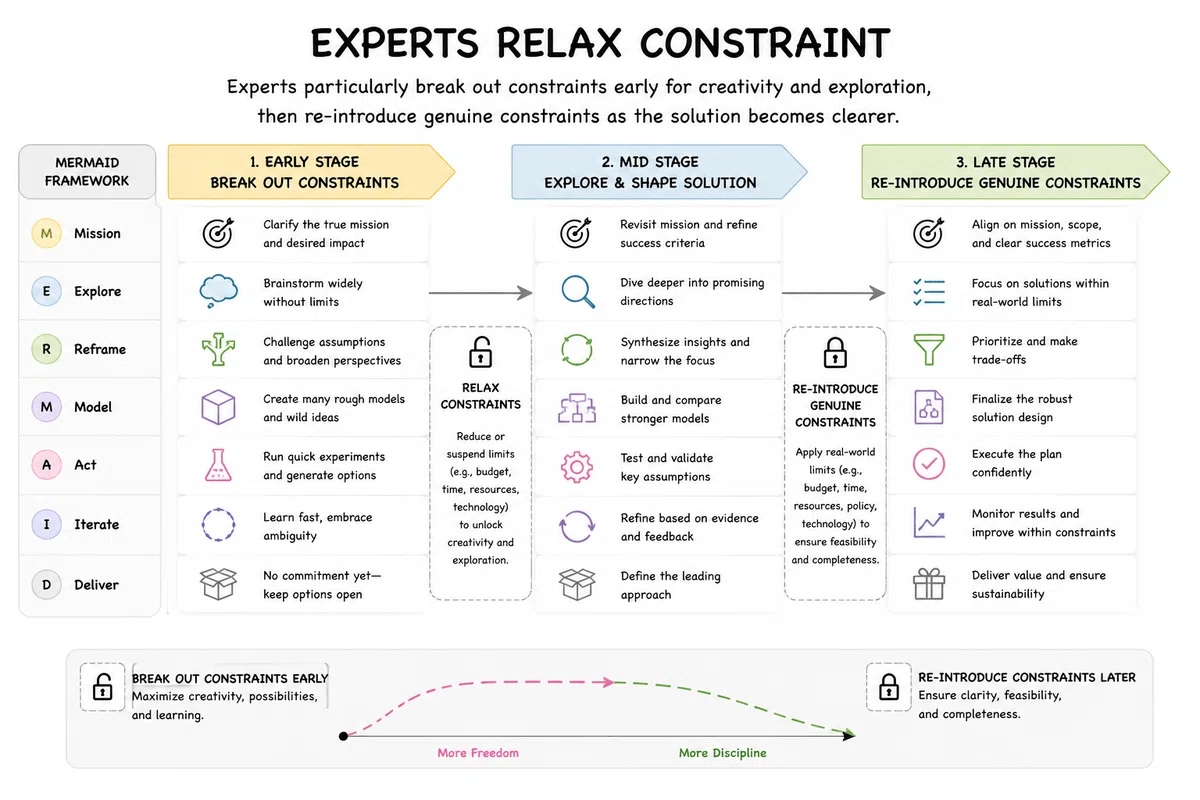
1. Why experts relax constraints
The idea that “experts relax constraints” is an important intellectual strategy for tackling complex problems. As the original text suggests, experts do not simply accept given assumptions or constraints at face value. When facing a difficult problem, they are willing to re-examine almost anything, including constraints that seem fixed or non-negotiable. By temporarily loosening those constraints, they can explore a wider range of possibilities, test alternative interpretations, and deepen their understanding of the problem. Later, once a clearer direction begins to emerge, they bring genuine constraints back into the picture so that the solution becomes realistic, coherent, and complete. This way of thinking is highly relevant in requirements engineering, software engineering, and knowledge engineering alike.
2. Requirements engineering: discovering the real requirement
From the perspective of requirements engineering, fixing constraints too early can prevent us from discovering the real requirements. Users and stakeholders often express their needs within the boundaries of current business processes or existing systems. As a result, what they describe is not always the true goal they want to achieve, but rather a request shaped by past limitations. For example, statements such as “we must keep the current report format” or “we cannot change the existing workflow” may not be fundamental requirements at all; they may simply reflect habits or assumptions carried over from the past.
An expert therefore begins by relaxing such constraints and asking more basic questions: What problem are we actually trying to solve? What outcome does the user really care about? This shift allows requirements to be reframed not as a list of requested functions, but as expressions of organisational goals, business value, and user purpose. Only after that exploration should practical constraints—such as legal rules, budget limits, deadlines, and operational realities—be reintroduced. In this way, the final requirements can be both meaningful and feasible.
3. Software engineering: widening the design space
From a software engineering perspective, relaxing constraints is useful because it expands the design space and makes better architectural choices possible. If a team commits too early to a particular technology, platform, or organisational convention, it may fall into a local optimum rather than finding the best overall solution. For instance, if the team assumes from the outset that “we must use this existing platform” or “we have to preserve the current module structure”, it may overlook a simpler, more maintainable, or more extensible design.
Experts instead keep the solution space open at the start. They consider multiple architectural options, different ways of allocating responsibilities, and alternative boundaries between components. They may even relax one constraint at a time to test how the system would look under different assumptions—for example, by asking what design would emerge if performance constraints were less strict, or if organisational boundaries were ignored. This kind of exploration sharpens understanding of the essential structure of the problem. Later in the process, however, the real engineering constraints—performance, security, availability, technical debt, integration with existing assets, and operational maintainability—must be brought back. Doing so turns a creative exploration into a robust and implementable design.
4. Knowledge engineering: uncovering the structure behind knowledge
From the perspective of knowledge engineering, relaxing constraints improves the quality of knowledge acquisition and knowledge modelling. Practical knowledge in organisations is rarely presented as a neat and complete set of rules. More often, it appears in the form of exceptions, tacit judgement, experience-based heuristics, and informal reasoning. If such knowledge is forced too quickly into a fixed model, rigid category system, or narrow set of constraints, its underlying meaning may be lost.
Experts therefore begin by loosening the frame through which knowledge is interpreted. They examine the same domain from different viewpoints, reconsider existing classifications, and search for alternative conceptual structures. This helps them move beyond surface-level procedures and towards the deeper logic behind how people make decisions and interpret situations. Once that deeper understanding has been reached, constraints such as consistency, completeness, traceability, and explainability can be reintroduced. At that stage, the goal is to turn a rich but fluid understanding of practice into a stable and operational knowledge model.
5. Conclusion: not ignoring constraints, but using them at the right time
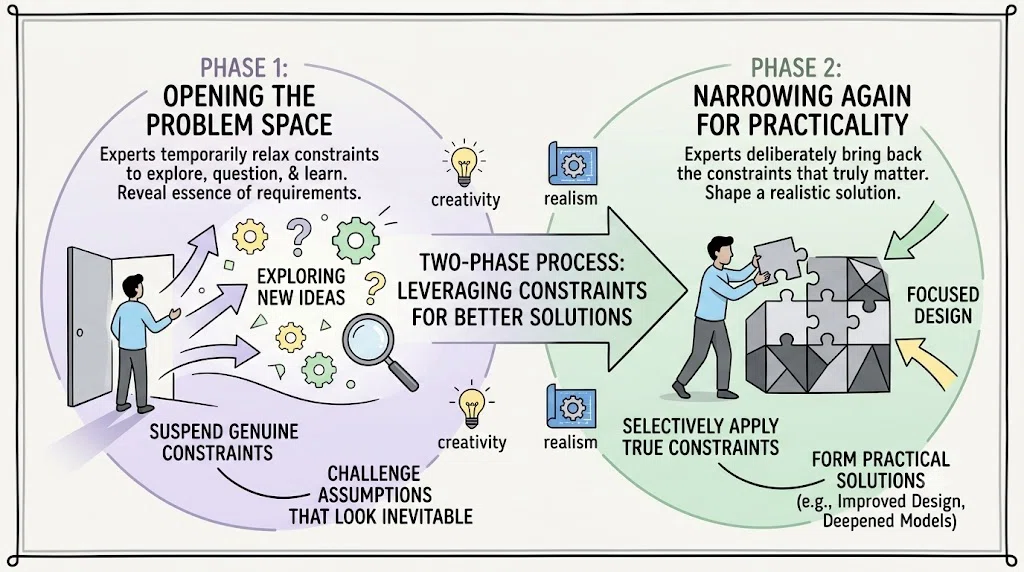
In all three fields, relaxing constraints does not mean dismissing them. Rather, it is a way of distinguishing genuine constraints from assumptions that merely look inevitable because they have gone unchallenged. Experts temporarily suspend constraints in order to explore, question, and learn; then they deliberately bring back the constraints that truly matter in order to shape a practical solution.
This movement—first opening up the problem space, then narrowing it again—is what allows experts to combine creativity with realism. It helps reveal the essence of requirements, improve the quality of system design, and deepen the structure of knowledge models. In that sense, relaxing constraints is not a rejection of discipline, but a disciplined method for reaching better solutions.
## 10 tags
Make 10 blog tags from the essay formatted as "#tag1 #tag2"#RequirementsEngineering #SoftwareEngineering #KnowledgeEngineering #SystemsDesign #ProblemSolving #DesignThinking #RequirementsAnalysis #KnowledgeModelling #ArchitectureDesign #ComplexSystems
## 10 Key Terms with Remarks
please extract 15 key terms from the essay and please note them with remarks, not use a table, make with markdown format.15 key terms from the essay
Relaxing constraints
Temporarily setting aside fixed assumptions, limitations, or “must-have” conditions in order to explore a wider range of possible solutions. In the essay, this is the central expert strategy.Constraints
Conditions that limit what a solution can be, such as budget, deadlines, regulations, technical limitations, or organisational rules. The essay distinguishes between genuine constraints and assumptions that only appear to be fixed.Requirements Engineering
The discipline concerned with discovering, analysing, documenting, validating, and managing what a system should achieve for its users and stakeholders.Software Engineering
The discipline of designing, building, testing, deploying, and maintaining software systems. In the essay, it is especially linked to architectural decision-making and design exploration.Knowledge Engineering
The discipline of capturing, structuring, modelling, and operationalising knowledge so that it can be used systematically, often in information systems, expert systems, or AI-supported environments.Real requirements
The underlying needs, goals, or business outcomes that stakeholders actually want to achieve, as opposed to requests that merely reflect existing workflows or legacy habits.Stakeholders
People or groups who affect, use, fund, govern, or are otherwise influenced by a system or project. Their stated needs are important, but the essay suggests they may also be shaped by inherited constraints.Design space
The range of possible solution structures, architectures, or implementation options available to a team. Relaxing constraints broadens this space and helps experts consider alternatives.Architecture / architectural options
The high-level structure of a software system: its major components, their responsibilities, and the relationships between them. The essay argues that architecture improves when premature constraints are avoided.Local optimum
A solution that seems good within a narrow set of assumptions, but is not the best overall solution. The essay uses this idea to explain the danger of locking into a platform or structure too early.Tacit knowledge
Knowledge that people use in practice but do not always express explicitly. It often appears as judgement, intuition, exceptions, or experience-based know-how rather than formal rules.Knowledge modelling
The process of representing knowledge in a structured form—such as concepts, rules, relationships, categories, or decision logic—so that it can be analysed, shared, or used in systems.Organisational goals / business value
The wider purpose behind a system or requirement, such as improving service, reducing risk, increasing efficiency, or enabling better decisions. The essay treats these as more fundamental than surface requests.Feasibility
The extent to which a proposed requirement or design can realistically be implemented within real-world constraints such as time, cost, regulation, and operational capability.Creativity and exploration
The early-stage activity of questioning assumptions, trying alternative framings, and searching for better ways to understand the problem before committing to a final solution.
## Key expressions
Please extract 7 key expressions in English for English learners as a grammar understanding with 2 example sentences over 30 words.Here are 7 useful key expressions from the essay, explained for English learners with grammar-focused remarks and 2 long example sentences each (each example is over 30 words).
7 key expressions from the essay
1. take something for granted
Meaning:
To assume that something is true, fixed, obvious, or will always exist, without questioning it.
Grammar note:
Common pattern: take + noun/pronoun + for granted
Often used in negative form: do not take ~ for granted
The object can be an idea, situation, rule, person, or opportunity.
Example 1:
Experienced engineers do not take existing business rules for granted, because a rule that seems permanent at first may actually be based on outdated assumptions that no longer support the organisation’s present goals.
Example 2:
If a development team takes the current workflow for granted without asking why it exists, they may end up building software that preserves inefficiency instead of helping users work in a more effective and meaningful way.
2. reconsider just about anything
Meaning:
To think again about almost every assumption, idea, decision, or condition, especially when solving a difficult problem.
Grammar note:
reconsider + noun / pronoun
just about means almost or nearly
It adds an informal but natural emphasis: just about anything / just about everything
Example 1:
When a project reaches a dead end, skilled designers may reconsider just about anything, including team responsibilities, data structures, user journeys, and even the original definition of the problem they thought they were solving.
Example 2:
A good consultant is often willing to reconsider just about anything during the early stages of analysis, because changing one assumption can reveal a completely different interpretation of the client’s real needs.
3. a broader range of possibilities
Meaning:
More possible options, directions, or solutions than one would see under strict assumptions.
Grammar note:
a range of + plural noun = a variety of things
a broader range of possibilities is a noun phrase often used after verbs like explore, open up, consider, or create
Example 1:
By delaying technical decisions until the team better understands the business problem, the architect creates a broader range of possibilities for the system design, which often leads to a more maintainable and scalable solution.
Example 2:
If teachers encourage students to question the first answer that comes to mind, they can help them see a broader range of possibilities and develop the habit of thinking more carefully before choosing a final conclusion.
4. break out constraints early
Meaning:
To deliberately step outside or temporarily remove constraints at the beginning of a process in order to think more freely.
Grammar note:
In the original text, break out constraints is a slightly unusual but expressive phrase.
For learners, it may be easier to understand it as break out of constraints or step outside constraints.
early works as an adverb showing timing.
Example 1:
Teams that break out of constraints early in a design workshop often discover ideas that would never appear if every suggestion had to satisfy budget, schedule, legacy system rules, and approval processes from the very beginning.
Example 2:
Although managers sometimes worry that free exploration wastes time, allowing analysts to step outside constraints early can actually save effort later by revealing which assumptions are truly necessary and which ones are merely habitual.
5. re-introduce genuine constraints
Meaning:
To bring back the real and necessary limitations after a period of exploration.
Grammar note:
re-introduce = introduce again
genuine constraints means constraints that are truly important, not just assumed or inherited
Common pattern: re-introduce + object
Example 1:
Once the team has explored several conceptual models and understands the trade-offs more clearly, it can re-introduce genuine constraints such as legal compliance, operational cost, and security requirements without losing the value of early creativity.
Example 2:
A useful design process does not ignore reality forever; instead, it first opens the problem space and then re-introduces genuine constraints so that the final proposal can be both imaginative and practical.
6. from the perspective of ~
Meaning:
When considering something from a particular field, role, discipline, or point of view.
Grammar note:
Fixed pattern: from the perspective of + noun
Common nouns after it: requirements engineering, management, users, customers, safety, business strategy
Useful in academic and formal writing.
Example 1:
From the perspective of knowledge engineering, a rule that appears simple on paper may actually hide a large amount of tacit judgement, because experts often rely on context and experience that they do not fully explain.
Example 2:
From the perspective of project management, an elegant technical design is not enough on its own, because success also depends on deadlines, stakeholder communication, staffing limitations, and the organisation’s willingness to adopt change.
7. distinguish A from B
Meaning:
To recognise and explain the difference between two things.
Grammar note:
Pattern: distinguish A from B
Very common in academic, analytical, and formal English
A and B can be ideas, concepts, people, categories, or causes.
Example 1:
One of the most important skills in requirements work is the ability to distinguish genuine user needs from requests that merely reflect the limitations of an old system, because the two may sound similar while leading to very different designs.
Example 2:
Experts are valuable not only because they know more facts, but because they can distinguish a temporary obstacle from a fundamental constraint, which helps them decide whether a problem should be reframed or solved directly.
## Markdown for Creating Mind map for Markmap
Make a mind map format text from the essay for markdown format.
---
Example
~~~


# <subject> as <role>
## <header>
- <keyword>
- <keyword>
## 賃金収入と家計消費
- 消費と投資
- 需要不足
# Relaxing Constraints as an Expert Strategy
## Core Idea
- Experts do not take assumptions for granted
- Hard constraints can be reconsidered
- Constraints may be relaxed temporarily
- Relaxation supports creativity and exploration
- Genuine constraints are re-introduced later
- The process moves from divergence to convergence
## Why Experts Relax Constraints
- To explore a broader range of possibilities
- To question inherited assumptions
- To challenge their current understanding
- To generate new insight
- To avoid being trapped by premature decisions
- To separate real constraints from assumed constraints
## Timing of Constraint Relaxation
- Most useful in the early phase of problem solving
- Supports creativity before solution commitment
- Encourages alternative interpretations of the problem
- Opens up the design and knowledge space
- Prevents early closure around one solution
## Requirements Engineering Perspective
- Avoid fixing requirements too early
- Question whether current constraints are truly necessary
- Distinguish real requirements from legacy habits
- Reframe stakeholder requests in terms of goals
- Focus on business value and user outcomes
- Reintroduce cost, schedule, regulation, and operational constraints later
## Real Requirements
- Not just requested features
- Not just current workflow preferences
- Not just existing report formats
- Underlying user needs
- Organisational goals
- Desired business outcomes
## Stakeholders and Existing Assumptions
- Stakeholders often speak within current system boundaries
- Existing workflows shape what people ask for
- Legacy systems influence expectations
- Experts ask what problem really needs to be solved
- Experts uncover hidden assumptions behind requests
## Software Engineering Perspective
- Relaxing constraints expands the design space
- Prevents premature commitment to one architecture
- Encourages comparison of multiple solution structures
- Helps avoid local optimum solutions
- Supports more maintainable and extensible designs
- Enables better architectural judgement
## Design Space Exploration
- Consider multiple architectures
- Revisit component boundaries
- Revisit allocation of responsibilities
- Explore alternatives to current platforms
- Examine different integration strategies
- Test assumptions one by one
## Examples of Relaxed Design Constraints
- Existing platform constraints
- Current module structure
- Organisational boundaries
- Performance assumptions in early ideation
- Technology lock-in
- Legacy integration assumptions
## Reintroducing Engineering Constraints
- Performance requirements
- Security requirements
- Availability and reliability needs
- Operational maintainability
- Technical debt concerns
- Integration with existing assets
## Knowledge Engineering Perspective
- Practical knowledge is often incomplete and informal
- Knowledge appears as exceptions and judgement
- Tacit knowledge is hard to capture directly
- Early rigid modelling can lose meaning
- Relaxing constraints helps reveal deeper logic
- Knowledge models should emerge after exploration
## Nature of Organisational Knowledge
- Tacit knowledge
- Experience-based heuristics
- Informal reasoning
- Exception handling
- Context-sensitive judgement
- Non-obvious decision logic
## Knowledge Modelling Process
- Observe the domain from different viewpoints
- Reconsider existing categories and classifications
- Search for alternative conceptual structures
- Move beyond surface procedures
- Identify deeper decision logic
- Build a stable operational model afterwards
## Reintroducing Knowledge Constraints
- Consistency
- Completeness
- Traceability
- Explainability
- Stable conceptual structure
- Operational usefulness
## Shared Pattern Across the Three Fields
- Start with exploration
- Relax assumptions and constraints
- Expand the problem space
- Learn what is essential
- Reintroduce genuine constraints
- Converge on a realistic solution
## What This Means in Practice
- Creativity should come before premature restriction
- Exploration should not ignore reality forever
- Constraints are not removed permanently
- The aim is disciplined problem solving
- Better solutions come from better understanding
- Experts manage both freedom and realism
## Final Conclusion
- Relaxing constraints is not the rejection of discipline
- It is a disciplined method of inquiry
- It helps reveal true requirements
- It improves software design quality
- It deepens knowledge models
- It allows creativity and realism to coexist## Generation
本投稿は、書籍「SOFTWARE DESIGN DECODED」(c) 2016 MIT の記述をベースに、英語学習用に、ChatGPTにより生成した文章です。
以下の英文をもとに、1200文字の要求工学、ソフトウェア工学、知識工学の視点でのエッセイを日本語で、生成ください。
強調するべきキーワードを、Markdownの<strong></strong>で、太字にしてください。

---
制約をいったん緩めることの意義――要求工学・ソフトウェア工学・知識工学の視点から
専門家は問題解決の初期段階において、あえて制約を緩める。与えられた条件をそのまま前提にして解を探すのではなく、まず「本当に解くべき問題は何か」「そもそも制約は絶対条件なのか」を問い直し、自由に発想する余地を確保するのである。そして解の全体像が見え始めた段階で、現実の制約を再び導入し、実行可能で整合的な解へと収束させる。この姿勢は、要求工学、ソフトウェア工学、知識工学のいずれにおいても重要な意味をもつ。
要求工学の観点では、初期段階で制約を固定しすぎることは、問題理解を狭める危険がある。利用者が「この業務はこういうものだ」と考えている制約には、制度上必須のものだけでなく、慣習や過去システムへの適応から生じた思い込みも含まれる。もし要件定義の冒頭から予算、組織、既存手順、既存システムの制約を強く前提化すると、本来検討すべき代替案や業務改革の可能性が見えなくなる。そこで専門家は、まず制約を一時的に外し、「理想的には何を達成したいのか」「利用者にとって本質的な価値は何か」を探索する。これは要求の背後にある目的や意図を明らかにし、表面的な要望ではなく本質的要求を発見するための重要なプロセスである。その後、法規制、納期、コスト、既存業務との整合性といった現実的条件を再導入することで、実現可能な要求仕様へと整理できる。
ソフトウェア工学の観点でも、この「制約の緩和と再導入」は設計品質を高める。初期設計で特定のアーキテクチャ、実装技術、既存モジュール構成に縛られすぎると、設計空間が狭まり、より良い構造を見落とす可能性がある。専門家は初期段階では、複数の設計案、抽象的な責務分割、異なるデータ表現や相互作用の形を広く比較し、問題に対する適切な構造を探る。この段階では「まず既存システムに合わせる」よりも、「何が変更容易性、保守性、拡張性を高めるか」を重視する。そして設計方針が定まった後で、性能制約、運用制約、技術スタック、納期、チーム能力といった現実条件を反映させる。つまり、発散的な設計探索と、制約を踏まえた収束的な設計具体化を切り分けることが、堅牢なソフトウェア設計につながるのである。
知識工学の観点では、制約を緩めることは知識獲得と知識構造化の質を高める。専門家知識をモデル化する際、最初から既存の分類枠や入力フォームに合わせて知識を収集すると、暗黙知や例外的判断、状況依存の推論が取りこぼされやすい。そこでまずは、専門家がどのような観点で状況を見て、どの概念を区別し、どのような判断規則を使っているかを自由に語ってもらい、概念間の関係を広く捉えることが重要となる。この段階では、モデルの整然さよりも、知識の豊かさと多様性を優先する。その後で、得られた知識を概念モデル、ルール、オントロジー、ナレッジベースへと整理する際に、表現形式や推論可能性、整合性といった制約を適用する。つまり、知識工学においても、最初に知識の可能性を広く開き、後から形式化の制約をかけることが、実用的で再利用可能な知識モデルを生み出す鍵となる。
このように、専門家が制約をいったん緩めるのは、無秩序に進めるためではない。むしろ、問題の本質を見極め、より良い要求、より良い設計、より良い知識モデルを得るための戦略的な方法である。重要なのは、制約を「捨てる」ことではなく、「いつ導入するか」を見極めることにある。創造と探索の段階では制約を緩め、解の骨格が見えた段階で現実条件を再び取り込む。この往復運動こそが、専門家の問題解決を柔軟かつ実践的なものにしている。
以上
## Appendix
要件定義段階で、以下の観点から、知識獲得や知識モデリングを行う際の典型的な生成AIを使った手法とその手順について提案ください。

-モデルの整然さよりも、知識の豊かさと多様性を優先する。その後で、得られた知識を概念モデル、ルール、オントロジー、ナレッジベースへと整理する際に、表現形式や推論可能性、整合性といった制約を適用する。生成した内容を、英語で、要点をまとめて、提示ください。Using Generative AI for Knowledge Acquisition and Knowledge Modeling in Requirements Definition
A practical way to use generative AI in requirements definition is to prioritize richness and diversity of knowledge first, and apply formal modeling constraints later. Instead of forcing early consistency, teams should first capture tacit knowledge, exceptions, decision criteria, and multiple stakeholder perspectives. After that, the collected knowledge can be organized into concept models, rules, ontologies, and knowledge bases.
Recommended process
1. Prepare the knowledge exploration
Identify stakeholders, documents, workflows, and decision points.
Ask generative AI to summarize existing materials and suggest missing viewpoints.
Define exploration lenses such as exceptions, judgment criteria, terminology gaps, and inter-department differences.
2. Perform divergent knowledge acquisition
Use AI to generate interview questions for different stakeholder roles.
Explore normal cases, exceptional cases, failure cases, and conflicting scenarios.
Let AI extract facts, assumptions, decision rules, exceptions, and unresolved issues from interview records and notes.
3. Organize knowledge fragments
Break the collected information into small “knowledge cards.”
Use AI to cluster them into categories such as concepts, procedures, rules, exceptions, and constraints.
Detect overlaps, contradictions, and missing links between pieces of knowledge.
4. Transform knowledge into structured models
Ask AI to derive candidate entities, attributes, relationships, and state changes for a concept model.
Convert decision knowledge into business rules.
Build ontology drafts by organizing terms into hierarchies, synonyms, and related concepts.
Define reusable knowledge-base entries.
5. Apply constraints only after exploration
Once enough knowledge has been collected, use AI to improve:
Consistency: remove contradictions in terms and rules
Completeness: check whether important cases and exceptions are missing
Inferability: make rules machine-processable
Traceability: link knowledge elements back to their sources
Standardized representation: unify the format of concepts, rules, and exceptions
6. Iterate through review and refinement
Review the models with stakeholders.
Use AI to summarize feedback, identify changes, and update the concept model, rules, ontology, and knowledge base.
Core idea
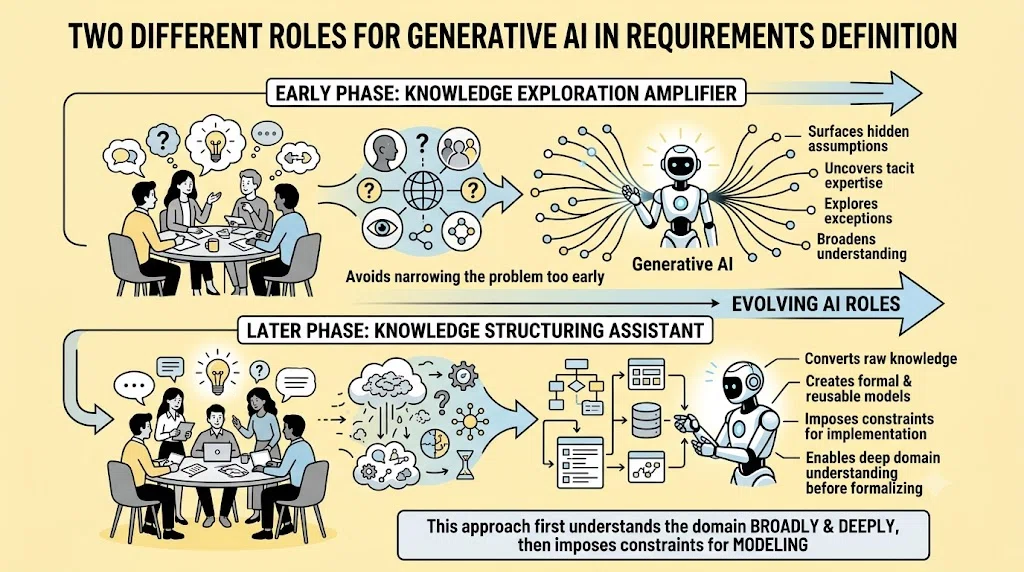
Generative AI should play two different roles during requirements definition:
In the early phase, it acts as a knowledge exploration amplifier, helping teams surface hidden assumptions, tacit expertise, exceptions, and alternative viewpoints.
In the later phase, it acts as a knowledge structuring assistant, helping teams convert raw knowledge into formal and reusable models.
This approach is effective because it avoids narrowing the problem too early. It enables teams to first understand the domain broadly and deeply, and only then impose the constraints needed for formal modeling and implementation.
はい。要件定義段階での「知識の豊かさと多様性を先に確保し、後から整形式なモデルへ収束させる」という方針に沿って、生成AIを用いた知識獲得・知識モデリングの典型的な手法と手順を、要求工学寄りに整理して提案します。
以下では、発散 → 構造化 → 制約適用 → 妥当化という流れを基本にします。ポイントは、最初から概念モデルやルール表に閉じ込めず、まずは業務知識・判断基準・例外・曖昧さを幅広く集め、その後にモデルへ落とすことです。
生成AIを用いた知識獲得・知識モデリング手法
― 要件定義段階における「豊かさ優先・整形式後回し」の進め方 ―
1. 基本方針
要件定義段階では、最初から「正しいデータモデル」「完全な業務ルール」「厳密な用語定義」を求めすぎると、現場の暗黙知や例外処理、判断の背景が失われやすいです。
そのため、生成AIはまず知識を広く引き出すための対話・再記述・観点展開の補助者として使い、後半で概念モデル、ルール、オントロジー、ナレッジベースへ整理する役割に切り替えるのが有効です。
2. 全体プロセス
以下の6段階を推奨します。
知識探索の準備
発散的な知識獲得
知識断片の整理とクラスタリング
概念モデル・ルール・オントロジーへの変換
制約適用(整合性・推論可能性・表現形式)
レビューと再学習ループ
3. 各段階の典型手法と手順
3-1. 知識探索の準備
目的
生成AIに与える材料を整え、「誰の、どの業務知識を、どの粒度で集めるか」を明確にする。
典型手法
知識源マッピング
ステークホルダー一覧作成
既存文書・手順書・FAQ・議事録の収集
業務イベントや意思決定ポイントの洗い出し
AI用探索観点の設計
「例外」「判断基準」「曖昧語」「部門差」「時系列変化」を観点として定義
手順
対象業務のスコープを決める
ステークホルダーごとに「持っていそうな知識」を仮置きする
既存資料を生成AIに要約させ、知識候補一覧を作る
AIに「不足していそうな観点」を逆提案させる
生成AIの使い方
「この業務文書から、業務判断・例外・前提条件・曖昧な用語を抽出せよ」
「この会議メモから、追加でヒアリングすべき論点を10個挙げよ」
3-2. 発散的な知識獲得
目的
モデルの整然さよりも、知識の豊かさ・多様性・暗黙知の露出を優先する。
典型手法
手法A: AI支援インタビュー設計
生成AIに、役割別の質問集を作らせる方法です。
例
業務担当者向け:普段の処理手順、例外対応、判断根拠
管理者向け:評価指標、責任境界、優先順位
システム担当者向け:既存制約、データ制約、障害時運用
手法B: シナリオ・事例展開
AIに「通常ケース」「例外ケース」「失敗ケース」「部門間衝突ケース」を生成させ、知識を引き出す。
手法C: 用語の多義性探索
AIに「この業務用語は人によってどう意味が違い得るか」を出させる。
手順
AIにインタビュー質問案を作らせる
インタビュー実施後、文字起こしをAIに投入する
AIに以下の観点で再整理させる
事実
判断基準
例外
前提条件
利害対立
不明点
AIに「別解釈」「反例」「追加質問」を生成させる
成果物
知識断片リスト
例外事例集
用語の揺れ一覧
判断基準メモ
未解決論点リスト
3-3. 知識断片の整理とクラスタリング
目的
発散的に得られた知識を、まだ厳密化しすぎずに整理する。
典型手法
手法D: 知識カード化
1知識断片を1カードとして分割する。
例:「承認金額が一定額以上なら部長承認」
例:「顧客ランクが高い場合は例外的に当日出荷」
手法E: AIによるクラスタリング
AIに以下の観点で分類させる。
概念知識
手続き知識
判断ルール
例外知識
制約知識
背景知識
手順
インタビュー記録や文書から知識カードを生成する
AIにカードを分類させる
類似カード、矛盾カード、重複カードを抽出させる
「どの知識がどの業務場面で使われるか」を紐づける
3-4. 概念モデル・ルール・オントロジーへの変換
目的
豊かに集めた知識を、再利用可能なモデルへ変換する。
典型手法
手法F: 概念モデル抽出
AIに、知識カード群から以下を抽出させる。
エンティティ候補
属性候補
関係候補
状態遷移候補
手法G: ルール抽出
「もし〜なら〜」「ただし〜の場合は例外」という形へ変換する。
手法H: オントロジー草案生成
上位概念・下位概念・同義語・関連概念を整理する。
手順
AIに用語一覧から概念候補を作らせる
概念間関係を図式化させる
判断知識を業務ルールとして抽出する
用語の定義差を吸収し、用語集・オントロジー草案を作る
ナレッジベース項目として保存単位を定義する
成果物
概念モデル草案
業務ルール一覧
用語集・オントロジー草案
知識ベース項目定義
3-5. 制約適用
目的
後半で初めて、整合性・推論可能性・表現形式の制約を適用する。
適用する制約
整合性:同じ用語が矛盾した意味で使われていないか
完全性:重要ケース・例外が抜けていないか
推論可能性:ルールが機械処理可能な形か
追跡可能性:知識の出典が分かるか
表現形式の統一:概念、ルール、例外、制約の記法統一
生成AIの使い方
「このルール集合の矛盾を指摘せよ」
「概念モデルに出てくる用語とルール中の用語の不一致を抽出せよ」
「例外ルールが通常ルールを破っている箇所を整理せよ」
3-6. レビューと再学習ループ
目的
一度作ったモデルを現場知識と往復しながら磨く。
手順
モデルを現場レビューにかける
レビュー結果をAIに要約させ、修正差分を作る
差分から新たな知識カードを生成する
概念モデル・ルール・オントロジーを更新する
4. 実務で特に有効な生成AIプロンプト例
知識抽出
「以下の会議記録から、業務判断、例外処理、暗黙の前提、未解決論点を分けて抽出してください」概念抽出
「以下の知識カード群から、概念候補・属性候補・関係候補を整理してください」ルール化
「以下の文章を、通常ルール・例外ルール・前提条件に分けて記述してください」整合性確認
「この用語集、概念モデル、ルール一覧の間にある矛盾・重複・未定義項目を指摘してください」
5. 提案の要点
要件定義段階で生成AIを使う際は、最初から厳密なモデル化を目指すよりも、知識を広く獲得し、異なる視点・例外・暗黙知を露出させることが重要です。その後で、概念モデル、ルール、オントロジー、ナレッジベースへ段階的に整理し、最後に整合性や推論可能性の制約を適用するのが効果的です。
つまり生成AIは、前半では知識探索の増幅器として、後半では知識整理・形式化の支援者として役割を切り替えて使うのが、要件定義における実践的な活用方法です。
必要なら次に、この内容をあなたの最近のエッセイ群に合わせて、**「要求工学・ソフトウェア工学・知識工学の3視点で再編した実務手順書」**として、以下のような形式に整えられます。
表形式(工程 / 目的 / 生成AIの役割 / 入力 / 出力 / 注意点)
実務フロー図形式(Mermaidで図化)
1200〜1600字のエッセイ形式
要件定義ワークショップ用の具体的プロンプト集
必要なら次は 「表形式 + Mermaid図」 でまとめます。
いいなと思ったら応援しよう!
 Generative AIを使って何ができるかを実践しています。応援ありがとうございます。