🟪24ラ英186- Is there any place that you want to visit later? - 関係代名詞that

#English_Grammar #ラ英2024 #ラジオ英会話 #24ラ英186 #Explanation_Rule
Slides
TOC
Slide Number	Subtitle	Main Topic Sentence / Core Remark
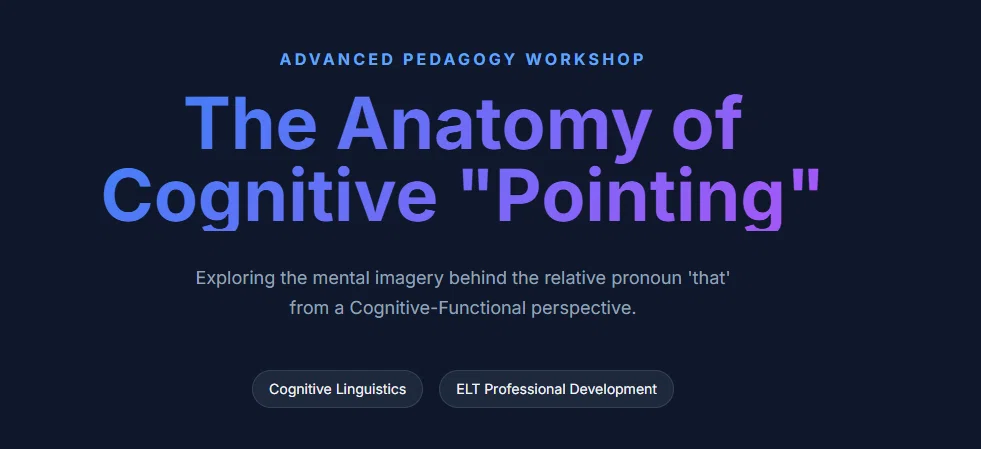
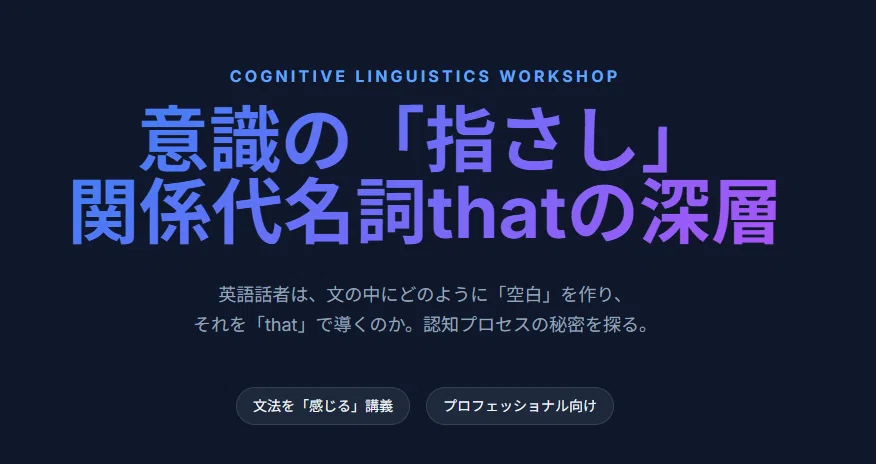
1	The Anatomy of Cognitive "Pointing"	Exploring the mental imagery behind the relative pronoun 'that' from a Cognitive-Functional perspective.
2	'That' as a Mental Signpost	The word 'that' serves as an explicit cue signaling the listener to anchor focus for following details.
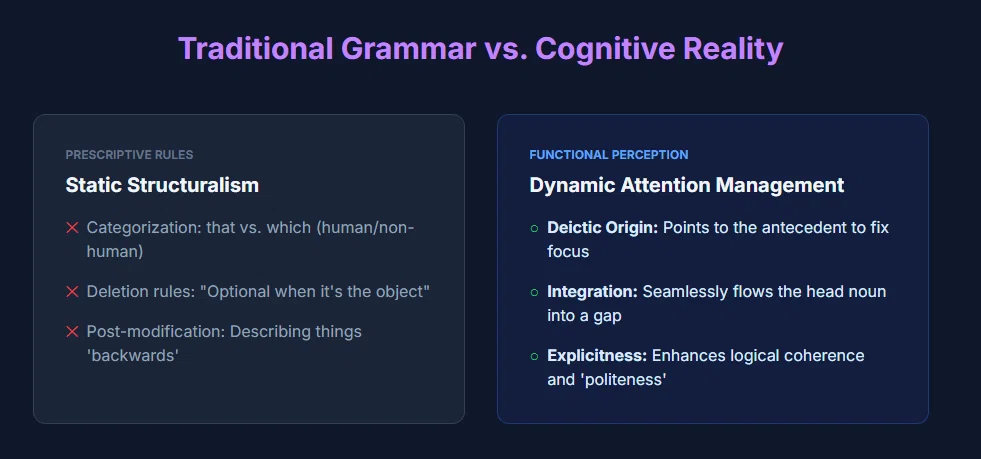
3	Traditional Grammar vs. Cognitive Reality	Shifting from static prescriptive rules (categorization/deletion) to dynamic attention management (deictic origin/integration).
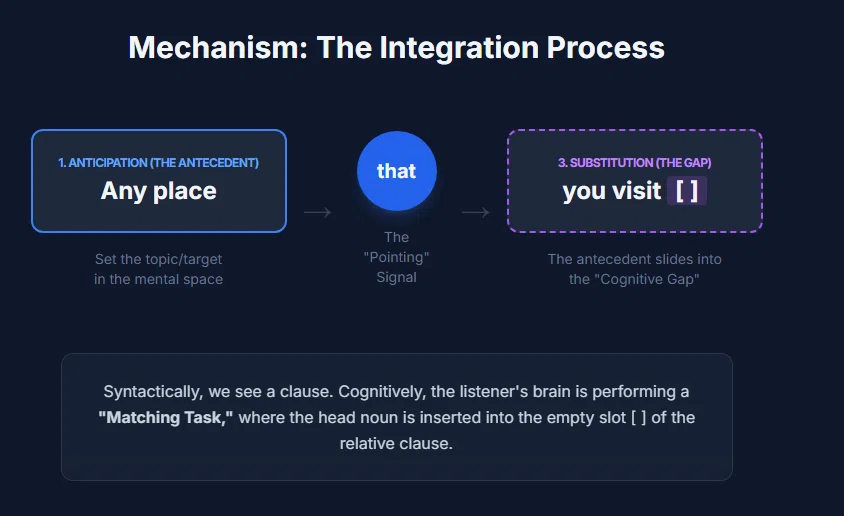
4	Mechanism: The Integration Process	The listener's brain performs a "Matching Task" where the head noun slides into a cognitive gap [ ].
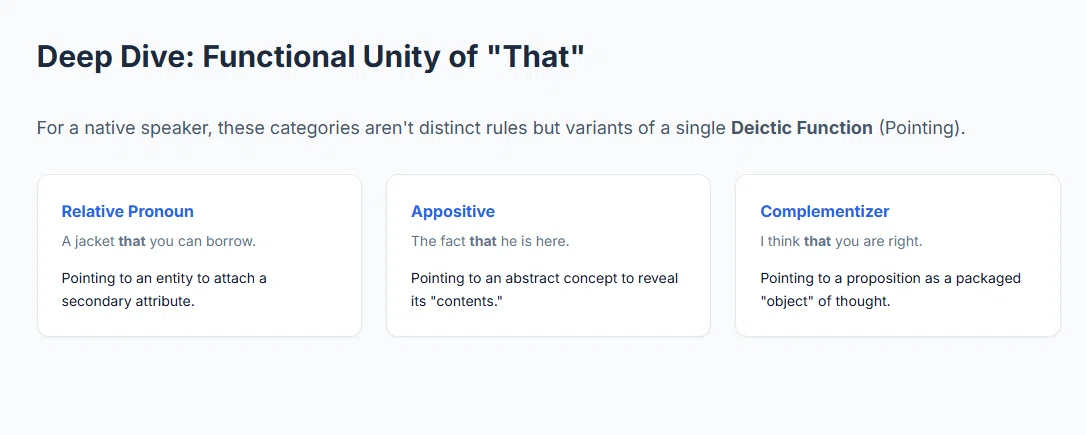
5	Deep Dive: Functional Unity of "That"	'That' represents a unified deictic function across relative pronouns, appositives, and complementizers.
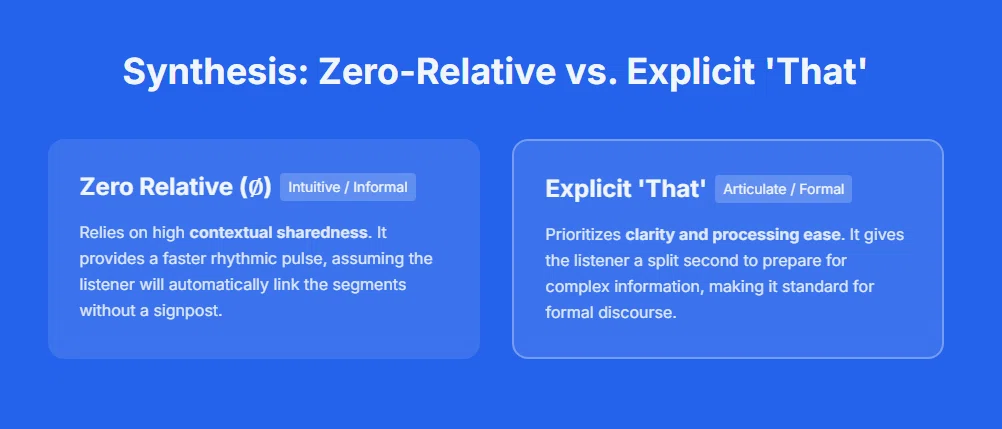
6	Synthesis: Zero-Relative vs. Explicit 'That'	The choice between ∅ and 'that' is a balance between intuitive rhythmic pulse and logical processing ease.
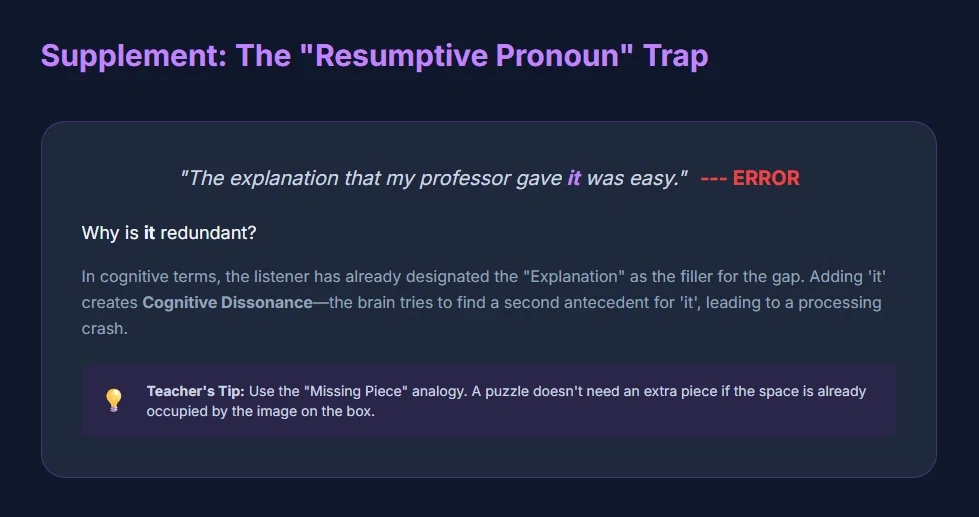
7	Supplement: The "Resumptive Pronoun" Trap	Redundant pronouns like 'it' cause cognitive dissonance because the brain has already filled the gap.
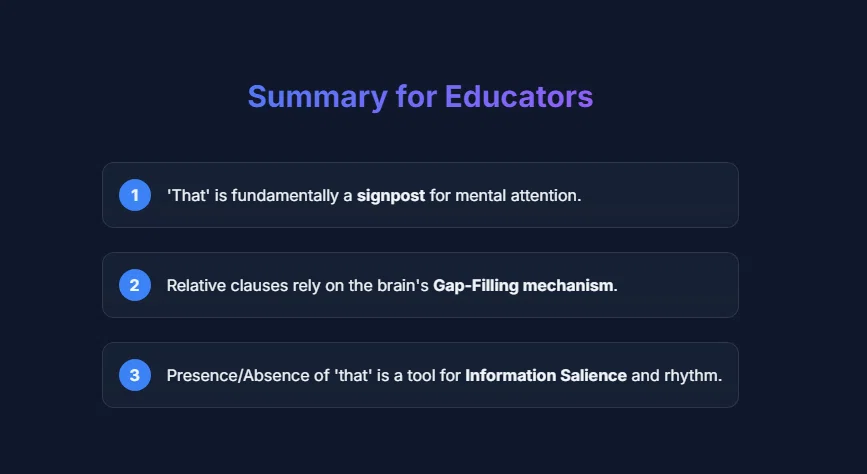
8	Summary for Educators	'That' is fundamentally a signpost for mental attention and a tool for managing information salience.
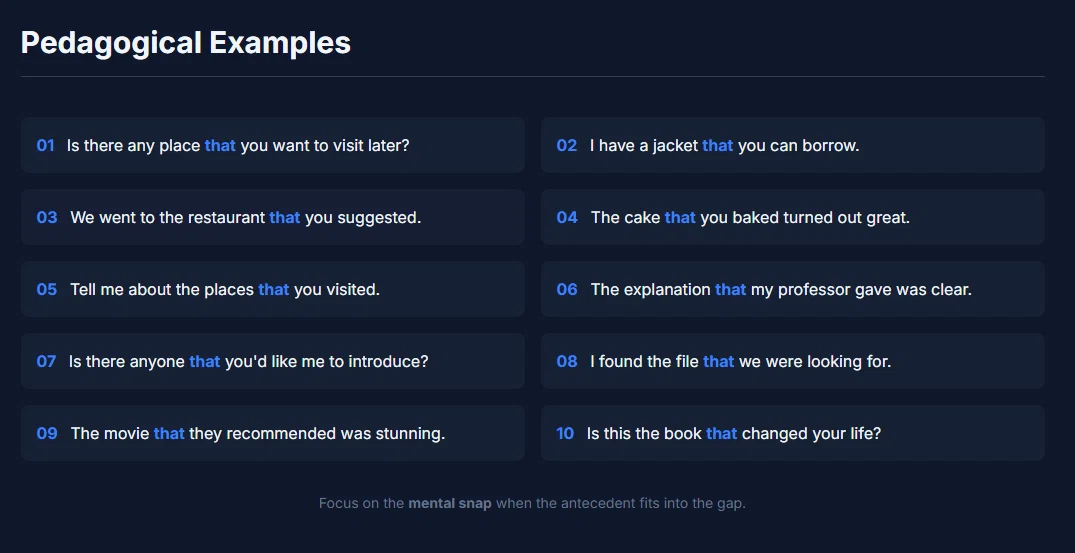
9	Pedagogical Examples	Focus on the "mental snap" when the antecedent fits into the gap across various sentence structures.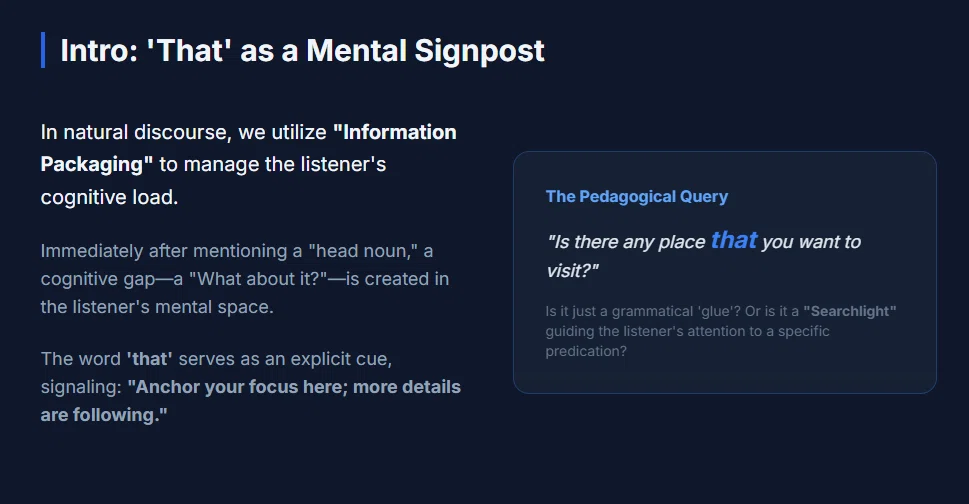
Contents
Speaker’s Notes: The Anatomy of Cognitive "Pointing"
Speaker Profile: British Male, 30s, ELT Professional (6 years in Japan). Tone: Intellectual, professional, yet conversational. Bridging the gap between UK linguistic traditions and Japanese learners' cognitive hurdles.
Slide 1: The Anatomy of Cognitive "Pointing"
Script & Guidance: Hello everyone. After six years of teaching here in Japan, we’ve all seen our students struggle with the relative pronoun 'that'. Usually, it’s taught as a dry structural rule—a way to join two sentences. But today, I want to move away from the "sentence-combining" approach and look at the Cognitive-Functional reality. We need to explain to our students not just where to put the word, but why their brain feels the need to use it. The term "pointing" is crucial here. In cognitive linguistics, 'that' isn't just a placeholder; it is a Deictic Marker. It functions like a mental finger pointing at a specific concept in the Mental Space. By the end of this session, you’ll be able to show your students that 'that' is the bridge between an initial thought and its essential details.
ASCII Diagram: The Mental Anchor
[ Head Noun ] <------- (Mental Finger: "THAT") ------- [ Predication ]
  "A Jacket"             "Focus on this one!"          "You can borrow"
Cognitive-Functional: Emphasize that language is a tool for human communication, not just a set of abstract rules.
Deictic Marker: The "pointing" function. Relate this to the physical act of pointing at something in the room.
Mental Space: The conceptual world where the listener builds the scene as you speak.
Slide 2: 'That' as a Mental Signpost
Script & Guidance: Think about the phrase "Is there any place...". At this exact moment, the listener’s brain is in a state of Anticipation. They have the category (place), but it’s an empty category. It lacks Saliency. When we say 'that', we are providing a Cognitive Signpost. It tells the listener, "Stay with me, I’m about to define this category." For our Japanese students, who are used to the 'pre-modifying' structure of Japanese (e.g., "visit-want-place"), this Linear Processing is a major shift. You are essentially teaching them to provide a "heading" first, then the "content." We are managing the Information Packaging. By using 'that', we ensure the listener doesn't wander off mentally before we finish the definition.
ASCII Diagram: The Searchlight Effect
Speaker: "I have a jacket..."
Listener's Brain: [?] (Which one? Why mention it?)
Speaker: "...THAT..."
Listener's Brain: [!] (Ah, specific info is coming!)
Information Packaging: How we slice and dice information to make it digestible for the listener.
Linear Processing: Processing language from left to right, as it is heard, rather than waiting for the end.
Cognitive Signpost: A linguistic cue that helps the listener navigate the speaker's intent.
Slide 3: Traditional Grammar vs. Cognitive Reality
Script & Guidance: We’ve all seen the textbooks. They focus on Prescriptive Rules: "Use 'who' for people, 'which' for things, and 'that' for either." But this classification doesn't help a student speak in real-time. It’s too slow. In Cognitive Reality, the choice is about Attention Management. When a student thinks "後ろから修飾" (post-modification), they are mentally translating. We need to replace that with the concept of Dynamic Attention. 'That' isn't a rule; it's a way to fix the focus. If you remove the 'that', you are relying on the listener to make the connection intuitively. If you keep it, you are being Explicit. It’s the difference between a quick sketch and a detailed map.
ASCII Diagram: Attention Shift
Trad:  [Clause A] + [Rel. Pronoun] + [Clause B]  (Math-like)
Cog:   (Attention) -> [Topic] -> (Pointing) -> [Detail] (Life-like)
Prescriptive Rules: The "Must/Should" rules found in textbooks that often fail in fluid conversation.
Attention Management: The speaker's ability to direct the listener's focus to specific information.
Explicitness: The degree to which the connection between ideas is made clear via linguistic cues.
Slide 4: Mechanism: The Integration Process
Script & Guidance: This is the most technical part of the session. We’re talking about the Integration Process. In cognitive linguistics, we posit that every relative clause has a Cognitive Gap or a "slot." When you say "The cake that you baked...", the word "cake" is the Filler, and the position after "baked" is the Gap. The listener’s brain performs a Matching Task. It’s like a puzzle piece. 'That' is the signal that the puzzle piece is currently being held in the air, ready to be snapped into the gap. If the student doesn't understand the gap, they can't understand the connection. This is why they often try to repeat the object (e.g., "The cake that you baked it"). They are trying to fill a gap that the brain has already reserved for the antecedent.
ASCII Diagram: The Puzzle Snap
ANTECEDENT: [ THE CAKE ]
                 |
                 V
CLAUSE: "you baked [ GAP ]"
                 ^
                 | (Snap!)
Cognitive Gap: The empty slot in a sentence where the antecedent "belongs" logically.
Filler: The noun or phrase that is intended to occupy the cognitive gap.
Matching Task: The mental operation of identifying which noun belongs in which gap.
Slide 5: Deep Dive: Functional Unity of "That"
Script & Guidance: Students often ask, "What’s the difference between the 'that' in 'I think that...' and the 'that' in 'The book that I read'?" Traditional grammar gives them different names (Complementizer vs. Relative Pronoun). But for us, there is a Functional Unity. In every case, 'that' is a Deictic Pointer. Whether it points to a "Noun" (Relative) or a "Whole Proposition" (That-clause), the mental movement is the same. It is an act of Categorization. We are saying, "I am pointing to this specific thought/thing." If we teach it as a unified concept, the student’s Cognitive Load decreases. They don't have to learn five different 'thats'; they just need to learn one way of "pointing" mentally.
ASCII Diagram: Unified Pointing
THAT --> [Noun]          (Relative)
THAT --> [Fact]          (Appositive)
THAT --> [Proposition]   (Complementizer)
Functional Unity: The idea that different grammatical structures share a single underlying purpose.
Proposition: A statement or thought that can be true or false.
Cognitive Load: The amount of mental effort used in the working memory.
Slide 6: Synthesis: Zero-Relative vs. Explicit 'That'
Script & Guidance: The big question: To 'that' or not to 'that'? This is about Information Salience and Rhythm. In the UK, we might drop it in a pub but keep it in a lecture. Why? Because in a pub, the Contextual Sharedness is high. We are on the same page. In a lecture, the concepts are harder, so we need the 'that' to slow down the Processing Speed. For Japanese learners, dropping the 'that' can sometimes make their English sound "choppy" because they haven't mastered the intonation required to signal the relationship. I always tell my students: "When in doubt, keep the 'that'." It provides a Rhythmic Anchor that helps both the speaker and the listener stay in sync.
ASCII Diagram: The Speed of Sound
Zero-Rel: [Fast] [Fast] [Fast] -> (Needs high context)
Explicit: [Steady] --THAT-- [Steady] -> (Needs logical clarity)
Information Salience: How much a piece of information stands out in a sentence.
Contextual Sharedness: The amount of information already known by both speaker and listener.
Rhythmic Anchor: Using a word to establish a beat or pause in speech for better understanding.
Slide 7: Supplement: The "Resumptive Pronoun" Trap
Script & Guidance: We see this error all the time: "The movie that I saw it was good." In linguistics, we call that 'it' a Resumptive Pronoun. Why do students do this? Because they are uncomfortable with the Cognitive Gap. Their brain wants to "close" the sentence "I saw it." But because we used 'that', the "it" is already spoken—it’s the "movie"! This creates a Processing Crash. It’s like trying to put two people in one seat. We need to help them visualize the Path of Reference. Once the "movie" has been pointed to by 'that', its ghost occupies the slot after 'saw'. There is no room for 'it'. This is a fundamental lesson in Economy of Language.
ASCII Diagram: The Occupied Seat
[ THE MOVIE ] --- (that) ---> "I saw [ MOVIE'S GHOST ]"
                                      ^
                                      | (NO ROOM FOR "IT"!)
Resumptive Pronoun: A pronoun used in a relative clause where a gap should be (common error).
Processing Crash: When a listener's brain stops because a sentence structure is redundant or broken.
Economy of Language: The principle that we don't use more words than necessary to convey meaning.
Slide 8: Summary for Educators
Script & Guidance: To wrap up, remember that our job is to move students from Mechanical Manipulation to Cognitive Awareness. Don't just give them a worksheet; give them a mental map. Remind them that 'that' is their best friend for Clarity. It allows them to manage Information Flow effectively. As teachers who have lived in Japan, we understand the struggle of switching from a head-final language to a head-initial one. Use the 'pointing' analogy. Use the 'puzzle' analogy. Most importantly, encourage them to feel the Mental Snap when a sentence finally connects. Grammar isn't just about being "correct"; it's about being understood across different mental spaces.
ASCII Diagram: The Successful Connection
[ Speaker's Intent ] <====( THAT )====> [ Listener's Understanding ]
Mechanical Manipulation: Changing sentence structures without understanding the meaning (rote learning).
Cognitive Awareness: Understanding the mental processes that drive language choices.
Information Flow: The smooth transition of ideas from the speaker to the listener.
Key Takeaways
'That' is a Pointer, not just a Link: It functions as a deictic marker to fix the listener's attention on the antecedent.
Gaps are Essential: Every relative clause contains a cognitive gap that must be filled by the antecedent, not a redundant pronoun.
Linear Processing is Key: We must train students to provide information in a forward-moving, linear fashion, using 'that' as a signpost.
Rhythm over Rules: The choice to include 'that' often relates to the desired rhythmic clarity and the complexity of the information.
Unified Function: Viewing 'that' as a single cognitive tool (pointing) reduces the learner's mental burden.
Blog Tags
#EnglishEducation #CognitiveLinguistics #ELTJapan #GrammarHacks #LinguisticTheory #EnglishTeachers #LanguageAcquisition #RelativePronouns
Examples
Terms
Key Term	Simple Explanation for Learners
Cognitive-Functional	Viewing English as a practical tool for communication rather than just a list of complex rules.
Deictic Marker	A "pointing" word. Like using your finger to point at something, 'that' points to the topic you are explaining.
Mental Space	The "picture" or "scene" you build in your mind while someone is speaking to you.
Information Packaging	The way we organize our ideas into small, easy-to-understand groups when we talk.
Linear Processing	Understanding English from left-to-right (the order it is spoken) instead of waiting until the end of the sentence.
Cognitive Signpost	A word that acts like a road sign, telling the listener: "Look here! Important information is coming next."
Attention Management	Helping the listener focus on exactly what you want them to notice.
Explicitness	Being very clear and direct so that the listener doesn't have to guess what you mean.
Cognitive Gap	An "empty seat" in a sentence that is reserved for the main topic (the antecedent).
Filler	The word (the topic) that sits in the "empty seat" to complete the sentence's meaning.
Matching Task	The mental game of connecting a topic (like "the cake") to its description (like "you baked").
Functional Unity	The idea that 'that' always does the same job (pointing), no matter which grammar rule is being used.
Cognitive Load	The amount of "brain power" or effort needed to understand or speak a sentence.
Contextual Sharedness	When both the speaker and listener already know the background story or situation.
Rhythmic Anchor	Using 'that' to create a steady beat or pause, making the sentence easier to follow.
Resumptive Pronoun	A common mistake where a learner puts an extra word (like 'it') in a spot that is already "taken."
Economy of Language	The "Green" rule of English: don't use extra, unnecessary words if the meaning is already clear.
Information Flow The smooth, natural way that ideas move from the speaker's mouth to the listener's ear.いいなと思ったら応援しよう!
 Generative AIを使って何ができるかを実践しています。応援ありがとうございます。