2608B- Why Are Taxes at a Record High When the Population Is Shrinking?

## Prompts
以下の文章をベースに、2000文字で、経済思考ベースのエッセイを中学生向けに平易な表現で、作成ください

===
## Topics
-

## Question
-

## Answer
- 上記の日本語のエッセイをもとに、英国人向けのEnglishで、英国人の中学生に分かりやすく英語化下さい。文章のカタマリ(パラグラフなど)毎に、サブ題目を上げてください。Please make a diagram as an illustration image from below paragraph for readers of essay to be easy to understand.
Please give it an illustration data.
- Color palette is restricted to black, white, grey, light yellow, light green, light violet and light blue.
---
## ParagraphPlease draw an illustration data as an image by your proposal. It can be downloaded for me.Create a horizontally wide banner logo for the blog title:
Design requirements:
- Background: light yellow, soft texture for warmth and clarity.
- Color palette: green and blue tones for the text and accents, symbolizing growth and stability.
- Typography: bold, modern sans-serif font.
- Overall mood: professional, forward-looking, and balanced between tradition and modernity.
## title
Please make a detailed script for presentation over 100 terms.Here’s a detailed presentation script (over 100 terms) you can use to explain the infographic clearly and naturally to English learners. It’s written in simple, spoken English style — perfect for classroom or seminar delivery.
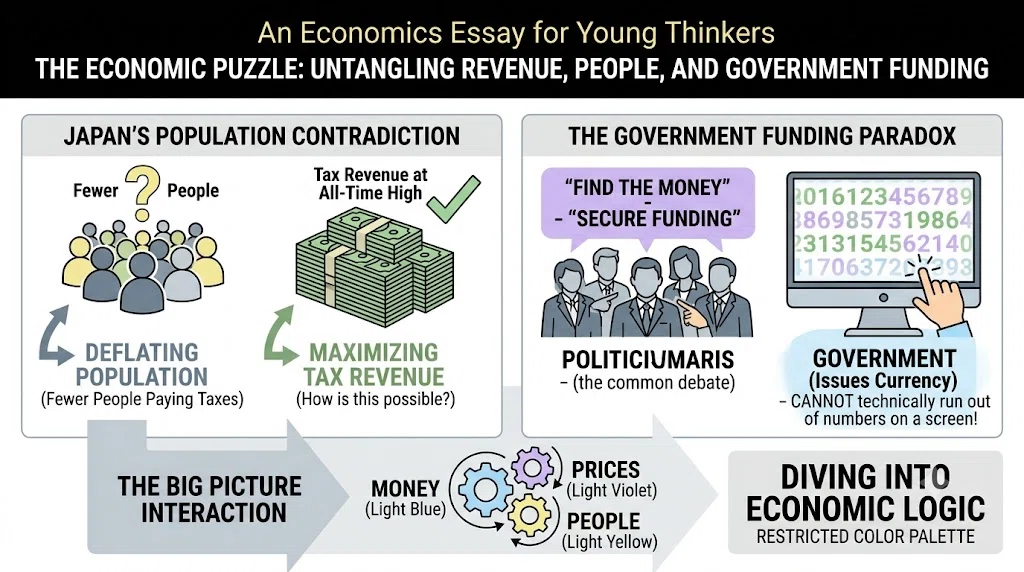
The Economic Puzzle — Untangling Revenue, People, and Government Funding
Good morning everyone. Today, we will look at an interesting infographic called “An Economics Essay for Young Thinkers.” It helps us understand how money, people, and government funding are connected in Japan’s economy.
Let’s start with the first part — Japan’s Population Contradiction. Japan’s population is getting smaller. There are fewer people, and that means fewer workers and fewer taxpayers. Normally, when fewer people pay taxes, we expect tax revenue to go down. But in Japan, something surprising is happening — tax revenue is at an all-time high. So, the question is: How can the government collect more money when fewer people are paying taxes? This is what we call a contradiction — something that seems impossible but is true. It makes us think deeply about how economic systems really work.
Now, let’s move to the second part — The Government Funding Paradox. Politicians often say things like “We must find the money” or “We need secure funding.” They talk as if the government can run out of money. But the truth is, the government itself issues currency — it creates money digitally. So, technically, the government cannot run out of numbers on a computer screen. The real challenge is not “finding money,” but deciding how to use it wisely to support people and the economy. This idea helps us see that government finance is not the same as a household budget.
Next, we look at The Big Picture Interaction. The infographic shows three main parts:
Money (in light blue),
Prices (in light violet), and
People (in light yellow). These three parts interact with each other all the time. When people spend money, prices change. When prices change, people’s behavior changes. And when people’s behavior changes, the government collects taxes differently. It’s a circle — everything is connected.
Finally, the infographic invites us to Dive into Economic Logic. It uses a restricted color palette to make the ideas clear and simple. The goal is to help young thinkers see that economics is not only about numbers or charts. It’s about understanding how people, money, and government decisions work together. Even with fewer people, smart policies and creative thinking can keep the economy strong.
So, to summarize: Japan’s economy shows two puzzles — fewer people but more tax revenue, and a government that can issue money but still worries about funding. These puzzles remind us that economics is full of logic, debate, and human decisions. It’s not just math — it’s about how society organizes its resources.
Thank you for listening. Now, let’s discuss what you think about these ideas — do you believe a government can really run out of money, or is it more about how we manage it?
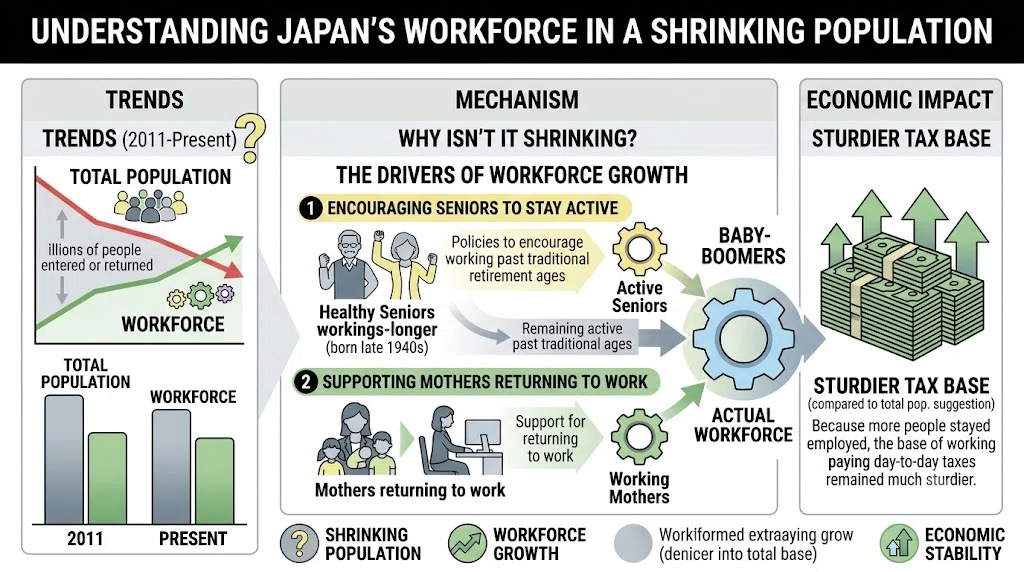
Understanding Japan’s Workforce in a Shrinking Population
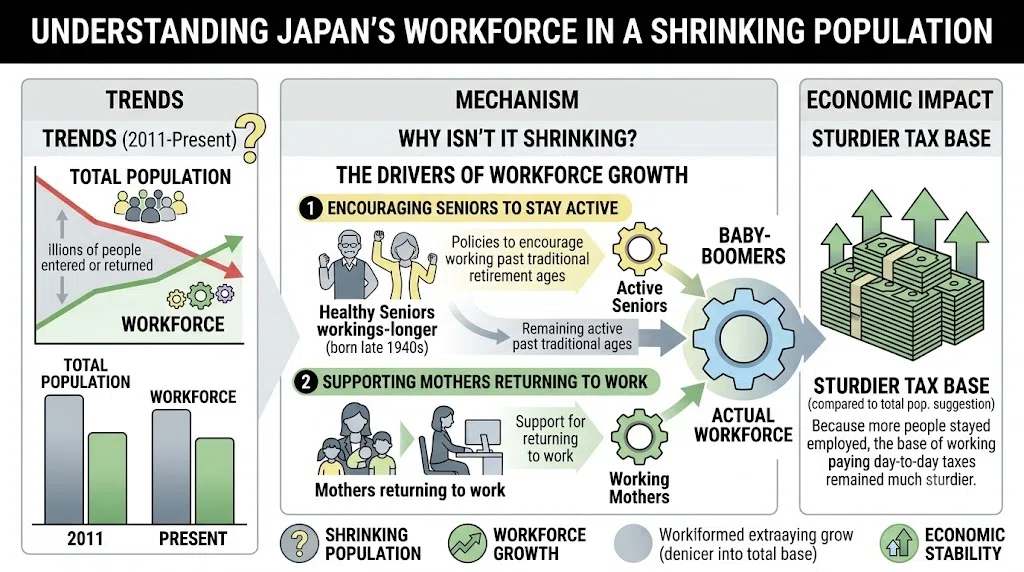
We will talk about an interesting topic — Japan’s workforce and how it stays strong even though the population is shrinking. This infographic helps us understand how Japan keeps many people working and paying taxes, even when there are fewer people overall.
Let’s start with the first part — Trends from 2011 to the Present. The red line shows that Japan’s total population is going down. There are fewer people living in Japan today than before. But the green line shows that the workforce — the number of people who are working — has stayed stable or even grown a little. So, while the population is shrinking, the number of workers is not shrinking as much. That’s a very interesting situation.
Now, let’s look at the second part — Mechanism: Why Isn’t It Shrinking? There are two main reasons, or drivers, for workforce growth.
The first reason is Encouraging Seniors to Stay Active. Many older people, especially those born in the late 1940s — the baby-boomer generation — are staying healthy and working longer. The government has made policies to help seniors work past traditional retirement ages. These active seniors keep contributing to society and help maintain the workforce. So, instead of retiring early, they continue to work and pay taxes.
The second reason is Supporting Mothers Returning to Work. In Japan, more mothers are coming back to work after having children. There are new programs and support systems that make it easier for mothers to balance family and career. This means more women are joining or rejoining the workforce. Together, these two groups — active seniors and working mothers — help keep Japan’s workforce strong.
Now, let’s move to the third part — Economic Impact: A Sturdier Tax Base. Because more people are working — seniors and mothers — the government collects more taxes. This creates a sturdier tax base, meaning the economy is more stable. Even though the total population is smaller, the number of people paying taxes stays high. That helps Japan maintain economic stability and support public services.
So, to summarize: Japan’s population is shrinking, but its workforce is staying strong. This is possible because seniors are working longer and mothers are returning to work. As a result, Japan’s economy remains stable, and the tax base stays solid. It’s a great example of how smart policies and social support can help a country face demographic challenges.
Here’s a detailed presentation script (over 100 terms) in easy English for explaining the infographic “The Power of Nominal GDP and Inflation.” It’s written for classroom or seminar use — clear, slow, and natural for English learners.
The Power of “Nominal GDP” and Inflation
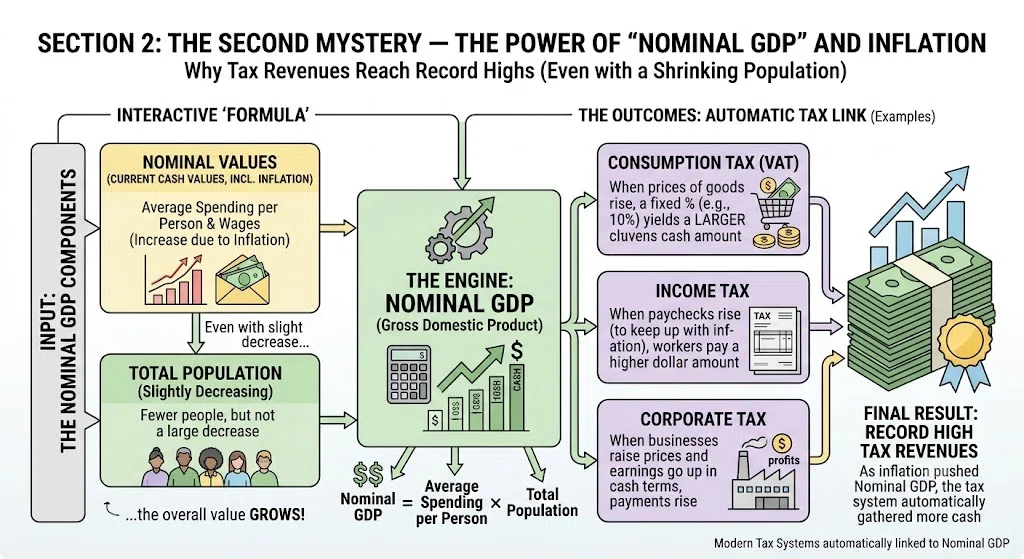
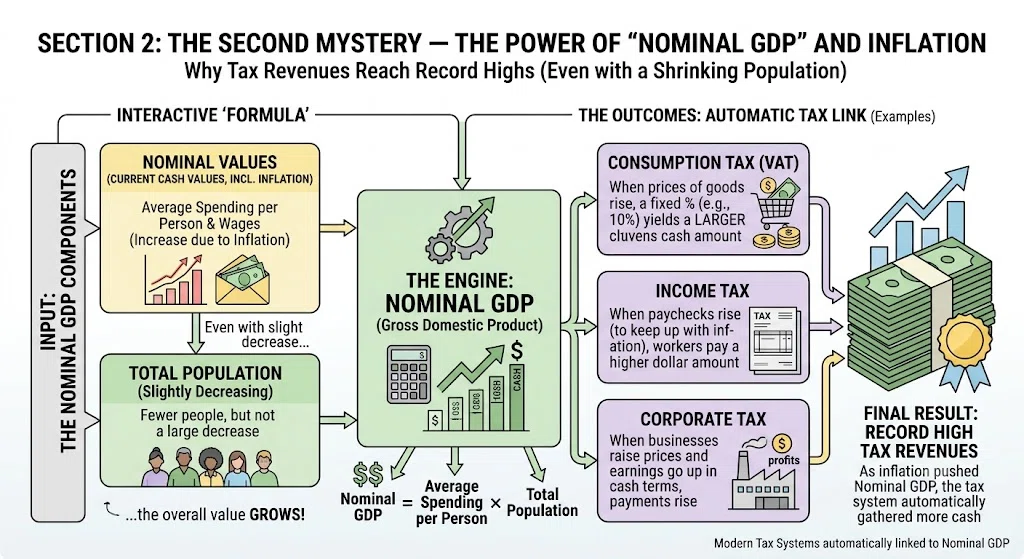
Next, we will look at Section 2: The Second Mystery — The Power of Nominal GDP and Inflation. This infographic explains why tax revenues can reach record highs even when the population is shrinking. It shows how inflation and spending work together to increase government income automatically.
Let’s start with the left side — the inputs. There are two main parts: Nominal Values and Total Population. Nominal values mean the current cash values, including inflation. When prices rise, people spend more money, and wages also increase. Even if the population becomes smaller, the total amount of money spent can still grow. So, the overall value of the economy — called Nominal GDP — goes up.
Now, look at the center box — the engine of the economy. Nominal GDP means Gross Domestic Product, or the total value of goods and services produced in a country. It is calculated by multiplying average spending per person by total population. Even if there are fewer people, higher prices and wages make the total value larger. This is why Japan’s economy can still show growth in tax revenue even with a shrinking population.
Next, move to the right side — the outcomes. Here we see how tax systems automatically respond to inflation. There are three examples: Consumption Tax, Income Tax, and Corporate Tax.
First, Consumption Tax (VAT) — when prices of goods rise, a fixed percentage like 10% gives a larger cash amount. Second, Income Tax — when paychecks rise to match inflation, workers pay more tax in dollar terms. Third, Corporate Tax — when businesses raise prices and earn more profits, their tax payments also increase. All these taxes are linked to Nominal GDP, so when inflation pushes up prices, tax revenues rise automatically.
Finally, look at the result — record-high tax revenues. As inflation increases Nominal GDP, the tax system collects more money without changing tax rates. This is why governments can earn more even when the population is smaller. It’s an automatic process built into modern tax systems.
To summarize: Nominal GDP grows when spending and wages rise due to inflation. Even with fewer people, the economy’s total cash value increases. Because taxes are based on these cash values, government revenue also grows. This is the hidden power of Nominal GDP and Inflation — a key idea in understanding modern economics.
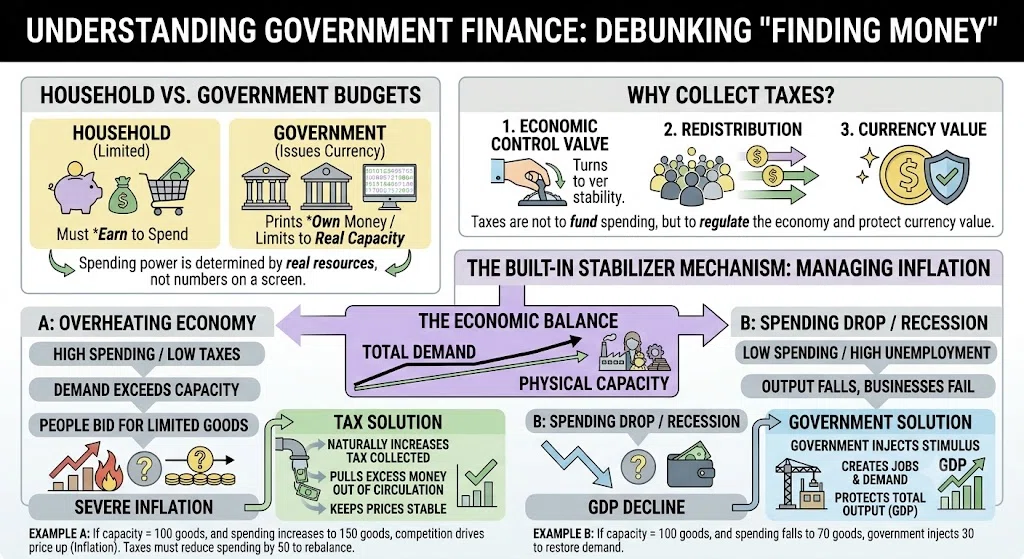
Understanding Government Finance — Debunking “Finding Money”
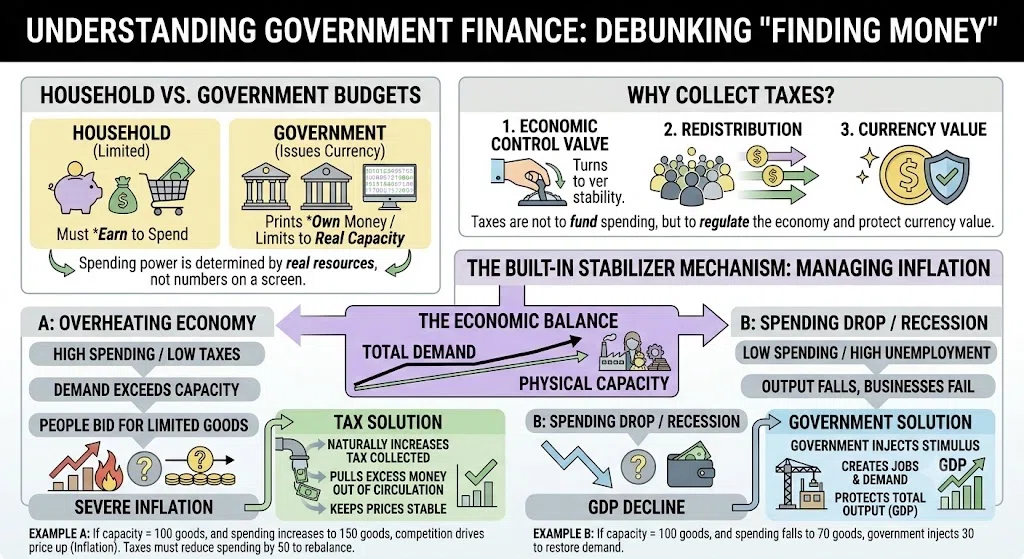
Good morning everyone. Today, we will explore how government finance really works and why the idea of “finding money” is often misunderstood. This infographic helps us see the difference between household budgets and government budgets, and how taxes help keep the economy stable.
Let’s start with the top section — Household vs. Government Budgets. A household must earn money before spending. If you want to buy something, you need income first. Your spending power is limited by how much you earn. But the government is different. The government issues its own currency — it can create money. However, it is limited by real resources, not by numbers on a screen. That means the government’s spending power depends on the country’s capacity — workers, materials, and production — not just printed money.
Now, move to the next part — Why Collect Taxes? There are three main reasons. First, Economic Control Valve — taxes help control inflation and keep the economy stable. Second, Redistribution — taxes move money from one group to another to support fairness and social programs. Third, Currency Value — taxes help protect the value of money and maintain trust in the currency. So, taxes are not mainly to fund spending, but to regulate the economy and keep balance.
Next, look at the middle section — The Built-in Stabilizer Mechanism: Managing Inflation. This part shows how the economy stays balanced between total demand and physical capacity — the amount of goods and services a country can produce.
Let’s look at Scenario A: Overheating Economy. When spending is high and taxes are low, demand becomes greater than capacity. People compete for limited goods, and prices rise — this is inflation. To fix this, the government uses tax solutions. Higher taxes pull excess money out of circulation and help keep prices stable. For example, if capacity is 100 goods but spending equals 150 goods, taxes must reduce spending by 50 to rebalance.
Now, Scenario B: Spending Drop or Recession. When spending is low and unemployment is high, businesses fail and GDP declines. In this case, the government does the opposite — it injects stimulus. It spends more to create jobs and demand, helping restore total output. For example, if capacity is 100 goods but spending falls to 70, the government adds 30 to bring demand back to balance.
Finally, the economic balance depends on managing both inflation and recession. Taxes and spending act like a stabilizer — they keep the economy from overheating or collapsing. This shows that government finance is not about “finding money,” but about managing resources and stability.
To summarize:
Households must earn before spending.
Governments issue currency but must respect real capacity.
Taxes regulate the economy, not fund spending.
The government adjusts taxes and spending to keep balance between demand and production.
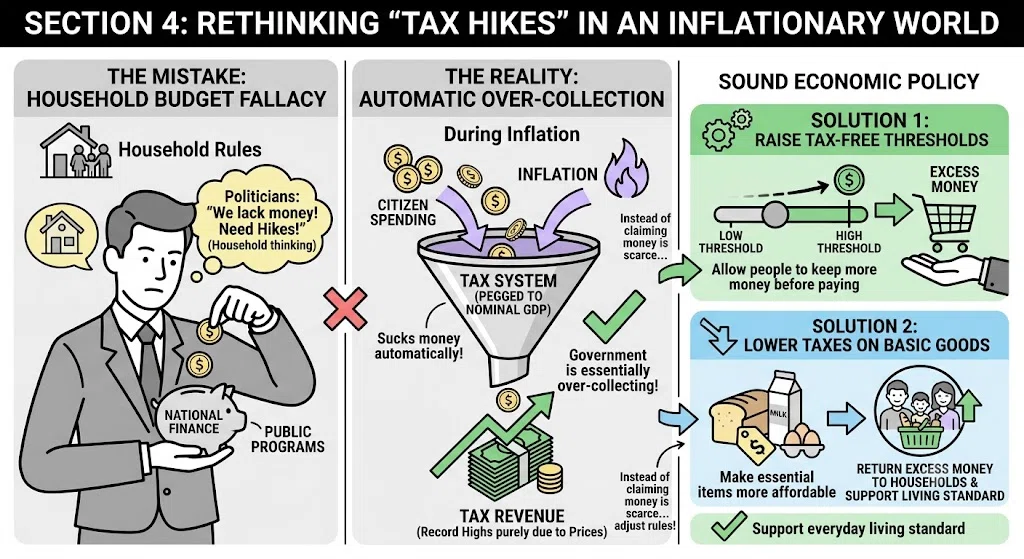
Rethinking “Tax Hikes” in an Inflationary World
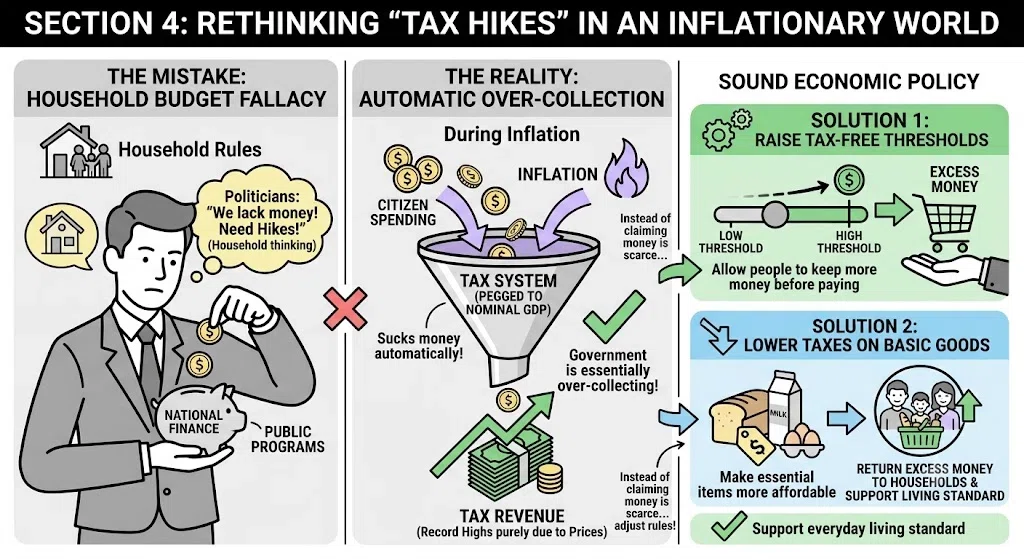
Good morning everyone. Today, we will talk about Section 4: Rethinking Tax Hikes in an Inflationary World. This infographic helps us understand why raising taxes during inflation can be a mistake, and how better policies can support people’s living standards.
Let’s start with the left side — The Mistake: Household Budget Fallacy. Many politicians think about national finance like a household budget. They say, “We lack money! We need tax hikes!” — as if the government must earn money before spending. But this is wrong. A household must earn before it spends, but a government issues its own currency. It doesn’t run out of money the same way a family does. Government spending depends on real resources — workers, goods, and production — not on coins in a purse. So, thinking like a household leads to poor decisions, especially during inflation.
Now, look at the middle section — The Reality: Automatic Over-Collection. During inflation, prices rise. When people spend more money, the tax system — which is linked to Nominal GDP — automatically collects more taxes. This happens without any new tax hikes. The government doesn’t need to “find money”; it’s already collecting more because prices are higher. In other words, inflation itself increases tax revenue. So, instead of claiming money is scarce, governments should adjust their rules to avoid over-collecting.
Next, move to the right side — Sound Economic Policy. This section shows two smart solutions.
Solution 1: Raise Tax-Free Thresholds. This means allowing people to keep more money before paying taxes. When inflation pushes prices up, raising the threshold helps citizens keep enough income to cover daily costs. It prevents unnecessary pressure on households and supports spending power.
Solution 2: Lower Taxes on Basic Goods. Essential items like food, milk, and daily necessities should have lower taxes. This makes them more affordable and returns excess money to households. It helps maintain a good living standard even when prices rise.
Together, these two solutions help balance the economy. They protect citizens from inflation’s effects while keeping government revenue stable. Instead of raising taxes, governments should focus on adjusting thresholds and supporting basic needs.
To summarize:
The household budget idea doesn’t apply to national finance.
Inflation automatically increases tax revenue.
Smart policies raise tax-free limits and lower taxes on essentials.
These actions help people live better and keep the economy healthy.
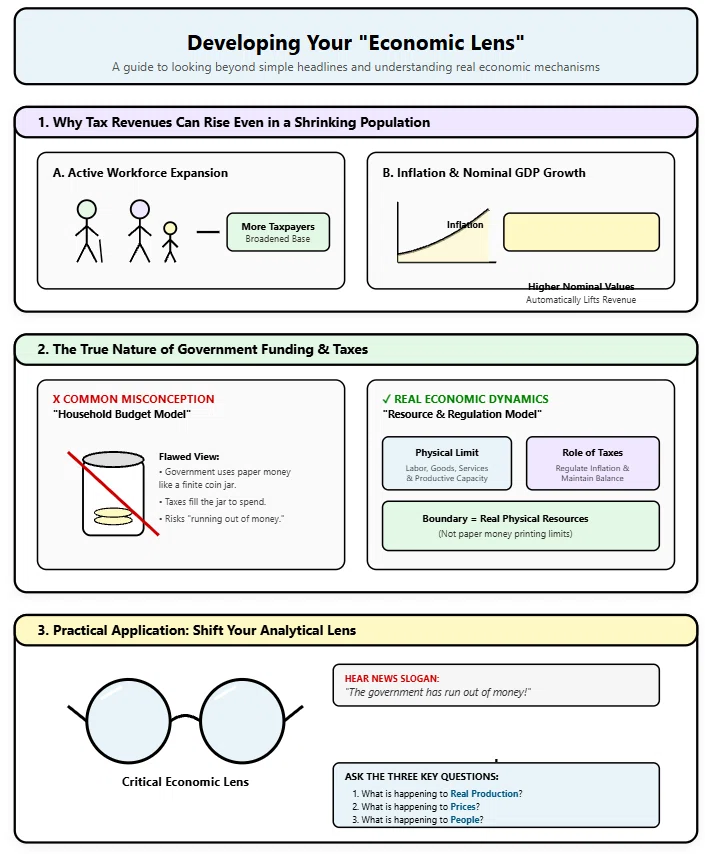
Developing Your “Economic Lens”
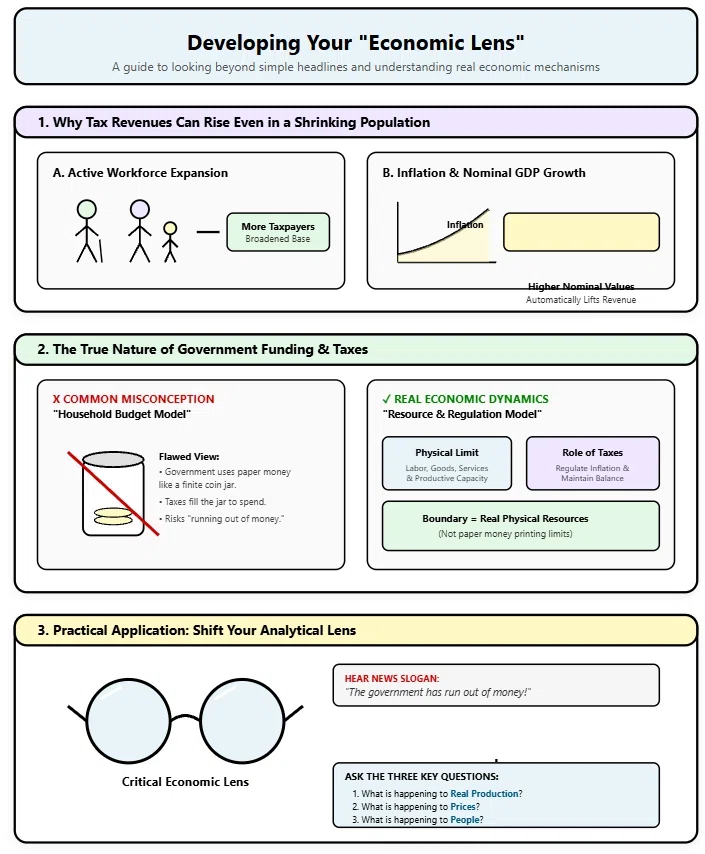
At the end, we will explore how to develop your economic lens — a way of seeing beyond simple headlines and understanding how real economic mechanisms work. This infographic gives us three main ideas: why tax revenues can rise even when the population shrinks, what government funding really means, and how to think critically about economic news.
Let’s start with Section 1: Why Tax Revenues Can Rise Even in a Shrinking Population. There are two key reasons. First, Active Workforce Expansion. Even if the total population becomes smaller, more people can join the workforce — for example, seniors working longer or mothers returning to work. This broadens the tax base and increases the number of taxpayers. Second, Inflation and Nominal GDP Growth. When prices rise, the value of goods and wages also increases. This means higher nominal values, which automatically lift tax revenue. So, even with fewer people, the economy can still collect more taxes because of inflation and active workers.
Now, move to Section 2: The True Nature of Government Funding and Taxes. Here we see two different models. On the left is the Common Misconception — the Household Budget Model. This flawed view treats government money like a family’s coin jar. It assumes the government must collect taxes before spending and risks “running out of money.” But that’s not how national finance works. On the right is the Real Economic Dynamics — the Resource and Regulation Model. In this model, the government’s limit is not money, but real physical resources — labor, goods, and productive capacity. Taxes are used to regulate inflation and maintain balance, not to fill a jar. The true boundary is the economy’s real capacity, not the amount of printed money.
Finally, Section 3: Practical Application — Shift Your Analytical Lens. This part encourages us to think critically when we hear economic news. For example, when you hear a slogan like “The government has run out of money,” don’t accept it immediately. Instead, use your Critical Economic Lens and ask three key questions:
What is happening to real production?
What is happening to prices?
What is happening to people? These questions help you focus on real economic activity, not just headlines or political statements.
To summarize:
Tax revenues can rise even with fewer people because of inflation and workforce expansion.
Government funding depends on real resources, not household-style budgets.
Thinking critically means asking about production, prices, and people — the real drivers of the economy.
Thank you for listening. Now, let’s reflect: how can this “economic lens” help us understand news about taxes, inflation, and government spending more clearly?
## 10 tags
Make 10 blog tags from above formatted as "#tag1 #tag2"#economic_lens #macroeconomics #tax_revenue #government_finance #inflation #nominal_GDP #economic_policy #public_spending #critical_thinking #economic_analysis
## 10 Key Terms with Remarks
please extract 10 key terms from above and please note them with remarks. No need to use a table format.Here are 10 key terms extracted from your previous presentation content, each with a short remark to clarify its meaning and importance. I’ve written them in a clean, readable format, and each term begins with a Guided Link as required.
Economic Lens — A way of thinking that helps you look beyond headlines and understand real economic mechanisms.
Nominal GDP — The total value of goods and services measured in current prices; rises automatically with inflation.
Inflation — A general increase in prices that also increases tax revenue without changing tax rates.
Tax Base — The group of people or activities that generate tax revenue; can grow even when population shrinks.
Workforce Expansion — Seniors and mothers returning to work, increasing the number of taxpayers.
Government Funding — Not like a household budget; depends on real resources, not “finding money.”
Household Budget Fallacy — The mistaken belief that governments must earn money before spending.
Automatic Over‑Collection — When inflation pushes tax revenue higher without any policy changes.
Tax-Free Threshold — The income level people can earn before paying taxes; raising it protects households during inflation.
Real Economic Capacity — The true limit of government spending, defined by labor, goods, and production—not money.
Please make a format data of mermaid.js from below paragraph:

## diagram: ClassDiagram

---
## A paragraph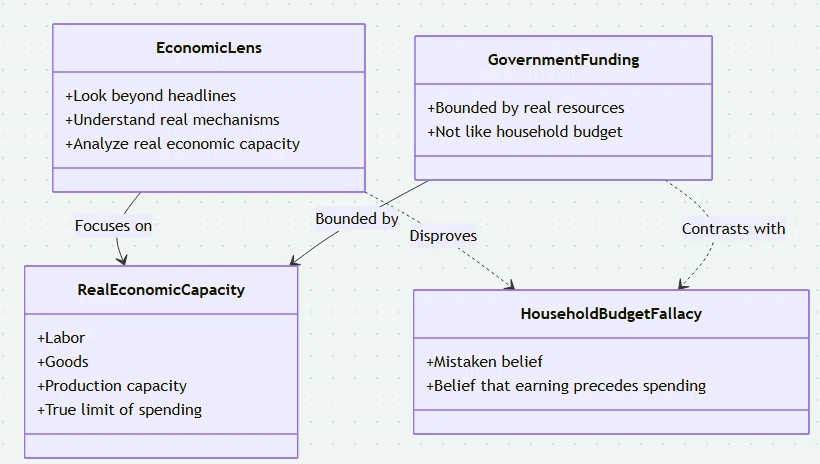
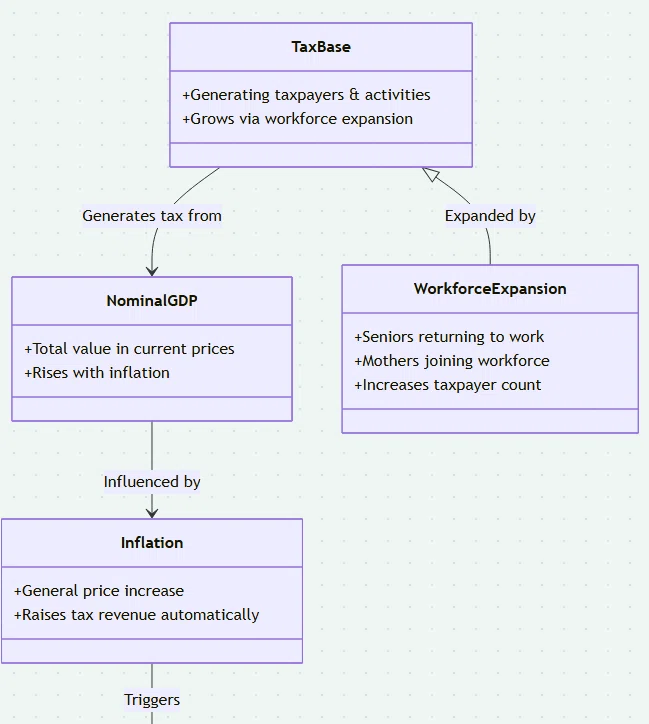
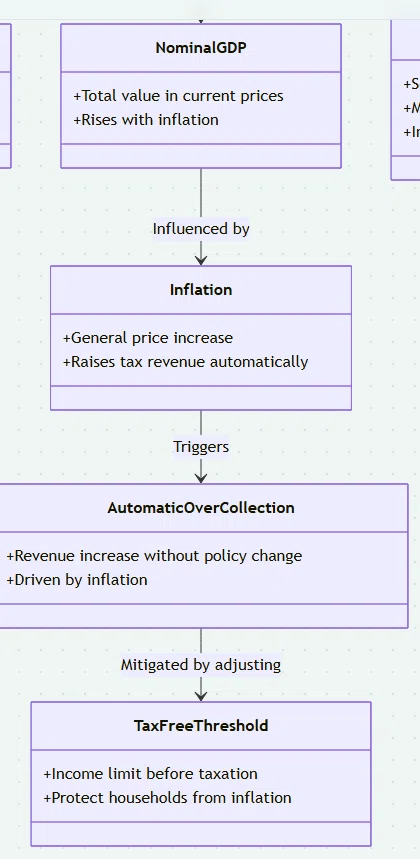
## Chie-Bukuro
本投稿は、「知恵袋」サイトでのQ&Aをベースに、英語のエッセイを、Copilotにて、英語学習用に生成したものです。
以下、日本語版。
人口が減っているのに「税収が過去最高になった」というニュースを聞くと、思わず首を傾げたくなりますよね。「住んでいる人が減ったら、税金を払う人も減るんだから、税収だって下がるのが当たり前じゃないの?」という疑問は、ごく自然で素直な感覚です。
また、ニュースで政治家や専門家が「〇〇の政策を進めるための財源(お金)をどう確保するか」と議論しているのを見て、「政府はお金をいくらでも作れるはずなのに、なぜ『財源がない』なんて言うんだろう?」と感じるのも無理はありません。
実は、世の中の経済の動きを「数字の仕組み」からひもといていくと、こうした「なぞなぞ」のような疑問の答えが見えてきます。中学生の皆さんにもわかりやすい「経済の思考法」を使って、この不思議な仕組みを解き明かしてみましょう。
1. 人口が減っているのに、なぜ税金がたくさん集まるの?
まず最初の疑問、「人口が減っているのに、なぜ税収が増えるのか?」から考えてみましょう。これには大きな理由が2つあります。
① 「働く人の数」は実は減っていない!
「日本の人口が減っている」というのは事実です。しかし、実は「実際に働いてお給料を得ている人の数(労働者数)」は、ここ10年ほどで増えています。
なぜそんなことが起きるのでしょうか?
かつての日本では、一定の年齢を迎えたおじいちゃん・おばあちゃん(シニア世代)や、子育て中の女性の多くは働いていませんでした。しかし、国が「みんなが長く活躍できる社会にしよう」と環境を整えたことで、シニア世代が定年後も仕事を続けたり、子育てが落ち着いたお母さんたちが再び働きに出たりするようになりました。
つまり、全体の人口は減っていても、社会全体で「働く人」を力強くかき集めたため、税金を払うベースとなる労働者の数は維持されてきたのです。
② 「名目GDP(全体の金額)」が増えているから!
もうひとつの、そして一番大きな理由は「名目GDP」と「インフレ(物価の上昇)」にあります。
ちょっと難しい言葉が出てきましたが、シンプルに説明します。
「GDP」とは、その国の人たちが1年間で生み出した「儲けの合計」のことです。そして「名目GDP」とは、物価の変動をそのまま計算に入れた「お金の金額そのもの」を表します。
名目GDPは、ざっくり言うと次のような式で成り立っています。
$$\text{名目GDP} = \text{1人あたりの消費額} \times \text{総人口}$$
人口が少し減ったとしても、お店で売っている物の値段が上がり(インフレ)、みんなが使うお金の額(消費額)や受け取るお給料の額(所得額)の「数字」が大きくなれば、国全体の名目GDPという数字は膨らみます。
ここで日本の税金の仕組みを見てみましょう。日本の税金(消費税、所得税、法人税など)は、「名目GDPが増えると、それにあわせて自動的に税収も増える」というルールになっています。
消費税:物の値段が上がると、同じ8%や10%でも払う金額が増える。
所得税:お給料の数字が増えると、引かれる税金が増える。
法人税:企業の売上や利益の数字が増えると、払う税金が増える。
つまり、人口が減っていても、物価や給料などの「世の中をめぐるお金の数字(名目GDP)」が大きくなったため、国が集める税金も勝手に増えて「過去最高」になったというわけです。
2. 国はいくらでもお金を作れるのに、なぜ「財源の確保」と言うの?
次に2つ目の疑問、「政府は『財源がない』『財源をどう確保するか』と言うけれど、お金って無限にあるんじゃないの?」という点について考えてみましょう。
結論から言うと、あなたの intuition(直感)の通り、自国の通貨を発行できる国にとっては「お金そのもの」が物理的に枯渇することはありません。
それなのに、なぜニュースでは「財源」という言葉が何度も使われるのでしょうか?
国の本当の役割は「お金集め」ではなく「需要のバランス調整」
国の経済運営において、本当の制限(限界)となるのは「お金の量」ではなく、「世の中にあるモノやサービスの量(供給力)」です。
もし政府がお金を無制限に刷って街中にバラまいたらどうなるでしょうか? 世の中にあるモノの量に対してお金の量ばかりが増えすぎてしまい、極端な物価高(ハイパーインフレ)が起きて、みんなのお金の値打ちが下がってしまいます。
経済学の世界には「ビルト・イン・スタビライザー(自動安定装置)」という考え方があります。これは、世の中の景気が良くなりすぎたり、物価が上がりすぎたりしたときに、税金を通してお金を回収し、経済が暴走しないようにブレーキをかける仕組みのことです。
ですから、本来的には「国民から税金を吸い上げないと、国はお金を使えない」わけではありません。国は、世の中の「需要(買いたい気持ち)」が足りないときには、補正予算などでお金を投入して経済(GDP)が落ち込まないように支え、逆に世の中にお金が回りすぎてインフレになりそうなときは税金で調整する、というコントロールを行っています。
それにもかかわらず、ニュースで政治家が「財源を確保しなければならない」と言うのは、「集めた税金の範囲内でやりくりするのが正しいやり方だ」という古い思い込みやルールに縛られているからです。
インフレによって名目GDPが増え、税金が自動的に「取られすぎ」の状態になっている今、本当は「財源がない」と騒ぐよりも、取りすぎた税金を国民に返したり(減税)、働きやすい税制に見直したりすることこそが、経済にとって必要な思考なのです。
まとめ:経済の「数字」の裏側を見破ろう
今回の疑問を整理してみましょう。
人口が減っても税収が過去最高なのはなぜ?⇒ 働くシニアや女性が増えて労働者の数が維持されていることに加え、物価上昇(インフレ)によって「名目GDP(お金の額面)」が大きくなり、自動的に引かれる税金が増えたから。
「財源の確保」って意味があるの?⇒ お金そのものは無限に作れますが、物価の安定を保つために税金で世の中のお金の量を調整しています。ニュースで言われる「財源不足」の多くは、お金の本質を見誤った誤解や古い政治的ルールによるものです。
ニュースで流れる言葉をそのまま受け取るのではなく、「本当に人が減るとお金も減るのかな?」「国にとってのお金の限界って何だろう?」と一歩立ち止まって考えること。それこそが、社会の本当の姿を見抜く最高の「経済思考」です。
皆さんも日常の中で「これっておかしくない?」と感じた疑問を大切にして、経済の面白さを探求してみてくださいね。
以上
いいなと思ったら応援しよう!
 Generative AIを使って何ができるかを実践しています。応援ありがとうございます。