
2606B-📄DECODED: <03> EXPERTS DIVIDE AND CONQUER

## An Essay
Based on the above Japanese essay, please translate it into English that is easy for a British audience to understand. Please provide a sub-topic for each section of the text (paragraph, etc.).Experts Divide and Conquer:
Integrating Requirements Engineering, Software Engineering, and Knowledge Engineering
Introduction: Solving Complexity Through Decomposition
The idea that experts break a complex problem into smaller, manageable problems is fundamental to modern system development. However, true expertise involves more than simply dividing a problem. Experts understand how the different parts relate to one another and how changes in one area can affect the whole system.
This way of thinking is particularly important when integrating Requirements Engineering, Software Engineering, and Knowledge Engineering. These disciplines may appear separate, but they all rely on balancing detailed analysis with an understanding of the bigger picture.
Requirements Engineering: Understanding the Whole Through Its Parts
In Requirements Engineering, the goal is to identify and define the needs of users and organisations. Real-world business problems are often complex, involving multiple stakeholders, objectives, and constraints.
To manage this complexity, experts break requirements into categories such as business requirements, functional requirements, non-functional requirements, and operational requirements. However, defining these requirements individually is not enough. It is equally important to understand how they influence one another.
For example, a change in a performance requirement may affect security, usability, or operational processes. As a result, requirements engineers must continually assess the relationships between requirements to ensure that the overall system remains aligned with business goals.
Software Engineering: Balancing Modular Design and System Integration
A similar principle applies to Software Engineering. Large software systems are typically divided into modules, services, or components that can be designed and developed independently.
Examples include user management, payment processing, analytics, and notification services. This modular approach improves maintainability, scalability, and development efficiency. However, the components do not exist in isolation.
Changes in one component may have consequences for other parts of the system. Because of this, software architects must carefully manage interfaces, dependencies, and communication between components. The objective is not local optimisation of individual modules, but optimisation of the entire system.
Knowledge Engineering: Structuring and Evolving Organisational Knowledge
Knowledge Engineering focuses on capturing, organising, and reusing knowledge in a structured form. This often involves building knowledge bases, ontologies, and rule-based systems.
Experts divide knowledge into concepts, relationships, and rules so that information can be managed effectively. However, maintaining individual pieces of knowledge is only part of the challenge. New knowledge must fit consistently within the existing knowledge structure.
When new insights emerge, experts may need to reorganise the entire knowledge framework. In this sense, knowledge engineering reflects the same principle of dividing a complex problem while continually reconsidering the overall structure.
Integration in Modern AI Systems
The integration of these three disciplines has become increasingly important in the development of AI-driven systems.
Requirements Engineering helps define what the system should achieve. Software Engineering determines how the solution will be implemented. Knowledge Engineering organises the information and expertise that the system will use.
Although these activities can be performed separately, they are closely connected. A change in requirements may lead to architectural changes, while architectural changes may require modifications to the underlying knowledge model. Effective system development therefore depends on continuous coordination across all three disciplines.
Conclusion: The Real Value of Expertise
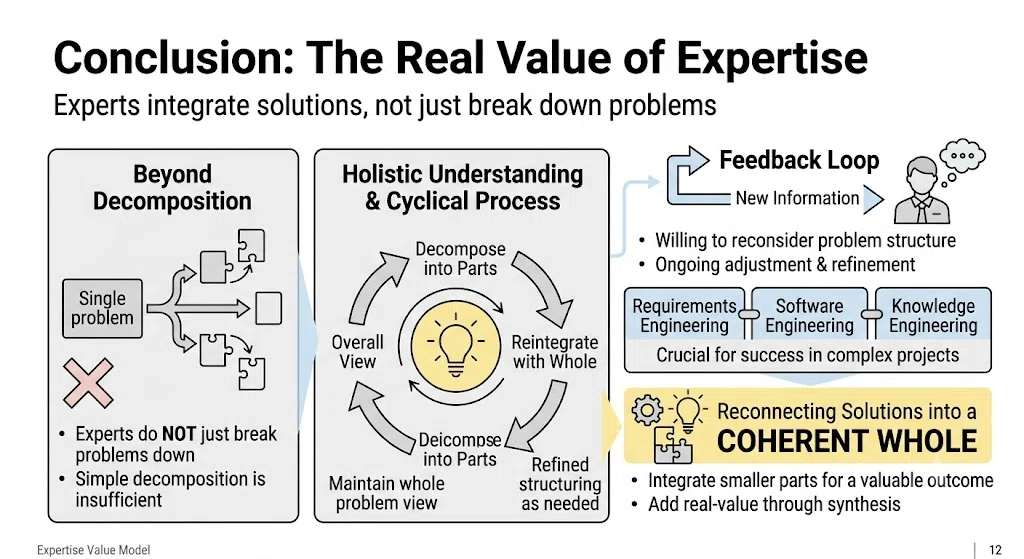
Experts are not distinguished simply by their ability to divide a problem into smaller parts. Their real strength lies in maintaining an understanding of the whole while solving the individual parts.
As new information becomes available, they are willing to reconsider how the problem itself should be divided and structured. In projects that combine Requirements Engineering, Software Engineering, and Knowledge Engineering, this ongoing cycle of decomposition and reintegration is essential for success.
In an increasingly complex world, the true value of expertise is not merely making problems smaller. It is the ability to reconnect those smaller solutions into a coherent and valuable whole.
## 10 tags
Make 10 blog tags from the essay formatted as "#tag1 #tag2"#RequirementsEngineering #SoftwareEngineering #KnowledgeEngineering #SystemsThinking #ProblemDecomposition #DivideAndConquer #SoftwareArchitecture #ComplexSystems #AIEngineering #SystemsIntegration
## 10 Key Terms with Remarks
please extract 10 key terms from an essay and please note them with remarks, not use a table, make with markdown format.10 Key Terms from the Essay
1. Requirements Engineering
Remark:
The discipline of identifying, analysing, documenting, and managing stakeholder needs and system requirements. It ensures that a system delivers the intended business value.
2. Software Engineering
Remark:
The systematic approach to designing, developing, testing, and maintaining software systems. It focuses on building reliable, scalable, and maintainable solutions.
3. Knowledge Engineering
Remark:
A field concerned with capturing, structuring, and managing knowledge so that it can be reused by people or intelligent systems, such as AI applications.
4. Problem Decomposition
Remark:
The process of breaking a large and complex problem into smaller, more manageable parts. This is a core strategy used by experts when solving difficult problems.
5. System Complexity
Remark:
The interconnected nature of components, requirements, and stakeholders that makes a system difficult to understand, design, and manage.
6. Functional Requirements
Remark:
Specifications describing what a system must do, including its features, services, and behaviours from a user's perspective.
7. Non-Functional Requirements
Remark:
Requirements that define how well a system performs, such as performance, security, reliability, usability, and scalability.
8. Modular Architecture
Remark:
A software design approach in which a system is divided into independent modules or components that can be developed and maintained separately.
9. System Integration
Remark:
The process of ensuring that different components, services, and knowledge structures work together effectively as a unified whole.
10. Holistic Thinking
Remark:
An approach that considers both the individual parts and the overall system. Experts use holistic thinking to balance local improvements with global objectives.
Key Insight
The central message of the essay can be summarised as:
Experts succeed not merely by dividing complex problems into smaller parts, but by continually reconnecting those parts into a coherent and valuable whole.
This idea links Requirements Engineering, Software Engineering, and Knowledge Engineering through the shared principle of decomposition and reintegration.
## Key expressions
Please extract key expressions in English for English learners as a grammar understanding with 2 example sentences.Key Expressions for English Learners
The essay contains several useful expressions commonly used in technical writing, academic essays, and professional discussions. Understanding these patterns will help you write more natural and logical English.
1. The goal is to ...
Meaning
Used to explain the purpose or objective of something.
Pattern
The goal is to + verb
Example from the essay
The goal is to identify and define the needs of users and organisations.
Example Sentences
The goal is to improve customer satisfaction.
The goal is to reduce development costs without sacrificing quality.
2. In order to ...
Meaning
Expresses purpose ("〜するために").
Pattern
In order to + verb
Example Sentences
In order to solve the problem, the team collected more data.
In order to improve performance, the software was redesigned.
Alternative
To solve the problem, the team collected more data.
3. It is important to ...
Meaning
Used to emphasise importance.
Pattern
It is important to + verb
Example from the essay
It is important to understand how they influence one another.
Example Sentences
It is important to communicate clearly with stakeholders.
It is important to test software before deployment.
4. The same is true for ...
Meaning
Used when a statement also applies to another subject.
Pattern
The same is true for + noun
Example from the essay
The same is true for Software Engineering.
Example Sentences
Remote work improves flexibility. The same is true for hybrid work.
Security is important in banking systems. The same is true for healthcare systems.
5. Not A, but B
Meaning
Creates a contrast and emphasises the more important point.
Pattern
not A, but B
Example from the essay
The objective is not local optimisation, but optimisation of the entire system.
Example Sentences
Success is not about luck, but preparation.
Software development is not about coding, but solving problems.
6. Focus on ...
Meaning
To concentrate attention on something.
Pattern
focus on + noun / verb-ing
Example from the essay
Knowledge Engineering focuses on capturing and organising knowledge.
Example Sentences
The project focuses on improving usability.
We need to focus on meeting customer requirements.
7. As a result, ...
Meaning
Shows a consequence ("その結果").
Pattern
As a result, + sentence
Example from the essay
As a result, requirements engineers must continually assess the relationships between requirements.
Example Sentences
The server failed. As a result, users could not access the website.
Customer demand increased. As a result, production was expanded.
8. May lead to ...
Meaning
Indicates a possible consequence.
Pattern
A may lead to B
Example from the essay
A change in requirements may lead to architectural changes.
Example Sentences
Poor planning may lead to project delays.
A security breach may lead to financial losses.
9. Depends on ...
Meaning
Shows dependency or a determining factor.
Pattern
depend on + noun / verb-ing
Example from the essay
Effective system development depends on continuous coordination.
Example Sentences
Project success depends on good communication.
The outcome depends on how quickly the issue is resolved.
10. The key to ...
Meaning
Describes the most important factor for success.
Pattern
the key to + noun / verb-ing
Example from the essay
Continuous learning is the key to professional growth.
Example Sentences
Collaboration is the key to innovation.
Testing is the key to software quality.
Useful Writing Pattern from the Essay
Many technical articles follow this structure:
To manage X, experts do A. However, A alone is not enough. Therefore, they must also do B. As a result, C becomes possible.
Example
To manage complexity, engineers divide a system into smaller components. However, decomposition alone is not enough. They must also understand the relationships between components. As a result, the entire system can be managed more effectively.
This pattern is extremely common in British and international technical writing because it creates a clear logical flow:
Problem → Action → Limitation → Additional Action → Result.
## Markdown for Creating Mind map
Make a mind map format text from the essay for markdown format.
---
Example
~~~


# <subject> as <role>
## <header>
- <keyword>
- <keyword>
## 賃金収入と家計消費
- 消費と投資
- 需要不足
# Experts Divide and Conquer as Systems Engineers
## Core Principle: Divide and Conquer
- Break complex problems into smaller parts
- Solve sub-problems independently
- Maintain awareness of the whole system
- Reconsider relationships between parts
- Repartition problems when necessary
## Requirements Engineering
- Understand stakeholder needs
- Define business objectives
- Analyse constraints
- Manage requirement relationships
### Types of Requirements
- Business Requirements
- Functional Requirements
- Non-Functional Requirements
- Operational Requirements
### Key Activities
- Requirement elicitation
- Requirement analysis
- Requirement documentation
- Impact assessment
- Traceability management
## Software Engineering
- Design large-scale systems
- Develop modular solutions
- Maintain system quality
- Manage dependencies
### System Components
- User Management
- Payment Processing
- Analytics Services
- Notification Services
### Architectural Concerns
- Interfaces
- Dependencies
- Communication
- Scalability
- Maintainability
### Engineering Goal
- Not local optimisation
- System-wide optimisation
- Integrated architecture
## Knowledge Engineering
- Capture knowledge
- Structure information
- Support knowledge reuse
- Build intelligent systems
### Knowledge Structures
- Knowledge Bases
- Ontologies
- Rules
- Concepts
- Relationships
### Key Challenges
- Knowledge consistency
- Knowledge evolution
- Framework reorganisation
- Knowledge integration
## Integration of Three Disciplines
### Requirements Engineering
- What should be achieved?
- Business value
- User needs
### Software Engineering
- How will it be implemented?
- System architecture
- Technical solutions
### Knowledge Engineering
- What knowledge is needed?
- Knowledge models
- Decision support
### Interactions
- Requirement changes
- Architectural changes
- Knowledge model updates
- Continuous coordination
## Systems Thinking
### Holistic Perspective
- Understand individual parts
- Understand overall structure
- Balance local and global goals
### Continuous Adaptation
- Learn from new information
- Reassess assumptions
- Refine system structure
## Expert Problem-Solving Skills
- Decomposition
- Analysis
- Integration
- Reflection
- Reorganisation
## Success Factors
- Systems thinking
- Cross-disciplinary integration
- Continuous coordination
- Effective communication
- Adaptive design
## Final Insight
- Complexity cannot be eliminated
- Complexity can be managed
- Experts connect parts into a coherent whole
- Decomposition and reintegration form a continuous cycle
- True expertise lies in seeing both the parts and the whole## Generation
本投稿は、書籍「SOFTWARE DESIGN DECODED」(c) 2016 MIT の記述をベースに、英語学習用に、ChatGPTにより生成した文章です。
以下の英文をもとに、1200文字の要求工学、ソフトウェア工学、知識工学の視点でのエッセイを日本語で、生成ください。

---
専門家は問題を分割して征服する ― 要求工学・ソフトウェア工学・知識工学の融合
「専門家は複雑な問題をより小さな問題へ分割し、それぞれを独立して解決する。しかし、部分を扱う際にも全体との関係を忘れない」という考え方は、現代の情報システム開発において極めて重要である。この考え方は、要求工学、ソフトウェア工学、そして知識工学を融合したシステム開発の本質を表している。
要求工学では、利用者や組織が抱える課題を明確な要求へと整理する。実際の業務課題は複雑であり、関係者の目的や制約条件も多岐にわたる。そのため、専門家はまず問題領域を分割し、業務要求、機能要求、非機能要求、運用要求などの観点から整理を行う。しかし、それぞれの要求を個別に定義するだけでは不十分である。ある要求の変更が他の要求へどのような影響を与えるのかを継続的に分析し、全体最適を維持しなければならない。これは専門家が部分と全体の両方を同時に見ていることを意味する。
ソフトウェア工学においても同様である。大規模システムは、モジュールやサービスへ分割され、それぞれが独立して設計・実装される。例えば、ユーザー管理、決済処理、データ分析、通知機能などは別々のコンポーネントとして開発されることが多い。この分割によって開発効率や保守性は向上する。しかし、実際には各コンポーネントは相互に依存しているため、一つの設計変更がシステム全体へ波及する場合がある。そのため、アーキテクトはインタフェース設計や依存関係の管理を通じて、部分最適ではなく全体最適を実現する必要がある。
さらに知識工学は、問題解決に必要な知識を構造化し、再利用可能な形で表現する学問である。知識ベースやオントロジーの構築では、概念やルールを細かく分類するが、それらの関係性も同時に管理する必要がある。新しい知識が追加された際には、既存の知識体系との整合性を確認しなければならない。これは、問題解決の途中で得られた知見が全体構造に影響を与える場合、専門家が知識体系そのものを再編成することに相当する。
近年のAIシステム開発では、これら三つの分野の統合がますます重要になっている。要求工学が「何を実現するか」を定義し、ソフトウェア工学が「どのように実装するか」を設計し、知識工学が「どのような知識を活用するか」を整理する。それぞれは独立した活動に見えるが、実際には密接に連携している。ある要求の変更は設計を変え、設計変更は知識モデルの再構築を促すことがある。
専門家が優れているのは、単に問題を細分化する能力だけではない。部分を解決しながら常に全体像を見直し、新たな知見に応じて問題の分割方法そのものを再設計できる点にある。要求工学、ソフトウェア工学、知識工学を融合した開発では、この「分割と再統合」の循環的な思考が成功の鍵となる。複雑性が増大する現代社会において、専門家の真価は、問題を小さくすることではなく、小さくした問題を再び統合し、価値ある全体へと昇華させる能力にあるのである。
## Key expressions
記述されたエッセイで、使われている表現で、特徴的な記述を、5つ、抽出して、表現方法の特徴を説明ください。また、その表現を使った例文を2つ挙げてください。このエッセイでは、学術的・論理的な文章でよく使われる表現が多く用いられています。特に、議論を展開する際の「対比」「因果関係」「統合」「抽象化」が特徴的です。
1. 「〜だけでは不十分である」
表現の特徴
ある考え方や方法の有効性を認めつつ、それだけでは課題を解決できないことを示す表現です。学術論文や技術文書で頻繁に使われます。
エッセイでの使用例
それぞれの要求を個別に定義するだけでは不十分である。
例文
テストを実施するだけでは不十分であり、結果を分析して改善策を立案する必要がある。
AIを導入するだけでは不十分であり、業務プロセスそのものの見直しも重要である。
2. 「〜においても同様である」
表現の特徴
前段落で述べた原理や考え方が、別の分野や対象にも当てはまることを示す表現です。議論の横展開に有効です。
エッセイでの使用例
ソフトウェア工学においても同様である。
例文
この課題は製造業で顕著であるが、サービス業においても同様である。
チーム開発では情報共有が重要であり、研究プロジェクトにおいても同様である。
3. 「〜に相当する」
表現の特徴
抽象的な概念や現象を、別の観点から言い換えるときに使われます。専門的な説明を分かりやすくする効果があります。
エッセイでの使用例
これは、問題解決の途中で得られた知見が全体構造に影響を与える場合、専門家が知識体系そのものを再編成することに相当する。
例文
このデータベースの更新は、企業における知識資産の再構築に相当する。
要求変更への対応は、設計思想そのものの見直しに相当する場合がある。
4. 「〜ではなく、〜である」
表現の特徴
対比を用いて筆者の主張を強調する表現です。読み手に「本質は何か」を印象づけます。
エッセイでの使用例
部分最適ではなく全体最適を実現する必要がある。
例文
重要なのは技術力ではなく、技術を活用する発想力である。
システム開発の目的はプログラムを書くことではなく、利用者の課題を解決することである。
5. 「〜の鍵となる」
表現の特徴
成功要因や重要なポイントを示す際に使われる表現です。結論部分や提言でよく利用されます。
エッセイでの使用例
この「分割と再統合」の循環的な思考が成功の鍵となる。
例文
継続的な学習がエンジニアとして成長するための鍵となる。
関係者間の信頼構築がプロジェクト成功の鍵となる。
これらの表現に共通する特徴
これら5つの表現は、単なる事実の説明ではなく、
論理を一段深める
因果関係を示す
対比によって主張を強調する
複数の概念を結び付ける
結論へ自然に導く
という役割を持っています。
特に技術エッセイ、要求工学、ソフトウェア工学、知識工学の分野では、
「〜だけでは不十分である」
「〜においても同様である」
「〜ではなく、〜である」
の3つは非常に頻出するため、習得すると学術的で説得力のある文章を書きやすくなります。
上記の日本語表現を、英語的に表現する例を、各々、あげてください。英語の技術エッセイや学術論文では、日本語の論理表現に対応する定型表現が数多くあります。以下に、前回抽出した5つの表現について、英語での自然な表現方法を紹介します。
1. 「〜だけでは不十分である」
英語表現
It is not enough to ...
Simply ... is not sufficient.
... alone is insufficient.
例文
日本語
テストを実施するだけでは不十分である。
英語
Conducting tests alone is insufficient.
It is not enough to conduct tests; the results must also be analyzed.
日本語
AIを導入するだけでは不十分である。
英語
Simply introducing AI is not sufficient.
AI adoption alone is insufficient to achieve business transformation.
技術論文でよく使う形
Functional decomposition alone is insufficient for managing system complexity.
2. 「〜においても同様である」
英語表現
The same is true for ...
This also applies to ...
Likewise, ...
A similar principle applies to ...
例文
日本語
この考え方はソフトウェア工学においても同様である。
英語
The same is true for software engineering.
This principle also applies to software engineering.
日本語
研究開発においても同様である。
英語
Likewise, this is true in research and development.
A similar principle applies to R&D projects.
技術論文でよく使う形
A similar principle applies to large-scale distributed systems.
3. 「〜に相当する」
英語表現
corresponds to ...
can be viewed as ...
amounts to ...
is equivalent to ...
例文
日本語
これは知識体系の再構築に相当する。
英語
This corresponds to a reconstruction of the knowledge structure.
This can be viewed as a reorganization of the knowledge base.
日本語
要求変更は設計思想の見直しに相当する。
英語
Requirement changes may amount to a reconsideration of the design philosophy.
Such changes are equivalent to revising the underlying design concept.
技術論文でよく使う形
This can be viewed as a form of architectural refactoring.
4. 「〜ではなく、〜である」
英語表現
not A, but B
rather than A, B
A is not ..., but ...
The goal is not A but B.
例文
日本語
重要なのは技術力ではなく発想力である。
英語
What matters is not technical skill, but creativity.
Success depends not on technical expertise alone, but on innovative thinking.
日本語
目的はプログラムを書くことではなく課題を解決することである。
英語
The goal is not to write software, but to solve problems.
Software development is not about coding; it is about delivering value.
技術論文でよく使う形
The objective is not optimization of individual modules, but optimization of the entire system.
5. 「〜の鍵となる」
英語表現
is the key to ...
plays a key role in ...
is critical to ...
is essential for ...
例文
日本語
継続的な学習が成長の鍵となる。
英語
Continuous learning is the key to professional growth.
Continuous learning plays a key role in career development.
日本語
信頼関係の構築が成功の鍵となる。
英語
Building trust is critical to project success.
Trust among stakeholders is essential for successful collaboration.
技術論文でよく使う形
Traceability is critical to successful requirements management.
英国系・米国系の技術エッセイで特によく使われるパターン
これら5つの表現を組み合わせると、英語らしい論理展開になります。
例
Simply decomposing a problem is not sufficient.
The same is true for software architecture.
Changes in one component may amount to changes in the overall design.
Therefore, the objective is not local optimization but system-wide optimization.
Such holistic thinking is the key to successful engineering.
(問題を単純に分割するだけでは不十分である。同じことはソフトウェアアーキテクチャにも当てはまる。あるコンポーネントの変更は全体設計の変更に相当する場合がある。したがって、目的は部分最適ではなく全体最適である。そのような全体的思考こそが工学の成功の鍵となる。)
この流れは、英国・米国のソフトウェア工学や要求工学の論文で非常によく見られる「主張 → 適用範囲の拡大 → 解釈 → 対比 → 結論」の典型的な論理構造です。
以上
## Appendix
What area of system modeling is relative with this concepts excepting Requirements Engineering, Software Engineering, and Knowledge EngineeringSeveral other system modelling disciplines are closely related to the essay's central idea of "divide and conquer while preserving the whole system view." In fact, this principle appears across many modelling approaches beyond Requirements Engineering, Software Engineering, and Knowledge Engineering.
System Modelling and Related Disciplines
Systems Engineering
Focuses on the entire lifecycle of complex systems.
Balances subsystem design with overall system objectives.
Emphasises interfaces, trade-offs, and integration.
Related Concepts
System decomposition
Interface management
Verification and validation
System-of-systems
Enterprise Architecture
Models organisations as interconnected structures.
Connects business processes, information, applications, and technology.
Related Concepts
Business architecture
Information architecture
Application architecture
Technology architecture
Examples
TOGAF
Zachman Framework
Model-Based Systems Engineering (MBSE)
Uses formal models as the primary means of system specification and design.
Particularly aligned with the essay's emphasis on partitioning and reintegration.
Related Concepts
SysML modelling
Traceability
Behaviour modelling
Structural modelling
Business Process Modelling
Represents organisational workflows and activities.
Breaks complex operations into manageable processes.
Related Concepts
Process decomposition
Workflow integration
Value streams
Process optimisation
Examples
BPMN
Event-driven Process Chains (EPC)
Domain-Driven Design (DDD)
Focuses on modelling business domains through bounded contexts.
Explicitly partitions complexity while managing relationships between contexts.
Related Concepts
Bounded Context
Ubiquitous Language
Aggregates
Domain Events
This is perhaps one of the closest software-development approaches to the essay's theme.
Enterprise Knowledge Modelling
Extends Knowledge Engineering into organisational decision-making.
Represents business concepts, rules, and relationships.
Related Concepts
Semantic models
Business vocabularies
Decision models
Organisational knowledge structures
Ontology Engineering
A specialised branch of knowledge representation.
Creates formal conceptual models of a domain.
Related Concepts
Taxonomies
Semantic relationships
Knowledge integration
Concept hierarchies
Examples
OWL
RDF
Knowledge Graphs
Complex Adaptive Systems Modelling
Studies systems whose behaviour emerges from interactions among components.
Recognises that solving one part may change the behaviour of the whole.
Related Concepts
Emergence
Feedback loops
Adaptation
Self-organisation
Application Areas
Organisations
AI ecosystems
Social systems
Economic systems
Cybernetics and Control Theory
Focuses on communication, feedback, and control within systems.
Related Concepts
Feedback loops
Regulation
Adaptation
Stability
The essay's idea of continuously adjusting partitions and solutions strongly resembles cybernetic thinking.
Architecture Description and Architectural Modelling
Concerned with representing systems through multiple viewpoints.
Related Concepts
Structural view
Behavioural view
Information view
Deployment view
Examples
ISO/IEC/IEEE 42010
4+1 View Model
Systems Thinking
Perhaps the broadest intellectual foundation behind the essay.
Core Principles
Understand relationships, not just components.
Observe feedback effects.
Recognise unintended consequences.
Balance local and global optimisation.
Famous Contributors
Peter Senge
Jay Forrester
Russell Ackoff
Closest Match to the Essay
If we rank the disciplines by similarity to the essay's message:
Systems Engineering
Model-Based Systems Engineering (MBSE)
Systems Thinking
Domain-Driven Design (DDD)
Enterprise Architecture
Ontology Engineering
Business Process Modelling
Cybernetics
Complex Adaptive Systems Modelling
The essay's central philosophy can be summarised as:
"Complex systems must be decomposed for understanding, but they must be continuously reintegrated to preserve coherence."
That statement is almost a textbook description of Systems Engineering, MBSE, and Systems Thinking, which can be viewed as the overarching disciplines connecting Requirements Engineering, Software Engineering, and Knowledge Engineering.
いいなと思ったら応援しよう!
 Generative AIを使って何ができるかを実践しています。応援ありがとうございます。